




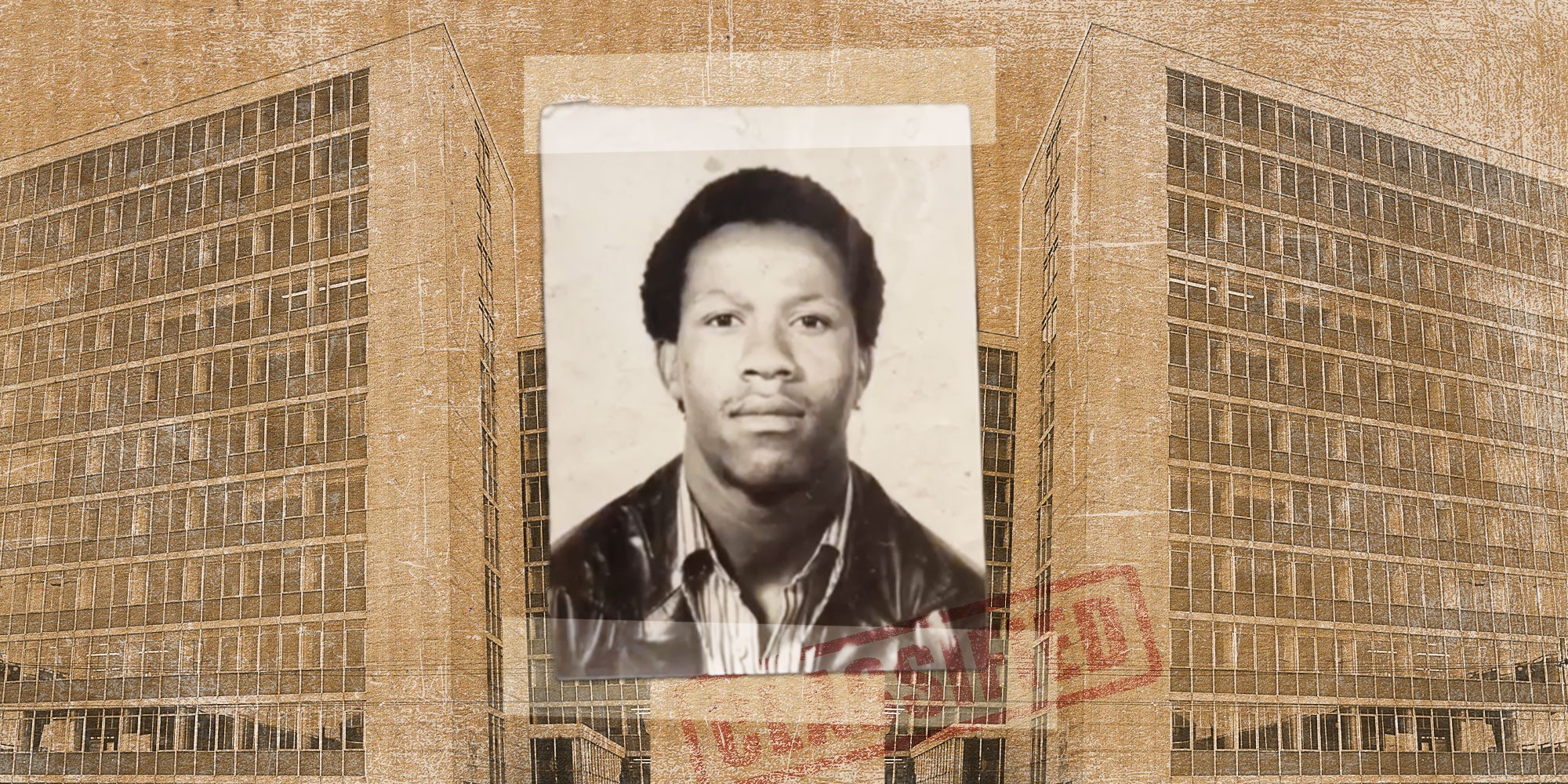
 Illustrative Image: Matthews Mabelane. (Image: Truth Be Told) | Classified stamp. (Image: iStock) | John Vorster Square. (Photo: Gallo Images / Sunday Times) | (By Daniella Lee Ming Yesca)
Nearly five decades after 22-year-old student activist Matthews “Mojo” Mabelane died in police custody on 15 February 1977, the reopened inquest at the Gauteng Division of the High Court in Johannesburg has challenged the official apartheid-era account of his death.
The original 1977 inquest into Matthews Mabelane’s death accepted the official police narrative: that he fell from a 10th-floor window at John Vorster Square police headquarters in Johannesburg while trying to escape.
Detained without charge under the Terrorism Act, Mabelane’s family was barred from asking questions or presenting independent evidence. Now, Judge Sandiswa Mfenyana is re-examining his death in apartheid police custody.
This reopened inquest contextualises Mabelane’s death within a broader pattern of systemic abuse by the apartheid Security Branch, whose officers routinely subjected political activists to indefinite detention, brutal torture and murder.
During the original inquest, Warrant Officer Leana Viljoen — the sole surviving Security Branch officer involved in the case — claimed she was in Room 1008 when Mabelane attempted to escape. According to her testimony, Mabelane stepped out of the window and walked along a narrow exterior ledge before vanishing from her sight; colleagues later informed her that he had fallen to his death.
On Tuesday, 2 June, Viljoen returned to the Johannesburg Central Police Station (formerly John Vorster Square) for an in loco inspection to point out the window in question. However, expert testimony presented in the current proceedings has already cast serious doubt on her initial account.
/file/dailymaverick/wp-content/uploads/2024/09/john-vorster-square.jpg "John Vorster Square Police Station, now called Johannesburg Central Police Station. (Photo: Supplied)")
An architect, Dr Heather Dodd, highlighted that the window sill was high, the external ledge exceptionally narrow and the windows opened outward — making any movement outside the building inherently precarious.
Those difficulties become even more significant in light of the evidence of fellow political detainee Mochibudi John Tseladimitloa, who testified to seeing Mabelane being taken to an interrogation room on the morning of his death. According to his account, Mabelane was handcuffed, shackled in leg irons, and in such a severely weakened, frail condition that he required physical support from two officers just to walk.
A trajectory expert, Dr Thivash Moodley, testified that if Mabelane had fallen as the Security Branch claimed, his body would have landed on the carport roof directly below. Instead, an eyewitness saw his body strike the bonnet of a parked car 6m away from the building.
Moodley explained that Mabelane could only have gained enough momentum to clear that distance in one of two ways: a running jump — which was physically impossible on the narrow exterior ledge—or by being vigorously swung by his arms and legs. Given Mabelane’s transversal landing position on the car, Moodley concluded that a forceful swing, launched from the roof of John Vorster Square, was the most probable scenario.
Torture
A specialist forensic pathologist, Dr Shakeera Holland, identified glaring irregularities in the crime scene’s management, testifying that Mabelane’s body was moved from the car bonnet and deliberately repositioned on the ground while photographs were being taken.
Holland and another forensic pathologist, Dr Steve Naidoo, highlighted a disturbing lack of emergency care for Mabelane, who was apparently still alive upon impact. Naidoo also noted postmortem injuries that could not have resulted from the fall, suggesting they were from torture. Because the original autopsy was fundamentally inadequate, Naidoo explained, the existence of additional pre-fall injuries could not be ruled out.
/file/dailymaverick/wp-content/uploads/2025/05/Feature-images-13.jpg "Forensic pathologist Dr Shakeera Holland. (Photo: Nicole Ludolph / Bhekisisa)")
Christopher Clifford Marion, a retired South African Police Service brigadier and current investigator for the Foundation for Human Rights, testified that the initial investigation into Mabelane’s death was a clear cover-up. He highlighted critical failures: no photographs were taken of the ledge or during the post-mortem, police collected no fingerprints, shoe prints or blood samples, and failed to interview the black officers involved in the interrogation. Furthermore, the state pathologist never visited the scene.
Given these deliberate gaps, expert evidence, and the strict security measures typically used on Terrorism Act detainees to prevent escape, Marion argued that the original police narrative was highly improbable and false. Instead, he suggested that Mabelane was probably tortured into unconsciousness and then thrown off the roof.
The reopened inquest, originally scheduled for June 1–12, was delayed after the legal team for Viljoen failed to appear in court. Her testimony has been rescheduled for July 21. This postponement caused visible frustration among the family, friends, and activists who have already waited 49 years for justice.
Closure
Despite the setback, Mabelane’s brothers Stephans and Tona welcomed the fact that a court is finally hearing independent evidence. For them, the inquest offers a long-awaited chance at closure. They fondly remember “Mojo” not just as a dedicated student activist whose life was cut short, but as a charismatic, intelligent and stylish brother and son who dreamed of a better future.
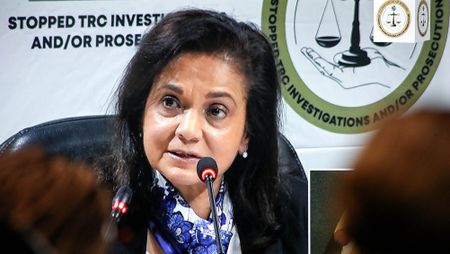
On the first day of proceedings, Howard Varney, lead counsel for the Mabelane family, paid tribute to the tireless efforts to seek justice by Matthews Mabelane’s mother, Messinah, his father, Philip, and his older brother, Lasch, who all died before they could see the case reopened.
The Mabelanes are currently part of a lawsuit alongside the families of other victims and survivors of apartheid-era crimes, suing the government, the National Prosecuting Authority and the South African Police Service for constitutional violations. They allege that political interference deliberately suppressed the investigation and prosecution of Truth and Reconciliation Commission cases, eroding the chances of criminal accountability. These allegations are currently under investigation by the Khampepe Commission of Inquiry. DM
Juliana Moreira de Souza Tubini is a human rights advocate and a Master’s candidate in Public Administration at Harvard Kennedy School. She is currently interning at the Foundation for Human Rights. Jessie Waldman is a senior legal coordinator on the Unfinished Business of the Truth and Reconciliation Commission Programme at the Foundation for Human Rights, and a PhD candidate at the University of Cape Town.
Comments
Scroll down to load comments...