



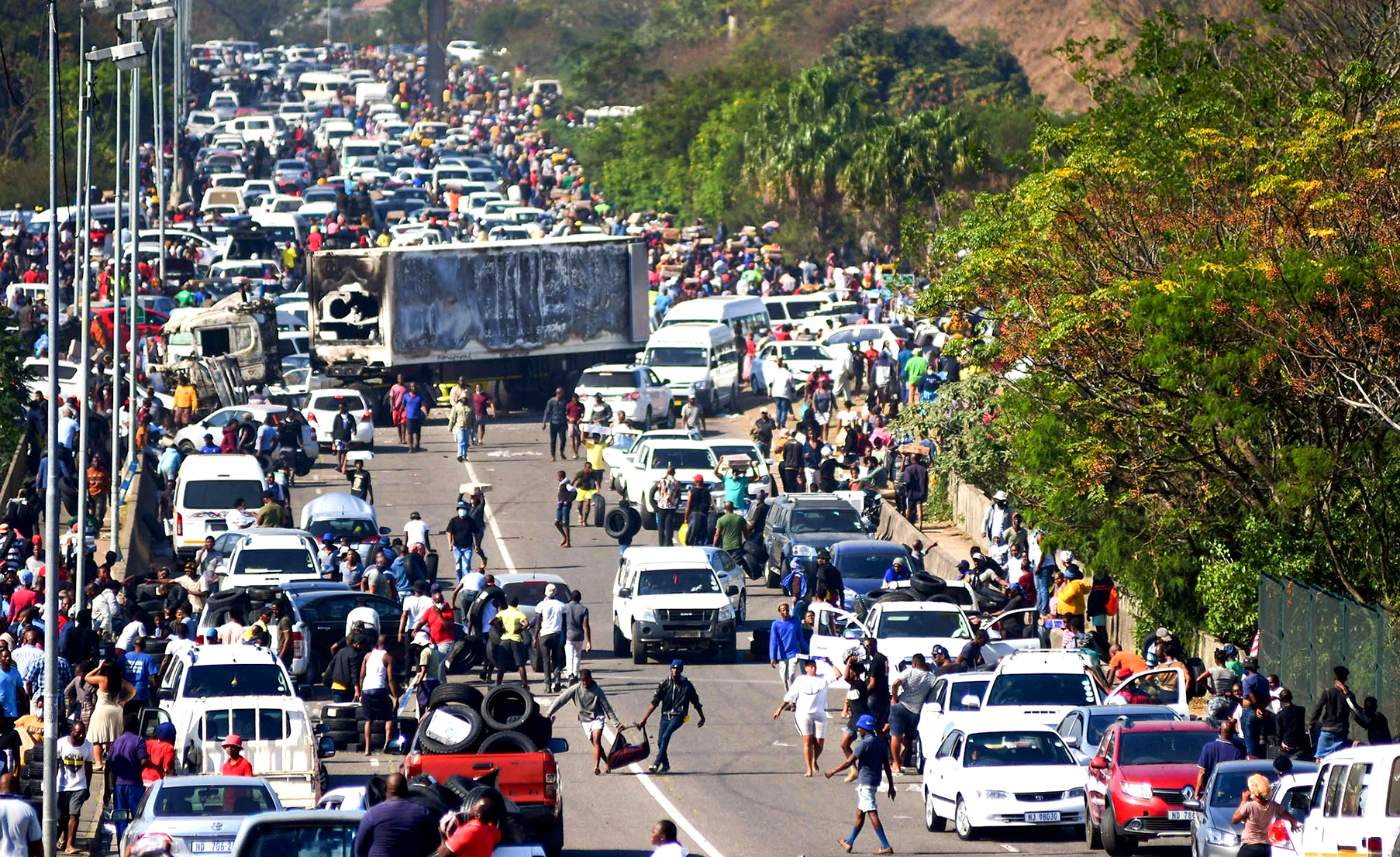
 Looters in Spine Road behind Pavilion Mall on 12 July 2021 in Durban, South Africa. (Photo: Darren Stewart/Gallo Images)
 And yes, we are back there again. Back in the build-up to the July 2021 pro-Jacob Zuma riots that rocked the nation. Back to the time of ethnic mobilisation disguised as legitimate protest. Back to that feeling of something imminent and ugly about to happen, something we all felt. Back to the somnolence of those in charge of the republic who didn’t seem to grasp what ordinary citizens could smell in the air – an explosion about to happen.
Our overlords were caught by surprise back then, but the bulk of the nation was not. The tension was as palpable as it is today. The issues are different, but the actors, the tactics and the mobilising tools are not.
In 2021, the grievance was the imminent jailing of the former president for being in contempt of the Constitutional Court. South Africa was still in the grip of a Covid-19-induced economic squeeze, and stomachs were grumbling loudly. So it was easy to light a match and get many who were not even slightly aggrieved about the Zuma matter to join in the mayhem.
The hand of those who had been key to the State Capture project was evident in the execution of that operation as they sought to reverse the repair of the nation.
In the aftermath of the destruction, which President Cyril Ramaphosa labelled an attempted insurrection, there was an official inquiry, and concrete recommendations were made to avert a similar occurrence. That inquiry, led by esteemed academic Sandy Africa, was damning of the preparedness for the outbreak and the response to it.
So yes, we are back there. There are rumblings of war again. There are the familiar noises – the traditional war chants that resounded around Zuma’s homestead in the build-up to that unleashing of violence. We hear the belligerent rhetoric and the near and open threats of violence. Elements that were there in July 2021 are resurfacing, agitating for action (whatever that might be). Some of them are not so visible, but their fingerprints are very much evident.
Insurrectionists
In 2021 the tinderboxes were obvious. Poverty, hunger, inequality. All enhanced by the pandemic. The insurrectionists just had to bring along a tiny box of matches. The report of the Sandy Africa panel was explicit about what was already obvious to most but apparently not to those who govern us – and still does not seem to be.
“Poorly rolled-out programmes of service delivery and unacceptable living conditions, the state of the economy and the persistent levels of poverty served to provide the ripe environment to light the tinderbox that was the incarceration of former President Zuma that led to many poor and desperate people joining in the looting, alongside those more calculating in their objectives and motivation,” the report said.
It also noted that “there had been several acts of major public disorder and violence in the lead-up to former President Zuma’s incarceration, with firearms being discharged publicly, among others.” There have been no firearms discharged publicly this time yet, but there have been numerous acts of public violence in various cities.
The panel report further informed us that there were “increasingly emboldened calls for disruptions … including a call for a national shutdown”. It said that “in spite of this, none of the intelligence structures of the state was able to predict or forewarn that the outbreak of looting, violence and destruction would take place in the form and the manner that it did.
“Several communities, in the days leading up to the violence, were aware that it would take place. Business delegations also informed us that they had been made aware that violence was imminent. It struck us as inexplicable that the security services, and in particular the intelligence services, did not know the violence would happen and take the form that it did.”
Sleepwalking through this crisis
Now, this lowly newspaperman is not suggesting that this is going to happen on 30 June or in the days that follow the deadline that has been set by the charlatans and rogues who now seem to be dictating our national discourse. It is only to warn about the seemingly lackadaisical attitude of our state. It was sleepwalking through this crisis right up until the rogues set the absurd deadline for all undocumented people to leave the country.
The Zuma grievance appealed to a limited section of the population, but it was able to ignite a conflagration because the instigators recognised the conditions on the ground. The grievance about immigration has much broader reach, even among those not affected by the working-class squeeze.
The government has moved to appease South Africans by embarking on several measures. Home Affairs is beefing up its systems. Raids have been conducted on businesses employing undocumented people. Expedited deportations are on the way. Biometric enhancements are being introduced to detect who is overstaying. It is a delayed reaction to a brewing storm that was ignored for way too long.
However, here is the real deal: we need to seriously interrogate who we have become. During the life of organisations such as Operation Dudula and March and March, there has been an evolution of an ideology of hate. We hate the other. Nigerians are drug dealers and sex traffickers so we hate all of them. Somalians take our spaza shops so we hate all of them. Zimbabweans, Mozambicans and Malawians take our jobs so we hate them even more. Even Basotho, among our closest brethren, are hated because they dominate the zama zama space. Where does one stop?
The ideology of hate has become so deep that we blockade the gates of hospitals and clinics to prevent “these people” from getting healthcare and pelt their children with objects as they walk into schools.
Although there are only 3.5 million or so foreign nationals (legal and undocumented) in the country, figures of up to 30 million are bandied about. Even a Setswana-speaking Bafana Bafana player who happens to have a Nigerian surname because his father comes from that country gets bombarded with hate when he is picked for the World Cup squad.
Although we should never underplay the frustrations of the working classes who feel the squeeze at the bottom of the economic order, the entry and normalisation of this ideology of hate should perturb us greatly. History’s great tragedies are made of this.
Not to sound sentimental, but this nation was forged in the furnace of hopeful ideology. The three main strands of our revolution – the ANC’s non-racialism, the PAC’s Pan-Africanism and black consciousness – were all forward-looking. But the governance failures of the recent past have made us regress. Blame for the suffering of South Africans is placed at the feet of those who arrived rather than those who run this place.
Hopefully we will find a way to turn down the heat to avoid conflagration. If not, it is hoped the authorities’ belated waking up will prevent tragedy. Longer-term, however, we need to work to heal the hate that is consuming us. Because it is not us. DM
Mondli Makhanya is Daily Maverick’s editor-at-large.
This story first appeared in our weekly DM168 newspaper, available countrywide for R35.
/file/attachments/2993/DM-120626_491550.jpg)
Comments
Scroll down to load comments...