




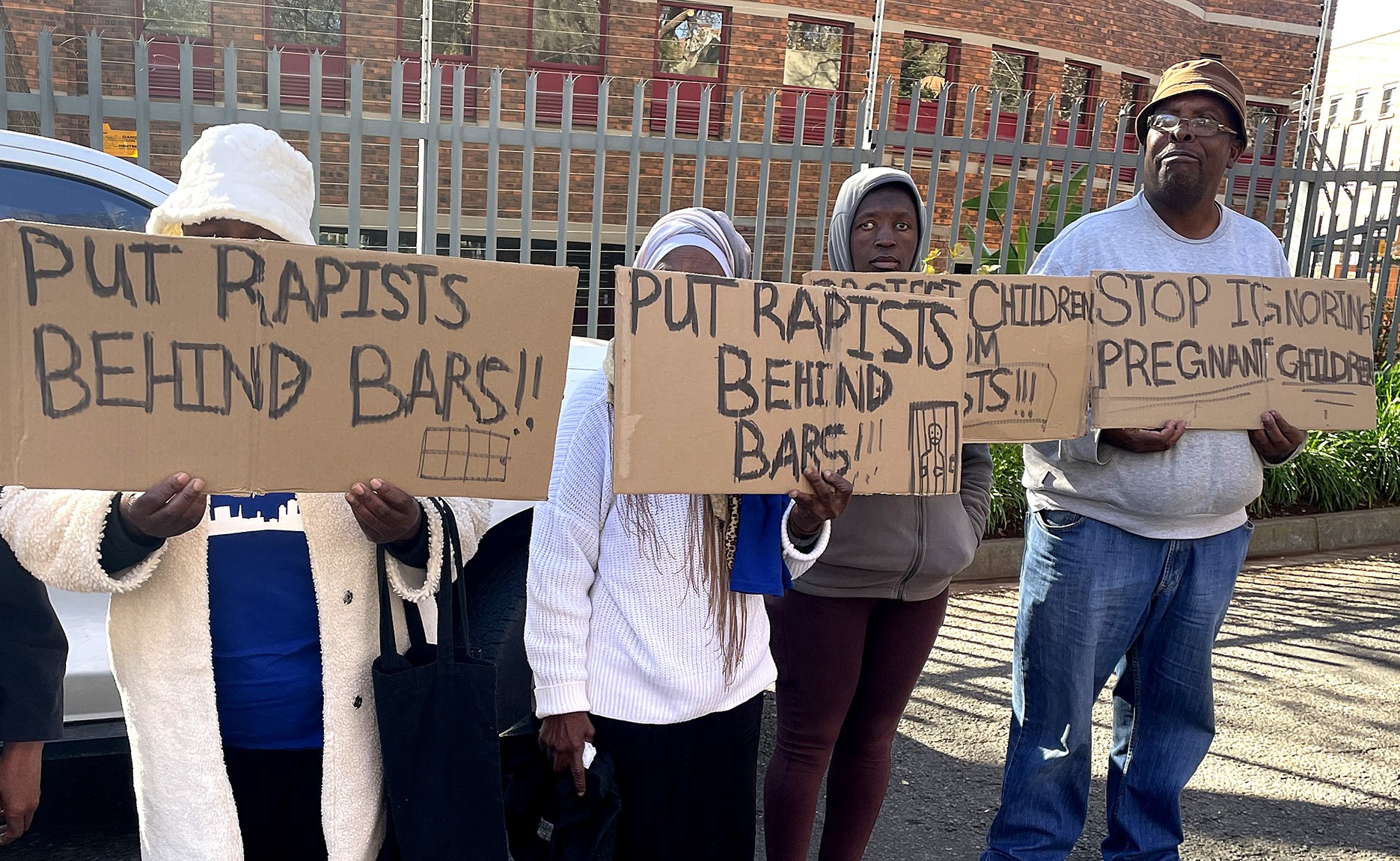
 Protesters held placards calling for child rapists to be prosecuted as the DA made its submission to the SAHRC in Parktown, Johannesburg, on 12 June. (Photo: Naledi Mashishi)
In the first half of 2025, 798 children between the ages of 10-14 gave birth in South Africa. Under the law, each of these cases should have been reported to SAPS for formal investigation.
Yet, the Democratic Alliance’s Gender-Based Violence Task Team has revealed that only 110 child births were reported to SAPS in the 2025/2026 financial year.
Its investigation found that a chronic lack of available rape kits, incomplete forms, and staff shortages for social workers led to just a fraction of child birth cases being reported.
On 12 June 2026, the DA lodged a formal complaint with the South African Human Rights Commission (SAHRC) against government departments, including the provincial departments of health, social development, and education and national departments of police and justice, for allegedly failing to report and prosecute child sexual abuse cases that led to child pregnancies.
The investigation, led by DA Members of Parliament Glynnis Breytenbach, Lisa Shickerling, Angel Khanyile, Bridget Masango, Michéle Clarke, and Nazley Shariff, uncovered a systemic breakdown in how statutory rape cases are investigated and prosecuted.
/file/attachments/orphans/GBVtaskteamjpg_651529.jpg "Members of the DA's GBV task team (from left to right) Michéle Clarke, Lisa Shickerling, Nazley Shariff and Angel Khanyile addressed media outside Sentinel House in Parktown on 12 June. (Photo: Naledi Mashishi)")
In one instance, DA spokesperson for police Lisa Shickerling detailed how she visited an 11-year-old girl who had given birth and found instances of girls as young as nine who had delivered a baby. In another, DA spokesperson for health Michéle Clarke described a case of a 15-year-old girl in the Western Cape who was not assisted at a clinic after a gang rape, and subsequently died while waiting to be attended to in a police station.
“SAPS cannot tell us where the statutory rape cases were opened as a result of mandatory Form 22 reports from the health care system. This raises serious concerns for us that cases are either not being reported properly, and most certainly are not being investigated once reported,” Shickerling said.
“And we do know that many families go to police officers and beg them not to open cases, because in most cases the perpetrator is known to them. It’s either a family member, it is the child’s biological father, it is the boyfriend of the mother, a very close family member or friend, or many times the breadwinner.”
The DA investigated the crisis through a series of parliamentary questions and site visits.
Over 50% of reported cases withdrawn
According to Section 54 (1) of the Criminal Law (Sexual Offences & Related Matters) Amendment Act, children below the age of 16 cannot legally consent to sex. Any person who has knowledge of a sexual offence committed against a child must report it to the police. It requires mandatory reporting of children under the age of 16.
The law mandates specific professionals, including doctors, nurses, teachers, or social workers, to report the offence. Reporters must complete a Form 22 document detailing their relationship to the child and the nature of the sexual abuse, which must be given to a social worker. Then the incident must be reported to the police.
However, research has found that healthcare workers often report inconsistently, with some medical workers fearing that reporting victims could deter them from seeking medical care. Other factors like stigma, a lack of available rape kits, and being turned away due to territorial boundaries are barriers to reporting.
/file/attachments/orphans/MicheleClarke_821938.jpg "DA spokesperson for health Michéle Clarke addressed the media outside Sentinel House in Parktown, Johannesburg on the DA's submission to SAHRC on the underreporting of child pregnancy cases on 12 June. (Photo: Naledi Mashishi)")
Data presented by SAPS to the Portfolio Committee on Police on 4 June 2026 revealed that over the past five years, 3,232 cases of statutory rape were reported to the police. Out of these cases, 1,853 (57.3%) were withdrawn and only 14% resulted in a conviction.
According to SAPS, the factors that contribute to cases being withdrawn included harmful cultural beliefs, financial dependency on perpetrators, fear of secondary victimisation and stigmatisation, threats from perpetrators, and a preference among some families and communities for alternative forms of dispute resolution.

At the portfolio briefing, Acting Deputy National Commissioner Hilda Senthumule (who is currently facing criminal charges in another matter) said that it was a crime to fail to report the cases, and those who failed to do so could face up to 10 years in prison. She added that police officers should not allow cases to be withdrawn either.
“So those who do withdraw such cases are actually acting outside the law and they should face consequence management, both departmentally and in terms of the law.”
However, SAPS has not collected statistics on the number of people who have been charged for failing to report or police officers who have faced disciplinary action for allowing cases to be withdrawn.
Clarke said that none of the relevant departments shares details of cases with one another, leading to cases falling through the cracks.
“There is really a need for us to have an integrated system in terms of hospitals, in terms of [the Department of Social Development] and SAPS, so that when a case is reported at a hospital for a statutory rape or GBV or underage assault, that these systems talk to each other and we can actually deal proactively with these issues,” she said.
Declining adolescent births
A 2026 study showed that adolescent pregnancies in SA have declined over the past four years, with the steepest decline of 40% among girls aged 10-14. However, with a pregnancy rate of 48.1 births per 1,000 adolescents aged 15-19, World Bank data shows that SA’s adolescent pregnancy rate is higher than the global average of 38 births per 1,000 adolescents.
This was confirmed in May when Eastern Cape Health MEC Ntandokazi Capa reported that there had been a decline in the number of births among girls aged 10-14 in the province. In the 2025/26 financial year, 292 girls aged 10-14 gave birth compared to 553 girls in 2022/23.
But Capa emphasised that pregnancies among girls under 16 were serious crimes.
“This is not only a health issue, it’s a legal and societal one. We are working closely with law enforcement to ensure that perpetrators are held accountable,” Capa said.
In a parliamentary reply in May 2026, Minister of Health Dr Aaron Motsoaledi, speaking specifically about the Eastern Cape, admitted that while the department is currently building an automated mandatory reporting tool in an effort to strengthen documentation, monitoring and reporting processes within health facilities, there is currently no data available on the number of cases reported.
“The Department of Health does not currently maintain a register containing details of girls who were reported to Department of Social Development and subsequently to law enforcement agencies,” Motsoaledi said.
And in a 2025 parliamentary reply, Minister of Social Development Nokuzola Tolashe said that the department did not keep records of reported cases either.
“The Department of Social Development (DSD) is not responsible to keep records of Child births for babies delivered at hospitals. This is the mandate of the Department of Health,” she said.
Over 150,000 unprocessed rape kits
The DA also said that, according to a parliamentary reply, in the first quarter of 2026 there was a backlog of over 150,000 rape kits that still needed to be processed and could take up to two years to be processed, delaying prosecution for up to two years and leading to cases being struck off the roll.
In addition, police planning documents said that in the Western Cape, the provincial SAPS only allocated 20% of the required kits to stations across the province. Nationwide, police stations and Thuthuzela Care Centres, which provide specialised care to survivors of sexual violence, either had insufficient supplies of rape kits or had expired kits.
/file/attachments/orphans/AngelKhanyile1_119661.jpg "DA spokesperson on women, youth, and people with disabilities Angel Khanyile addressed the media outside Sentinel House in Parktown, Johannesburg on the DA's submission to the SAHRC on the underreporting of child pregnancy cases on 12 June. (Photo: Naledi Mashishi)")
“Now it would mean when the victims present themselves at the Thuthuzela Care Centres, they will still need to wait for a police officer that is going to be called to come and assist with the rape kits. That can take up to an hour, two hours,” explained DA spokesperson for women, children, and people with disabilities Angel Khanyile.
“The DA has petitioned the South African Human Rights Commission to investigate these systemic failures across all responsible state departments, declare the ongoing neglects of these departments unconstitutional, order an immediate, unified data tracking framework across government departments, and force urgent accountability mechanisms for officials who fail to act.” DM
Comments
Scroll down to load comments...