



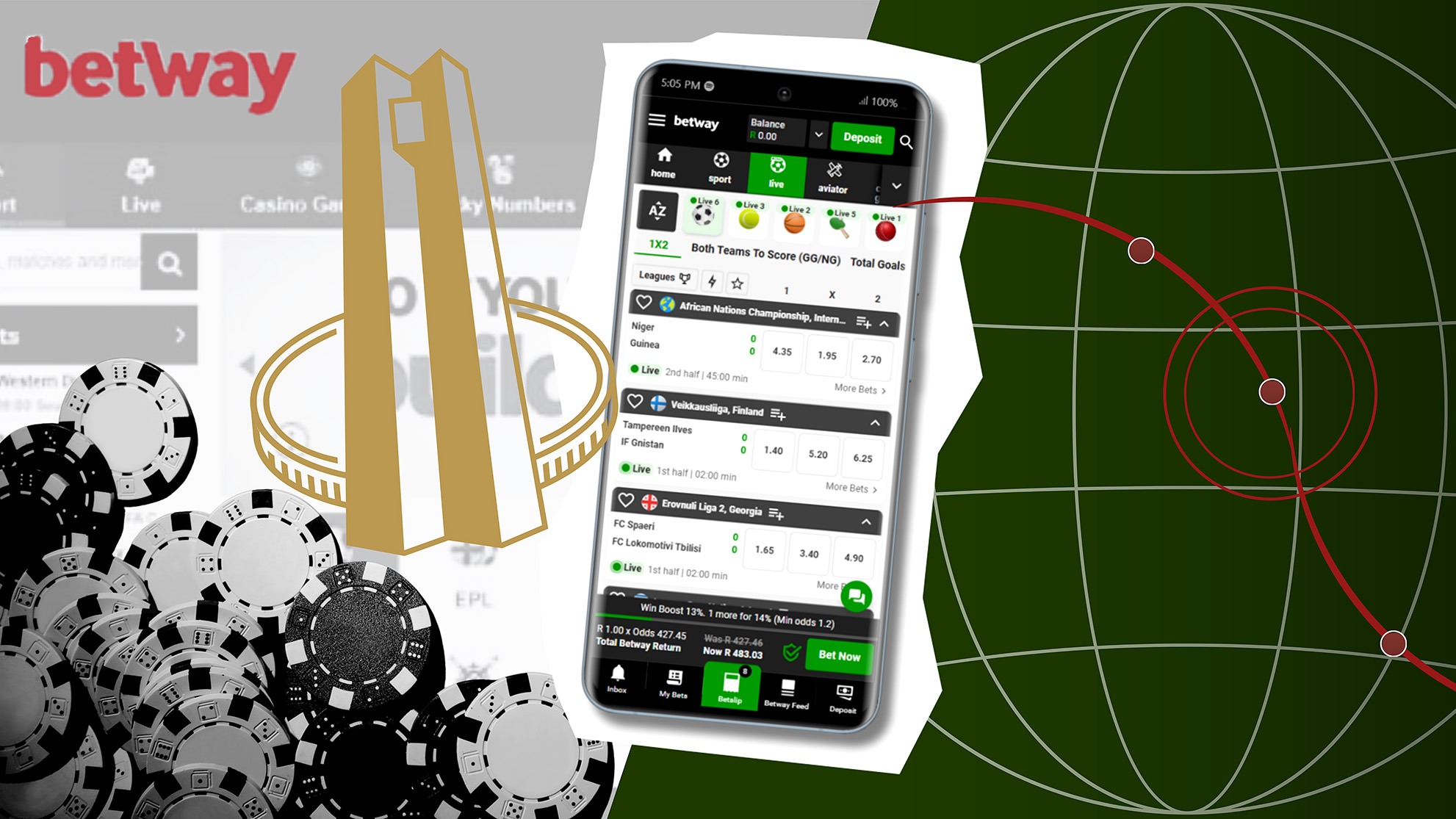
 The South African Reserve Bank has launched an investigation into gambling giant Super Group’s transfers of money between its local and offshore subsidiaries. (Illustration: Betway / Envato /Canva)
In the middle of a snowballing gambling epidemic, industry leader Super Group (Betway and Jackpot City) has quietly made it known that it faces an investigation by the South African Reserve Bank (Sarb).
In its latest annual report, a footnote informed shareholders that the Sarb’s financial surveillance department is looking into the way the group’s South African operations paid for software licences and other services from other parts of the multi-national group.
According to Super Group, the investigation is “regarding historical transactions involving the transfer of funds from the Company to foreign / non-South African resident entities within the Super Group (SGHC) Limited group structure, allegedly in breach of the South African Exchange Control Regulations”.
It added: “These transfers were made in exchange for, amongst other things, services and licenses provided to Raging River under various agreements.”
Raging River is the local Super Group operating subsidiary.
The Sarb has, as is its habit, declined to comment, saying that the South African Reserve Bank Act precludes it from disclosing any information on the specific investigation – including when it was initiated and even whether or not it has been finalised.
These kinds of investigations, however, come with an obligation to pay a refundable deposit pending any findings which, according to Sarb, “is discretionary and is often agreed between the parties after due consideration of various factors, including the facts of the specific matter and the relevant risks”.
In Super Group’s case, R30-million has been deposited, according to the group’s annual report. In the context of the group’s operations this is practically nothing.
While neither the investigation nor the deposit reflect guilt, amaBhungane has previously reported on some of the gambling group’s arguably exploitative business practices, including what could be considered as payment of “hush money” to a gambling addict to head off a complaint to regulators.
Labyrinth
Super Group has a labyrinthine international structure, which makes it difficult to determine which offshore units might be implicated in the Sarb investigation.
While the group is listed on the New York Stock Exchange, the ultimate parent company is registered in the English Channel island of Guernsey and has a list of more than 100 subsidiaries around the world housing its various operational components, gambling licences and intellectual property.
This structure has been constantly shifting.
By way of example, in 2024 a Maltese holding company called Alphamedia Limited suddenly became the conduit for profits from SA and possibly elsewhere.
Financial records from Malta show Alphamedia receiving dividends of €195-million, or roughly R3.9-billion, in that year.
Early this year Alphamedia received a $60.5-million (R1-billion) dividend from SA.
The major offshore companies that sell services to the rest of the group, however, include Win Technologies (UK) Limited, which sells well over R1-billion in services to the rest of the group in any given year but utilises an exemption in UK law to not report its dealings with related parties in its publicly available financials.
Printing money
The group as a whole, but in particular its South African operations, remain an evergreen jackpot.
In 2025, Super Group had revenue of over $2.2-billion (R36-billion), of which more than $700-million (R11.5-billion) came from SA. After the first quarter of this year the group is predicting 2026 will see it rake in over $2.5-billion.
Gambling in Africa is, judging by Super Group’s latest presentation to shareholders, exceptionally profitable.
Its “Africa” segment (of which SA accounts for 80%) in 2025 had a profit margin of over 35%. By way of comparison the profit margin of its “International” segment (consisting of European and North American markets) was 22%.
The best measure of the group’s success may, however, be its spectacular dividend payments. Since the middle of last year it declared and paid out an interim dividend of $81-million, a final dividend of $25-million and a “special” dividend of $127-million.
That is altogether nearly R4-billion.
Political funding
A major beneficiary of this bonanza is South African expat Martin Moshal, who is the beneficiary of a number of trusts that together own 45% of Super Group.
Moshal is a controversial figure for at least two reasons, one being that he is a trustee of Keren Hayesod, a fundraising organisation which, among other things, funds personal support for foreign recruits into the Israeli Defence Force.
Israel is widely accused of perpetrating genocide in Gaza – and SA filed an ongoing case at the International Court of Justice in December 2023, alleging that Israel’s military operations in Gaza violate the 1948 Genocide Convention.
Moshal has not publicly commented on these allegations. He is known for being a fiercely private and reclusive individual who avoids media interviews and public statements.
Locally, Moshal has also become the single largest individual funder of political parties by donating in the region of R110-million to opposition parties, chiefly the Democratic Alliance and ActionSA.
In the first quarter of this year Moshal donated R5-million to ActionSA, bringing his total support for the party close to R50-million.
Overall he is behind only the extended Oppenheimer family and Capitec founder Michiel le Roux, who donates through a number of corporate vehicles. DM
Disclosure: amaBhungane is funded by Millennium Trust (which is associated with Michiel le Roux) and the Oppenheimer Memorial Trust.
This story was produced by the amaBhungane Centre for Investigative Journalism. Sign up for their newsletter.
Comments
Scroll down to load comments...