




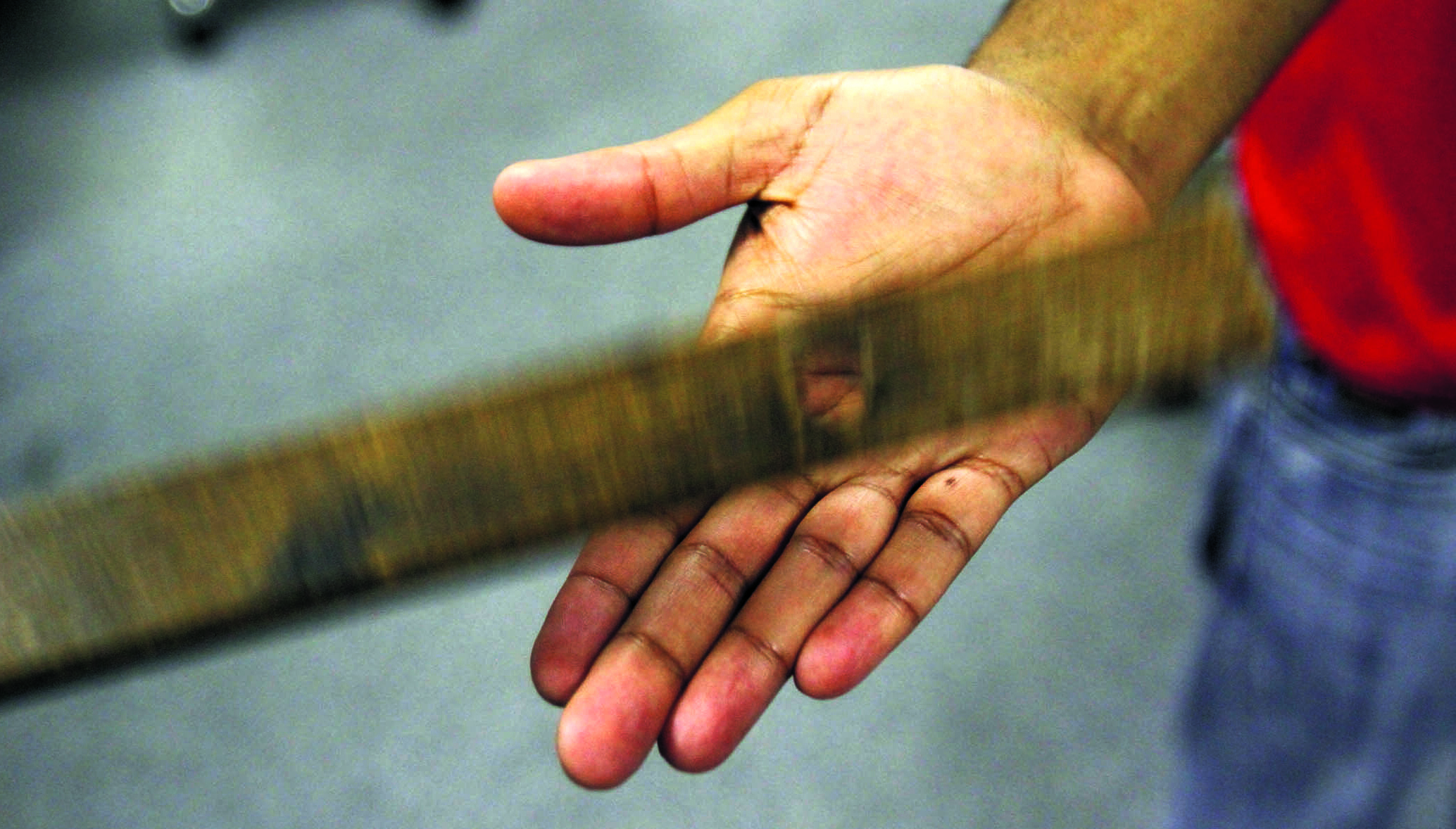
 Despite the ban, student teachers regularly describe witnessing occurrences of physical punishment performed on children during their school observations and teaching practicals. (Photo: Gallo Images / Daily Dispatch / Mark Andrews)
In a few weeks, thousands of student teachers will walk into South African classrooms for their teaching practicals and find themselves caught between two competing pressures related to discipline in the classroom: on the one hand, the well-established legal framework regarding their responsibilities towards children, and on the other, the normalisation of violence towards children in our society. These tensions frequently lead to profound ethical dilemmas which student teachers find themselves grappling with, often long after their return to university or college. How to manage these dilemmas is something that must be addressed in their training.
Corporal punishment, defined as any deliberate act against a child that inflicts pain or physical discomfort, has been outlawed in South African schools for 30 years, with a raft of laws, guidelines and judgments shoring up this ban. These include the South African Schools Act of 1996; the National Education Policy Act of 1996; the Abolition of Corporal Punishment Act of 1997; the Constitutional Court judgment in Christian Education South Africa v Minister of Education, 2000; the South African Council of Educators’ Ethical Code for Educators, 2024; and the recent Basic Education Laws Amendment Act.
Despite this comprehensive legal framework, student teachers regularly describe witnessing occurrences of physical punishment performed on children during their school observations and teaching practicals. The recent Child Gauge (2025) published by the Children’s Institute recognises that violence against children is a larger problem than what is observed in the classroom. “Corporal punishment must be understood as a structural problem, perpetuated by a broader system that has historically endorsed the use of violence as a legitimate means of disciplining learners. It is often a symptom of inadequate teacher training in classroom management, making it an accessible – albeit harmful – fallback strategy. In contexts where schools are underresourced, learner-to-teacher ratios are high, and in-class support for educators is limited, the likelihood of resorting to harsh disciplinary practices increases.”
Corporal punishment is one node in a web of violence that schools both suffer and reproduce.
The tensions between the regulatory framework, social norms and the reality in classrooms makes this issue a complex one to research. We have several ways to build a picture of what is happening at schools in order to develop support strategies for student teachers:
First, official statistics (always to be read with caution!): for example, the South African Council of Educators, in its 2024/25 annual report tabled in Parliament, states that 606 new complaints of unprofessional conduct against teachers were recorded, with assault and corporal punishment the most common offences. The report frames these patterns as underscoring an urgent need for professional development in positive discipline, particularly among teachers who continue to apply corporal punishment, and 70 sanctioned teachers were directed to attend such programmes.
Second, the reflections of student teachers on what occurred during their teaching practicals provide further insight. In a qualitative research project at Stellenbosch University in 2024, student teachers were asked to reflect on their experiences around classroom management during their teaching practicals. We found several themes emerging, including: the experience of witnessing corporal punishment and not knowing how to deal with it, especially given that they had been taught that this was illegal; the knowledge that they needed to exert authority in the classroom, but were not actually “in control”, and that this sense of being in control was of critical importance to the perceived success of their teaching practical; and above all, that they need much more support and training around issues to do with classroom management.
Third, the public’s response to reported cases. The Western Cape Education Department recently reported 120 instances of corporal punishment in the 2025/26 financial year. This number is certainly the tip of the iceberg and must be read with national figures, together with the knowledge that most cases go unreported. More telling are the comments on a recent social media post about these reported cases. While comments on a Facebook post are certainly not a representative sample, the sentiments they carry are real, and it speaks directly to why corporal punishment persists in South African schools despite being legally prohibited.
The claim, which can be summarised as ‘I was hit and I am fine’, fits into a category known as naturalistic fallacy.
Many of the 1,200 comments can be categorised into two camps: I was hit and I turned out fine; and children today are unruly precisely because the cane was taken away. Both are empirical claims, and the evidence supports neither. A University of Cape Town systematic review of 53 quantitative studies conducted around the world found that school corporal punishment is consistently associated with physical injury, poorer academic performance and worse mental health (Heekes et al, 2022). A recent South African study goes further: even “mild” physical punishment carries a risk of escalation, and evidence suggests that children who are physically punished tend to reproduce what was done to them, which can result in turning the same coercion on peers and even teachers (Rubbi Nunan, 2025).
What the research has never found is evidence that physical punishment is effective: it buys a moment’s compliance, not pro-social behaviour in the long term and certainly not better academic performance. In addition, the claim that the legal ban on corporal punishment caused today’s lack of discipline does not survive contact with the data – no relationship has been found (Heekes et al, 2022).
The claim, which can be summarised as “I was hit and I am fine”, fits into a category known as naturalistic fallacy: the leap from “this happened to me” to “therefore it’s fine”. This contradicts research that shows that the harm is often delayed and difficult to measure in the moment: Turner and Muller (2004) tie corporal punishment to depressive symptoms that persist into young adulthood, while Röhrs (2017) associates it with a heightened risk of aggression and criminality. These are costs that emerge years after the fact and can pass to the next generation. As a society, we have to concede that social relations in South Africa can in no way be described as “fine”. With a murder rate of about 37 per 100,000 – roughly six times the global average – and levels of sexual violence among the highest in the world, South Africa exhibits exceptionally high levels of interpersonal violence. Schools are a microcosm of the society of which they are a part. Corporal punishment is therefore one node in a web of violence that schools both suffer and reproduce.
Student teachers need a structured space to interrogate the discipline they themselves absorbed at school.
Where does this leave teachers and student teachers? The tools for nonviolent ways of managing a classroom exist, but currently are not well integrated into initial teacher education programmes. For example, the Department of Basic Education has published a patchwork of documents around this issue, including a guide to alternatives to corporal punishment in 2000, a protocol on how to deal with incidences of corporal punishment in 2017, and a National School Safety Framework in 2015. The Western Cape Department of Education has a Positive Behaviour Programme on its website – but no information about how this should be implemented, or how implementation is supported and/or evaluated. Equal Education, in its 2023 report titled “Safety Ngoku: Seeking Sanctuary in Western Cape Schools”, found that teachers lacked the training to keep pupils safe and that almost half the schools it visited did not know the safety framework existed. A case study from the University of KwaZulu Natal (Ntuli, 202) found the same – teachers were well aware that physical punishment is illegal, but most had not been shown what disciplinary measures to use in its place. The gap Ntuli describes is not only one of training but of belief: many of these teachers still held an inherited conviction that physical punishment is effective. The vacuum cannot be closed by supplying techniques alone.
This is not a problem of missing policy; it is a problem of inadequate and superficial preparation. And preparation is precisely what initial teacher education exists to provide. Student teachers cannot be sent into classrooms with only the knowledge that hitting children is against the law and a few tips for crowd control. They need a structured space, such as a community of inquiry, to interrogate the discipline they themselves absorbed at school and to reason through what they will actually do in the moments of conflict they are likely to face during their teaching practicals and beyond. A community of inquiry is a method of collaborative, dialogical inquiry, developed as a classroom practice through Matthew Lipman’s Philosophy for Children movement. It inverts the usual classroom hierarchy: a facilitator offers a stimulus, but it is the participants (in our case, student teachers) who raise the questions and pursue them
together, building on one another’s reasoning rather than trying to score points (as in a debate), and treating disagreement not as something to be smoothed over but as the very thing that drives the inquiry forward. The approach has since spread well beyond its origins and is now practised in more than 60 countries. It has been promoted by Unesco through its Chair on the Practice of Philosophy with Children and, while it remains primarily a classroom practice with children, it has increasingly been adopted in teacher education and professional development, supported by international networks such as the Society for the Advancement of Philosophical Enquiry and Reflection in Education and the International Council of Philosophical Inquiry with Children, which run training programmes for teachers.
Given the trauma that many South Africans experience, student teachers also need training in trauma-informed teaching.
The nature of this approach makes it well suited to productively engage with the uncertainty student teachers carry back from their practicals. As Stoughton (2007) argues, student teachers’ perplexities and concerns are not obstacles to be managed but catalysts for deeper, more thoughtful dialogue. We saw this in the research project mentioned above – within minutes of opening such a space, student teachers were grappling deeply with the contradictory roles they inhabit in classrooms. During these sessions it also became clear that, given the trauma that many South Africans experience, student teachers also need training in trauma-informed teaching, a well established educational approach that recognises the multifaceted impacts of trauma on pupils, including on their behaviour in the classroom.
Adopting this practice will not, of course, shrink a class of 50 or undo the vast structural inequality South African teachers and pupils inhabit. But a student teacher who has had many structured opportunities to sit with peers, lecturers and, ideally, practitioners, deeply thinking about and reasoning through these issues, will arrive in the classroom with more authority, presence and the ability to make reasoned decisions that are in line with their professional and ethical responsibilities. This is supported by the recent recognition by the Children’s Institute that “there is an urgent need to invest in training all teachers to enable them to manage difficult classroom behaviour as this has the potential to shift the experience of millions of children across South Africa. Ideally this should be incorporated into teacher training and continual professional development” (Jamieson, 2025).
Three decades after the ban on corporal punishment, our student teachers and the children they will serve throughout their careers deserve a thoughtful and structured approach to managing pupils and classrooms without resorting to physical violence. DM
Lynn Chambers has 15 years’ experience working in a variety of South African educational settings, including as a lecturer in the Faculty of Education at Stellenbosch University. She is currently working in academic staff development at UCT’s Centre for Innovation in Learning and Teaching.
Ndikhokele “DK” Mgcineni is a third-year bachelor of education student at Stellenbosch University and secretary of the Education Student Committee, whose interests are languages, belonging and justice in South Africa.
Comments
Scroll down to load comments...