




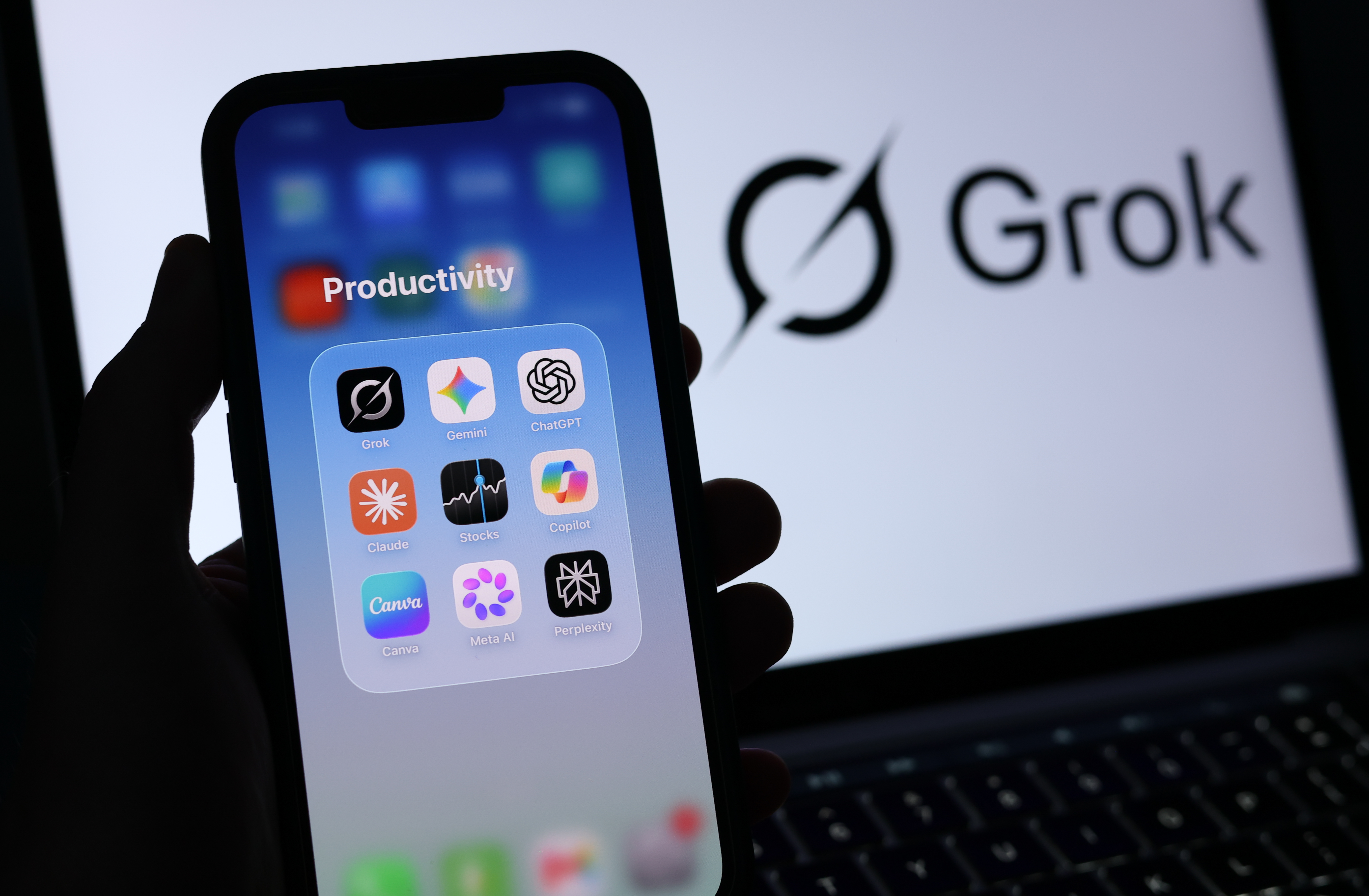
 A 'Productivity' folder containing Artificial Intelligence applications is displayed on a mobile phone alongside the Grok logo displayed on a laptop screen in Liverpool, Britain, 09 June 2026. Leading AI (artificial intelligence) and technology companies Anthropic, OpenAI, and SpaceX are preparing to go public this year at an estimated combined valuation of around four trillion dollars (approximately 3.44 trillion euros). EPA/ADAM VAUGHAN
The concept of initial public offerings (IPO) is less about the public and more about our money. When companies decide to list on stock markets and sell shares it means that they have exhausted all of the private investment available and now need to raise additional capital from the wallets of the citizenry.
Strangely, given the Wall Street hype, IPOs raised only $87.5-billion through 26 May, the highest level recorded since 2021. So this mighty return to form with the current attacking trio (sorry, Ke Nako, mos) of trillion-dollar-valuation companies rapidly debuting is being viewed as the most consequential test of investor appetite for high-growth tech stocks in the last decade.
The SpaceX IPO is, of course, the headliner – which is basically just a referendum on Elon Musk and his wild ideas of future galactic communities… as well as space data centres. Why space data centres? Because the mood on terra firma has soured, and, quite frankly, the market has cooled.
None of the data centres Microsoft announced in 2023 have been finished and that is just the headline on a rapidly freezing market. It’s a combination of the market greed that drove all the prices of components and construction up, coming to bite the market in the race to bottom.
SpaceX is still a space company with a loss-leading AI industry tacked on – so their valuation and future revenues are kind of believable.
It’s the pure artificial intelligence players that are more questionable. Since 2021, AI rapidly emerged as the defining investment theme of the decade, and the major AI players are now transitioning to public markets to secure funds after taking all the hot air out of the seed funding.
The ChatGPT maker OpenAI recently filed confidentially for a US IPO, targeting a valuation of up to $1-trillion, with a stock market debut that could come as early as September.
While OpenAI reported generating $2-billion in monthly revenue in March, growing four times faster than early internet and mobile giants, the company does not expect to be profitable until 2030.
Anthropic – the purveyor of Claude and OpenAI’s chief rival – also confidentially filed for its own US IPO, so we don’t know exactly how ridiculous that prospectus looks.
But like I was saying, AI development involves soaring costs, which initially forced OpenAI to create a for-profit arm in 2019. While these AI giants have successfully extracted astronomical sums from private backers (such as Anthropic’s recent $65-billion funding round that valued it at $965-billion, and OpenAI’s $110-billion raise from SoftBank, Amazon and Nvidia) they are reaching the limits of what private markets can sustain.
Even in Mzansi, Stanlib has already thrown its pension fund weight behind Africa Data Centres’ ambitions to bring Nvidia chips to our shores.
Which was then followed by Standard Bank underwriting the Dangote foray into the stock market to fund its massive expansion. But whether it is OpenAI reporting unprecedented revenue growth or the Dangote refinery exceeding its nameplate capacity to achieve a sustained production of 700,000 barrels per day, both industries are leveraging public capital to cement their status as significant global players.
And when the bubbles pop, guess who is left holding broken dreams and promises? You and me. Be careful out there, they’re coming for your future. DM
Comments
Scroll down to load comments...