




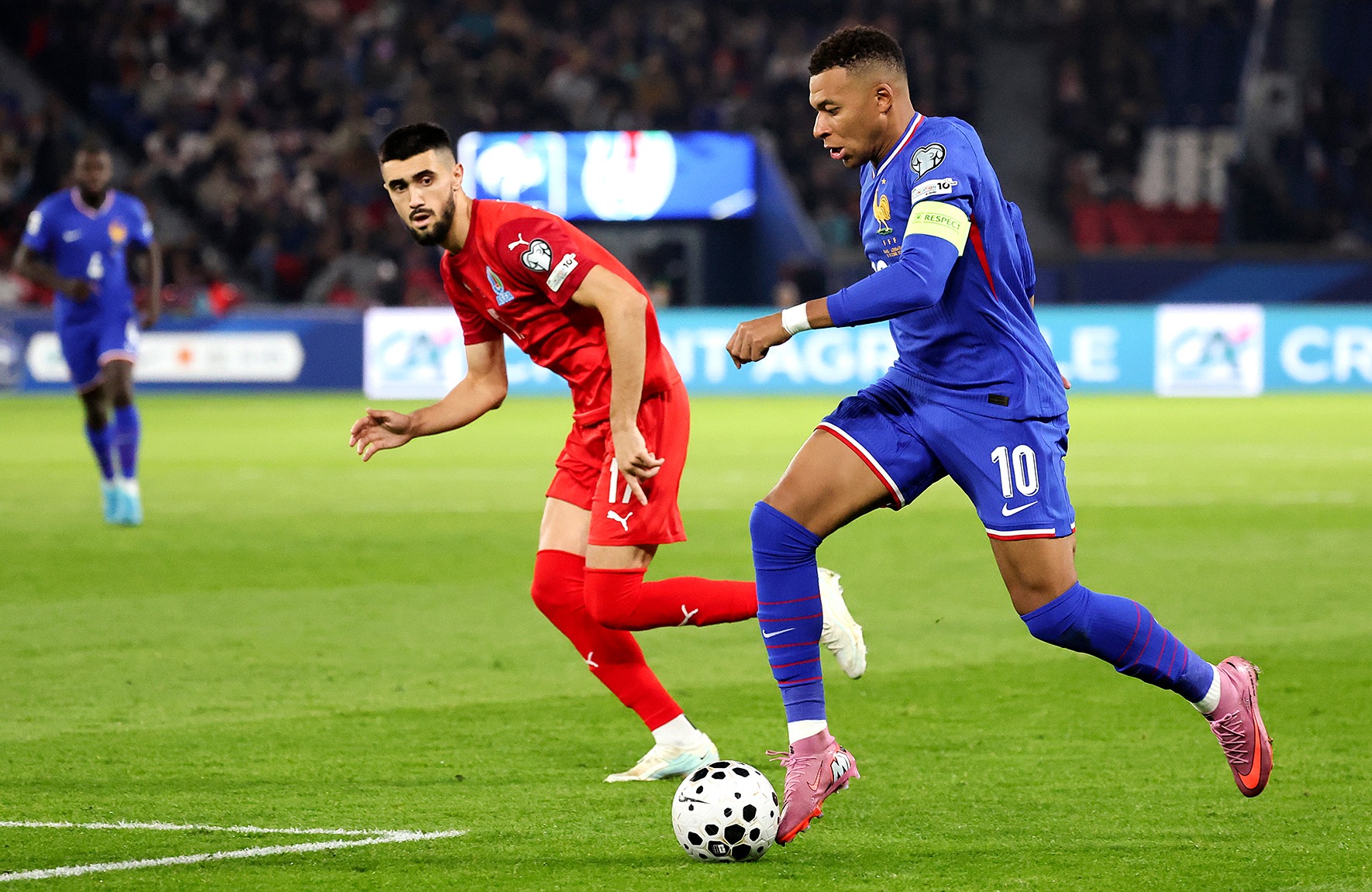
 Kylian Mbappé will once again be the centre of attention in a star-studded team. (Photo: Catherine Steenkeste / Getty Images)
France
The plan
“It is a pain to watch, but it makes you win,” is perhaps the most succinct summary of France under Didier Deschamps. The words were Antoine Griezmann’s during Euro 2024, a competition in which Les Bleus reached the semifinals. However, goals were hard to come by and, in the semifinal defeat against Spain, Randal Kolo Muani became the only French player to score from open play in the entire tournament. Their other three goals came either from the penalty spot or via own goals.
Granted, this was France at their most conservative. The boundaries of Deschamps’ approach, it seems, were being tested. The metaphorical handbrake was released during France’s tour of the US in March this year as his side netted five goals across two games against Brazil and Colombia. During that tour, Deschamps said he wanted his team to be “less predictable and readable”. But would their defensive solidity be sacrificed for attacking flair? “At times, we’ve been a bit on the limit,” said Deschamps.
That’s the devil on his shoulder talking. The defence remains the backbone; only four European nations conceded fewer than Les Bleus in qualifying, but there is now an array of attacking talent at Deschamps’ disposal, including captain Kylian Mbappé, the Ballon d’Or winner Ousmane Dembélé and Michael Olise.
/file/attachments/orphans/2280719356_827034.jpg "Michael Olise comes into the 2026 Fifa World Cup as one of the best attacking players in the world. (Photo: Xavier Laine / Getty Images)")
Lucas Hernandez says France has “the best attack in the world”, and when you look at the individuals, it is hard to contest that claim. Moulding them into something coherent is the challenge for Deschamps, and finding the correct formula has been difficult since Olivier Giroud’s retirement from international football in 2024. In the March friendlies, the balance seemed to have been struck, but whether the more expansive prototype will be used at the World Cup is the big question.
The coach
Didier Deschamps has become the gold standard of international management. His conservatism and pragmatism have elicited replication, notably by Gareth Southgate when he was at the England helm. Despite taking France to back-to-back World Cup finals, as well as a Euros final during his 12-year tenure, Deschamps’ approach has regularly drawn criticism. “Watch something else, then,” was his response to such jibes. His success justifies his dogmatism and, given that he will step back from Les Bleus this summer, he is not about to change tack now. Having previously had success with Monaco and Marseille, Deschamps has said he is open to a return to club management.
/file/attachments/orphans/UP1EM681MR1BB_752696.jpg "France coach and legend Didier Deschamps. (Photo: Sarah Meyssonnier / Reuters)")
Star player
Kylian Mbappé leads an all-star cast that also includes Ballon d’Or winner Ousmane Dembélé and the man who could succeed him in winning the individual award, Michael Olise. But the main man, as has been the case since he fired France to World Cup glory back in 2018, remains Mbappé, who has evolved from an electrifying winger to a prolific goalscorer. Now operating as a No 9, the Real Madrid star is the player that France’s attack has been built around — and for good reason, given Mbappé is about to overtake Olivier Giroud as the country’s all-time goalscorer.
One to watch
Warren Zaire-Emery is only 20 but has already experienced his fair share of career ups and downs. He netted on his France debut at the age of 17 and was sold as the next big thing. Injuries and a subsequent loss of form saw him fall down the pecking order at PSG and be demoted to the France Under-21s. He has bounced back spectacularly. Now a key member of arguably the best club midfield in world football, he seeks a more prominent role with Les Bleus, where he could even be a solution to Deschamps’ right-back problem, as he showed in the Champions League against Bayern Munich.
/file/attachments/orphans/2246971257_827076.jpg "Warren Zaire-Emery may play a key support role in a star-studded French team. (Photo: Franco Arland / Getty Images)")
Unsung hero
Dayot Upecaemo has added consistency and composure to his game in the past year. So while William Saliba has come in for plaudits for his performances at Arsenal in recent seasons, and is also growing in stature for France, he is massively helped in the national team by Upamecano. The Bayern Munich centre-back, now 27 and in his prime, started all of France’s World Cup qualifiers, bar a dead-rubber against Azerbaijan, and has kept Liverpool’s Ibrahima Konaté on the fringes of the French setup.
What to expect from fans
As has been the case for many fans, pricing has been a deterrent for the French. Nonetheless, up to 1,000 supporters are expected at each match, with around 650 Irrésistibles Francais (IF), Les Bleus’ biggest organised fan group, expected for the opener against Senegal. It is the IF who bring the noise in the stands, albeit their chants can be rather simplistic. “Allez Les Bleus” (Go the Blues), “Qui ne saute pas n’est pas Francais” (those who don’t jump are not French, accompanied by mass jumping), and the Marseillaise, the national anthem, will be on rotation at stadiums around North America this summer.
/file/attachments/orphans/RC2XPLA18RIM_276780.jpg "France's Kylian Mbappe. (Photo: Sarah Meyssonnier / Reuters)")
Relations with the US/Trump
There were only four months between Donald Trump’s initial election as president and that of Emmanuel Macron in France back in 2017, and the pair initially enjoyed a strong relationship. Recently, however, that relationship has teetered, notably due to disagreements initially over the war in Ukraine and more recently the war in Iran. Trump has criticised France’s reluctance to support the US in Iran, and the president’s criticism became personal when he singled out Macron’s wife, Brigitte, for personal flak. “[She] treats him extremely badly,” said Trump, referencing a video from last year in which Brigitte appeared to shove Emmanuel in the face. Macron replied by saying that Trump’s comments were “neither elegant nor up to standard”.
Norway
The plan
Ståle Solbakken’s journey to becoming Norway’s national team manager started in the 1998 World Cup when he sat as an unused substitute, shouting suggestions to the then-boss Egil “Drillo” Olsen when Norway turned a 1-0 deficit into a 2-1 victory against Brazil. Like his mentor Olsen, Solbakken has never been a naive or particularly romantic football manager. He is a product of the Northern European soccer school, where the result always holds the most weight. It is largely about tight zonal defence and aggressive attacking play focused on breakthroughs — soccer that is as effective as possible.
Norway usually uses a 4-3-3 formation, but with significant flexibility. For example, Antonio Nusa, the winger who loves to dribble, tends to maintain width on the left, while the crossing machine full-back Julian Ryerson pushes up as a right winger, making it look more like a 3-5-2. This allows the strikers Erling Haaland and Alexander Sørloth to operate as close to goal as possible. Solbakken has also attempted a flatter 4-4-2 with varying success. The approach is pragmatic in the sense that the Norwegians want to maximise their X-factor players. This is especially found in Haaland’s raw power up front, as well as captain Martin Ødegaard’s passing ability and vision. If space behind the opponent’s defence is available, Solbakken will be furious if the ball is not played there when Haaland starts one of his trademark runs.
/file/attachments/orphans/RC2WNX9AJYBY_142945.jpg "Norway coach Ståle Solbakken. (Photo: Andrew Couldridge / Action Images via Reuters)")
It must be mentioned, however, that Norway have significantly developed their own style of play in the past year. Even during the Euro 2024 qualification, ball-playing defenders were a scarcity in the squad. But with the left-footed Torbjørn Heggem alongside Kristoffer Ajer, this looked much better in 2025. Norway’s three games in the group stage are likely to be vastly different. Expect them to try to dominate against Iraq, play smart and varied versus Senegal, and sit deeper against France, relying heavily on counterattacks and set-pieces.
The coach
Ståle Solbakken was a player for the Danish club FC Copenhagen in 2001 when he suddenly collapsed during a training session. He had suffered a heart attack. By the time the ambulance arrived, he had been clinically dead for seven minutes. He eventually woke up in the hospital, his football career over. In 24 of the 25 years since his forced retirement, he has been a manager, coaching clubs including Wolves, Köln and Copenhagen. In 2020, Solbakken, who won 58 caps for his country, took over the national team. After failing to qualify for the Euros two years ago, he took Norway to their first major tournament since Euro 2000. “I don’t think I’ll have any better nights than this in my life. It’s almost surreal,” Solbakken said after his team topped their qualifying group.
Star player
Erling Haaland should prove a scary proposition for defenders at this World Cup. Going up against the Manchester City striker tests your physical and mental stamina. If you give him a second or 10cm, you’ll probably be punished. For more than 90 years, Jørgen Juve held the record for most goals for Norway. His tally of 33 seemed impossible to pass. None of Ole Gunnar Solskjær, Tore André Flo or John Carew came close. Then Haaland burst onto the scene, surpassing Juve at the age of just 24 when he scored his 34th goal in his 36th appearance. Can a Haaland-inspired Norway shock the football world this summer? Of course they can. Because when you have Erling Braut Haaland up front, you can beat anyone.
/file/attachments/orphans/UP1EM671J814Z_159111.jpg "Erling Haaland will be the Norwegian talisman in this World Cup. (Photo: Brad Penner) / Imagn Images via Reuters)")
One to watch
Antonio Nusa has idolised Neymar throughout his career and there are some similarities between the two. Like the Brazilian great, Christianity is very important to Nusa, while on the pitch the wideman is able to elicit a gasp from supporters when he receives the ball and speeds towards the defenders. But unlike the much-criticised former PSG star, Nusa has never courted controversy. “I always point to God when I score and when I come onto the pitch. I thank God that I can experience this,” he told Norwegian newspaper Aftenposten in 2023. Just before the World Cup, Nusa released his own book – a manual for children who dream of becoming top footballers. Not everyone who reads it will become a professional of course, but if you follow Nusa’s advice, you will most likely at least become a good person. The 21-year-old has been with RB Leipzig since 2024.
Unsung hero
Sander Berge provides vital balance for Norway behind their talented front line. The rangy Fulham midfielder offers composure on the ball plus an ability to cover space, which are crucial attributes for Solbakken’s side. His importance to the team was evidenced before a crucial qualifier against Estonia last June, when Berge became father for the first time. Norway was in danger of missing him, before the Norwegian Football Federation intervened to pay for a private plane to take him to Tallinn. Norway won the game, and Berge was one of the best players on the pitch. At the time of writing he has only scored one international goal, and he rarely steals the headlines, but his value to the national team is almost immeasurable.
/file/attachments/orphans/2279262520_407395.jpg "Sander Berge will do the dirty work for his team. (Photo: Mateusz Slodkowski / Getty Images)")
What to expect from fans
You will hear the chant “Row! Row! Row!” from fans during Norway’s matches, as the supporters row in rhythm in the stands in reference to the Vikings who rowed across the Atlantic to the United States. Norway boast a lively group of supporters travelling to the US for their first World Cup since 1998. The Norwegian Football Association estimates the number of fans travelling to North America to be between 7,000 and 10,000 for the group stage matches. Don’t be surprised if you see hundreds of Viking helmets in the streets and the stands.
/file/attachments/orphans/2280411127_722385.jpg "Martin Ødegaard will bring stacks of creativity to the Norwegian team. (Photo: Vincent Carchietta / Getty Images)")
Relations with the US/Trump
“I believe very strongly that Norway controls who gets the Nobel Peace Prize. I have lost a lot of respect for Norway. I have ended eight wars.” That’s what Donald Trump said earlier this year. Fortunately for Trump, his good friend Gianni Infantino and Fifa created their own peace prize, with Trump announced as the surprise winner. Norwegian football president Lise Klaveness was one of many who voiced their displeasure, saying: “We want to see this prize abolished. We do not believe that it is part of Fifa’s mandate to award such a prize.”
Senegal
The plan
Senegal arrive in North America in fine shape. They dominated their qualification group, becoming one of the first African sides to punch their ticket to the finals. Goals are easy to come by thanks to a freshened-up frontline, and the defence is its usual sturdy self. However, Senegal’s history at the World Cup is complex: despite being African champions heading into Qatar 2022, they could not better the record run to the quarterfinals of 2002. They left Morocco in January as African champions once more but have since had their title stripped by the Confederation of African Football after its appeal board decided that Senegal “forfeited the final” when some players left the pitch in protest at Morocco being awarded a late penalty.
/file/attachments/orphans/2254252739_948441.jpg "Senegal head coach Pape Thiaw. (Photo: Visionhaus / Getty Images)")
Their coach, Pape Thiaw, who describes his team as “ambitious outsiders” rather than one of the favourites this summer, has taken a tactical decision to integrate some younger players into his squad while moving away from some of the veteran names who went to Qatar. This regeneration is evident on the pitch: six players have virtually no World Cup experience whatsoever. “I want to see a team that plays without the weight of the past — I have opted for a faster and younger profile,” said Thiaw. While Kalidou Koulibaly remains the captain and heart of the defence, the identity of the team has shifted to a game based on possession and dynamic movement.
Recent tournaments, aside from the most recent Cup of Nations, have ended fairly brutally: a damaging defeat by England in the last 16 of the last World Cup and a penalty shootout exit at the same stage at Afcon 2023. These scars have prompted a more flexible tactical approach — the Lions of Teranga have reverted to a 4-3-3 formation after a brief and unsuccessful attempt to play three at the back during qualifying. In attack, Thiaw has the speed of Ismaïla Sarr and Nicolas Jackson, supported by the vision of Lamina Camara in midfield.
The coach
Often accused of being too pragmatic in the past, Pape Thiaw, a former Senegal international forward, has evolved. He has transformed Senegal into a side that demands that its midfielders, such as Pape Matar Sarr, take risks in the final third. Thiaw’s greatest strength remains his man management, maintaining a harmonious balance between the stars from the Saudi Pro League and the new wave of young players in Europe. There were reports in late May that Thiaw had not been paid — and operated without a contract — since February, but that issue then appeared to have been settled.
Star player
While Sadio Mané’s explosive pace from his years at Liverpool has naturally diminished, his tactical intelligence and his aura remain unmatched. He still leads from the front, now in a more central role, and is the emotional barometer of the team. For the 34-year-old, this World Cup represents a ‘last dance’: his final opportunity to lead an African nation deep into the tournament. A Champions League winner with Liverpool, the 34-year-old has been with Al-Nassr since 2023.
/file/attachments/orphans/2280210633_442920.jpg "Sadio Mané remains the brightest stars of Senegalese team. (Photo: Ronald Cortes / Getty Images)")
One to watch
The Génération Foot prodigy Amara Diouf turned 18 during the buildup to the tournament and will be the player all the scouts want to watch. The winger possesses the element of surprise and is capable of taking three defenders out of the game with one burst of pace. The carefree nature of Senegalese soccer’s next great hope is contagious. He was already a senior international at 15 years and 94 days old — the youngest in the country’s history — and is the only player in the squad to play his soccer in Senegal.
Unsung hero
While the main focus this summer is understandably on big names such as Sadio Mané and Kalidou Koulibaly, it is Moussa Niakhaté who will be key to Senegal’s team structure. Since his first cap in 2022, the former Nottingham Forest centre-back has become the brains of the backline thanks to his excellent reading of the game. Capable of covering for his marauding full-backs and getting out of tight spots when in possession, he brings a serenity that Pape Thiaw cannot be without. As the coaching staff often point out, Niakhaté does not need the armband to be a leader: he is the dependable one at the back who allows the attacking talent to express themselves freely.
What to expect from fans
Prepare yourself for an explosion of colour and rhythm. Wherever the Lions of Teranga head, the “12th Gaïndé” (12th man) turns the stands into a carnival of percussion and singing. However, the excitement has been tempered by the increasing frustration at the extortionate costs of travelling to North America. Supporters’ associations have complained of the “scandalous” ticket prices, and there are fears that the Senegalese contingent will not be as big as at previous World Cups. Despite the anticipation, this tournament is being called the “World Cup du racket.” Senegal supporters will no longer have to pay a $15,000 visa deposit in the United States, provided they are travelling with valid match tickets.
Relations with the US/Trump
Diplomatic relations between Dakar and Washington are usually stable, but in April the Senegalese prime minister, Ousmane Sonko, hit out at Trump for the war against Iran, saying: “None of the objectives has been met, and yet the world has been plunged into chaos that nothing can justify. Mr Trump is not a man of peace; he is a man who destabilises the world.” The Senegal team, meanwhile, tend to steer clear of geopolitics during major tournaments, as was the case in Qatar. The focus will be on soccer as the team looks to reinforce its image on the global stage after what happened at the Africa Cup of Nations. The players will not take up political stances and will not get involved in any debates surrounding the Trump administration.
/file/attachments/orphans/UP1EM1918RZUZ_883091.jpg "Senegal's Kalidou Koulibaly in action (Photo: Amr Abdallah Dalsh / Reuters)")
Iraq
The plan
A year ago, when Graham Arnold was appointed, no one believed he could take Iraq to the World Cup. Morale was at an all-time low after losing 2-1 to Palestine, relinquishing a lead late on. The Lions of Mesopotamia had been on course to qualify from their group, but after picking up just a point from two games, the coach Jesús Casas was sacked.
In his first meeting, the Australian wrote the word “believe” on the board, asking players if they had faith they could qualify. The 62-year-old has deployed a 4-3-3 formation and lately a bold 4-4-2 with two out-and-out strikers. Players slowly bought into what Arnold was trying to do, prioritising team discipline and working on changing the mindset, with the target being to reach the World Cup.
The moment a whole nation began to believe was when Iraq were awarded a penalty by VAR in the final minute of stoppage time against the UAE in Basra last November. At 1-1, Iraq needed victory to advance to the Inter-Confederation playoff. It came down to the last kick, in the 107th minute. Iraq’s penalty taker, Amir Al Ammari, had noticed the UAE’s goalkeeper often dived early, and waited until the last moment to make his decision, putting it to his right to score.
Iraq were only a game away from qualifying for their first World Cup in 40 years, with a final against Bolivia in Monterrey, their 21st qualifier, but things didn’t go smoothly. War broke out in the Middle East, with airspace closed and flights grounded. Unable to gather his squad, Arnold, stuck in a hotel in the UAE, demanded that Fifa postpone the playoff, but the clouds cleared, and after a 12-hour drive from Baghdad to Amman, and a 17-hour flight to Mexico, Iraq reached their destination, 10 days before their game.
/file/attachments/orphans/2279862631_235426.jpg "Iraq head coachGraham Arnold. (Photo: Diego Souto / Getty Images)")
“Do it for your families and make yourselves proud,” Arnold rallied. Iraq scored 10 minutes in, but Bolivia equalised. It was 1-1 at half-time before Aymen Hussein netted to secure the 48th and final spot at the World Cup. Arnold said later: “The players went through a hell of a lot of stress and a lot of pressure on their shoulders from 46 million people in Iraq to qualify for a World Cup for the first time in 40 years. Every one of those games was heartbreak or survival.”
The coach
The first Australian to lead two countries to a World Cup, having previously guided his home nation to the 2022 World Cup in Qatar through the play-offs. When Graham Arnold stood down as Socceroos coach two years ago, feeling he “couldn’t do any more for the country”, no one expected him to turn up as Iraq’s coach. The Lions of Mesopotamia are in the Group of Death with France, Norway and Senegal, or the Group of Excitement, as the coach prefers to call it. “I say let’s go for it. All the pressure is on France to win it; the pressure’s on Norway and Senegal to get through — the pressure is not on Iraq. When we’re there, we’ve got nothing to lose, so we’re going to play without fear, shock the world and enjoy it while we’re doing it.”
Star player
Striker Aymen Hussein has gone from being compared to a motionless plank of wood, having his Sarutobi Sasuke ponytail mocked, facing ridicule from a political satirist, to scoring the goal that qualified Iraq for their first World Cup in 40 years. “It was a dream I’ve lived since childhood. The feelings of 46 million Iraqis were with me as we worked to achieve the dream we shared,” he said. It was a testament to a man who lost his father and brother to the turmoil after the 2003 US-led invasion. He had faced a barrage of criticism and was seen as a laughing stock for his misses, and in one game, Iraq’s coach came onto the pitch to instruct him not to take a penalty.
/file/attachments/orphans/2280181951_190620.jpg "Aymen Hussein (right) will be key for Iraq at the World Cup. (Photo: Diego Souto / Getty Images)")
During the last World Cup qualifying campaign, after a run of poor results, Iraqi fans turned against the team, with the social media hashtag: “This team doesn’t represent me.” Aymen was one of the players targeted, with the forward even physically confronting fans after one qualifier. But he quickly turned things around. After scoring the winner in Monterrey, the striker was given a diplomatic passport, three 2026 Chevrolet Tahoe cars, a villa and an apartment, a 21-karat gold iPhone 17 Pro Max, and a 200-square-metre plot of land. He is now among the top five all-time Iraqi goalscorers and the highest-paid player in the Iraq Stars League at Al-Karma.
One to watch
There is online footage of a tiny Marko Farji with the ball at his feet going past players and scoring. Those were his early years, training on a field with his father in his home city, Grimstad, Norway, where at just five, he “fell in love” with the game and became a child prodigy, attracting attention from Aston Villa, Liverpool and Manchester City. A trial at City followed, but the feedback was that he was not strong enough and needed to toughen up mentally and physically. Being only 11, it upset him, hitting him hard. Now older (22), wiser, and stronger, the winger had his breakthrough season last year, scoring nine goals for Strømsgodset in Norway’s Eliteserien and earning a €1.3m move to Venezia, and will play in Serie A next season.
Unsung hero
Italy’s 1994 and 1998 World Cup midfielder Demetrio Albertini was once described as the player who made the great Milan team of the 1990s tick, and Amir Al-Ammari is pretty similar in style and stature. Technically gifted, the Brøndby IF graduate took his time to find his natural role, for a long time seeing himself as a box-to-box midfielder. But the boy from Jönköping, where one of the Abba members also comes from, has matured into a metronomic modern-day No 6. His late, late penalty to see Iraq advance to the play-off in Monterrey exorcised the demons of the 2023 Asian Cup round of 16 exit to Jordan, where his misplaced pass led to Iraq conceding the opening goal has constantly been at the back of his mind.
/file/attachments/orphans/1978323249_234290.jpg "Amir Al-Ammari is the glue of Iraq. (Photo: Etsuo Hara / Getty Images)")
What to expect from fans
Fans from Iraq will travel to Foxborough, Philadelphia and Toronto to watch the games. Iraqi Americans live across the US, with a large number in Michigan, California and Illinois, while there are also many in Canada, especially in the province of Ontario. Decades of conflict have scattered Iraqis around the globe, and they will turn up at the World Cup from everywhere, like the Iraqi team itself, a representation of the nation’s past, present and future. After 40 years, Iraqis are just happy to be back and be part of the world football community once again. If fans begin to chant, “Who told you to play Toba (soccer),” at opposition fans, then it will certainly mean things are going well for Iraq on the pitch, a popular taunt more than a chant. People may also hear: “With spirit, with blood, we redeem you, Iraq.” A popular chant under Saddam Hussein, with the name of the deposed former leader now replaced with Iraq.
Relations with the US/Trump
Over 30 years ago, the outgoing Iraq FA president Adnan Dirjal, then Iraq’s coach, declared that if Iraq qualified for the 1994 World Cup in the US, “we know it will be the biggest slap the monster America will get”. They say politics and sport should never mix, but at the World Cup, people will see for themselves how the two cannot be easily separated. Recently, Donald Trump said that the US war in Iraq in the 2000s “was a mistake”. For Iraqi fans, like most, they only want their visa applications to be accepted, to be able to peacefully get through US Customs and Border Protection at airports, have security at games, and for there to be reasonable ticket prices. DM
Comments
Scroll down to load comments...