




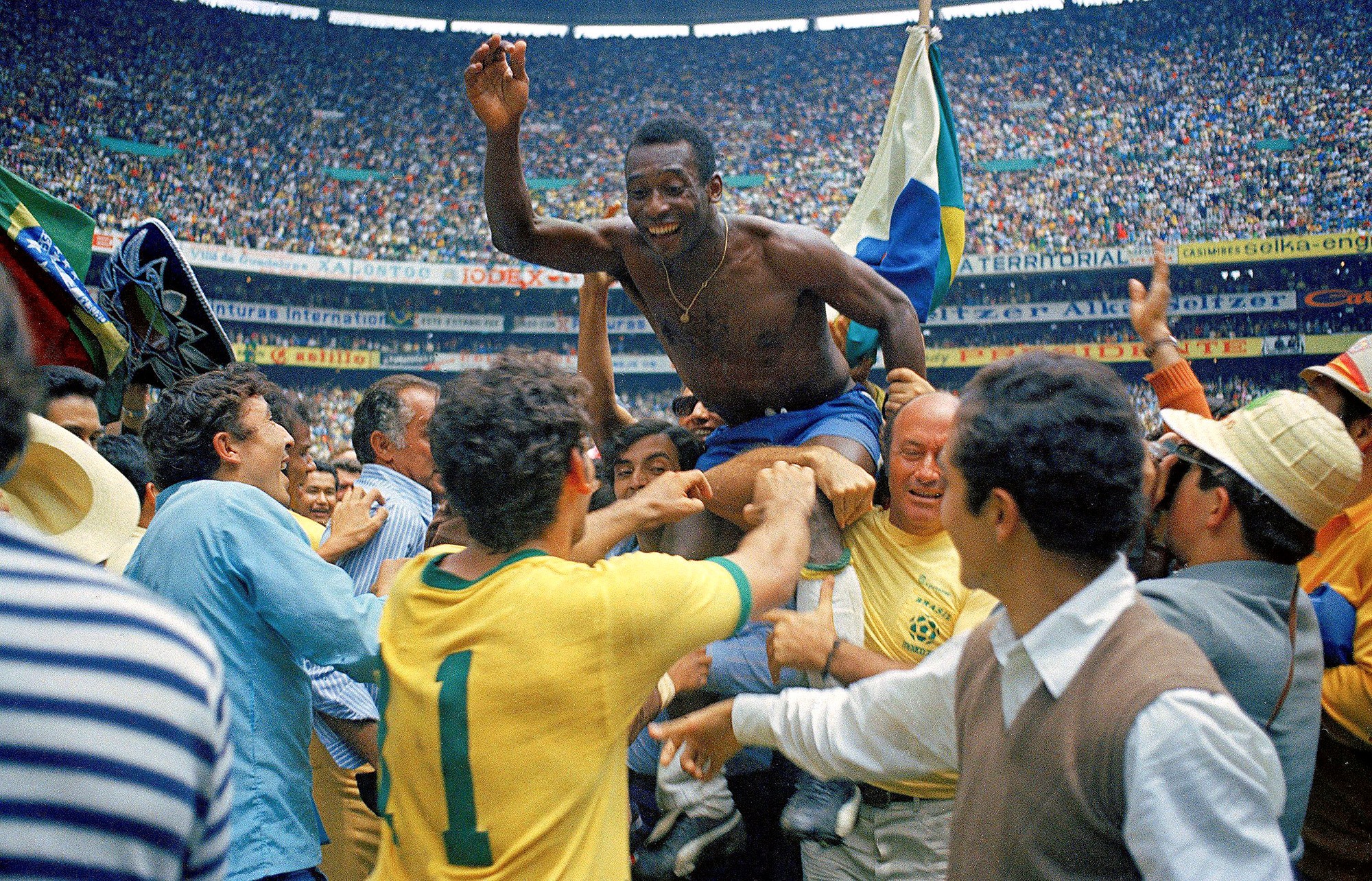
 Brazil’s Pele celebrates after winning the 1970 World Cup at the Azteca Stadium in Mexico City. (Photo: Alessandro Sabattini / Getty Images)
Stadiums are constructions of steel, glass, cement and dozens of other substances. They should not have life. They are inanimate objects, plonked on a piece of land to serve the purpose of temporarily housing thousands of people for an event.
But to me as a sportswriter, stadiums are so much more than that. They are not simply structures – they represent joy and despair, hope and success, failure and ignominy.
They provide a backdrop to all of humanity’s best and worst traits and give life to talent. In a sporting context, stadiums are the literal gatekeepers to collective and individual memories, for those who play in them and those who sit in the stands.
Every sports stadium has stories to tell – from superb feats of athletic brilliance and human failure, to the collective joy and sadness of the thousands in the bleachers.
Objectively of course, a stadium is just a structure. But subjectively, emotionally, they are not inanimate objects. They are living, breathing pages of history, constantly adding new chapters.
Ask any Springbok player from 2023 about the Stade de France in Saint-Denis, in Paris’ northern suburbs. The answer will be tinged with a smile and recollections of a place where they will always return with fond memories.
Ask the same question of a French, English or New Zealand player and you might have the opposite reaction. Yes, it’s a piece of turf, roughly 120m long and 70m wide, set inside a concrete bowl of tiers and seats. But it takes on life and meaning because of the athletes who have demonstrated their talents and exposed their fallibilities there, and fans who have cried tears of joy and sadness in response to those feats.
That emotion seeps into the steel and stone. Somehow humanity infiltrates the metal and masonry. Stadiums have institutional memory.
/file/attachments/orphans/MT1ACI2068542_692567.jpg "The 1970 Fifa World Cup final – Brazil at the Azteca Stadium, Mexico City. (Photo: Action Images / Sporting Pictures)")
Azteca
Few stadiums on earth have written more of those chapters than the Azteca. And tonight, a new one begins.
When it comes to the World Cup, no stadium has seen more than the Azteca in Mexico City’s southern suburbs, perched more than 2200m above sea level.
Opened in 1966, in time for the 1968 Olympic Games (although it wasn’t the main stadium of that Olympiad), the Azteca became synonymous with greatness during the 1970 World Cup in Mexico.
That tournament produced many wonderful games, which reached a crescendo in the semi-final and final at the Azteca.
To mark the semi-final, a commemorative plaque outside the Azteca still honours the 1970 clash between Italy and West Germany. Italy won 4-3 in a pulsating encounter, underlining its status as one of the most important matches ever played.
A few days later, in the World Cup final of 1970, Pelé’s Brazil including Jairzinho, Rivelino, Tostão and Carlos Alberto – played football so transcendent at the Azteca that Mexican fans stormed the field afterwards and stole the players’ clothes, leaving Pelé in nothing but his underpants, desperate to hold onto something from what they’d seen.
That dazzling Brazil team claimed their third world title, beating Italy 4-1 in the final.
Maradona’s magic
In 1986, the Azteca was the stage on which Diego Maradona weaved his blend of magic and mayhem into the fabric of the stadium and of World Cup folklore.
In the quarterfinal, the stocky Maradona netted the ball with his hand against England for the first goal of the match. The officials missed the handball, despite the remonstrations of England goalkeeper Peter Shilton.
/file/attachments/orphans/1064052402_609217.jpg "Diego Maradona of Argentina uses his hand to score his team’s first goal during a 1986 Fifa World Cup quarterfinal against England at the Azteca Stadium on 22 June 1986. Maradona later claimed that the goal was scored by ‘The Hand Of God’. (Photo: Archivo El Grafico / Getty Images)")
The goal stood. It was a wicked piece of blatant cheating by Maradona.
The great Argentinean later claimed it was the “hand of God” that scored it.
If that goal showed the worst side of Maradona (or the best, depending on your view), his second, four minutes later, demonstrated his genius.
Taking the ball inside his own half, he wriggled and accelerated past five England defenders, to score what is considered the best goal in World Cup history.
Maradona returned to the Azteca a few days later and scored both goals in a 2-0 semi-final win over Belgium, which included current Bafana coach Hugo Broos in the lineup.
In the final against West Germany, in front of 114,500 people at the Azteca, Maradona didn’t score in a 3-2 win. But it was his insouciant turn and defence-splitting 25-metre pass to Jorge Burruchaga to score the winner that is best remembered.
If Brazil’s 1970 vintage were considered the best team to grace the Azteca, Maradona was surely the best player to honour its turf.
/file/attachments/orphans/1449637413_987276.jpg "Diego Maradona celebrates at the Azteca.(Photo: Paul Bereswill / Getty Images)")
In 2002, Fifa invited supporters to vote for the greatest goal in World Cup history. Maradona’s second against England won by an overwhelming majority and was officially confirmed as the “Goal of the Century”.
A statue of Maradona frozen in the moment of that run was later placed at the entrance to the Azteca. Bafana’s players will see it tonight.
These feats echo through time, and the Azteca is the permanent stage providing the backdrop in sepia-toned video. The World Cup continues, players retire and the sport moves on. But echoing through the structure, a little piece of the souls of those who have been there endures.
Tonight, for the first time in a World Cup, Bafana Bafana will grace the turf that once canonised Pelé and immortalised Maradona.
The Azteca is a structure, but it’s so much more and now it will forever hold a little piece of Mzansi. DM
Comments
Scroll down to load comments...