




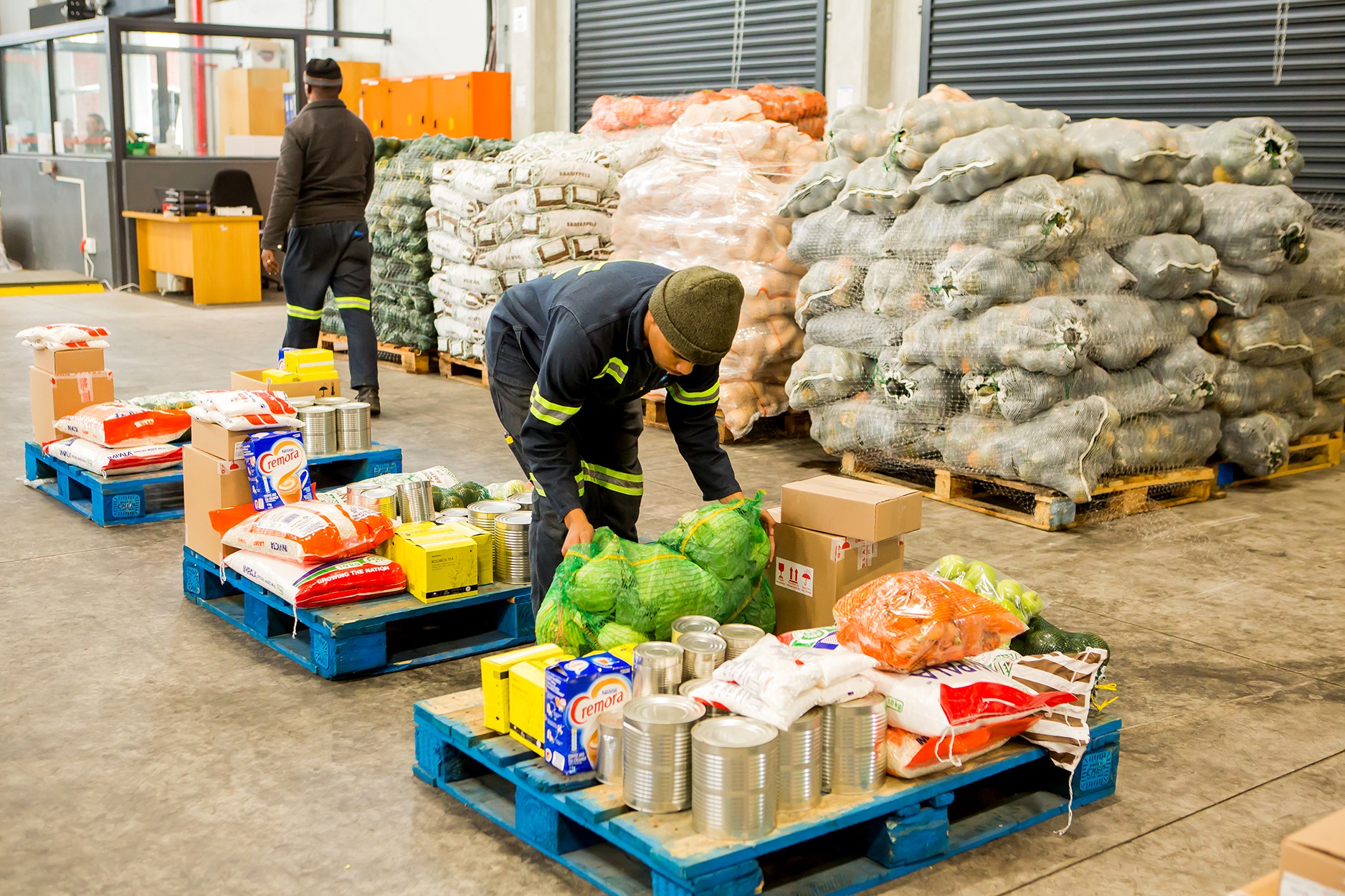
 A FoodForward SA worker sorts donated goods at the organisation’s warehouse. A new draft national standard establishes a comprehensive framework that defines the responsibilities of every actor in the food donation chain. (Photo: Supplied/FoodForward SA)
Somewhere in South Africa today, a food manufacturer will destroy produce that is safe to eat. The best-before date has passed, or the packaging is imperfect, or the stock is surplus. Donating it is theoretically possible, but without clear national guidance on what is safe to give away, who bears responsibility at each point in the chain, and what receiving organisations are required to do with it, the easier decision has always been disposal.
South Africa loses or wastes more than 10 million tonnes of largely edible food every year, while 63.5% of households are food-insecure, according to FoodForward SA. Nearly half of that waste occurs at the processing and manufacturing stage, where uncertainty about what can safely be donated and fear of legal liability if something goes wrong have long made destruction the easier commercial choice.
Sans 2088, South Africa’s first national standard for food donation and redistribution, is the first serious attempt to change that. Published by the South African Bureau of Standards (Sabs) on 17 April, the document is currently in draft form and open for public comment until 16 June, after which it will be finalised and made available to relevant industries and sectors.
Before the standard, different donors applied different requirements, resulting in inconsistent processes across the sector, said Trishay Naidoo of the South Africa Community Food Bank, a community-based NPO that relies on food donations.
The standard is voluntary, compliance is not legally required, and there are currently no formal discussions about making it compulsory, according to Dr Sadhvir Bissoon, divisional head of standards at Sabs.
“The standard seeks to support a more structured, consistent and effective approach to food donation and redistribution across South Africa,” said Bissoon.
What the dates on your packaging actually mean
One of the most consequential clarifications in Sans 2088 concerns something most people encounter daily: the dates printed on food packaging.
“Best before” relates to quality; after that date, food may taste or look slightly different, but it is not necessarily unsafe. “Use by” relates to safety; food cannot be donated, sold or consumed after this date unless it was frozen before it passed. And “sell by” is a stock management tool for retailers; food past its sell-by date can be donated as long as the use-by date has not passed.
/file/attachments/orphans/2_167478.jpeg "Donated surplus produce awaiting redistribution at a FoodForward SA facility. (Photo: Supplied/FoodForward SA)")
“Industry partners were not clear on what can be donated or how to navigate date labelling issues,” said Andy du Plessis, the managing director of FoodForward SA, an organisation that spent three years advocating for the standard.
Ozzy Nel, the CEO of SA Harvest, said the confusion has had direct consequences. “If donors are uncertain, the safest commercial decision is often to discard rather than donate,” he said. “That is exactly the kind of barrier a standard like Sans 2088 can help address.”
The standard goes further than date labels. It provides specific guidance on how long different food categories — ambient, bakery, fresh produce, frozen — can be used beyond their best-before dates, and under what storage conditions. It also permits certain frozen foods to be refrozen after thawing under very specific, controlled conditions.
A rulebook for the entire donation chain
Sans 2088 establishes a comprehensive framework that defines the responsibilities of every actor in the donation chain — donors, redistribution organisations, food banks and charities — and requires all parties to comply with existing national legislation, including Regulation R638 on food hygiene and the Foodstuffs, Cosmetics and Disinfectants Act.
Practically, this means organisations must hold certificates of acceptability as required by law, ensure staff and volunteers are trained in food hygiene, and conduct visual checks for mould, spoilage, pest damage and packaging integrity before distribution.
Full traceability records, including supplier and receiver details, batch numbers, quantities, transaction dates and temperature recordings, must be maintained throughout. Vehicles carrying donated food must be clean and may not carry food alongside waste, poisons or live animals.
/file/attachments/orphans/29_398865.jpg "An SA Harvest food rescue logistics truck with donated produce. (Photo: Mpumelelo Mcau)")
For businesses donating food, the standard recommends appointing a dedicated donation manager and assessing redistribution partners on their registration status, operational scale and cold-chain capacity.
According to Nel, the donor-partner selection guidance addresses a real gap: donors need confidence that the organisations they work with have the operational capacity and compliance systems to handle food safely.
“The standard provides a framework that gives clear guidance on the roles and responsibilities of all stakeholders involved in the donation, recovery and redistribution of surplus food, which was lacking,” said Du Plessis.
The standard also establishes a hierarchy: preventing food waste at source comes first. Where waste is unavoidable, redistribution for human consumption is the highest-value use of surplus food, ranked above animal feed, composting or landfill.
From proposal to draft
The standard originated not from a government initiative but from a proposal by FoodForward SA. Du Plessis approached Sabs in June 2023 with research on food loss, waste, and insecurity to make the case for a dedicated national standard.
“Neither government nor industry had this standard on their list of priorities at the time,” he said. “They paid attention because of concerted pressure and advocacy over many years.”
A ballot of industry stakeholders in October 2023 returned a unanimous vote in favour. The technical committee that developed it over the following months comprised 14 participating members, including FoodForward SA, the Harvard Law School Food Law and Policy Clinic, the Consumer Goods Council of South Africa, Woolworths, Famous Brands and the National Consumer Commission.
FoodForward SA said it was already seeing a 17% year-on-year increase in food donations, as supply chain partners consulted during development began increasing short-dated donations ahead of publication. Du Plessis estimates that up to one million tonnes of surplus food could eventually be unlocked through the standard.
Success, du Plessis said, would look like a 40% to 50% increase in donations for redistribution organisations within a year, and a shift in behaviour upstream, with food donation integrated into supply chain processes as routine practice rather than an exceptional act.
Not everyone is convinced the standard will translate into change at the community level. “I remain unconvinced that the introduction of these standards will translate into meaningful improvements for people experiencing food insecurity and hunger,” said Sandra van Oostenbrugge, executive director of The People’s Pantry in Johannesburg’s Makers Valley.
A national standard has the potential to improve confidence within the food donation ecosystem, said Naidoo. Many businesses remain hesitant because they are uncertain about legal responsibilities, food safety requirements and liability concerns, and a clear national framework could provide reassurance to both donors and recipients, she said.
Obstacles
But standards alone will not solve all challenges. “Many obstacles are practical rather than regulatory — transportation costs, storage capacity, infrastructure limitations, and limited awareness of food donation opportunities remain significant barriers. For meaningful impact, the standard should be accompanied by education, capacity-building initiatives and support mechanisms for community organisations,” said Naidoo.
/file/attachments/orphans/19_358349.jpg "An SA Harvest food rescue bakkie with donated naartjies. (Photo: Mpumelelo Mcau)")
Nel raised a parallel concern: compliance requirements around documentation, temperature control and traceability could inadvertently exclude smaller community organisations. “Requirements must be food-safe, but also implementable in real South African conditions,” he said.
Naidoo backed this up from the receiving end, warning that unless these grassroots organisations receive a boost in operational capacity, they won’t have the infrastructure to handle bigger influxes of food donations.
The challenge is most acute outside major metropolitan areas, said Nel, where fresh, chilled and frozen products, which require more technical handling and more expensive infrastructure than ambient goods, are hardest to move.
“It will take 12 to 18 months for the standard to penetrate the various sectors,” said Du Plessis.
Van Oostenbrugge’s critique of the standard reminds us that formal standards do not solve poverty, power cuts or corporate monopolies. For the vulnerable communities at the end of the donation chain, a vast gap still separates a published policy from an actual meal on the table.
The standard’s most significant limitation is legal. Under Section 61 of the Consumer Protection Act, strict liability applies across the entire supply chain regardless of negligence. Sans 2088 does not change that.
“Legislative reform is needed,” said Du Plessis, “but sadly, there does not seem to be the political will or institutional capacity to bring this about.”
The standard is open for public comment until 16 June. The draft standard can be accessed here. Comments should be directed to the Sabs Standards Division by sending an email to dsscomments@sabs.co.za before or on 16 June. DM
Comments
Scroll down to load comments...