





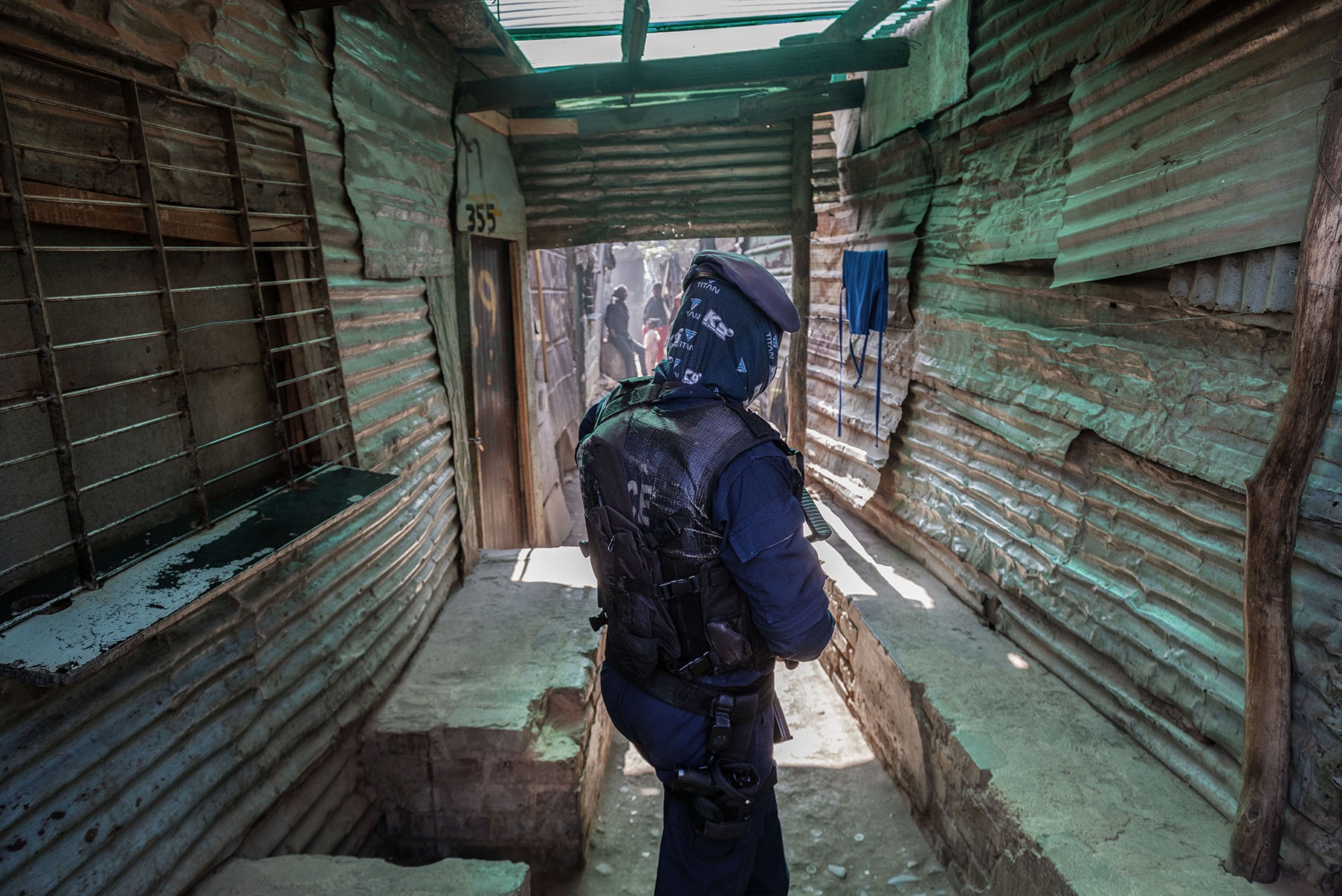
 An armed police officer stands guard as Mlungisi Mabaso, the City of Johannesburg’s Human Settlements MMC, visits the site of a mass shooting at Jumpers informal settlement in Cleveland, where 12 people were killed on Tuesday, 9 June. (Photo: Leon Sadiki)
“Cleveland is hell on earth. Our children do not know peace,” Dorah Molefi (46) told Daily Maverick on Thursday, 11 June.
“There is no fear of the police, making this area feel isolated.”
Residents of the Jumpers informal settlement and business owners in the surrounding Cleveland, Johannesburg, area say they have lived with violence and intimidation for years before the mass shooting in which 12 people died and 15 were injured, on Tuesday night, 9 June 2026.
While police are still investigating the attack, some in the community suspect it may be linked to illegal mining in the area. Molefi, who has lived in Jumpers for almost two years, said she knew some of the victims.
“Some of those I knew were ordinary members of the community, and whether they were involved in illegal mining or not, I cannot say.”
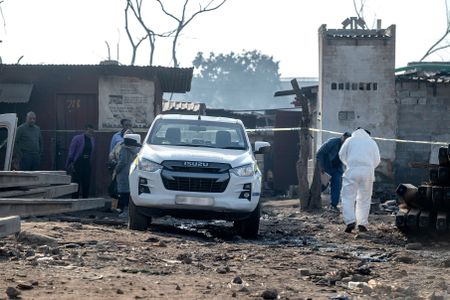
At approximately 11.10pm on Tuesday night, police responded to reports of a mass shooting. Ten heavily armed men had reportedly arrived at the settlement in a white Toyota Quantum minibus before allegedly indiscriminately opening fire on Jumpers residents.
Describing what she heard during the attack, Molefi said the night air was disrupted by relentless bursts of gunfire, with each volley echoing through the informal settlement’s narrow alleys.
She said it was “immensely terrifying to the adults and the children within the community.
“Here, we sleep with one eye open like birds.”
Another resident, Lieketseng Rakhatla (48), told Daily Maverick on Thursday afternoon: “What makes this particularly unsettling is that children, regardless of background, are the ones caught in the middle. They inherit not only their parents’ choices, but also the unresolved debates of entire communities.
“It’s a reminder that while we may differ in how we raise them, the stakes are shared and the government must regain control.”
/file/attachments/orphans/GUNFIRE3_976399.jpg "Forensic investigators remove the bodies of victims following the mass shooting at Jumpers informal settlement in Cleveland, Johannesburg, on Tuesday night. (Photo: Leon Sadiki)")
/file/attachments/orphans/VISIT7_766630.jpg "An armed police officer stands guard in the Jumpers settlement in Cleveland, as Johannesburg’s MMC for Human Settlements, Mlungisi Mabaso, visits the site of the mass shooting. (Photo: Leon Sadiki)")
Dennis Releni (28) said: “We have a huge lawlessness problem in our area with guns blazing almost on a daily basis.”
Nombula Nogumbe (58) said Jumpers residents have little faith in the police, who are seen as complicit in criminality.
“How about sorting out the police first so that communities can regain the confidence in the policing system and be empowered to report criminals as per the SAPS request?”
Velile Khoza (53) pointed the finger directly at zama zamas. “The lawlessness in this area is as mainly as a result of illegal mining.”
“We don’t know peace, we are at the mercy of these law-breakers and the police and the government do not want to do anything about it… We are cultivating rebels, a generation forged in appalling conditions.”
What happens when SAPS leave?
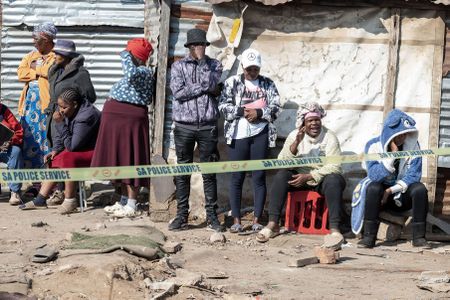
Senior police officers and City of Johannesburg officials toured Jumpers on Thursday, but residents said the real question was what would happen once the officials, police reinforcements and media crews left.
Police announced the seizure of equipment linked to illegal mining operations, the closure of 10 liquor outlets and arrests for illegal firearms and drug-related offences. But community members said gunfire, illegal mining and fear were part of daily life and would continue as soon as the hype over the killings passed.
Gauteng police commissioner Lieutenant-General Tommy Mthombeni said police operations targeting illegal mining and related criminal activity had already resulted in the seizure of 22 pandukas – which are used to crush gold ore– along with other equipment believed to be linked to illegal mining operations.
Police had also arrested one person for possession of an illegal firearm and made five drug-related arrests, he added.
/file/attachments/orphans/VISIT12_364923.jpg "A police officer looks on as City officials toured the Jumpers informal settlement in Cleveland, Johannesburg. (Photo: Leon Sadiki)")
/file/attachments/orphans/VISIT2_397544.jpg "Residents go about their daily activities as City officials visit the site of the mass shooting the Jumpers informal settlement in Cleveland, east of Johannesburg. (Photo: Leon Sadiki)")
Mlungisi Mabaso, the City’s MMC for Human Settlements, said Johannesburg had already begun intervening in the settlement before the latest killings through its electrification programme and efforts to formalise the area.
Audits had been conducted identifying local residents for housing, illegal electricity connections removed, non-residential structures demolished and households decanted as part of attempts to decongest the settlement.
“The best way to avoid crime is to formalise,” Mabaso said.
/file/attachments/orphans/VISIT3_861362.jpg "Councillor Mlungisi Mabaso, the MMC for Human Settlements in the City of Johannesburg. (Photo: Leon Sadiki)")
The City would install solar-powered street lights and surveillance infrastructure to improve safety and monitor activity in the area, he said.
He alleged that some shack owners were renting structures to illegal miners and protecting them from authorities, while City officials working in the settlement frequently faced threats and intimidation.
Illegal mining was not unique to Jumpers, he added, pointing to other affected areas, including nearby Denver, Crown Mines and George Goch.
Under-resourced police station
Ward 118 councillor Neuren Petersen questioned whether the latest interventions would bring lasting change.
Petersen said police had indicated they would maintain an increased presence in the area for about 14 days following the killings, but warned that short-term operations would not address deeper problems.
“The police say they will monitor the area for 14 days, but what happens after that?” he asked.
He also expressed concern about the capacity of the nearby Cleveland Police Station.
“It is a fairly new police station and should be well resourced, but residents told us that during the shooting, only one police vehicle initially responded and withdrew because of the intensity of the gunfire before returning later with reinforcements,” Petersen said.
He was equally sceptical about plans to install solar-powered surveillance infrastructure.
“They will not last longer than a few days. We have seen this happen elsewhere in the city, including End Street,” he said.
Petersen said he had not witnessed major demolition of shacks in the settlement despite the City’s claims.
Businesses in fear
For nearby businesses, the problem is not a lack of official promises but the daily reality of living alongside heavily armed criminal networks.
Several factory owners and business operators near the settlement declined to speak on record, saying they feared retaliation against themselves and their employees, some of whom live in Jumpers.
/file/attachments/orphans/VISIT14_179048.jpg "Businesses in the area are reportedly considering relocating because of ongoing violence and security concerns following the mass shooting in Cleveland, Johannesburg. (Photo: Leon Sadiki)")
“We often get gunshots through the solar panels on our roofs. We do fear for our safety here,” said one business owner.
A resident who asked not to be named for fear of reprisals said the community was exhausted by the violence.
“We want to live peacefully here but the zamas make problems. We hear gunshots every night and we don’t know if they are coming to us,” he said.
He also claimed the police arrived in a single vehicle and were forced to withdraw.
“These people come here today with the cameras and speak promises, then they go away and leave us with the problems tonight.” DM
Comments
Scroll down to load comments...