




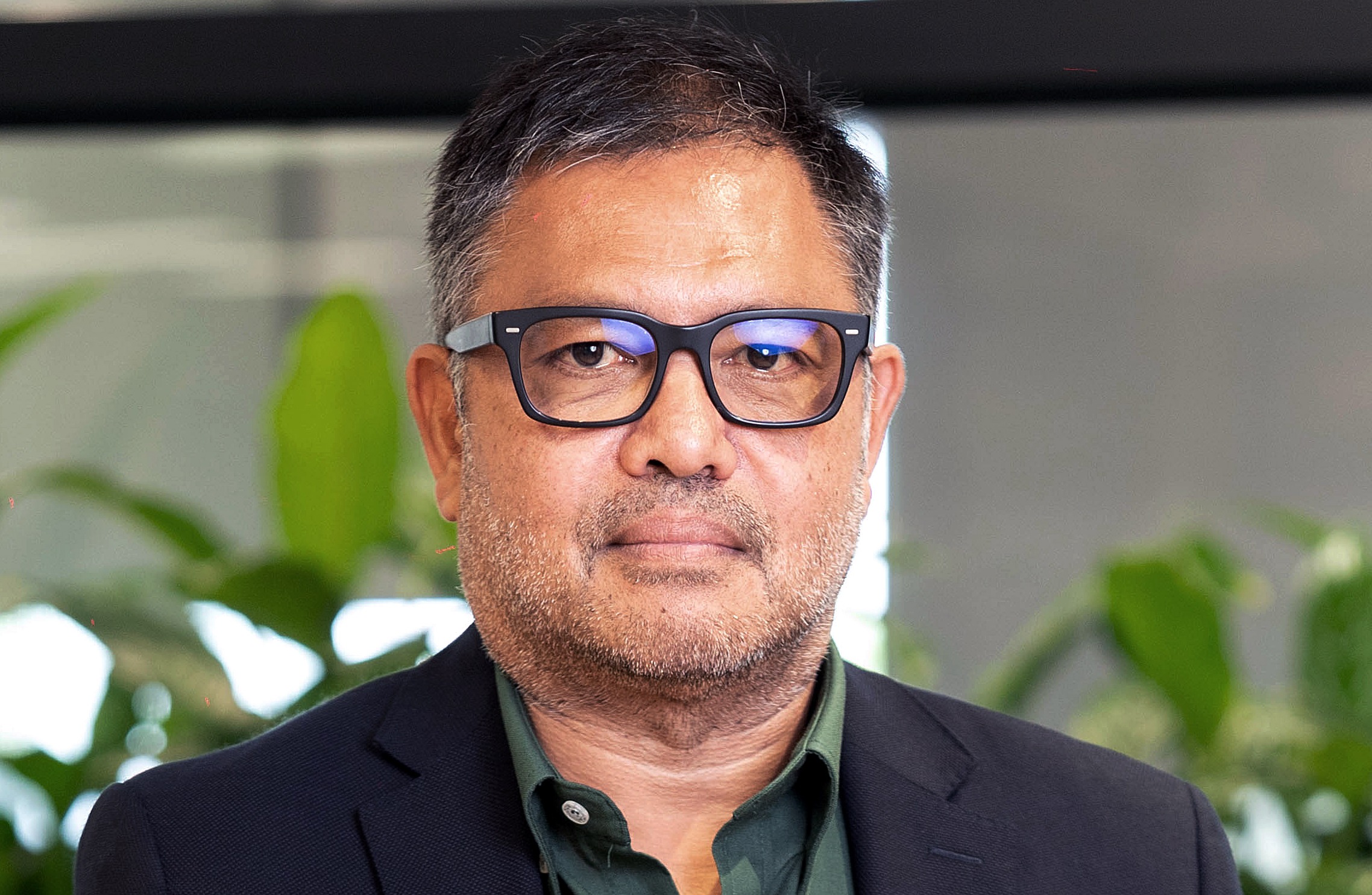
 Reeza Isaacs, CEO of the Spar Group. (Photo: Supplied / Spar)
For a man who only stepped into the hot seat on 1 March, Spar’s new CEO, Reeza Isaacs, has had little time for a gentle landing.
The group’s interim results for the 26 weeks that ended on 27 March 2026 show just how much work lies ahead. Group revenue from continuing operations increased by 3.6% to R67.5-billion, but headline earnings per share fell by 53.9% to 199.9 cents.
Operating profit dropped by 45.3% to R740.5-million, while operating profit before extraordinary items came in at R882-million, down almost 40%.
Shareholder dividends remain missing in action.
In southern Africa, where the pain is concentrated, revenue increased by just 1.7% to R50.8-billion. Grocery and liquor wholesale revenue grew by 1.1%, while retail sales were also up 1.1% against internal selling price inflation of 2.6%. In plain language, volumes are under pressure.
/file/dailymaverick/wp-content/uploads/2022/11/GettyImages-1241914958.jpg "Spar's retail sales were up 1.1% against internal selling price inflation of 2.6%. (Photo: Waldo Swiegers / Bloomberg via Getty Images)")
The southern Africa division’s operating profit before extraordinary items fell to R396-million from R989-million in the prior period. After extraordinary items, the operating margin was just 0.5%.
Isaacs is not blaming the consumer, interest rates or the weather.
“These are not market problems; they are execution problems, and they are fixable,” he said in the results announcement.
In an interview with Daily Maverick, he drilled this down to three main issues: the company’s KwaZulu-Natal distribution centre, Black Friday promotional overspend and debtor costs.
The company’s Irish business, BWG Foods, remains the smoother part of the Spar machine, delivering operating profit of R502.8-million, up 3.5%, with gross margin improving to 13.7%. “There’s no issue there,” Isaacs said. “It’s a great business.”
The problem, he openly acknowledged, was in South Africa, and specifically in the grocery and liquor business.
❌ The KwaZulu-Natal distribution centre contributed R123-million to the group’s operating profit decline.
❌ The company’s Black Friday campaign contributed R212-million to the decline after additional promotional investment failed to generate enough return.
❌ Debtor costs rose by R159-million, reflecting a more conservative approach, a methodology change and retailer distress in parts of the network.
Where did it all go wrong?
On the topic of KZN, Isaacs didn’t beat around the bush and was characteristically straightforward, saying there was a breakdown between marketing, merchandising and logistics.
Marketing and merchandising were trying to “go and get sales at all costs”, drive volumes and improve loyalty, while logistics was “effectively in repair and containment mode”.
“They didn’t talk to each other, and the whole system was just not geared for that level of activity and volumes,” he said.
The result was margin sacrifice, higher operating costs, additional warehouses, more external trucks and extra labour.
“It was a bit of a mess, to be honest,” said Isaacs.
Spar says a structured stabilisation programme is now in place in KZN.
Leadership has been changed below the managing director, including in merchandising, operations and finance. The company says out-of-stock rates have improved materially, and the region recorded three consecutive months of positive operating profit towards the end of the half, closing the period marginally above break-even.
Isaacs would not give the current out-of-stock rate but said that at its peak it was “probably three times as high as what it should have been”.
“It is closer to where it should be,” he said, adding that service levels were still not exactly where they needed to be. “I don’t want to declare victory and promise the world. We’ve done that many times before.”
The aim, he said, was to stabilise the operation and ensure sustainable changes in the distribution centre.
The expensive Black Friday lesson
Spar’s results show that the group over-invested in promotional subsidies without generating a commensurate return.
“Accountability in that area is fragmented and fractured, and it’s one of the things we need to get right,” he said.
A new chief marketing officer has been appointed. John Bradshaw has been in the role for three months, having moved over from Pepkor. Before that, he was at Pick n Pay for just over a dozen years. All marketing spend will now be subject to a return-on-investment framework. The Black Friday approach will also be repositioned for the next financial period.
The broader recovery plan rests on five pillars:
➡️ Stronger procurement and sharper pricing;
➡️ Better marketing ;
➡️ Repositioning SPAR2U;
➡️ Upgrading retail technology; and
➡️ Helping retailers improve profitability.
The retailer relationship is central to the reset. Spar’s model relies on independent retailers buying through its wholesale network. Retailer loyalty on a 12-month rolling basis was 78.5%, slightly below the group’s 80% target.
Spar says it now wants retailer profitability to become its primary operating metric. Planned support includes national benchmarking, staff scheduling tools, rental negotiation support and the establishment of a Guild Profitability Committee.
The financial pressure
The group’s balance sheet is also still showing signs of strain. Net debt increased to R7.3-billion from R5.4-billion at September 2025, mainly because of working capital movements, Swiss loan repayments and lower Ebitda. Southern Africa leverage is 3.29 times, still within the covenant of 3.5 times, while group leverage is 2.73 times.
The board says it wants to return to dividends, but only once headline earnings per share are on a sustained recovery path and leverage moves towards the medium-term target range of 1.5 to two times. There are no planned share buybacks and no planned equity raise.
The Bloed Street SuperSpar drama
The operational reset also comes against renewed governance scrutiny.
Last week, Spar issued a statement rejecting media reports linked to a BDO report commissioned by the businessman Amaan Sayed as part of his proposed R4-million acquisition of the Bloed Street SuperSpar and Tops store. Spar said the report was a limited single-store due diligence review, not an audit or forensic audit of the group, and rejected any suggestion that VAT fraud had been established.
Asked whether Spar would commission an independent external review, Isaacs said the group had asked its outsourced internal audit provider, EY, to review the BDO findings.
He said EY’s preliminary review suggested there may have been some incorrect account allocations and classification issues, but “from a zero-rated VAT perspective, there’s no issue”.
The external auditors had also looked at the matter and did not believe there was a reportable irregularity, he said.
The EY review will not be made public.
“This is something for the board and the audit committee to manage, and they are comfortable that we are managing it,” said Isaacs.
He described the matter as relating to one store and a R4-million sale.
“It’s really not newsworthy at all,” he said.
That may be Spar’s view, but the group’s recent history means governance questions are unlikely to disappear quickly.
Just a few years ago, in 2023, Spar was already dealing with boardroom upheaval after PwC notified the company of a reportable irregularity linked to loans arranged for retailers. Former chief executive Brett Botten retired, and Mike Bosman moved from incoming non-executive chairperson to executive chairperson as part of the crisis management response.
/file/dailymaverick/wp-content/uploads/2023/01/Mike-Bosman.jpg "Mike Bosman. (Photo: Supplied)")
Spar has since exited Poland, Switzerland, and, most recently, southern England, leaving the group focused mainly on southern Africa and Ireland.
Isaacs would not give a target for where the company’s southern Africa margins should be by year-end.
“I’m three months into the job,” he said. “I’m certainly not going to put margin targets out there just yet, or timelines. Give us some time to assess where we are.”
For now, the promise is not a dramatic turnaround, but a cleaner operating model and fewer self-inflicted wounds.
Isaacs says he is sleeping “pretty soundly”, despite what he describes as a very eventful first three months.
“There’s still lots ahead, but I’m confident that we’ve got the right team in place, the right level of accountability, and that we’ve got a plan,” he said. He acknowledged that he is not one to back away from a challenge.
“I think turnarounds are interesting, and taking something that’s not working well or broken and fixing it. I think it’s a privilege, and it’s enormously challenging, and that can bring enormous satisfaction.” DM
Comments
Scroll down to load comments...