




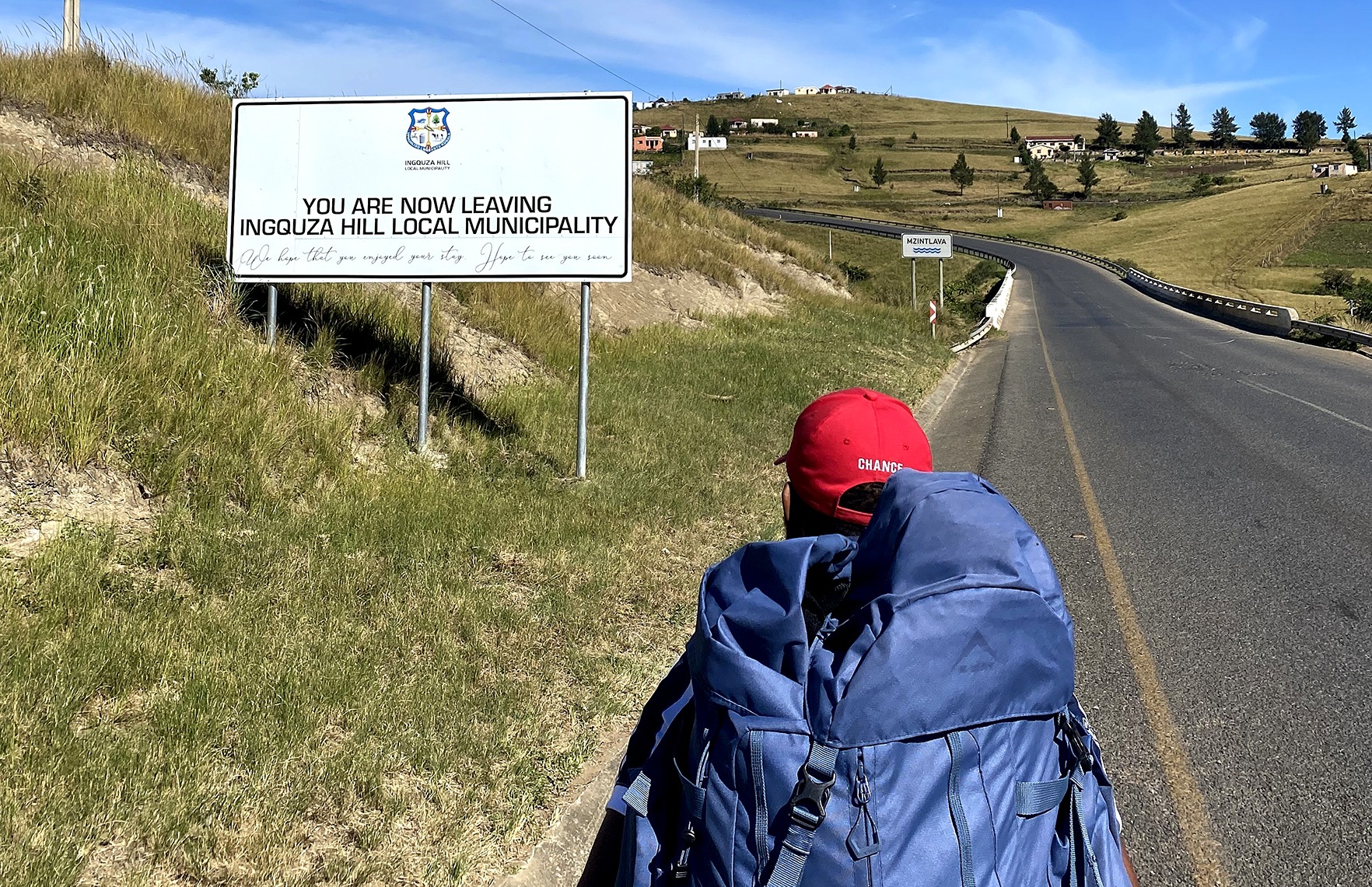
 Wandile Mthiyane is in the final leg of walking from Durban to Cape Town. (Photo: Walk for Home)
When I first set out on this 1,600km walk, I thought I knew exactly what I was doing. I was walking to raise awareness about South Africa’s ongoing housing crisis, raise funding for my upcoming Master’s studies at Harvard University, and document the mission of Ubuntu Home, an AI-driven platform I founded to help ordinary people navigate the overwhelming process of designing, financing and building a home.
Those goals remain deeply important. But somewhere along the road between KwaZulu-Natal, the Eastern Cape and the Western Cape, the journey transformed.
It became an education, and not the kind I expect to receive in an Ivy League classroom, but a raw unlearning of my own assumptions. It forced me to confront the enormous gap between the SA that dominates our headlines and the one that actually exists on the ground.
For 55 days, I have walked alone through townships, wealthy suburbs, farming communities, informal settlements and historic missions like Suurbraak.
I have shared meals with strangers, slept in backyard rooms, and sat with mayors, teachers, pensioners and unemployed youth.
What I discovered along the road didn’t match our national script of perpetual division. The SA on the ground is kinder, more resourceful and far more connected than the one designed to keep us outraged.
/file/attachments/orphans/RepresentativesfromtheMosselBayBusinessChamberandMosselBayTourismwhowelcomedandsupportedtheWalkforHomeasitpassedthroughtheregion_WalkforHome_307975.jpeg "Representatives from the Mossel Bay Business Chamber and Mossel Bay Tourism, who welcomed and supported the Walk for Home as it passed through the region. (Photo: Walk for Home)")
The infrastructure of kindness
As a Zulu boy who grew up in KwaMashu, I carried my own baggage into this journey. Apartheid was not simply a system of land dispossession; it was a psychological engineering project designed to control human relationships.
Laws like the Group Areas Act physically separated us into silos, ensuring entire generations grew up knowing nothing about one another except the fears and stereotypes they had been taught. This walk forced those inherited stories to collide with lived reality. One by one, they collapsed.
In the Eastern Cape, a gogo in Humansdorp woke up before sunrise to make sure I had my requested oatmeal, only to surprise me with a massive, secondary full English breakfast right after. Weeks later, in the Western Cape, an Afrikaans tannie in Mossel Bay asked me the exact same questions and prepared an almost identical breakfast. The same maternal care happened again in Wilderness with an English-speaking host.
The languages changed and the accents shifted, but the maternal instinct was identical.
Even our cultural misunderstandings became points of connection. In the black households I grew up in, soup is comfort food eaten strictly when you are sick. When my white hosts offered me soup at every turn, I initially wondered if I looked desperately ill. When I finally asked, we burst out laughing; it turns out soup is just the default white South African winter staple.
Beneath the surface, the underlying heart was matching.
Across every demographic, my hosts eventually shifted into that timeless auntie routine, creatively sliding in questions about whether I had a partner, followed by a relentless journalistic investigation into why a young man walking across the country hasn’t settled down to start a family yet.
/file/attachments/orphans/MrsKeyserofHeidelbergwhodonatedherComradesMarathonrunningshoesafterdaysofrainhadleftmyshoessoakedandunusableallowingthejourneytocontinue_WalkforHome_674642.jpeg "Mrs Keyser of Heidelberg, who donated her Comrades Marathon running shoes after days of rain had left Mthiyane’s shoes soaked and unusable, allowing the journey to continue. (Photo: Walk for Home)")
Shared fractures, shared foundations
Connection is quiet. It happens around dinner tables at 7pm and over morning prayers.
In a community called Redoubt in the Eastern Cape, I was integrated into a family structure where I bathed out of a hot bucket of water at 6am and talked late into the night about school homework. Weeks later, in the Elgin Valley, the luxury of indoor plumbing changed, but the family dynamic didn’t shift an inch.
Remarkably, in a country plagued by the trauma of gender-based violence, three of my hosts were single, divorced or widowed middle-aged men.
They stepped into tender parental roles, showing me a form of fatherly care I didn’t know I needed. I was young enough to be treated like their last-born son, and old enough to be trusted with the raw stories of their divorces.
When conversations turned to the state of the nation, I realised that wealthy or financially frustrated, black or white, we are increasingly united by institutional failure. We are just paying different prices for it.
Along the Garden Route, affluent homeowners complained bitterly about the exorbitant capital required to switch to solar power and rainwater harvesting tanks, likening the expense to taking out a second mortgage. They felt forced to build private infrastructure just to maintain continuity.
Meanwhile, in neighbouring townships, residents spoke of going weeks without water, explaining how a 2,500-litre JoJo tank is nowhere near enough when municipal taps dry up completely.
It broke my heart to see two sides of the same coin, divided by race and historical asset access, yet buckling under the exact same municipal collapse. The terrifying reality of modern SA is that every citizen is now being forced to become their own independent municipality.
/file/attachments/orphans/JamesDonaldHarvardalumnuswhoreachedoutafterreadingabouttheWalkforHomeandhostedmeinSwellendamJamesintroducedmetoSwellendamMayorFrancoisduRandt_Walk_976308.jpeg "James Donald, a Harvard alumnus who reached out after reading about the Walk for Home and hosted Mthiyane in Swellendam. Donald introduced him to Swellendam Mayor Francois du Rand and shared the town's history and community with him, helping deepen his understanding of the region and SA’s housing crisis. (Photo: Walk for Home)")
Bureaucracy vs the vulnerable
This observation brings me back to housing. Housing is rarely what people wake up thinking about; they think about feeding their families, paying school fees and finding work. Housing becomes the central, consuming crisis only when the foundation fails, when a flood hits, a fire spreads or a storm tears through a community.
I am increasingly convinced of a concept my friend Oliver Libby often speaks about: society must provide a strong base, but no ceiling.
Housing is not the ultimate dream; it is the physical platform that makes dreaming possible. When 100% of your daily human energy is spent on raw survival, you have 0% left for innovation or future planning. Our current state systems are failing to provide that base because our policies have become paralysed by red tape.
While walking through Seabrook, I met Mr Williams, a single pensioner living in an informal settlement. Weeks prior, a severe gale-force storm had completely flattened his home. Because he still has to work every day to eat, he had no time or resources to rebuild. For three weeks, this elderly man had been sleeping in a cramped, two-foot-high gap beneath collapsed plywood and twisted corrugated iron sheeting.
When he spoke to me, his voice was tight with pain. My host that evening, a Harvard alumnus named James Donald, went with me to the local mayor’s office to plead for him. The resolution we reached was telling: the City structure could not directly intervene to assist a single individual due to rigid provincial disaster relief protocols and anti-corruption regulations. Instead, we had to coordinate a grant through the local Rotary Foundation to get him immediate aid.
The mayor wasn’t heartless; he was trapped.
We have spent so much time over the past three decades writing convoluted policies designed to curb corruption that our administrative systems can no longer pivot to protect the most vulnerable. We have prioritised procedural compliance over human dignity.
/file/attachments/orphans/DrRobynneHansmannPrPlnplanneracademicandDurbanUniversityofTechnologylecturerwhohostedmeinCalitzdorpduringtheWalkforHomejourneyfromDurbantoCapeTown_WalkforHome_348069.jpeg "Dr Robynne Hansmann (Pr Pln), planner, academic, and Durban University of Technology lecturer, who hosted Mthiyane in Calitzdorp during the Walk for Home journey from Durban to Cape Town. (Photo: Walk for Home)")
/file/attachments/orphans/AthletesfromBayetheAcademycyclingalongsidemeastheyescortedtheWalkforHomeoutofMosselBaythroughKwaNonqabaTownshipdemonstratingthepowerofcommunitysupportandyouthleadership_WalkforHome_161179.jpeg "Athletes from Bayethe Academy cycle alongside Mthiyane as they escort the Walk for Home out of Mossel Bay through KwaNonqaba Township, demonstrating the power of community support and youth leadership. (Photo: Walk for Home)")
Turning hope into agency
If housing is a policy challenge, it is equally a trust challenge. Every South African I met had a horror story about a builder who took a massive deposit and vanished, or delivered structural defects that ruined a family’s life savings.
This isn’t just bad luck; it is a systemic failure. Our country’s systematic defunding and neglect of technical and vocational education (TVET) colleges has created a catastrophic shortage of certified artisans while wiping out industry accountability.
Today, anyone with a hammer can claim to be a contractor.
This is precisely why we designed Ubuntu Home’s peer-to-peer model. Trust cannot rely on luck. We need transparent digital platforms where ordinary citizens can verify a builder’s ratings, see photos of past work, and track development material transparently. Information creates agency, and agency breaks the back of dependency.
The policy that still excites me most is the Enhanced People’s Housing Process (EPHP), because it recognises that South Africans are not passive recipients of development. When you give our people serviced land, structural support and transparent access to knowledge, they don’t wait for the state. They build extraordinary things.
/file/attachments/orphans/StaffmembersofOldJailCoffeeHouseinRiversdaletogetherwithaphotographerfromHessequaTourismwhohelpeddocumentandsharethestoryoftheWalkforHomewiththelocalcommunity_WalkforHome_638149.jpeg "Staff members of Old Jail Coffee House in Riversdale together with a photographer from Hessequa Tourism, who helped document and share the story of the Walk for Home with the local community. (Photo: Walk for Home)")
The real infrastructure
We often look at grassroots initiatives as mere charity, but on this walk, I saw them for what they truly are: the real, functioning infrastructure of our country.
In Bisho, I crossed paths with a group of young people from Port Elizabeth who had organised themselves into a volunteer choir.
They travelled out of their own pockets to a local church to run a drug awareness programme for neighbourhood youth. Their answer to me was simple: “Prevention is better than cure. No one is coming to save us.”
In Mossel Bay, I spent time with the “Surfer Kids” programme, which takes children out of the townships, teaches them to navigate the ocean, and employs them at a local surf shop. Crucially, they are paid in Bitcoin to teach the next generation digital financial literacy and long-term asset planning.
Nearby, the Bayethe Multisport Academy is placing township boys into triathlons, a sport historically inaccessible to black working-class children, using athletic discipline to help them graduate and become lawyers and accountants.
This is the true meaning of ubuntu. It isn’t a soft, poetic philosophy to be quoted in speeches. It is a hard, relational infrastructure.
Throughout this journey, I have been documenting the raw highs and lows of the open road on social media, and the digital community quickly became physical reality. The journey moved forward because one follower would see a post and call a friend in the next town, who would prompt a local newspaper story, leading to a conversation with a community leader, a mayor or an organisation doing extraordinary work.
The idea of this walk never changed over the last 55 days, but the public response did. Nobody cared when it was just an abstract idea. People rallied only when I put my body on the line. The moment I accepted the physical discomfort, the blisters, the freezing mornings and the sheer vulnerability of walking this country alone, SA showed up for me.
/file/attachments/orphans/WandileandayoungsupporterwavetheSouthAfricanflaginGeorgeduringtheMountainUltra-TrailMUTwhilecelebratingtheracewinner_WalkforHome1_575642.jpeg "Mthiyane and a young supporter wave the South African flag in George during the Mountain Ultra-Trail (MUT) while celebrating the race winner. Moments like these reminded him that the Walk for Home was not just about housing, but about the people and communities that made South Africa feel like home. (Photo: Walk for Home)")
The journey ahead
As Steve Biko famously wrote, one of the greatest gifts Africa will give to the world is a human face. After 1,600km, I have seen that face. It is lined with worry, it is tired of waiting, but it is bursting with generosity, resilience and an unshakeable desire to connect across the barriers meant to keep us apart.
As Nelson Mandela reminded us, love comes more naturally to the human heart than its opposite. Our past legacy is real, and it is hurting all of us. When millions are locked out of the economy and trapped in survival mode, the entire nation loses its collective genius. But our agency is equally real. The same soil that engineered apartheid gave birth to the very concept of ubuntu.
Five days from now, my feet will step into Cape Town, and this physical walk will end. Even if I don’t meet my financial targets for Harvard, my life has been permanently altered. This road didn’t just introduce me to my fellow countrymen; it showed me the true soul of our nation.
As I look toward the work ahead at Harvard, and the scaling of Ubuntu Home, I know the real journey is only beginning.
We don’t need to wait for a political saviour or a structural miracle. We are the ones we have been waiting for. If we can begin to see our neighbours not through the lens of institutionalised fear, but through the infrastructure of ubuntu, there is absolutely nothing this country cannot become. DM
You can read the daily logs and view the documentation of Mthiyane’s journey on Instagram and TikTok at @wandileubuntu.
Comments
Scroll down to load comments...