




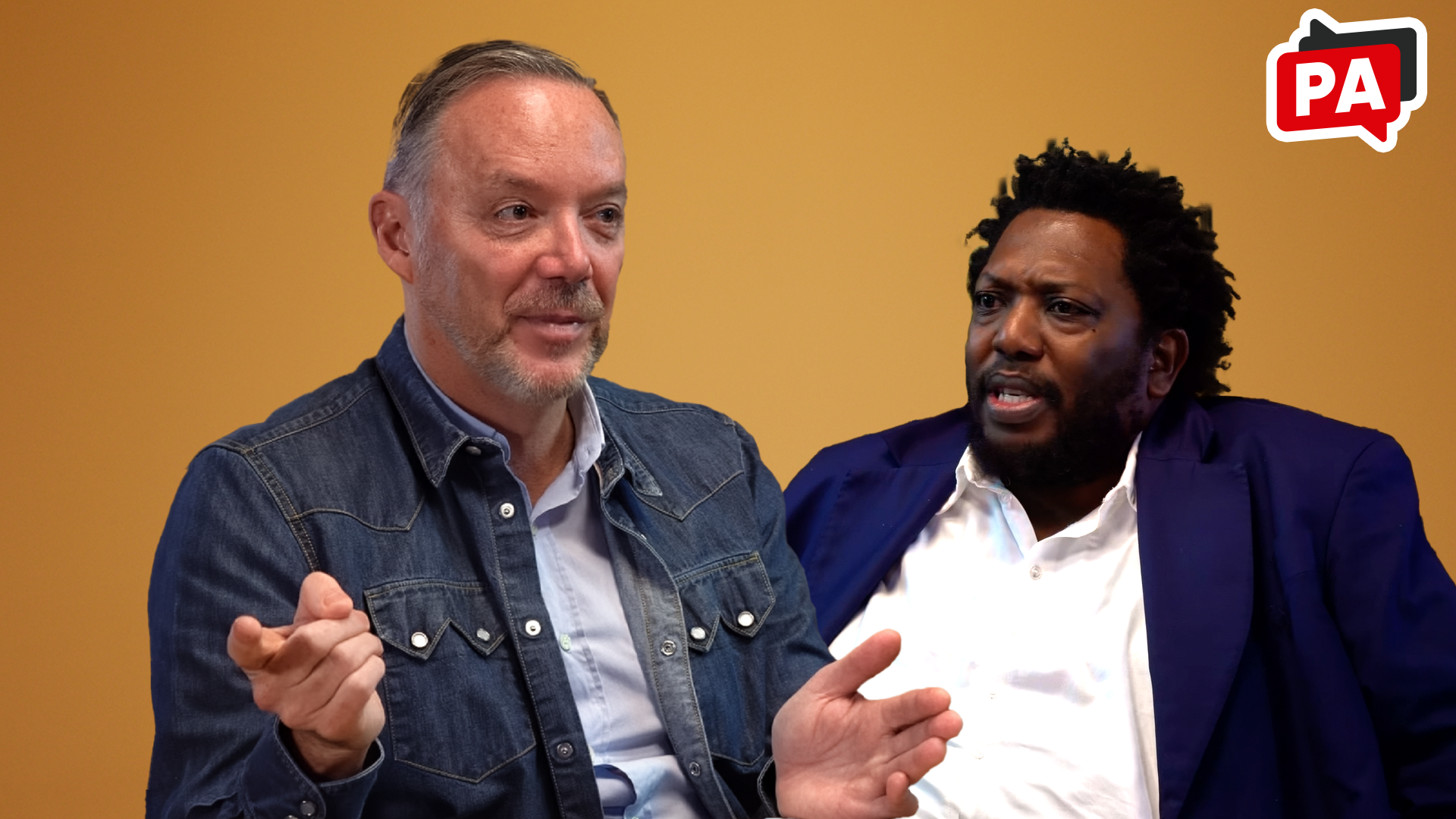
 Brett Herron and KG Mokgadi. (Illustration: Politically Aweh)
In the latest episode of Politically Aweh, host KG Mokgadi sits down with former City of Cape Town Mayoral Committee member and current GOOD Party Secretary-General Brett Herron for a conversation that goes far beyond party politics.
As a former DA insider, Herron wasn’t watching from the sidelines. He was in the room where decisions were made, policies were crafted and political battles were fought. Now, he’s speaking openly about what he saw.
The conversation tackles some of the most contested issues in Cape Town politics today, from affordable housing and donor influence to crime, urban planning and growing inequality.
Herron argues that while Cape Town may excel at administration, audits and financial management, those successes mean little if the outcomes for ordinary residents remain unchanged. He points to the city’s housing crisis, where approximately 440,000 people are on the housing demand database while only 2,480 housing units are expected to be built this year.
Questioning why major housing promises have failed to materialise, Herron says: “The land has been released, but nothing’s been built. And there is a pipeline of social housing projects that are waiting for funding, and there’s no funding for them.”
He argues that political ideology, not a lack of land, is standing in the way of meaningful housing reform.
“Helen Zille told me when I was working on affordable housing projects in this area where we are now in Woodstock, Salt River. She told me no, using well-located land is over-subsidising the poor.”
The discussion also examines the controversial N2 wall project, which Herron believes reflects a deeper failure to address the root causes of crime and poverty.
The ‘hell run’
“If they genuinely believe it’s about crime, then you need to solve the conditions in which people live.” He adds: “The solution to the hell run, as it’s called, the N2, is not to build a wall.”
Perhaps most controversially, Herron speaks openly about the role of political donors.
“I learned in the Democratic Alliance how much say they have. And it’s dangerous.”
Reflecting on his time in the DA, he recounts a meeting about affordable housing proposals, adding: “The funders questioned me about this land that I wanted to make available for affordable housing in Woodstock and Salt River.” His conclusion is blunt, “That’s where funding influences policy.”
Herron also weighs in on Zille’s criticism of Johannesburg and her own record in government.
“She’s pointing out all these faults in Johannesburg. And I’m saying, but you were mayor in Cape Town for three years. And then you were premier of the Western Cape for 10 years.
“If she really cared about those conditions, she had 13 years to fix them and nothing has changed.”
Growing voter frustration
For Herron, growing voter frustration stems from a simple reality that for the vast majority of South Africans, not much has changed since 1994. He argues that the government has failed to live up to the promises contained in the Constitution.
“Chapter Two of the Constitution, which is our Bill of Rights, is a manifesto. It says people should not go hungry, but people are starving. I mean, over 50% of the Western Cape population is food insecure. Now, must we drag the government to court to force them to introduce a feeding scheme?”
Throughout the conversation, Herron makes the case that South Africa’s crisis is not a lack of resources or policy frameworks, but a failure of political choices and leadership.
Despite his criticism, Herron insists his focus is not on party political point-scoring.
“It’s not about hating on the DA, but I’m trying to make life better for people who live here.”
Whether viewers agree with his conclusions or not, the episode offers a rare insider account from someone who spent years at the centre of Cape Town’s political machinery before becoming one of its most vocal critics. DM
For more from Politically Aweh, subscribe on YouTube, visit our website or follow us on Instagram, Facebook, TikTok or X.
Comments
Scroll down to load comments...