




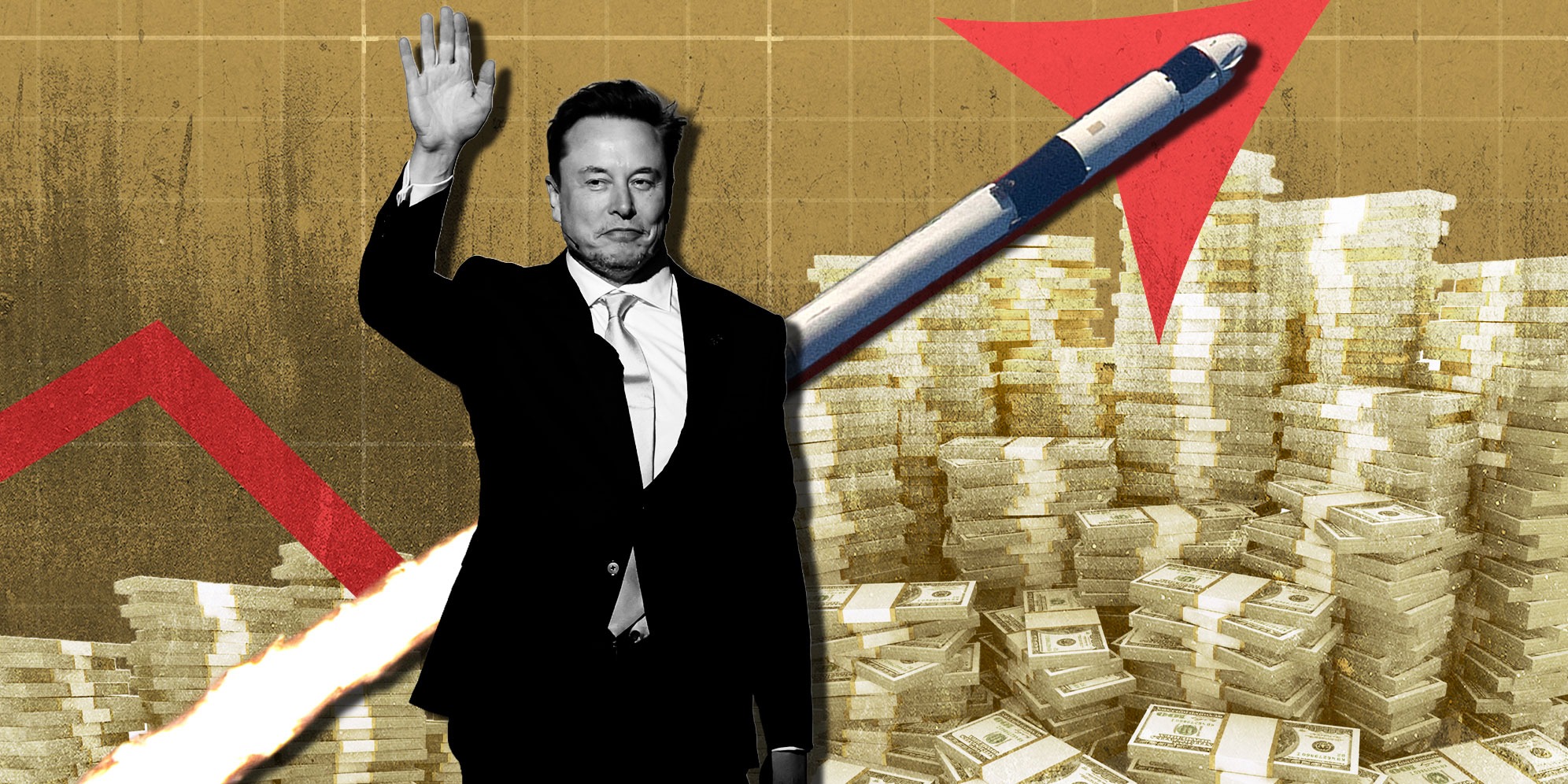
 Illustrative Image: Elon Musk. (Photo: Ali Haider / EPA) | A SpaceX rocket. (Photo: Cristobal Herrera-Ulashkevich / EPA | Money stacks. (Image: iStock) | (By Daniella Lee Ming Yesca)
 More than a century ago, in 1916, John Rockefeller became the world’s first billionaire as he rode a wave of gushing profits from his Standard Oil company.
The global economy in the 20th century was defined in large part by the hydrocarbons that have sparked the climate crisis, and Rockefeller’s ascent into the exalted wealth category measured in 10 digits was emblematic of this trajectory.
On Friday, 12 June, a new and astonishing threshold on the wealth front looks set to be shattered. On that day, the eccentric and controversial South African-born entrepreneur Elon Musk will probably become the world’s first trillionaire when the initial public offering (IPO) of his company SpaceX blasts off into a 21st-century market defined by the tech and AI booms.
/file/attachments/orphans/JohnWinkoppUnitedStatesShortlistOpenCompetitionMotionSonyWorldPhotographyAwards2026_787320.jpg "A SpaceX Falcon9 rocket blasts across the sun, and appears distorted due to sound waves interacting with the light. The rocket in the image is carrying satellites to study solar wind. (Photo: John Winkopp, United States, Shortlist, Open Competition, Motion, Sony World Photography Awards 2026)")
That means his wealth will be measured in 13 digits, a level that surpasses the gross domestic product (GDP) of all but about 20 countries in the world. Musk, at least on paper, will be worth more than double South Africa’s GDP, and his wealth will be more than 50 times larger than Malawi’s — a scale far beyond the wildest dreams of billionaire avarice in the 20th century.
SpaceX is seeking a staggering $1.77-trillion valuation, which would make it one of the 10 largest companies in the world.
At first glance, this appears preposterous — the company generated revenue in the first quarter of this year of only $4.3-billion. But valuations are based on projected earnings, and SpaceX claims that its will soar to the stars and it wants to take investors into orbit with it.
“For the entirety of its existence, human civilization has lived on a single celestial body: Earth. The current paradigm, in which human civilization is confined to one planet, exposes humanity to existential threats that are unpredictable and uncontrollable on a planetary scale,” reads the company’s filing with the US Securities and Exchange Commission (SEC).
This is not your run-of-the-mill SEC filing and prospectus ahead of an IPO.
“By moving beyond the only home we have ever known, we ensure species-level redundancy and that the light of consciousness will not be tied to a single planet subject to the inevitable hazards of a harsh and vast universe. We do not want humans to have the same fate as dinosaurs,” it says.
Space: the final frontier
Sparing humanity from the fate of the dinosaurs is a noble goal and in line with Musk’s typically grandiose visions. But the bait for investors is not averting our species’ extinction. It is AI — Musk wants to build data centres in space to tap solar power.
“Harnessing this energy in space is considerably more efficient than on land. Space-based solar arrays can generate more than five times the energy per unit area of terrestrial solar due to continuous illumination, lack of atmospheric interference, and optimal orientation,” says the SEC filing.
“SpaceX is well-positioned to capture this space-based solar energy through our ability to rapidly access Sun-synchronous orbit through our satellite manufacturing scale and launch capability.”
/file/attachments/2993/14046294_389059.jpg "Protesters gather outside the Nasdaq exchange during a demonstration against SpaceX's upcoming initial public offering in New York, New York, USA, 05 June 2026. Protesters cited concerns over Elon Musk's consolidated corporate control. EPA/OLGA FEDOROVA")
At a time of a growing global public backlash to the roll-out of energy and water-intensive data centres, this seems like a win-win — though mounting concerns about AI are not restricted to its power and H2O consumption and also reflect angst about potential job losses and other social disruptions.
And the bottom line for investors is: Can this space odyssey deliver a return?
“There’s no doubt that it’s a very cool company and doing amazing things. The biggest question is: Is it worth $1.77-trillion? At face value, is it worth 100 times forward revenue, and I don’t think it is,” Byron Lotter of Johannesburg private investment company Vestact told Daily Maverick.
“I wouldn’t be surprised if 10 years down the line the company had fulfilled many of its promises and was making lots of money, and they took that money to try and colonise the Moon or Mars, and I don’t know how shareholder-friendly that’s gonna be.”
But Musk sees this as an eventual money-maker with new markets beyond Earth.
“We believe that our current space efforts will catalyse transformative breakthroughs that could reshape terrestrial industries and lead to the emergence of new trillion-dollar markets on the Moon, Mars, and beyond,” proclaims the SEC filing.
“In particular, we believe our goal of establishing a lunar presence will enable terawatt-scale annual AI compute growth, support deeper space exploration and industrialisation, and serve as a stepping stone to establishing a civilisation on Mars.”
/file/dailymaverick/wp-content/uploads/2021/05/GettyImages-1171862750.jpeg "A prototype of SpaceX's Starship spacecraft at the company's Texas launch facility on 28 September 2019 in Boca Chica, Texas. The Starship spacecraft is a massive vehicle meant to take people to the Moon, Mars, and beyond. (Photo: Loren Elliott / Getty Images)")
There are also worries that an IPO of this size — and rival AI giants such as OpenAI and Anthropic are following this 13-digit path — will drain liquidity from other companies and roil markets in unexpected ways.
“The overall effect on stock markets will be chaotic, not a sure rise. For all of these companies to list at $1-trillion or more, it’s likely that some money will have to come out of other major space and tech stocks — hedge funds and investors could shift their bets from Northrop Grumman to SpaceX, for instance, or from Microsoft to OpenAI, or from SpaceX to Anthropic,” Matteo Wong recently noted in The Atlantic.
Such concerns may be overwrought. Liquid assets in money markets rose last year to a record $8-trillion, according to Bloomberg, and much of that money can be diverted to other uses. And instruments such as pension funds constantly grow from contributions.
That in turn raises another potential and dangerous consequence flagged by Wong — if these gigantic AI bubbles burst, they could evaporate the savings of many workers invested in such companies through pension and other funds.
Pension funds also require human workers rather than robots to keep the liquidity flowing.
Inequality back on Earth
This brings us back to Earth, and the growing campaigns against and jitters about AI, which also speak to concerns about widening inequality — and Musk as a trillion-dollar baby will be a Mars-sized symbol on that front.
In its 2026 World Inequality Report, the Paris-based World Inequality Lab (WIL) says that the top 10% of the world’s income earners make more than the rest of the 90% combined, while the poorest half account for less than 10% of total income.
“Wealth is even more concentrated: the top 10% own three-quarters of global wealth, while the bottom half holds only 2%,” it says.
“Musk becoming the world’s first trillionaire points to a terrifying vision of the future whereby you have a combination of extreme inequality and AI and robots destroying labour markets with potentially millions of people impoverished,” Lucas Chancel, the WIL’s co-director, told Daily Maverick in a telephone interview.
Chancel said this was potentially similar to the 19th century, during the first and second industrial revolutions and the colonial thrust into Africa, which witnessed surging inequality on the back of often ruthless exploitation and, in many cases, declining standards of living.
“This could be what AI brings, and at the same time it brings extreme wealth for those who are using it and, more generally, a couple of tech companies that are betting on finding a Planet B when Planet A is becoming increasingly dysfunctional from a planetary perspective but also from a socioeconomic perspective because of these huge inequalities,” said Chancel.
“This is frankly a dystopian vision of the future, but it’s not science fiction.”
Returning to the first billionaire, Rockefeller, Chancel noted that policymakers took action to reduce his wealth by splitting his business into many entities. The WIL backs measures such as wealth taxes and redistributive programmes to tackle inequality - an issue which has taken on renewed urgency in the face of the unfolding AI revolution.
Bond villain or hero?
Musk, it must also be said, is an entrepreneur of note, and companies such as Starlink offer the prospect of internet access to even the poorest of the poor, while Tesla has driven the electric vehicle revolution, which reduces the carbon emissions linked to rapid climate change.
/file/dailymaverick/wp-content/uploads/2025/03/12879847.jpg "For much of the public, Musk’s companies are regarded as toxic because of their association with him. (Photo: Erik S Lesser / EPA-EFE)")
There are certainly some who would argue that he has been a force for good, and if he has amassed a previously unheard of fortune in the process, then so be it.
Seen through this prism, his initiative can unlock human potential and productivity, creating wealth and opportunities for others and not just a select few.
But Musk is also a polarising and, in many ways, unlikeable figure, to say the least, and his accumulation of wealth on such a vast and unprecedented scale will further entrench his image as a Bond villain.
For much of the public, Musk’s companies are regarded as toxic because of their association with him. But the invisible hand of the market may trump Musk’s visible personal shortcomings. DM