




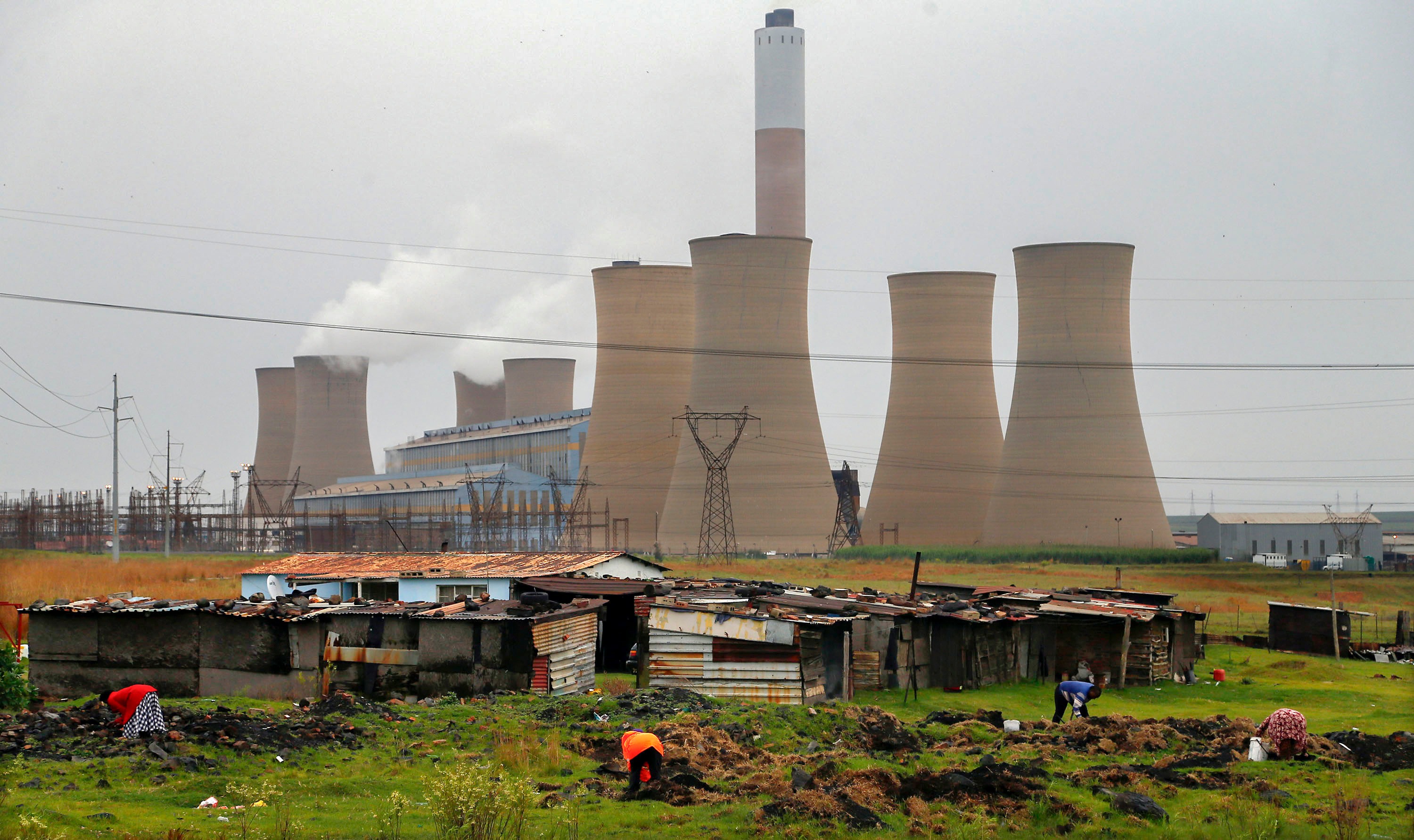
 SA’s 130 air-quality monitoring stations are meant to monitor and police air pollution, but a third of these facilities are not fully operational. (Photo: Felix Dlangamandla)
As South Africa continues to be country powered by coal, provinces such as Gauteng, North West, Mpumalanga and Free State continue to be blanketed by significant high levels of air pollution.
Across South Africa 130 government-owned air quality monitoring stations are meant to monitor and police this pollution, but a third of these sites are not fully operational, and this has been an environmental and public health concern since the news broke in 2025.
The stations are meant to measure particulate matter (PM), sulfur dioxide (SO2), nitrogen dioxide (NO2), ozone (O3), and carbon monoxide (CO), among other air pollutants. These pollutants are evaluated against the National Ambient Air Quality Standards (NAAQS) to assess whether concentrations of pollutants are within acceptable levels for human health.
However, with more than 50% of monitoring stations operating at diminished or no capacity, the government is effectively blind to the extent of pollution and its impact on the environment and the health of vulnerable communities, particularly on the Highveld.
The concerning state of the nation’s air-quality management capabilities seems to be an issue the Department of Forestry, Fisheries and the Environment (DFFE) has been mulling over, as evidenced by an ambitious R625-million proposal to right the ship presented during a portfolio committee meeting on Tuesday, 9 June.
The plan, presented to Parliament by acting deputy director-general for climate change, Dr Patience Gwaze, will see the South African Weather Service (SAWS) take over the operation, management and maintenance of 60 stations across the country that provincial governments and municipalities currently manage.
This proposed intervention is an attempt to strengthen the nation’s weakened ability to track pollution, predict episodes, implement evidence-based interventions, enforce emission regulations and ultimately protect public health.
/file/attachments/2989/ED_556356_777519.jpg)
“These interventions represent a pragmatic and cost-effective approach to strengthening our air quality and the monitoring of our networks, whilst also addressing existing constraints. They also reaffirm the government’s commitment to evidence-based environmental governance and the protection of public health,” DFFE minister, Willie Aucamp, said.
Why SA needs reliable air quality monitoring
According to a study by the Centre for Clean Energy and Research (CREA) and Greenpeace Africa, approximately 42,000 people, including 1,300 children under five in South Africa, died from ambient fine particulate matter (PM2.5) in 2023.
More concerning is that these deadly effects are not equally distributed across the country, with 16,000 deaths projected in urban-industrial Gauteng, 7,000 deaths in KwaZulu-Natal and 5,600 deaths in the Highveld Priority Area.
Fine particulate matter is particles with a diameter less than 2.5μm (PM2.5). PM2.5 is one of the most hazardous pollutants in the air because of its small size and ability to penetrate deep into the lungs and enter the bloodstream.
The report also found that the entire country was exposed to PM2.5 levels that exceeded the World Health Organisation’s 2021 guidelines.
Daily Maverick previously reported that the study’s estimates are based on globally recognised models that link PM2.5 exposure to premature deaths from heart disease, stroke, respiratory illness and more.
The CREA and Greenpeace study highlights why it is important that all the county’s air-quality monitoring stations are fully operational. Without real-time and reliable data, neither the government nor ordinary citizens can know whether the air they are breathing is safe or not, leaving key populations vulnerable to health complications.
Gauteng makes minor wins
Gauteng is not exempt from the air-quality monitoring problem plaguing the rest of the country. Daily Maverick previously reported that of the province’s 31 municipal-owned stations, only 12 are fully operational. A further three are partially operational, while 16 are completely non-operational.
This was of particular concern given the fact that the province is not only the country’s most densely populated, but also its most polluted region.
The Gauteng Department of Environment told Daily Maverick that the number of fully operational stations rose from 12 to 19 since October 2025.
A network built at significant cost
While South Africa has already invested more than R500-million over the past two decades to build an extensive air-quality monitoring network it is the maintaining of this network that has become increasingly difficult.
According to the DFFE, the stations contain highly specialised equipment whose costs range from hundreds of thousands of rands to more than a R1-million per analyser. The stations require climate-controlled shelters, uninterrupted power supplies, backup systems and regular calibration to ensure accurate readings.
The problem is that there is inadequate funding to ensure that these requirements are met. Moreover, many stations have also been affected by vandalism, theft and ageing equipment.
The DFFE’s R625-million proposal is aimed at improving the maintenance of existing stations, which is why it carries substantial financial implications.
The DFFE believes that SAWS is uniquely positioned to manage the national network because it already has extensive experience running air-quality monitoring stations.
Since 2010, the department has progressively transferred responsibility for monitoring stations in priority pollution areas to SAWS. The weather service currently manages networks in the Vaal Triangle Airshed Priority Area, the Highveld Priority Area and the Waterberg-Bojanala Priority Area, amounting to about 17 monitoring stations.
A three-year phased roll-out
/file/attachments/orphans/Graphic1_987121.jpg "The Department of Forestry, Fisheries and the Environment will transfer the management of 60 air-quality monitoring stations to the South African Weather Service in three phases over 10 years. (Source: DFFE)")
The transfer would be implemented in three phases over the next 10 years if the proposal is greenlighted by Treasury.
The first phase would cover 26 stations in Mpumalanga, North West, Gauteng, Limpopo and Free State. These stations would be supported through the existing SAWS laboratory in Irene, Gauteng.
In phase two, 20 stations in KwaZulu-Natal and Eastern Cape would be transferred to the weather service, with a second regional laboratory established to support operations.
The final phase would establish a regional centre in the Cape region to support roughly 14 stations in Western Cape and Northern Cape that would be transferred to SAWS.
Once complete, SAWS would manage approximately 60 stations in addition to those already under its control. The proposed expansion would build on this experience by transferring responsibility for a much larger network while utilising SAWS’ existing national infrastructure and technical expertise.
According to the department, the intervention would not only improve the management of existing monitoring stations but also lay the foundation for a national air-quality forecasting system capable of predicting pollution levels in the same way that weather forecasts predict rainfall and temperature.
In response to the proposed transfer of the management of the 60 monitoring stations, the Gauteng Department of Environmental Affairs GDEA) said:
“The Department of Environment considers that the DFFE’s SAWS proposal could provide a cost-effective, strategic and sustainable solution for operating and maintaining strategic air-quality monitoring infrastructure.
“However, the department’s view is that the approach should not be applied uniformly. Some municipalities are able to maintain stations and provide annual budgets without significant difficulty. Any decision to proceed should be made in consultation with municipalities, as the owners of the stations.”
Gaps in monitoring SA’s capabilities
According to the Clean Air Fund, air-quality monitoring stations are not evenly distributed in South Africa.
The stations are concentrated around major population centres and industrial regions such as Gauteng, Mpumalanga, the coastal metros and the Vaal Triangle, where pollution risks are highest, leaving 40% of the population without access to a station within 25km.
/file/attachments/orphans/Graphic2_304595.jpg "The location of air-quality monitoring stations in South Africa that should report to the South African Air Quality Information System. (Source: DFFE)")
This inaccessibility of data further prevents communities and authorities charged with managing environmental health from delivering evidence-based action.
To address this, the DFFE is increasingly deploying low-cost air quality sensors to supplement traditional monitoring stations.
Unlike conventional monitoring stations, which require dedicated shelters and expensive equipment, these compact devices can be installed on infrastructure such as streetlights, bus stops and power facilities. They are cheaper, easier to deploy, require minimal maintenance and can operate using solar power in areas without reliable electricity.
Funding concerns
With the proposal in place, the buck stops with the National Treasury. Gwaze told the committee that Treasury had requested that the department draw up a detailed business plan to support the DFFE’s case for funding.
While several MPs in attendance at the meeting congratulated the DFFE on developing a proposal that, on paper, was responsive to the nation’s air-quality monitoring crisis, they expressed concern about whether the intervention would be funded, given the tightening of the public purse. Gwaze claimed that Treasury had committed to come on board with the project, though it may not fund the entire initiative.
In the meantime, the DFFE said, it was also engaging with donors and possible partners to see the intervention through.
GDEA told Daily Maverick that the proposal to transfer management of air-quality monitoring stations to the SAWS has been under discussion since 2022, and a business case was developed. However, that proposal was not fully funded by the National Treasury.
Despite its R625-million price tag, Gwaze said the plan is the most cost-effective and sustainable option for improving the nation’s air-quality monitoring capabilities and protecting public health. DM


Comments
Scroll down to load comments...