



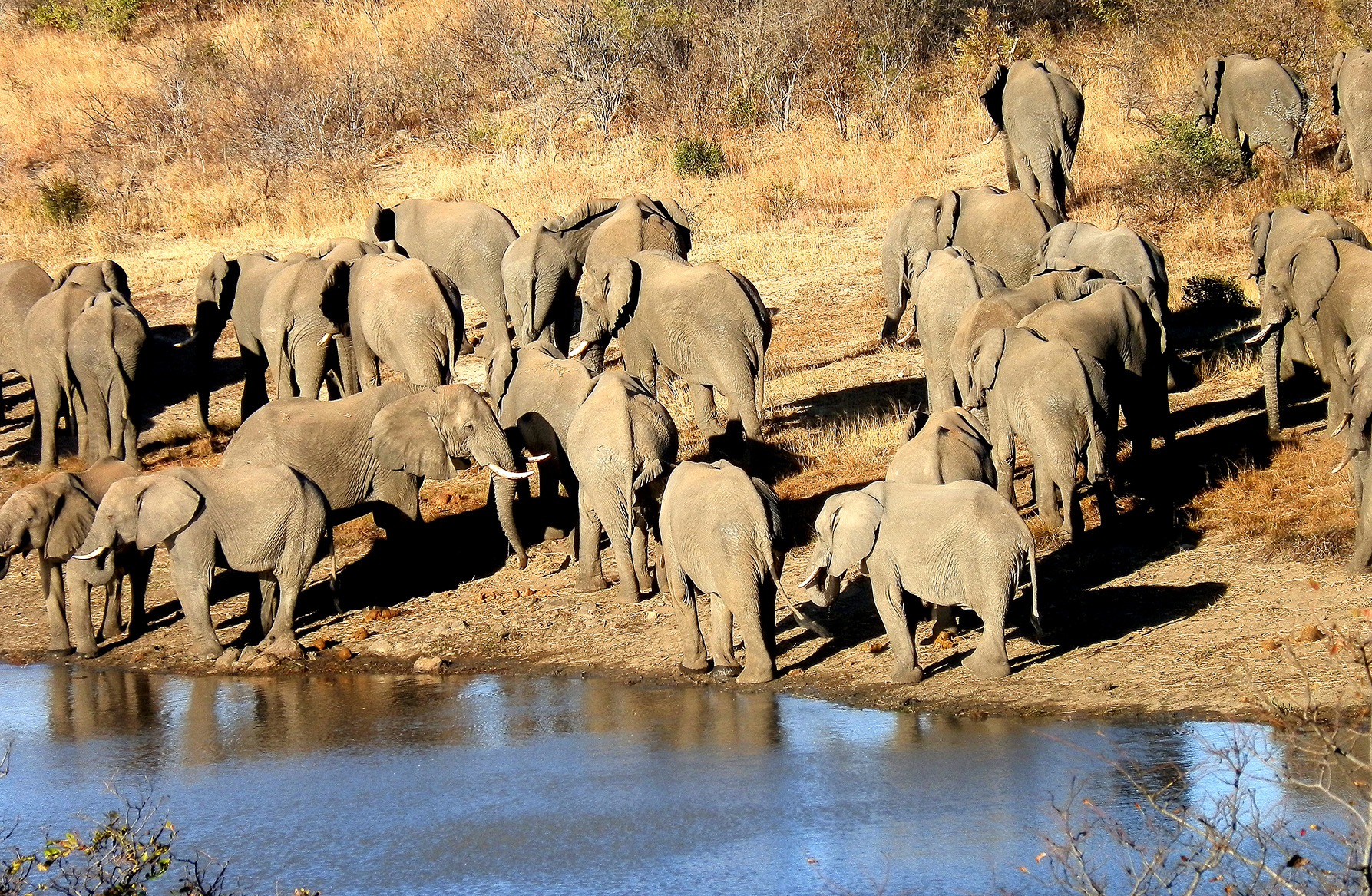
 During the winter months, Shangani Holistic becomes a migration route for up to 300 male elephants moving between Hwange National Park and areas to the northwest. (Photo: Supplied)
If you expect to see a typical commercial cattle ranch at Shangani Holistic in Zimbabwe, you are in for a shock. Instead of neatly fenced, homogenous meadows, you find a 65,000-hectare open savanna where 7,700 commercial cattle graze side-by-side with roughly 3,500 wild animals, including zebras, giraffes, leopards and migrating herds of elephant.
For Dr Elizabeth le Roux, an associate professor at the University of Aarhus, the contrast with European cattle production landscapes – where farmland is often tightly managed and uniform – is stark.
“When I ask my Danish students to go and observe cattle-driven dynamics in Shangani, they expect to find a commercial farm meadow,” Le Roux says. “They are blown away by how natural the space is. It is coexistence with a lot of wildlife species, more so than most people from a European perspective realise is possible.”
Rangeland dynamics
Owned by the Oppenheimer family, the ranch functions as a large ecological laboratory.
In a wholesale departure from traditional paddocking, the team uses a livestock management strategy that mimics natural movements of roaming buffalo herds. Large stretches of internal fencing have been removed, says resident director Max Makuvise, who manages ranching operations alongside research manager Peter Makumbe.
Makumbe says this localised approach has yielded strong results.
Given the abundance of wildlife at Shangani Holistic, leopards are not considered a major livestock problem. Previously, the ranch lost a calf a day to predators, says Makumbe. Now, they lose about one a month, as predators have shifted their attention to natural prey such as impala and bushpig.
The ranch is also shifting its herd towards indigenous Nkone cattle, which, like their South African Nguni counterparts, are well adapted to drought conditions and show greater resilience to diseases and ticks.
Outreach
Crucially, Shangani Holistic’s practices extend beyond the ranch boundaries into surrounding communities in Matabeleland South.
Mupenyu Mberi, who leads the community livestock programme, works with farmers in nearby villages on rangeland management methods.
/file/attachments/orphans/Leopard_225004.jpg "At Shangani Holistic, abundant wildlife includes predators such as leopard. (Photo: Supplied)
<br>")
In nearby Ward 18, Mberi’s programme helps local farmers manage grazing and rangeland conditions. As these agropastoral communities face mounting pressure from climate change and environmental degradation, some farmers are adopting mobile kraals in their crop fields to create concentrated nutrient hotspots.
Mberi says the longer-term goal is to build a stronger regional cattle and wildlife economy linked to local communities.
Elephant corridor
But this open-landscape approach means interactions between people and wildlife must be carefully managed.
To reduce pressure on both wildlife and surrounding small-scale farmers whose crops are vulnerable, a migration corridor is kept open. Makumbe is currently analysing field data to map these movements more precisely.
“We have not yet developed a model to mitigate conflict. But it is a priority, and we prefer, in our context, to speak of ‘interaction’, not conflict,” he says.
To mark 2026 as the International Year of Rangelands and Pastoralists, farmers in Ward 18 plan to host a showcase of local rangeland management practices and pastoral culture in partnership with Shangani Holistic, Grazing Concepts, the Food and Agriculture Organization and Zimbabwe’s National University of Science and Technology.
Vegetation management
Vegetation management is another major focus of research at Shangani. To address bush encroachment – a growing problem in many southern African rangelands – researchers are testing a range of interventions including goat browsing, controlled burning, herbivore exclusion, environmentally sensitive chemical treatments and combinations of these methods.
Some of this work is being led in collaboration with researchers from the University of Exeter.
Le Roux says natural ecosystems require an intermediate level of disturbance to remain healthy. The aim, she explains, is to create continuous, patchy disturbance across the landscape. Too little disturbance allows dominant species to take over; too much leaves only hardy pioneer species able to survive.
Impact on smaller species
Backed by a Jennifer Ward Oppenheimer research grant, Le Roux’s team uses LiDAR (light detection and ranging) scanners, temperature loggers and camera traps to measure how cattle movement affects microclimates and habitats for smaller species such as lizards, birds, mongooses and bush babies.
For these species, movement is often constrained not by fences, but by degraded landscapes that function as a “fence of desolation”.
By managing grazing patterns to restore ecosystem function, Shangani and its partners aim to maintain ecological connectivity across the landscape, says Le Roux.
These landscape connections, she adds, are not only important for smaller terrestrial species, but also for wide-ranging scavengers that move across international borders.
The ‘Shangani Wanderer’
Every evening, just before bed, Josephine Mundava checks her phone. She is not checking messages but looking for the GPS pings of the “Shangani Wanderer” – a young, critically endangered white-backed vulture fitted with a tracking tag.
As a lecturer at the National University of Science and Technology, Mundava monitors the ranch’s vulture populations. “I put satellite tags on the birds to see in real-time where they are going,” Mundava explains. It is a daily priority aimed at making sure “these birds keep doing well so they keep cleaning our environment”.
Because Shangani employs strict law enforcement and active patrols, it has become a rare sanctuary; the ranch’s vulture population has boomed from about 10 nesting sites in 2012 to an estimated 80 to 100 today.
/file/attachments/orphans/Josephine-and-Leeroy-Moyo-with-Shangani-Wanderer-Copy_919785.jpg "Josephine Mundava and Leeroy Moyo of Birdlife Zimbabwe, hold the Shangani Wanderer
<br>shortly after tagging. (Photo: Supplied)")
shortly after tagging. (Photo: Supplied)
Outside the ranch’s borders, threats remain severe. Recently, 100 vultures were killed by poisoned carcasses in the Lionspruit Game Reserve, and another 100 were poisoned in Kruger National Park. To combat this, Mundava’s team uses the tracking data to monitor the birds’ vast transboundary flights, identifying critical areas for establishing Vulture Safe Zones. Recent data showed one tracked vulture, T1, journeying through Botswana into South Africa’s Madikwe Game Reserve, while another, BK1700, flew through Mozambique into the Sabi Sand Nature Reserve.
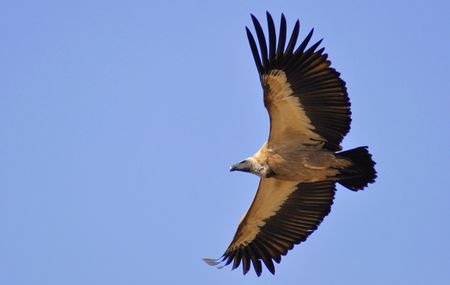
During tagging exercises the team also draws blood from the birds to test for lead exposure, a deadly consequence of vultures ingesting bullet fragments left behind by hunters. “Our data shows the Shangani Wanderer has already traversed international borders, demonstrating the critical importance of transboundary conservation efforts,” Mundava notes.
/file/attachments/orphans/White-backed_vulture_Gyps_africanus_707310.jpg "An adult white-backed vulture in flight. (Photo: Charles J Sharp / Wikimedia Commons)
<br>")
Fieldwork challenges
Conducting scientific research in rural Zimbabwe is rarely glamorous, and often deeply frustrating.
For Le Roux’s team, securing research permits meant submitting 14 colour-coded copies in person in Harare, forcing a student to drive from Bulawayo just to deliver paperwork.
Field conditions are also unpredictable. Mundava recently spent 10 exhausting days attempting to capture 10 birds for blood testing, but managed to catch only two.
Then there is the unpredictable human element. Le Roux recalls a PhD student painstakingly collecting heavy soil samples from community areas, only to leave the bags behind to fetch later. “While eating lunch, she saw a group of schoolkids walking past, swinging her bags of soil and throwing the samples everywhere,” Le Roux says. “Her argument was ‘who would steal soil?’, and the kids thought ‘who would care if I take this soil?’” Mundava notes that she has lost count of how many camera traps – or just their memory cards – have been stolen from carcass sites.
Embracing the in-between
Despite the stolen soil, missing cameras and endless red tape, the research at Shangani is focused on one of Africa’s most pressing conservation questions: can humans, livestock and wildlife share the land?
It is a question that has reshaped Le Roux’s own thinking. She admits that she initially became an ecologist to work in untouched wilderness, far from people. But fieldwork led her to rethink that position and to engage with the “messy, in-between spaces” where humans, cattle and wildlife coexist.
“Society views nature and humans as two separate things, but coexistence is not so far off or difficult,” Le Roux notes. “It requires small tweaks to how we manage, and it doesn’t mean that if you let nature in, you have to give up on profit. It is a mental block we need to overcome.” DM
This story was produced with the support of the independent research engagement agency, Jive Media Africa.


Comments
Scroll down to load comments...