




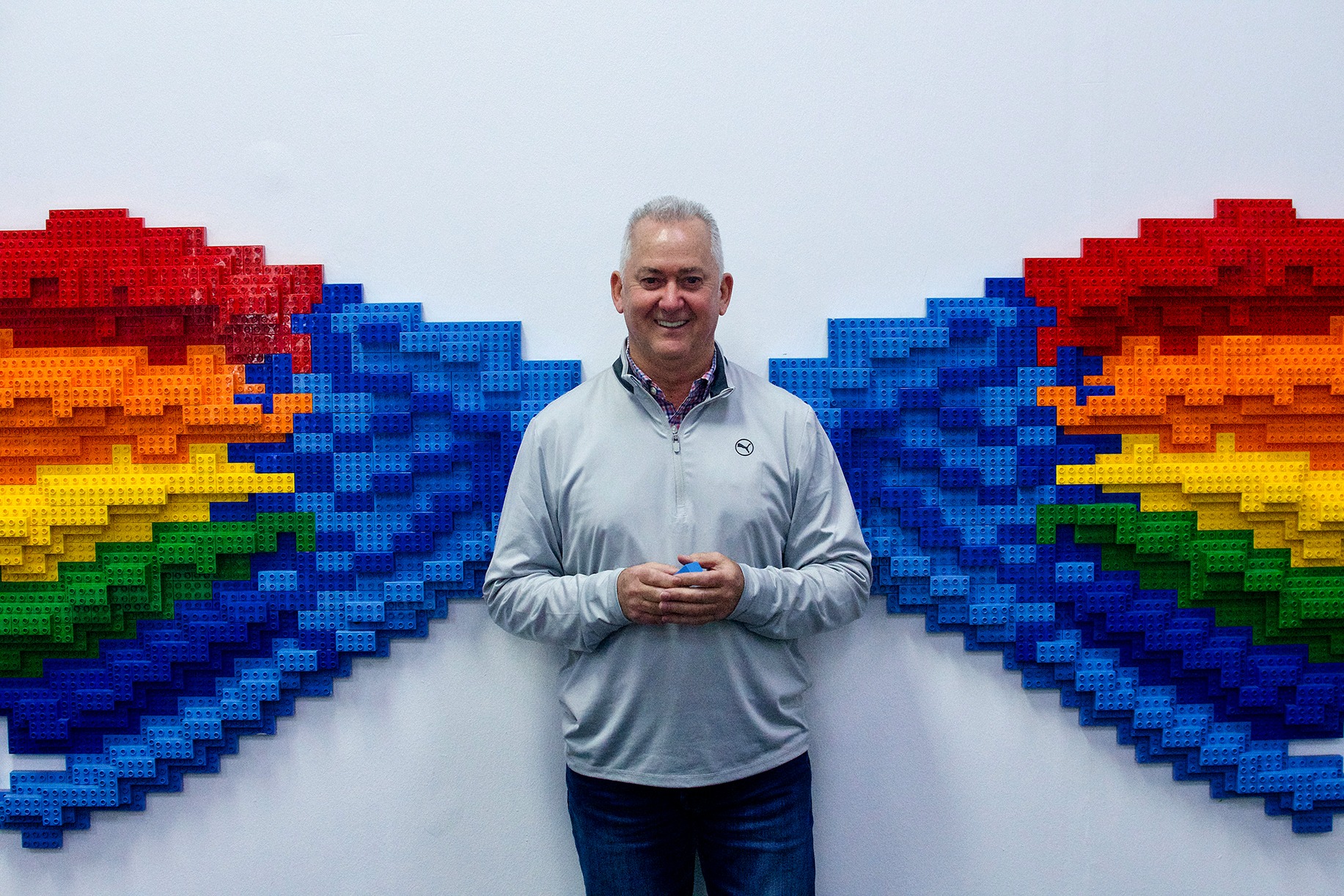
 Brent Hutcheson is both a respected educator and an irritant to conventional thinking. (Photo: Oliver Roberts)
Brent Hutcheson has an interesting theory about snot.
If you go into a classroom of young children and see it running down their noses, a lot of the time it has nothing to do with illness or cold weather.
“The vestibular system is incredible,” Hutcheson says. “It’s a built-in spirit level behind both our ears. One of the things it detects is inactivity in the brain. And if there’s inactivity in the brain, what does it need? It needs the hands to move. So if your nose is dripping, what do you do? You wipe your nose.”
Hutcheson has seen it countless times. He visits a crèche where children sit glassy-eyed and sniffling. He introduces Lego bricks, trains the teachers in how to use them, and returns a week later.
“No snot.”
It is exactly the kind of observation that has made Hutcheson both a respected educator and an irritant to conventional thinking. For more than three decades he has argued that many of the problems in education stem from a surprisingly simple mistake: we ask children to sit still when they are designed to learn through their hands.
The boy who brought his own computer
It’s the early 1990s. Hutcheson, a young teacher at Rivonia Primary, brings his own computer to school. At the time, computers were still the preserve of specialists and nerdy enthusiasts. Few teachers knew how to use them. Fewer still knew how to teach them.
When the school’s headmaster discovers that Hutcheson owns one, he gives him a new responsibility: helping to establish a computer centre. With that, Hutcheson becomes the first full-time computer teacher in South Africa.
The computer centre was such a success that it was soon commercialised. One of Hutcheson’s contracts was with EA Sports, which sent games for the children to test. For the pupils of Rivonia Primary, it was about as close to paradise as a computer lab could get.
Hutcheson, however, was already looking beyond the screen. He wanted to teach the children robotics. To do that, he assumed he would need to teach them logic. What he discovered instead would shape the rest of his career.
The missing machines
“I quickly realised it wasn’t logic that was the problem,” he says. “The children’s logic was fine. The problem was mechanical. What children didn’t have then, and still don’t today, is exposure to and understanding of the six simple machines.”
Hutcheson is referring to the building blocks of engineering: the lever, wheel and axle, pulley, inclined plane, wedge, and screw. Master them, he argues, and you can build almost any machine in the world.
The children could programme a robot. Building one was another matter entirely.
Hutcheson was beginning to realise that technology could be a useful assistant, but that learning starts somewhere far more fundamental.
/file/attachments/orphans/1_305610.jpeg "Imagination, Brent Hutcheson argues, is not a decorative extra to learning. It is the mechanism through which learning happens. (Photo: Oliver Roberts)<br>")
“Seventy percent of your brain is connected to the input from your hands,” he says. “So a child’s greatest assets are these things here.”
He raises his hands between us and wiggles his fingers as if they’re conduits of concepts and ideas. Then, for the first time during the interview, a flash of frustration surfaces in his voice.
“At school we ask children to keep their hands on their lap. That’s why I had to leave a school system that was killing creativity and innovation, and try to foster it in a very different way.”
Six Bricks
Hutcheson’s solution became known as Six Bricks: a learning model built around six ordinary Lego bricks that remain within a child’s reach throughout the school day.
Through a series of short, structured activities, children use the bricks to explore concepts such as literacy, numeracy, memory, perception and problem-solving. The idea is rooted in a belief that learning happens most effectively through construction rather than instruction; that children develop an understanding of themselves and the world not simply by being told things, but by manipulating objects, testing ideas and discovering patterns with their own hands.
“The bricks had to be plain,” he says. “I didn’t want a Lego brick that looked like something, because then you’re bypassing imagination.”
It was a conscious choice. A brick shaped like a spaceship remains a spaceship. A plain brick can become anything. An aeroplane. A bridge. A house. A dinosaur. The child is forced to supply the missing ingredient.
Imagination, Hutcheson argues, is not a decorative extra to learning. It is the mechanism through which learning happens.
“The school system does the opposite to imagination: it kills your brain,” he says. “Children are forced into a box, and to think a certain way.”
/file/attachments/orphans/4_921306.jpeg "Brent Hutcheson’s vision is a more diverse educational landscape, one in which different schools cater to different ways of thinking and where communities play a greater role in shaping what education looks like. (Photo: Oliver Roberts)")
It is a fiery statement, but one that sits at the heart of his philosophy. Children, he argues, learn best when they are given room to explore, experiment and make sense of the world for themselves.
The idea has proven remarkably portable. Teachers who encountered the programme in South Africa have taken it home, introducing variations of Six Bricks in classrooms as far afield as Denmark, Mexico, Turkey and Ukraine. It has also been the subject of six PhDs.
“Private schools all over the world are buying Six Bricks,” he says. “If they want it, it tells you it’s about equalising the base. It’s the simplest, easiest, quickest intervention you can make. And the cool part is it’s so simple.”
Ingenuity born from necessity
The majority of Hutcheson’s work takes place in underresourced schools, through his organisation, Care for Education. Fifteen years ago, he started a township robotics programme in Atteridgeville. Today, six dedicated centres cater for 200 children a year, challenging assumptions about who gets to become an engineer, inventor or problem-solver.
“At some robotics tournaments, the township schools have outperformed the private ones,” Hutcheson says. “While it’s true that a township child’s base may be poor, and their language may be poor, when it comes to lateral thinking and problem-solving: no problem.”
He believes this is partly because many children in underresourced communities encounter practical challenges from an early age. A gate that won’t close properly. A door that needs fixing. Problems that demand observation, experimentation and ingenuity.
“More privileged children don’t know what that looks like,” he says.
For Hutcheson, the explanation has less to do with innate ability than experience.
In fact, he argues that affluence can sometimes work against a child’s development.
“Helicopter parents will kill their children,” he says.
He points to the way many modern homes are organised. Children’s toys are smaller. Bedrooms are tidier. Everything is designed to be stored away neatly. The large, physical toys of previous generations – rocking horses, train sets and things that could be pushed, pulled, climbed on or dismantled – have gradually disappeared.
Power in diversity
Despite his criticism of the education system, Hutcheson remains optimistic.
The problem, he says, is not a lack of good intentions. Most teachers enter the profession because they genuinely want to make a difference. The trouble lies in a system that often rewards conformity over creativity and administration over leadership.
“Teachers become teachers because they want to make a difference and you do everything thinking it’s right,” he says. “Then, after about eight years, all the wheels fall off.”
He points to a cycle in which talented teachers are promoted into administrative roles for which they may be poorly suited, while classrooms lose experienced educators. The result, he believes, is a system that struggles to adapt to the needs of individual children.
His vision is a more diverse educational landscape, one in which different schools cater to different ways of thinking and where communities play a greater role in shaping what education looks like. Not every child needs to follow the same path, he argues, and not every child needs to go to university.
Ultimately, however, his concerns come back to something far simpler.
“We need to give children systems where they keep their self-belief, self-confidence and self-esteem,” he says.
For more than three decades, whether through computers, robotics or six small Lego bricks, that has been the thread running through Hutcheson’s work. Not simply teaching children what to think, but giving them the confidence to discover what they are capable of thinking for themselves. DM
This story is sponsored by Jozi My Jozi.
Oliver Roberts is a multi-award-winning journalist, writer and photographer whose work has been published locally and internationally. He has also won prizes and been shortlisted for his short fiction. His work can be viewed here.
Comments
Scroll down to load comments...