




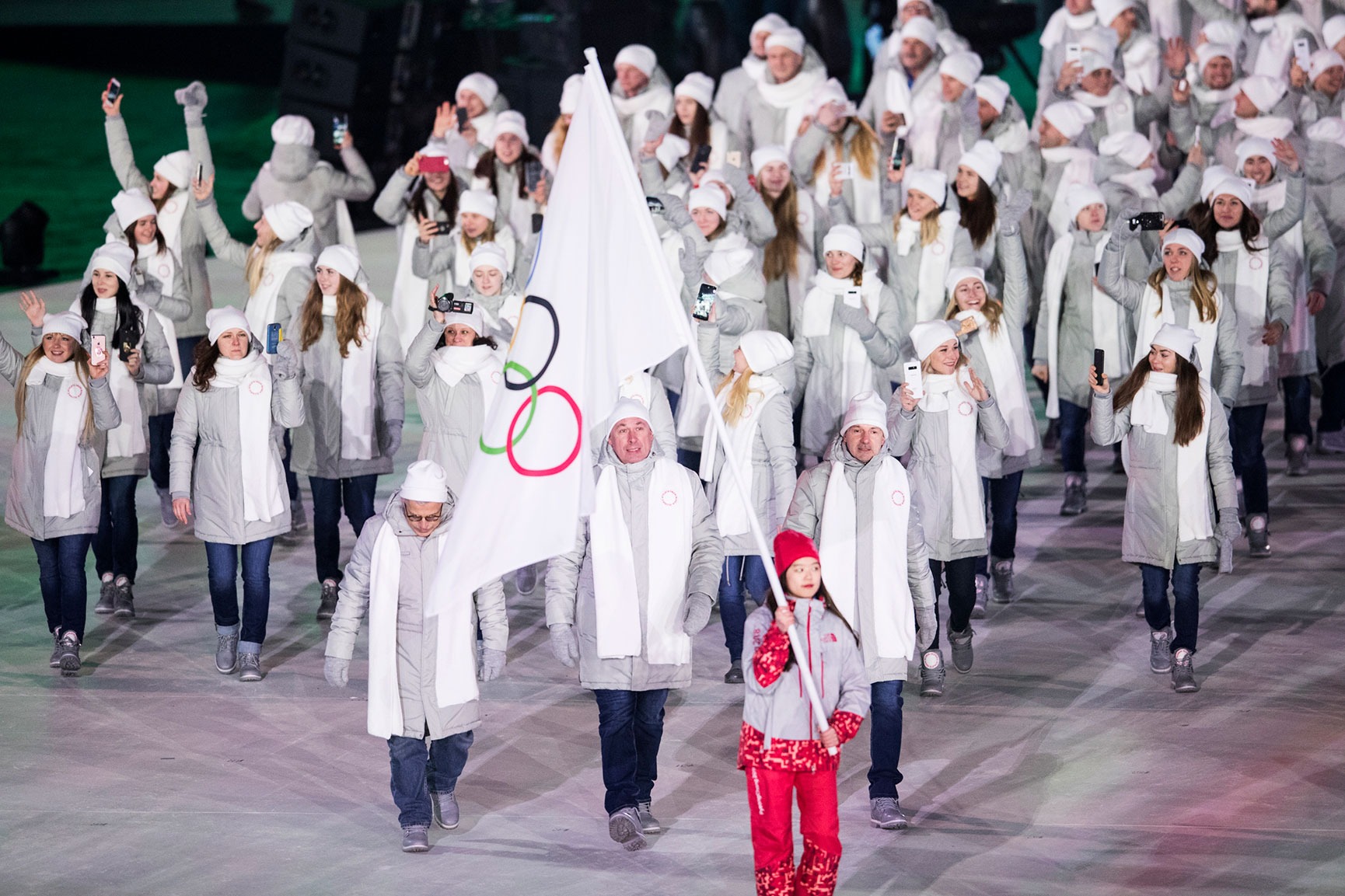
 Following the exposure of the Russia state-sponsored doping programme between 2011 and 2015, Russia was banned from competing under its flag at the 2018 PyeongChang Winter Olympics. (Photo: XIN LI / Getty Images)
A few weeks ago, the Enhanced Games, a sporting competition that allowed the use of banned performance-enhancing substances, took place. While it did not have the desired effect its stakeholders were hoping for, it did spark a conversation around the state of global anti-doping efforts and systems.
At the forefront is the ongoing tension between the World Anti-Doping Agency (Wada) and the United States Anti-Doping Agency (Usada). These two groups have been at odds for several years, with no signs of repair.
The dispute centres largely on Wada’s handling of two of the most significant doping controversies of the past decade and a half: Russia’s state-sponsored doping programmes and the controversial Chinese swimmers case.
Anti-doping politics
According to Travis Tygart, chief executive of Usada, Wada has had a “questionable track record when it comes to holding countries and athletes accountable to the same rules and standards” and that it needs to get its “house in order”.
In 2016, a report came out that Russia operated a state-sponsored doping programme from 2011, including the build-up to London 2012, and continued through the 2014 Sochi Winter Olympics up until August 2015.
The report claimed that more than 1,000 Russian athletes, including a number of Olympic medallists, benefited from the Russian sports ministry’s calculated manipulation of urine samples.
“In that devastating Russian affair, which is still ongoing, Wada hoped to simply limit the damage and pacify Russia,” Tygart told Daily Maverick. “Wada supplied excuse after excuse for not uncovering Russia’s drug programme earlier and then leaned on technical justification for its failure to handle it ‘effectively’.”
Then in 2021, 23 Chinese swimmers tested positive for trimetazidine (TMZ) months before the Tokyo Olympics began in July. Wada was notified in June 2021 of the Chinese anti-doping organisation’s decision to accept that the swimmers were exposed to the substance through contamination from spice containers in the kitchen of a hotel they were staying at.
/file/dailymaverick/wp-content/uploads/2024/04/GettyImages-1331213565.jpg "Gold medallists Junxuan Yang, Yufei Zhang, Bingjie Li and Muhan Tang of Team China with their gold medals for the women’s 4x200m freestyle relay final at the Tokyo 2020 Olympic Games on 29 July 2021. (Photo: Tom Pennington / Getty Images)")
According to Wada, it had no evidence to challenge the scenario.
Consequently, in February, US President Donald Trump signed into law a provision that withholds the US’ annual dues of $3.6-million to Wada. The US also withheld its 2024 dues under the Biden administration.
“Usada is working closely with the US government to push for transparency, accountability and meaningful reform, including an independent audit by outside anti-doping experts,” said Tygart.
/file/attachments/orphans/2220623976_275071.jpg "Travis Tygart, chief executive of the United States Anti-Doping Agency. (Photo: Kayla Bartkowski / Getty Images)")
Wada claimed the allegations of not being transparent were “simply false” and pushed back on the demand for an independent audit, insisting that it already undergoes routine audits.
“These allegations are untrue and are made with all the evidence pointing in the opposite direction,” a Wada spokesperson told Daily Maverick. “Wada operates entirely independently of sports and governments, carrying out its work without fear or favour, and treating athletes and organisations the same under the rules.”
The spokesperson continued to defend its position, asserting that “no organisation has been tougher on Russia than Wada”.
“It was two Wada-led investigations that uncovered the full extent of the institutionalised doping scheme in Russian sport,” the spokesperson said. “Wada sought sanctions on Russian sport for a period of four years (a sanction that was disappointingly halved on appeal by the Court of Arbitration for Sport).
“So far, more than 300 sanctions have also successfully been imposed.”
Increasing pressure on South Africa’s anti-doping efforts
While Khalid Galant, chief executive of the South African Institute for Drug-Free Sport (Saids), told Daily Maverick there is no knock-on effect in South Africa or Saids in terms of the fractured relationship between Usada and Wada, the country is still facing its own mounting pressure on anti-doping systems.
The South African anti-doping system took a huge hit in 2024 when Wada formally suspended the accreditation of the South African Doping Control Laboratory (the Laboratory) in Bloemfontein due to “multiple non-conformities with the International Standard for Laboratories”.
After granting the Laboratory a 12-month extension Wada moved to officially revoke its accreditation in May 2025.
Consequently, Saids was forced to send samples to overseas labs for testing. It still does.
Now, it costs more to conduct tests, the turnaround time is longer and as a result fewer tests are being conducted across the board, said Galant.
“We saw an increase in costs anywhere from 45% to 65%,” he said. “Additionally, our grant from the government is static – there wasn’t a commensurate increase planned.”
Therefore, with the cost increase, Saids has had to adjust its testing quantity to fit within the budget, otherwise it would go into a deficit.
/file/attachments/2993/Saidsgraph_110366.jpg "Saids’ annual doping tests across all sports annually. (Source: Saids annual reports)")
Having to send test samples overseas further cuts out a vital stream of income, said Galant.
“We just did a lot of testing for World Athletics with the Cape Town Marathon,” he said. “Generally, those samples would get tested in Bloemfontein and some revenue generated for [Saids].
“That revenue now has all but disappeared because we can collect the samples, but now we have to send those samples [elsewhere].”
While Galant acknowledged a general decrease in testing across the board due to these factors, he stated that figures published by the Telegraph regarding a reduction in rugby drug testing over the past decade are somewhat distorted.
The Telegraph noted that the number of tests carried out within rugby by Saids fell from 785 in 2015 to just 127 in 2024.
But according to Galant the nature and strategy of drug testing used 10 years ago versus today has changed.
“Part of the reduction is because we use a lot of intelligence-based testing,” he said. “Now we have access to different types of data. We can be precise, we can look at performance, intelligence-based information and tip-offs.
“All those feed into our testing strategy. So, the numbers do decrease because there’s more precision in terms of the testing strategy.”
Galant emphasised that the lower number of tests does in no way dilute the integrity of the system.
“Athletes can still trust that those caught will be treated fairly with respect to administrative justice and the Code,” he said.
Increase in contamination cases
When the Enhanced Games first emerged their main claim was that anti-doping systems were outdated and ineffective.
However, sports scientist Ross Tucker previously told Daily Maverick that “anti-doping currently is the thing managing doping”.
According to Tucker, where it causes confusion and undermines anti-doping’s credibility is when athletes get caught for accidental doping such as taking contaminated supplements.
This is where strict liability becomes pertinent.
The Wada rules dictate that even if a positive test is proven to be caused by contamination, national anti-doping agencies must find a violation, disqualify results and make a public announcement.
Asenathi Ntlabakanye’s case is the most recent one in strict liability discourse.
The Springbok and Lions prop was recently handed an 18-month suspension for testing positive for the banned substance anastrozole and self-declaring his use of the anabolic steroid DHEA.
Ntlabakanye’s defence maintained that both substances were unknowingly taken in good faith under the prescription and clearance of medical professionals to treat a weight loss-related condition.
Under the sport’s strict liability rules, however, Ntlabakanye was still held accountable.
/file/attachments/orphans/TL_2422485_385993.jpg "Asenathi Ntlabakanye warms up for a game between South Africa and Italy in Gqeberha on 12 July 2025. (Photo: Anton Geyser / Gallo Images)")
Similarly but much less punitively, in 2025, Jannik Sinner faced a three-month ban from tennis after testing positive twice for clostebol that he had been inadvertently contaminated with by his physiotherapist.
“The Wada anti-doping system is built on the principle of strict liability, so it is critical that athletes understand the rules and practise due diligence when it comes to checking the prohibited status of medications and treatments,” said Tygart. “But medical professionals who treat athletes should also take the time to educate themselves on the rules.”
But, the question emerges: under strict liability, why did the Chinese swimmers face zero consequences?
“With the Chinese positives, Wada admits that China did not follow the rules on transparency. And even if Wada genuinely believed that the Chinese positive tests were caused by contamination, China was still required to follow the rules by finding violations, disqualifying results and making the cases public,” said Tygart.
Wada’s spokesperson acknowledged that the issue of contamination is “real and growing”.
“More and more, we are seeing those who test positive put forward contamination defences,” the spokesperson said. “Our challenge is to distinguish between cases of genuine contamination versus those who dishonestly seek to use it in an attempt to avoid sanction.
“If the system is too strict and rigid, innocent athletes will suffer injustice. If the system is too lenient, cheats could evade detection.”
Changes that are coming into effect in the 2027 version of the Wada code will provide for more flexibility and fairness in cases of contamination, said Wada’s spokesperson.
Can we still trust the system?
Asked if citizens can still trust the integrity of anti-doping systems, Usada said that the science behind anti-doping testing has never been more “robust”, but that fairness and equal application of the rules is less reliable.
“Restoring confidence will require more transparency, accountability and meaningful reform at Wada, starting with an independent audit by outside anti-doping experts,” said Tygart.
According to Wada, the clean sport system remains strong and maintains that it treats athletes fairly.
“The political attacks following the China cases have sought to damage the reputation of the global anti-doping system, which ultimately does not benefit the athletes, but Wada has and always will endeavour to protect clean sport and treat athletes fairly.” DM
Comments
Scroll down to load comments...