




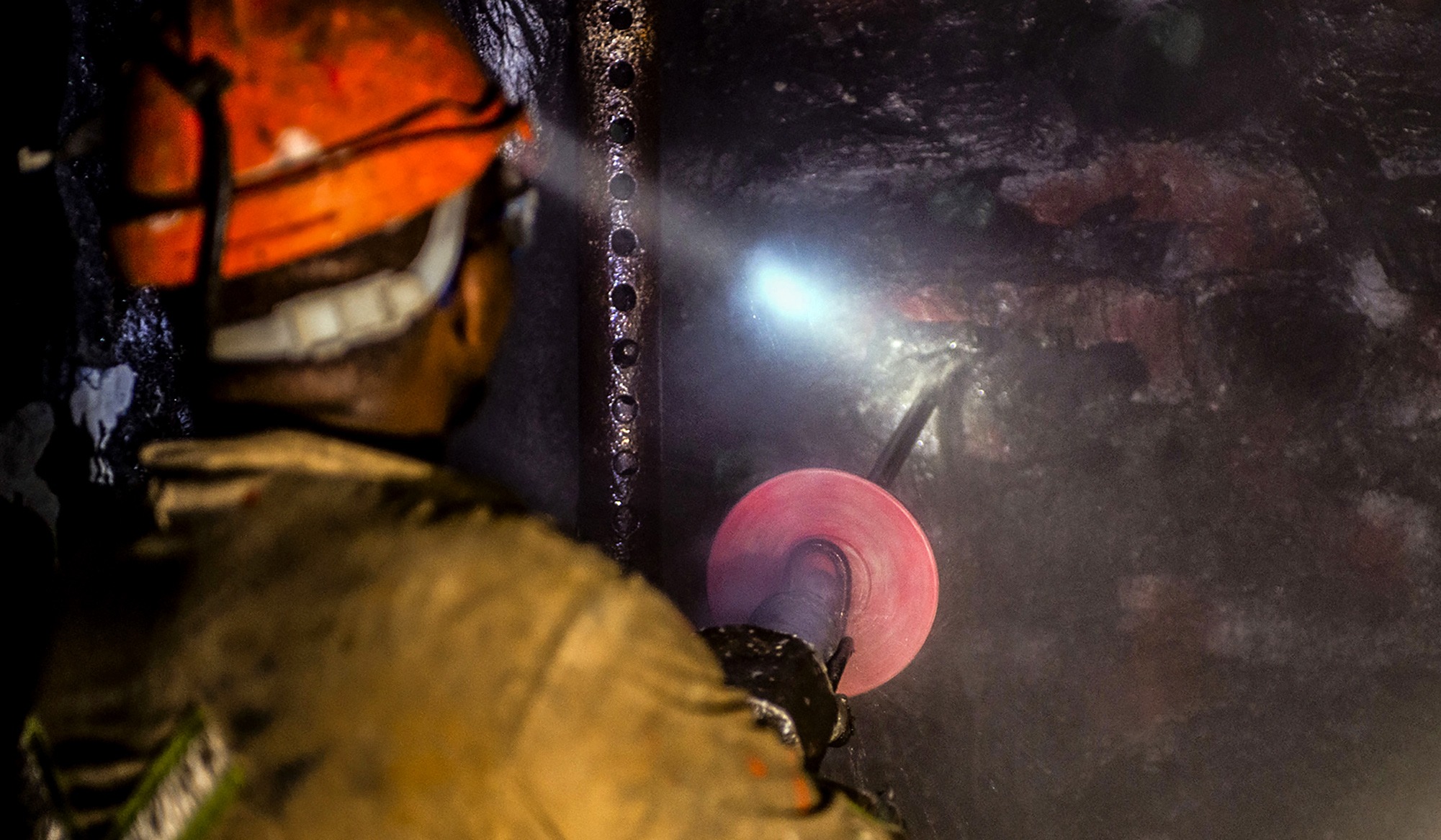
 A miner operates drilling machinery in the mine shaft during a media tour of the Sibanye-Stillwater Khuseleka platinum mine, operated by Sibanye Gold Ltd., outside Rustenburg, South Africa on Wednesday, Oct. 16 2019. Sibanye said its on track to resume paying dividends next year, should the company settle a wage dispute with platinum-mine workers without too much disruption. (Photo: Waldo Swiegers / Bloomberg via Getty Images)
The roll-out of South Africa’s long-delayed mining cadastre, seen as crucial for shining the light of transparency on the sector and addressing backlogs in applications for permitting and rights, has a new timeframe: by 31 March next year.
That was the timeline given by Jacob Mbele, the director-general of the Department of Mineral and Petroleum Resources (DMPR), during a panel discussion organised by Resources4Africa at the Junior Mining Indaba in Johannesburg on Tuesday, 9 June.
“The end of my financial year, which is 31 March,” Mbele said when asked point blank for a date by veteran miner Bernard Swanepoel, who quipped that “this will be the fifth time that you don’t keep it but give me a date”.
The mining sector would be forgiven for not holding its breath. Cadastre date launches have been promised numerous times, raising hopes in the industry, only to be sunk down a shaft of despair.
A functional mining cadastre displays the state of play of mining rights in a country and its geology, and enables companies to seamlessly apply for such rights in a transparent manner. The lack of one is seen as a key deterrent to investment in South Africa’s mining sector, notably for exploration – and a mining industry has no future without robust exploration.
/file/attachments/orphans/2026-02-0916_51_55-Greenshot_184516.jpg "The impact of having a non-functioning cadastre is reflected in the downturn in mining exploration in South Africa. (Image: MCSA)")
Cadastre is a ‘mythical creature’
“The new cadastral system has become a mythical creature that is difficult to believe in. Every time we get close to the projected roll-out date a new date is set,” James Lorimer, a DA MP and the party’s spokesman for mineral and petroleum resources, told Daily Maverick on the sidelines of the conference.
“There is a library of excuses, which is continually growing. One is forced to ask who benefits from keeping us in ignorance of who owns mining rights.”
Mbele said at the Mining Indaba in Cape Town in February that “data issues” were hampering the roll-out, and basically repeated this refrain on Tuesday – while adding the new target date.
“We initially wanted to implement the cadastre nationwide, but we quickly realised as we started that it was not going too well. And we decided to implement it by first starting in one province,” Mbele said.
That was in the Western Cape, and Mbele said that test drive had gone smoothly and that the province’s applications and licensing system had “fully migrated” to the cadastre.
Viewed through this prism, the DMPR is taking no chances and wants everything ship shape for the national roll-out, which is fair enough.
/file/dailymaverick/wp-content/uploads/2025/06/GettyImages-651390860.jpg "Initial plans to launch the cadastre nationwide were dropped when the Department of Minerals and Petroleum Resources realised the enormity of the task; it is now being rolled out province by province. (Photo: Waldo Swiegers / Bloomberg via Getty Images)")
And it’s probably the case that transferring data from the dysfunctional Samrad system – which has been in place for mining and prospecting applications for more than a decade – is a more daunting task than many realised, including Canada’s Pacific GeoTech Systems, which was announced as the preferred bidder to head the cadastre consortium in January 2024.
But the endless delays fuel suspicions that the spoor of corruption at DMPR provincial offices, notably in Mpumalanga and Limpopo, needs to be concealed.
Mpumalanga, where criminality surrounding the coal value chain is widely seen as being rife, has long been the main bottleneck for applications for mining permits in South Africa.
Brief timeline of the winding, unfinished road to SA’s mining cadastre
⚒️ August 2021: The DMPR – then the DMRE – launches a tender to replace its dysfunctional Samrad system with a functional cadastre.
⚒️ October 2022: Director-general Jacob Mbele makes a commitment that a cadastre will be procured by the end of the financial year – by 31 March 2023.
⚒️ February 2023: At the Mining Indaba, President Cyril Ramaphosa says the cadastre procurement “is under way”.
⚒️ End of February 2023: Mantashe says the State Information Technology Agency is still scrutinising bid specifications.
⚒️ August 2023: The department announces that a winning bidder has been selected to develop the cadastre, and the announcement will be made in October.
⚒️ January 2024: The preferred bidder is announced – three months late. It is a consortium led by Canada’s respected Pacific GeoTech Systems.
⚒️ October 2024: Mantashe assures a mining conference that the cadastre will go live in June 2025.
⚒️ May 2025: The DMPR says the launch will be restricted to the Western Cape as a test drive.
⚒️ February 2026: It turns out that “data issues” delay the roll-out and the aim is now for implementation to take place by 31 March 2027.
Provinces with cadastre ‘challenges’
Mbele pointedly said that after the Western Cape, the cadastre would be adopted next in the Free State, KwaZulu-Natal and the Eastern Cape, noting that “[...] the data issues in those regions are not as big as in other regions. [...] We do recognise that Mpumalanga, Limpopo and North West have their challenges.”
Mbele also said that the DMPR had hired “data capturers” to help with the process – though they may be running in some cases into the wall of State Capture.
“You have to migrate your data. Many other countries do not have the complexity that we have. There’s a lot of data to move from the current system,” he said.
/file/dailymaverick/wp-content/uploads/2025/05/IMG_0742.jpg "The mining applications process of the new cadastre displayed on a big screen. (Photo: Ed Stoddard)")
Asked about the applications bottleneck and its current size, Mbele did not provide a precise figure, but said that the DMPR received about 2,800 applications per year “so the backlog is in a rolling window. [...] On average we are able to process about 2,500 applications per annum.”
And once the cadastre is up and running he said many of those applications would be rejected outright by the system – a clear sign that dubious applications are being made.
So the mining sector has a new date and we will see by 1 April next year if this one is met or not. That will be almost six years since the DMPR launched its first tender to replace Samrad. DM
Comments
Scroll down to load comments...