




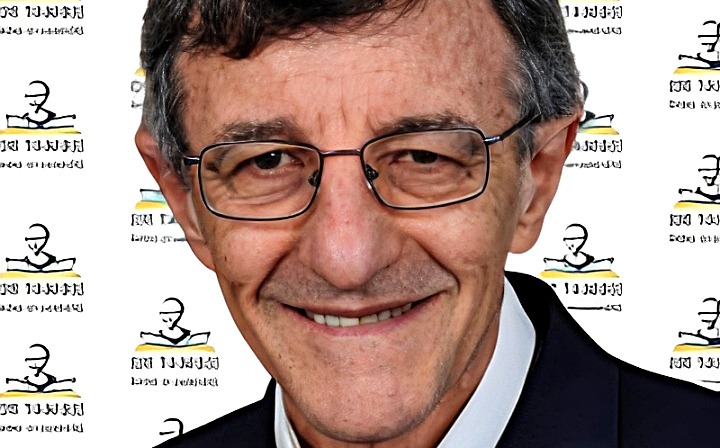
 Mr John Pampallis. (Photo: OR TAMBO School of Leadership / Wikipedia)
John Pampallis, who has died at the age of 77 of pneumonia on 2 June in Johannesburg, dismantled the intellectual scaffolding of apartheid and helped forge South Africa’s democratic education system. As a teacher, mentor and chief intellectual architect of the 1996 South African Schools Act, he transformed abstract ideals of equity and justice into tangible, enduring law.
/file/attachments/orphans/714699779_1559188369551020_5507778104187555994_n_445428.jpg "John Pampallis, a lifelong champion of equitable, non-racial education, captured here in a moment of<br>quiet authority during his later years of public service. (Photo: JET Education Services / Facebook)")
quiet authority during his later years of public service. (Photo: JET Education Services / Facebook)
/file/attachments/orphans/0000205877_351690.jpg "John Pampallis speaks during the launch of the White Paper on Post-School Education and Training on January 16, 2014 in Pretoria. (Photo: Gallo Images / Foto24 / Lisa Hnatowicz)")
He was born in Durban on 15 May 1949, the son of a businessman whose interests included Kings Coffee Bar, a hamburger joint in the city centre. His childhood blended disciplined academics with the arts.
Anthony Akerman, the writer and playwright, who attended Highbury Preparatory School with him from 1955 to 1962, recalled the young Pampallis as a dedicated student and budding pianist. “I would arrive at the school on my bicycle,” Akerman recalled, “and I could hear him practising Beethoven’s Für Elise in the music rooms. I loved that tune, but all I could play on the piano was chopsticks. In our final year we were in the scholarship class, just nine of us.”
During school holidays the boys would watch Elvis Presley films before retreating to his father’s coffee bar for free hamburgers and double-thick malted milkshakes. They later attended different high schools, Pampallis going to Kearsney College, before their paths crossed again in 1967 at an army camp in Voortrekkerhoogte.
It was a brief reunion before the divergent currents of apartheid South Africa pulled them apart. Akerman went into exile in the Netherlands and Pampallis to Canada. The colonial traditions of Kearsney inadvertently exposed Pampallis to the stark inequalities of the society he would later strive to reform. He recognised early that true liberation required the emancipation of the mind, and that education was the most potent weapon in that struggle.
Pampallis left South Africa in 1976 and became an active member of his local ANC branch in Winnipeg. It was through that branch that he learnt the ANC was recruiting teachers for a new school in Tanzania.
/file/attachments/orphans/HIGHBU_1_184582.jpg "Highbury Preparatory School for Boys, Standard 6, 1962. John Pampallis seated extreme left with the beatific smile. Anthony Akerman back row standing, fifth from the right practicing an Elvis Presley side smile. (Photo: Supplied / Anthony Akerman)")
/file/attachments/orphans/JohnPampallisatHighburypreparatoryschoolin1962_372605.jpg "John Pampallis at Highbury preparatory school in 1962. (Photo: Supplied / Anthony Akerman)")
His wife Karin says: “He responded to the call and spent eight years teaching at Somafco (Solomon Mahlangu Freedom College, an ANC school in Tanzania). Many of the teachers in the early days of Somafco did not have formal teaching qualifications or teaching experience. My husband was a qualified teacher, and he was therefore in a position to mentor some of his colleagues.”
At Somafco he taught history and English, eventually rising to head the social science department and becoming deputy vice-principal. Former students recalled his calm authority and fairness, noting that he commanded respect without ever raising his voice.
In the early years there was no school library at Somafco. Karin says her husband “arranged with the construction team to build shelving in the living room in their house at Somafco.
“He slowly accumulated an extensive library of books from foreign donors and other sources. The shelves filled up with books on politics, history, economics and various other topics. Students would come to their living room to read, study and borrow books.”
The depth of his commitment was perhaps best captured in a letter he wrote to Akerman in 1984, after receiving a copy of Akerman’s play Somewhere on the Border. Writing from Somafco, Pampallis reflected on the “unreal” nature of their shared past in the military, contrasted with the “horribly real” struggle then unfolding. “If one compares the attitudes and morale of the South African troops with those of the uMkhonto weSizwe cadres,” he wrote, “one is left in little doubt about which side is eventually going to win.”
He spoke of his years in Tanzania with modesty: “I’m enjoying it on the whole and feel that I’m at least doing something a little useful. Also it’s nice to be working for ‘the system’ because one agrees with it, instead of always trying to work to try to subvert it.” In a flash of humour, he teased Akerman about his move to Holland: “Your Afrikaans was always so fucking lousy. Have you learned to speak Dutch properly?”
/file/attachments/orphans/IMG_0001_773702.jpg "Handwritten notes (dated 21 January 1984) from John Pampallis to his former schoolmate, South African writer and playwright Anthony Akerman. Akerman had sent him a copy of his play Somewhere on the Border while Pampallis was teaching at SOMAFCO (the ANC school in Tanzania) in exile. The letter is written on Umkhonto we Sizwe (MK) stationery, including the movement’s 1961 manifesto. (Image: Supplied / Anthony Akerman)")
/file/attachments/orphans/IMG_0002_223093.jpg)
With the dawn of democracy in the early 1990s, Pampallis returned to a nation on the cusp of change. His work as research coordinator, and later director, of the Education Policy Unit at the University of Natal saw him play a pivotal role in shaping post-apartheid schooling governance. As a prominent member of the influential Hunter Committee on the Organisation, Governance and Funding of Schools, his recommendations laid the direct groundwork for the South African Schools Act of 1996, a cornerstone of democratic education reform.
Pampallis served as director of the Centre for Education Policy Development, Evaluation and Management (CEPD), a professionally autonomous centre established on the initiative of the mass democratic movement. He spearheaded major research initiatives focused on human rights, democracy and social justice in education.
He was instrumental in establishing the Education Policy Consortium, a partnership of four university-based Education Policy Units. These efforts produced seminal works, including Emerging Voices: A Report on Education, published by the Nelson Mandela Foundation, and Democracy and Human Rights in Education and Society, which Pampallis co-edited.
/file/attachments/orphans/JohnPampallisontherightlookingatthephotoatServicesSchoolVoortrekkerhoogte1967_799060.jpg "John Pampallis (on the right looking at the photo) at Services School, Voortrekkerhoogte, 1967. (Photo: Supplied / Anthony Akerman)")
As a writer, Pampallis produced Foundations of the New South Africa, a history textbook drafted in the mid-1980s and tested on senior classes at Somafco before publication in South Africa in 1991.
Jane Rosenthal, the South African literary critic and book reviewer, notes that he “also wrote the matric history textbook” and served as series editor for 13 biographies in the They Fought for Freedom collection, published by Maskew Miller Longman, championing non-racialism and gender equality.
Rosenthal was among the writers he commissioned for the series: “He specifically wanted some of the women who had been leaders in the Struggle to be written about. In Cape Town these included Ray Alexander, Cissie Gool and Dora Tamana. I chose Dora Tamana. This book was published in 1995.”
The series ranged widely: Rosenthal recalls that “John commissioned books on many others: Sol Plaatje, Mahatma Gandhi, ZK Matthews, Steve Biko, Oliver Tambo, Nelson Mandela, Thabo Mbeki, Seretse Khama. And other women such as Helen Joseph, Ruth First and Lilian Ngoyi. He roped in Chris van Wyk, poet and writer, as consulting editor of this series.
“These small books were accessible and properly researched stories of black South African history that brought new light to students and also their teachers. Before this there was almost nothing written at school level which told the whole story of South African history, not just the white, colonial viewpoint.”
Rosenthal described him as “an inspiring and interesting person to work for, courteous, considerate, well informed and really excited about bringing the proper history of South Africa into schools and homes in South Africa. He introduced me to many people who had known Dora Tamana, so it was easy to set up interviews. These included Wolfie Kodesh and Ray Alexander.” She remembered him as “one of those old South African lefties, unpretentious, straightforward and seriously committed to bringing about change in South Africa”. He was a good friend of Blade Nzimande and worked as one of his policy advisers when Nzimande was minister of higher education and training.
Tributes from across the nation reflected the respect he commanded. Minister of Higher Education and Training Buti Manamela described Pampallis as a pivotal figure in both the struggle against apartheid and the building of a democratic education system. “During the darkest days of apartheid, John chose the path of activism through education,” Manamela said. “He didn’t just document South African history; he helped rewrite its future.”
This sentiment was echoed by Rej Bhai Brijraj, a fellow educationalist, who remembered Pampallis as a “gentleman revolutionary” and an “intellectual giant” with the humility to make everyone feel important. “He knew, and taught us, that education transformation was key to a democracy in the making,” Brijraj reflected, adding that Pampallis’s down-to-earth friendliness disarmed even the most hardened radicals, empowering all towards pragmatism.
Beyond his scholarly and policy contributions, Pampallis dedicated himself to nurturing future generations. At the CEPD he established a highly successful Capacity Building Internship Programme, recruiting and developing young research professionals in education and social transformation. Many former interns have since ascended to senior roles in academia, government and civil society.
Professor Mandla J Radebe, professor of strategic communication at the University of Johannesburg, added a personal perspective: “John was a close family friend whom I came to know well through my wife Sarah, who had a long-standing friendship with both John and his wife, Karin.
“What stands out most about John, apart from being a dedicated and loyal South African who devoted his life to improving education, was his humility, almost to a fault. Reserved and unassuming, his views were often bold and deeply insightful. Whenever you gave him a draft he would take a pencil and carefully annotate it with thoughtful, polite comments in his distinctive cursive. Even when he disagreed, his observations were never dismissive; they were always measured and delivered with humility and grace.”
Graham Dyson, who worked as an anti-apartheid lawyer in Johannesburg in the 1980s, says: “When he returned to South Africa, he contributed by continuing to work with education and wrote many fine contributions to South African history, which corrected several of the distortions presented by the apartheid regime’s education system.
“As people of Greek heritage, the Pampallis family, like lots who did not fit the apartheid regime’s Übermensch model of Protestant Christians, suffered discrimination and prejudice for being ‘different’.
“John and I studied together at university in Durban. I remember well that he already had installed in him a powerful strength of righteousness from the start of his tertiary studies.
“He was not a loud person. But he was always firm and consistent when confronted with racism and discrimination. Although we have lived in different countries (Norway) for much of our adult lives, I shall miss John. Go well, quiet hero.”
Outside the policy rooms and the archive, Pampallis was a man of specific pleasures. His daughter Irene recalls that “for a man who spent so much of his time reading, writing and attending meetings, he had a passion for the outdoors. He loved fly fishing, and was excited to share that love with me.
“Some of my fondest childhood memories are of visiting various dams and streams, watching Dad fish, learning to cast.” In Johannesburg, where he moved in 1996 and remained until his death, he walked often around Emmarentia Dam, almost always with Irene. “We would spend hours strolling and chatting,” she recalls.
“I loved hearing his stories about growing up in Natal in the 1950s and 1960s as the child of Cypriot immigrants, about his adventures in Europe and Canada and Tanzania.” Whenever the family visited Durban, he was always keen to take an early morning walk along the beachfront. “I still can’t see the ocean without thinking of his great love for it,” Irene says.
“Although he moved from Durban to Johannesburg in 1996 and remained in Johannesburg until his death, he always remained a Durban boy at heart. Even as Dad got older and his health began to fail, he loved to sit outside on the veranda, watching the garden and listening to the birds. It gave him such great joy to hear them.”
John Pampallis’s legacy is such: While others fought apartheid through politics or armed struggle, Pampallis fought through education, believing it to be the most enduring path to a just and equal society.
A friend and colleague, Professor Salim Vally from the University of Johannesburg, says: “In later years John’s gentle smile never left him despite serious health challenges. The only time I saw a flash of anger cross his face was when he expressed disgust at the appalling corruption of well-known figures.”
He is survived by his wife Karin, his daughter Irene, his brother Michael and his sister Maria Shiakallis. DM
Comments
Scroll down to load comments...