




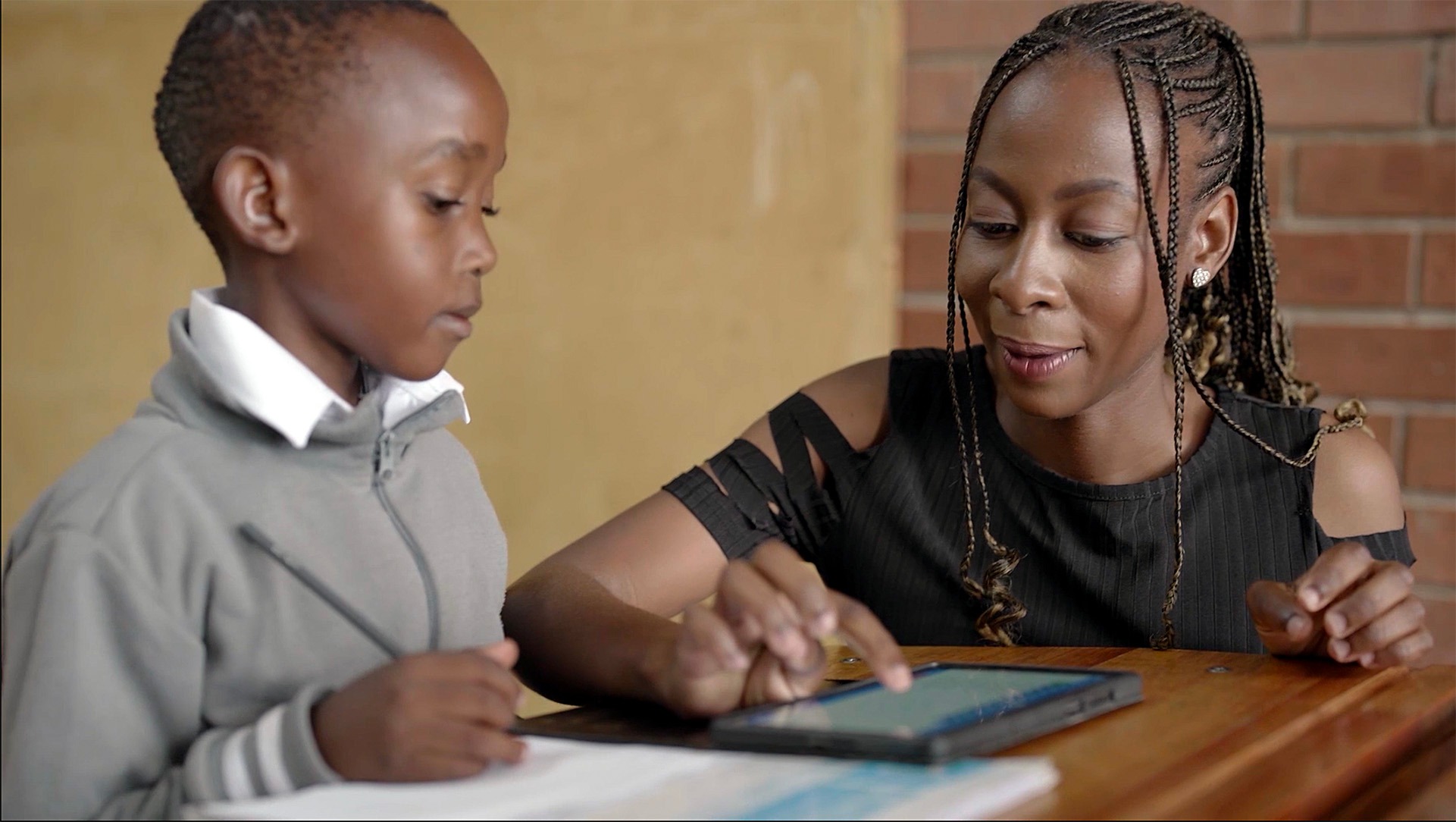
 The JumpStart Foundation operates at the intersection of early-grade mathematics education and youth employment, placing young adults into schools as educator assistants. (Photo: Iron Heart Content Creation Studio)
For many young South Africans, the months after matric are marked less by celebration than by uncertainty: a wait for work, for study or for any clear next step.
According to the latest Quarterly Labour Force Survey from Statistics South Africa, the country’s youth unemployment crisis continues to worsen, with the jobless rate for those aged 15 to 24 climbing to 60.9%. Additionally, 45.6% of young people in the country aged 15 to 34 are currently classified as Neet (Not in Employment, Education or Training), leaving nearly half of SA’s young people locked out of both the economy and the classroom.
The JumpStart Foundation, a non-profit organisation that operates at the intersection of early-grade mathematics education and youth employment, believes the solution doesn’t require looking outside the school gates. Instead, one response to youth joblessness can be found inside the primary school classroom, through JumpStart’s Educator Assistant programme.
A dual crisis necessitates a dual solution
Lufuno Muthubi-Mthethwa, the executive director of the JumpStart Foundation, explained that South Africa’s systemic struggle with mathematics is a concern, with international assessments consistently ranking the country’s learners at the very bottom of global benchmarks. To fix these foundational numeracy gaps while simultaneously tackling the country’s youth unemployment crisis, the non-profit developed a dual-intervention model.
/file/attachments/orphans/LUFUNOHEADSHOT_388362.jpg "Lufuno Muthubi-Mthethwa, executive director of the JumpStart Foundation. (Photo: Iron Heart Content Creation Studio)")
Muthubi-Mthethwa explained that they recruit unemployed young people directly from the communities surrounding their partner schools and train them to work as classroom tutors. The foundation deploys roughly 230 interns across Limpopo, the Free State, Gauteng, Mpumalanga and the Eastern Cape.
While 40 of these interns are stationed at a specialised software lab in Cresta, Gauteng, learning digital development, the rest are deployed directly in the field. These tutors provide immediate feedback to learners, help bridge learning gaps, and ease the burden on educators in under-resourced communities.
“South Africa struggles in mathematics, particularly in Quintile 1-3 schools that are under-resourced, and in some instances where teachers are not capacitated enough to teach maths at that age,” said Muthubi-Mthethwa.
From post-matric limbo to career pathways
By stepping into these gaps, the interns gain as much as the pupils they teach.
“We train them up as tutors, giving them meaningful work experience. The foundational framework is ultimately about trying to get the youth ready for the digital economy as well as creating pathways for youth to participate economically,” said Muthubi-Mthethwa.
For many assistants, the 12-month internship is their first meaningful step into the job market, earning them a monthly stipend, helping them build practical workplace skills, confidence and leadership abilities in a structured environment, while providing early-grade learners with the intensive numeracy support they need to succeed.
/file/attachments/orphans/SCENE31_311270.jpg "A young learner tackles a numeracy problem in class. Through the JumpStart programme, learners receive an additional three and a half hours of dedicated, high-quality mathematics practice each week. (Photo: Iron Heart Content Creation Studio)")
The programme is designed to offer more than temporary work as participants receive e-learning modules, masterclasses and access to a bursary pool for those who want to pursue degrees in education.
The foundation also absorbs roughly 10% of each cohort internally to serve as supervisors for the next cycle.
The tangible impact of this training is reflected in recent data from a cohort of more than 300 participants:
- 17 participants completed the programme and went on to pursue further studies;
- 15 participants secured employment opportunities outside the programme;
- Several participants transitioned into teaching-related roles; and
- Many others continued studying or completed additional qualifications while participating in the programme.
For one former participant, the programme became a turning point. Thato Molewa, who joined one of JumpStart’s programmes in Limpopo, said the experience sparked an interest in education and helped her picture herself as a teacher.
“I love working with learners. We monitor their progress, we help them where they struggle, and we celebrate their wins. Through JumpStart, I’ve learned new skills, and it has also opened doors for me. After this, I’ll be studying to become a teacher myself,” said Molewa.
What the numbers show
On the ground, the intervention is integrated directly into the schools’ existing timetables rather than running as an extracurricular afterthought. Working closely with local districts to secure a dedicated allocation of time, the foundation adds an additional 3½ hours of maths per week inside the classroom.
“We add on top of what the learners are already being exposed to at school. We use a workbook called NumberSense Workbook, which is typically used in private schools, and we bring it into the classroom,” said Muthubi-Mthethwa.
To monitor progress, the foundation tracks the workbooks through an app called JumpTrack.
“Tutors in real time are able to capture the progress of each learner. We are able to then see where the gaps are, where the learners need assistance, and feed that back into the school,” explained Muthubi-Mthethwa.
/file/attachments/orphans/SCENE46_796797.jpg "Educator assistants use the JumpTrack app to capture learner progress in real time, allowing the foundation to flag learning gaps before they widen. (Photo: Iron Heart Content Creation Studio)<br>")
This data-driven learner support is paired with direct teacher development, including a blended online teacher-training pilot in the Free State that the foundation plans to implement in Limpopo next.
Having recently wrapped up cycles in Limpopo and the Eastern Cape, Muthubi-Mthethwa describes the feedback as “amazing.”
In the Amathole and Chris Hani districts, the monthly stipend given to young people ripples through entire communities. “A teacher said to us, ‘Your programme has put food on the tables of families that had no hope,’ because through the youth development intervention, they earn a stipend, ” said Muthubi-Mthethwa.
On the academic front, Muthubi-Mthethwa said they observed a 12% increase in performance between 2024 and 2025 for Eastern Cape learners who moved from Grade 1 through to Grade 4.
A similar success story occurred in Finetown, Gauteng, where the foundation ran a three-year project in an exceptionally overcrowded and under-resourced school. Through the implementation of a high-intensity model, learners received a double layer of support: an hour and a half of targeted tutoring during the school day, followed by mandatory afternoon sessions.
“Those learners outperformed every single learner in our programme because they were getting an extra dosage every single day,” said Muthubi-Mthethwa. The difference in classroom outcomes was so visible to the faculty that exiting the school became a bittersweet milestone.
“When we closed those projects, the teachers were asking us to find more funding and stay in the school,” she said.
The limits of philanthropy
Operating strictly on donor funds from strategic partners including the Sasol Foundation, Old Mutual, the Oppenheimer Trust and the DG Murray Trust, the programme’s long-term sustainability and scalability remain inherently linked to donor funding.
Muthubi-Mthethwa was candid about the structural limits of civil society’s reach when facing South Africa’s macroeconomic reality.
“I do believe programmes like ours can help, but we do need better consolidation and working with the government more clearly, collaboratively and strategically to actually solve this problem. At the end of the day, I can lead an intern into an economic pathway, but if there is no job in that sector, it’s a problem,” she said.
While the Department of Basic Education has increasingly focused on early learning outcomes, the actual pace of change remains the ultimate hurdle, which has a devastating cost for the children waiting in South Africa’s classrooms.
“We’ve had this problem for a very long time, and it’s almost exploded. The wheels are turning very slowly, and as they turn slowly, these learners are getting older and taking those learning gaps with them,” she said. DM
Comments
Scroll down to load comments...