




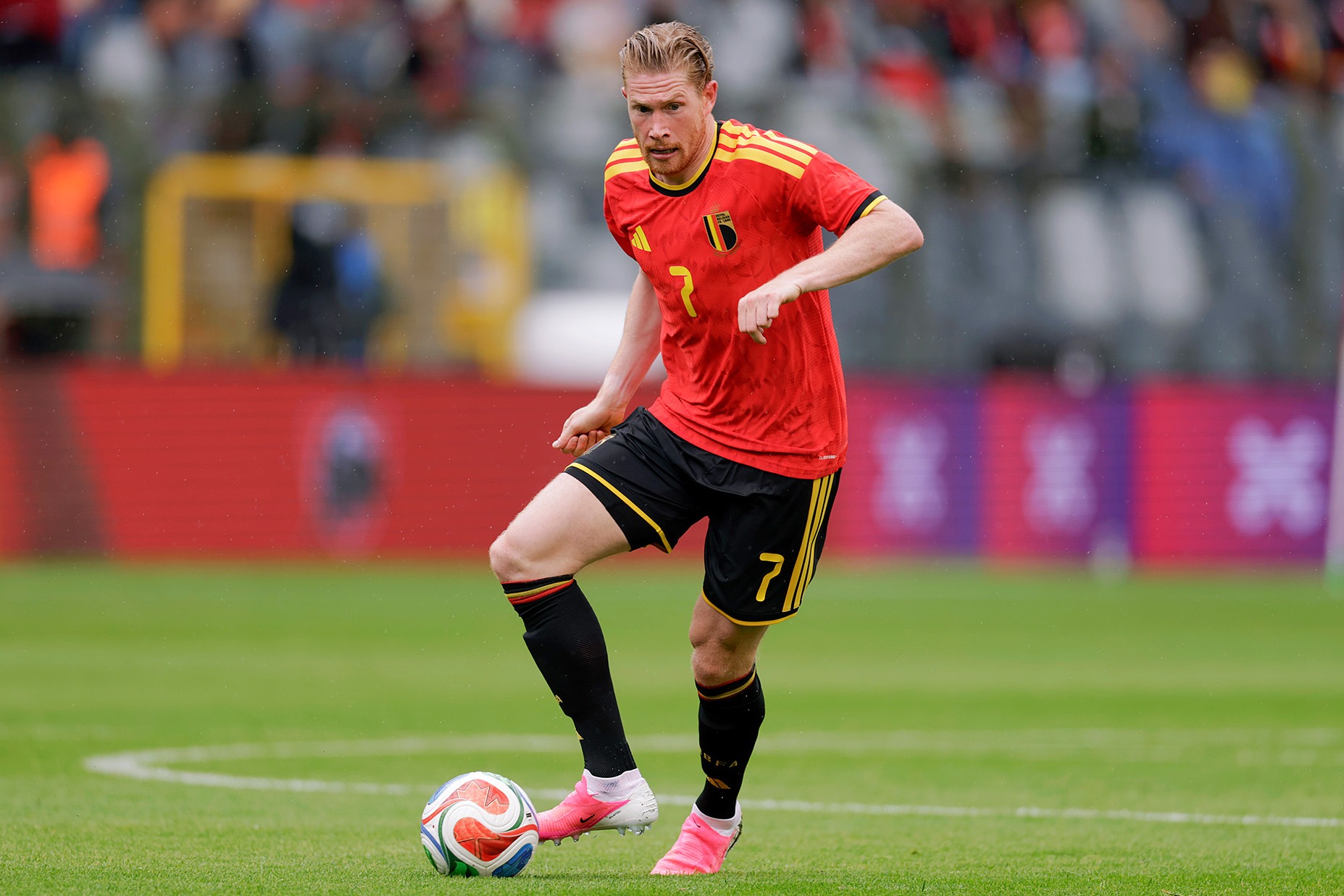
 Belgian midfielder Kevin de Bruyne remains central to his country’s World Cup hopes. (Photo: Joris Verwijst / Soccrates / Getty Images)
Belgium
The plan
The head coach, Rudi Garcia, is well aware that the Red Devils’ strength lies in attack. Kevin de Bruyne, Jérémy Doku and Romelu Lukaku can each make a difference. The defence is, except for goalkeeper Thibaut Courtois, the weak point after the golden generation of Toby Alderweireld, Vincent Kompany, Thomas Vermaelen and Jan Vertonghen dropped out. “That is why I will always choose four defenders and not five,” Garcia explains. “With five defenders, I have to sacrifice an attacking player, and that would be a shame.”
Garcia usually opts for a medium block to support the attack and not put too much pressure on the defenders. His reasoning could be described as flawed because there is a problem with Lukaku. He played only 64 minutes for Napoli this season and none for the national team because of injuries. He was also deeply affected by the death of his father. Belgium’s all-time top scorer — 89 goals — will therefore start the World Cup without a match rhythm.
Qualifying went smoothly against Wales, North Macedonia, Kazakhstan and Liechtenstein. Despite going undefeated, the level of play was not high, and there were three draws, two against North Macedonia and one in Kazakhstan. With 29 goals in eight games, the Red Devils underlined where their strengths lay. It’s clear that there will be plenty of attention on Doku in attack and Courtois to prevent goals.
Garcia has only been in charge since January 2025 and said at his unveiling: “I am ready to take on the challenge. It will take time to learn, even though we don’t have much of it. It’s not about trying; it’s about doing; that’s my motto.” Hard work is key, according to the Frenchman. “We must focus on the mindset. We must wear the jersey with pride and give everything for the national team.”
The coach
Rudi Garcia is a national coach for the first time in his career and will be making his World Cup debut in North America. The 62-year-old succeeded Domenico Tedesco in January 2025 and has plenty of experience, having been in charge at Lille, Roma, Marseille, Lyon, Al Nassr and Napoli, among others. The Frenchman is old-school, rejecting data-led analysis, and has restored a good atmosphere to the national squad. “What matters to me is that there is a team on the field,” he says. “My experience shows that you get the furthest that way.”
/file/attachments/orphans/2279598664_194261.jpg "Belgium head coach Rudi Garcia. (Photo: Rene Nijhuis / MB Media / Getty Images)")
Star player
Jérémy Doku is the most popular player in the squad. The 23-year-old Manchester City attacker is still making giant steps in his development. Having relied solely on his impressive speed, he has developed his crossing ability of late and scored some important goals in the closing stages of this Premier League season. “I know my qualities and know that I have to work on my statistics,” he said. “But I’m not there yet.”
/file/attachments/orphans/2279629642_302243.jpg "Speedster Jérémy Doku of Belgium dribbles with the ball during the international friendly match between Belgium and Tunisia on 6 June in Belgium. (Photo: Rene Nijhuis / MB Media / Getty Images)")
One to watch
Matias Fernandez-Pardo was not in Garcia’s plans until early May. The 21-year-old Lille striker, who holds Spanish and Belgian passports, had declared he would choose Spain. When the Belgian FA sounded him out again due to the doubts surrounding Lukaku and the decline of Loïs Openda at Juventus, he changed his mind. His speed, dribbling skills and opportunism have earned him a slot in the World Cup squad. Fernandez-Pardo left Gent in the winter of 2025 as a winger, but the Lille coach Bruno Génésio has deployed him as a striker, leading to eight goals and five assists in 29 league games in 2025-26.
Unsung hero
Maxim de Cuyper. The 25-year-old Brighton left-back is of great value to the Red Devils with his attacking contributions and, in the absence of Lukaku, developed into a regular goalscorer with four goals in his past 14 games by mid-May, each one more beautiful or important than the last. Under Garcia, he has started every match when fit. He will likely retain that status during the World Cup despite his status as a substitute all too often at Brighton.
What to expect from fans at games?
Belgian fans love having a few beers before entering the stadium, having fun and are never violent. However, there are not many chants because Dutch, French and a little German are spoken in Belgium, the linguistic mix making it difficult to coordinate the songs. As a compromise, they simply sing in English, if there is any singing at all.
Relationship with the US/Trump?
Just as in most other EU countries, there is scepticism about Donald Trump, and certainly about his manner of expression. He once called Molenbeek, a suburb of Brussels, a “hellhole”, and that did not go down well. The Belgian FA is unlikely to say anything publicly, and while fans have complained about high prices, there has not been any talk of a boycott. By Ludo Vandewalle
Egypt
The plan
Egypt qualified for the World Cup unbeaten after missing out on Qatar 2022, booking their ticket to North America with a game to spare. They scored 19 goals in nine matches, as Mohamed Salah led the way with nine, and the defence conceded two goals and kept seven clean sheets. Despite the impressive numbers in qualifying, Egypt’s shape is pragmatic more than romantic, and they carried that same muscle memory into the 2025 Africa Cup of Nations: tight games, deep stretches without the ball, quick release into Salah or Omar Marmoush. This was exposed by a semifinal defeat to Senegal, when Egypt were set up more to endure rather than to control.
Egypt’s World Cup formation will probably begin in a 4-3-3 that becomes a 4-2-3-1 when they have to chase a game, while occasionally switching to a 3-5-2 against high blocks. Mohamed El-Shenawy is likely to start in goal, although Mostafa Shobeir has lately been giving the veteran a run for his money. The rest of the spine looks solid with Rami Rabia and either Hossam Abdelmaguid or Yasser Ibrahim in central defence. Marwan Attia and Hamdi Fathi will screen the backline, and Emam Ashour will carry the ball to the trio up front: Salah, Mostafa Mohamed and Omar Marmoush.
The coach, Hossam Hassan, has effectively confirmed there will be no late tactical revolution, saying he has settled on “90%” of the side. He also frames the team as “100% locally made” compared with other African rivals who are stocked with European-born players.
“Hossam Hassan is completely different from the foreign coaches we have had before,” says the forward Ahmed Sayed “Zizo”. “He manages to convince you that you are the best player in the world even if you’re coming to the camp not having been in good form.”
Egypt are cohesive, often hard to score against and emotionally committed, but they can still look blunt if opponents double up on Salah and the midfield cannot pass through the press. The draw placed Egypt in Group G with Belgium, Iran and New Zealand. Egypt have never won a World Cup match, and that is the floor-level target.
The coach
Hossam Hassan is the national team’s all-time leading scorer and a legend in Egyptian football. As a manager, the fanfare is considerably thinner. Across nine clubs and two national teams, he has won zero trophies. His appointment in 2024 carried a nationalist tone from day one. When Egypt qualified for the World Cup, he declared: “We are happy for this great day for Egyptian football and for pleasing the Egyptian people, headed by Abdel Fattah el-Sisi [president of Egypt].”
After the 2025 Afcon semifinal exit, Hassan blamed the loss on mosquito-infested hotels and scheduling conspiracies before resorting to blood-and-soil nationalism. “Egypt is the mother of Arabs and Africa. No one possesses the history we possess. We won the African Cup seven times. This creates jealousy. No one will achieve what Egypt’s national team accomplished.” When a journalist pressed him on tactical shortcomings, Hassan replied: “Your questions are impolite and show no respect. I will not answer you. You lack media etiquette.” It was recognisably on brand.
Star player
This is still Mohamed Salah’s team, even if the club version has entered a more mortal phase. For Egypt, he remains the attacking system and the emotional infrastructure. In qualification, he was decisive again, scoring twice in the match that secured the World Cup spot and was the main reason Egypt’s campaign did not require late drama. Salah turns 34 the same day the Pharaohs play their first group match. He is approaching the end of his international career and is acutely aware that this may be his final chance to change that.
/file/attachments/orphans/2280240110_840642.jpg "This may be Mohamed Salah's last chance to play in the Fifa World Cup. Salah remains the attacking system and emotional infrastructure for Egypt. (Photo: Kirk Irwin / Getty Images)")
One to watch
FC Nordsjælland’s Ibrahim Adel is not a pure touchline winger: he attacks the half-space, arrives at the back post and presses with more appetite than many Egyptian attackers raised on a counterattack diet. The 25-year-old’s case is built on movement. He may not start every match, but tactically he offers something Egypt need: a wide threat capable of carrying the ball into the final third independently of Salah, which reduces the team’s dependency on a single right-side channel. This tournament could cement him as a genuine option at this level, but it could also reveal his limitations.
Unsung hero
Marwan Attia is the sort of midfielder who makes the whole side look slightly more coherent than it is. The 27-year-old screens centre-backs, covers full-backs, kills counters, restarts attacks, receives awkward passes under pressure, and gives Emam Ashour and the wide players permission to go forward. After qualification, Attia spoke of the World Cup as a source of immense pride and of the current generation’s potential to achieve positive results, especially “securing Egypt’s first-ever World Cup victory”.
/file/attachments/orphans/2280232680_847485.jpg "The versatile midfielder Marawan Attia of Egypt (right) competing for the ball against Igor Thiago of Brazil during the international friendly match between the teams on 6 June. (Photo: Kirk Irwin / Getty Images)")
What to expect from fans?
Egyptian support will be present, but not socially representative. The reality is the overwhelming majority of Egyptians will watch from their homes or in cafés, with a phone screen propped against a cup of tea if they need to. North America is not as close as Qatar, and Egypt is not part of a visa waiver program. The $185 visa application fee alone exceeds Egypt’s current minimum wage ($132), before flights, hotels or tickets. Expect diaspora families, wealthier Cairenes, corporate guests and expatriates. The broader Ultras, historically the most visible and vocal force in Egyptian football, have been systematically repressed since 2013, proscribed as terrorist organisations, and many of them are in prison.
Relationship with the US/Trump?
The team and the EFA are not publicly pro- or anti-American; however, the state relationship is more telling. Under Donald Trump, Cairo has usually received warmth and fewer human-rights lectures. In his first term, Trump infamously called Sisi his “favourite dictator”, while his second administration preserved Egypt, alongside Israel, as an exception in a wider foreign aid freeze.
The Egyptian president returned the praise, saying that Trump “is the only one capable of bringing peace to the region”. Notably, the World Cup flashpoint is cultural rather than diplomatic. The EFA formally asked Fifa to block LGBTQ+ pride activities around Egypt v Iran in Seattle, saying they clashed with cultural and religious values. The two countries have objected to the locally branded Pride match, which coincides with the city’s Pride weekend and was planned before the tournament draw took place. By Saher Ahmed
Iran
The plan
Iran were one of the first teams to secure qualification for the 2026 World Cup and, compared to previous campaigns, they had a relatively smooth path to the tournament. However, preparing the team for the competition has been anything but easy. Iran’s conflicts with the United States and Israel threw their involvement at the World Cup into serious doubt — all three of their group games take place in the US — and Amir Ghalenoei and his coaching staff have had to work hard to minimise disruption.
Nevertheless, in their two friendlies in March against Nigeria and Costa Rica, Iran showed that they have different plans in mind for the World Cup. In the first match against Nigeria, they lined up in a 3-6-1 formation — a setup Ghalenoei described as the team’s “defensive plan B”, probably designed for the group meeting with Belgium. In the second game, against Costa Rica, Ghalenoei used a 4-4-2 formation, indicating that he intends to shift tactics depending on the opponent. The primary system remains 4-2-3-1, which Iran used in most of qualifying.
A few players can feel certain of their place in the starting lineup regardless of the formation. Alireza Beiranvand will be Iran’s first-choice goalkeeper for a third consecutive World Cup. Shojae Khalilzadeh is the only centre-back guaranteed a starting spot, while Saeid Ezatolahi, if fully fit, is the undisputed No 6 in midfield. Up front, whether Iran play with one striker or two, Mehdi Taremi — wearing the captain’s armband — will lead the line. Another star forward, Sardar Azmoun, has been left out. He is a divisive figure in Iran following the publication of photos with the ruler of the United Arab Emirates, who supported the US and Israel during the war.
Despite the problems and controversies surrounding the national team, who moved their World Cup base camp from the US to Mexico just weeks before the tournament, Ghalenoei still believes his side are capable of achieving something special. “We’ve had many problems recently, but the players tried their best and made sacrifices. They worked so hard [through qualification] and sacrificed a lot, so it is my job to thank them. They can do something epic in the World Cup. They can do it; they have the technical potential to make this a World Cup to remember.”
The coach
Amir Ghalenoei was a diminutive midfielder who played mainly for Esteghlal, one of Tehran’s two biggest clubs. The most memorable moment of his playing career was a physical altercation in the Tehran derby that resulted in a six-month suspension. As a coach, Ghalenoei went on to become one of the most decorated managers in Iran, although his aggressive personality has prevented him from becoming universally popular. This is his second spell in charge of the national team. He first took over after the 2006 World Cup but was dismissed following Iran’s elimination from the 2007 AFC Asian Cup — an episode he still recalls bitterly. Success this summer would give Ghalenoei an opportunity to settle old scores with his long-time critics.
Star Player
Mehdi Taremi has never truly been a fan favourite, but there is no doubt that if Iran are to achieve something significant at the World Cup, their hopes will rest on the form of a player who has delivered consistently for Porto, Inter and Olympiakos. Having spent several years competing at the highest level in Europe, Taremi has developed confidence and authority, to the point that he is now influential in the team’s internal decisions as well. He is a hard-working striker who also contributes defensively. His greatest strength lies in making runs behind the opposition’s defence and finding himself one-on-one with the goalkeeper. In those situations, he is always ready to either score or go down at the slightest contact and win a penalty for his team.
/file/attachments/orphans/2218817130_820162.jpg "Mehdi Taremi is a key figure in the Iranian national team. (Photo: Mohamed Farag / Getty Images)")
One to watch
Many in Iran expected Mehdi Ghayedi to develop into a major star, but controversy and off-field distractions seem to have followed him everywhere. So far, he has failed to achieve the level of consistency and continuity that had been expected of him, but he is only 27 and should be in his peak years. The lightning-fast Al-Nasr (UAE) winger could, in fact, become Amir Ghalenoei’s surprise weapon in North America. With his dazzling dribbling skills and precise finishing, Ghayedi is capable of producing eye-catching moments. After spending some time sidelined through injury, he marked his return to the national team with a stunning goal against Costa Rica in March.
Unsung hero
Since making his debut almost a decade ago, Saman Ghoddos has been a reliable, consistent member of the Iran squad. However, since he has never played for any Iranian club, he has not benefited from the traditional support of club fans, and as a result, has received less media attention. Nevertheless, thanks to his good character and professionalism, the former Brentford player — who can play almost anywhere on the pitch — is a well-liked figure within the team. Born in Malmö (Sweden), he left the Premier League for Kalba FC in the UAE in September 2024.
What to expect from fans at games?
For the second consecutive World Cup, Iranians are deeply divided over the national team. On one side are the supporters who back Team Melli under any circumstances; on the other are those who oppose the Iranian government and therefore prefer to see the national team — which they view as representing the state — lose. Given the visa restrictions facing Iranians travelling to the US, a large portion of Iran’s supporters at the tournament will probably be members of the diaspora already living in the US, many of whom are opposed to the government in Tehran. Like in Qatar in 2022, Fifa is expected to ban the Shir-o-Khorshid (lion and sun) flag — Iran’s pre-revolutionary flag — from stadiums, but it would not be surprising to hear chants in support of Reza Pahlavi, the former crown prince of Iran. Likewise, if Iran concede goals or lose matches, sections of the crowd are likely to celebrate those moments openly.
Relationship with the US/Trump?
After the outbreak of the recent war, serious doubts emerged over whether Iran’s national team would travel to the US for the World Cup. Ahmad Donyamali, Iran’s sports minister, said: “Given that this corrupt regime has assassinated our leader, under no circumstances can we take part in the World Cup.” After Donald Trump stated that the Iran team might not be guaranteed security while travelling to the US, Iran’s head coach, Amir Ghalenoei, responded sharply in an Instagram story: “No one can keep the Iranian national team out of the World Cup.”
In the end, the decision was made that Iran should take part. One important reason was the perception that Trump would prefer to see the competition held without Iran’s presence, and Iranian officials did not want withdrawing from the tournament to be seen as giving the president what he wanted. Despite the security concerns, the Iranian government views the national team’s participation as another symbolic victory against Trump and the US. By Behnam Jafarzadeh
/file/attachments/2993/fifa_2026_groups_533614.png)
New Zealand
The plan
New Zealand, known as the All Whites, are back at the World Cup for just the third time, thanks to winning the Oceania region’s sole qualifying spot. Since their last World Cup in 2010, New Zealand have evolved from part-timers to professionals, and there is the belief they have the skillset and experience to make the knockout rounds for the first time.
It’s a tall order, though — New Zealand, at No 85 the event’s lowest-ranked qualifiers, are up against Belgium, who are ninth, Egypt in 29th and Iran (21st) in Group G. Renowned commentator Paul Ifill says the current squad is “miles better” than the one that went to South Africa, where they finished unbeaten with three draws. After the squad’s announcement, the coach, Darren Bazeley, agreed the side was in a good place: “It’s a blend of exciting young talent and experienced players to maximise our chances of winning games and getting out of our group.”
Bazeley favours possession football, which worked in their qualifiers but will be a bigger ask against more skilled opponents. Since qualifying, their 10 friendlies have included a draw against Norway (without Erling Haaland) and seven losses, including two to Australia. The warm-up matches in March were mixed — a lacklustre 2-0 loss to Finland preceded a sparkling 4-1 win over Chile days later. It was NZ’s first-ever win against a South American side.
Captain Chris Wood (Nottingham Forest) is one of two survivors of the last campaign, and much will depend on his fitness. The striker was a contender for top Premier League scorer in the 2024-25 season, but a serious knee injury late last year sidelined him for several months.
“New Zealand will need to be able to defend without the ball and then work out how to hurt opponents when we get the ball back. A lot will depend on whether Wood is fully fit,” says Ifill. The qualifying campaign — sealed with victory over New Caledonia in March 2025 — was “money for old rope for the All Whites” against smaller Pacific nations, said commentator Mathew Nash. “The gulf between New Zealand and the other OFC nations has been exacerbated to a chasm in recent years, as evident by the All Whites’ last 15 games against federation rivals: 14 wins, one draw, four goals conceded and 64 goals scored,” he told RNZ.
/file/attachments/orphans/2268567431_785477.jpg "Darren Bazeley, head coach of New Zealand. (Photo: Phil Walter / Getty Images)")
The coach
Northampton-born Darren Bazeley has grown into the role and got the team playing better to such a degree that they could be capable of the knock-out phase. Bazeley will achieve a World Cup first in LA — the first man in Fifa’s history to have coached at Olympic Games, Under-17, Under-20 and senior World Cup level. As a defender, he chalked up more than 450 appearances for Watford, Wolves and Walsall before coaching in the A-League and the MLS in the US. But the bulk of his experience has unfolded in New Zealand, where his involvement at age-group level has seen him work with all the current senior squad. They’re the players he’s kept faith with for the World Cup.
Star player
Chris Wood — 88 caps and 45 goals for the national team at the time of writing — fills a role akin to Cristiano Ronaldo for Portugal and Kylian Mbappé for France — skipper, record goalscorer and an inspiration. “He puts so much into playing for New Zealand, and he turns up, and he does everything off the pitch,” says Bazeley. Having arrived in England and West Bromwich in 2009, he had six loan spells in three years at the club — before representing Leicester, Leeds, Burnley and Newcastle and then taking his game to another level at Nottingham Forest.
/file/attachments/orphans/22802198531_672373.jpg "Chris Wood is widely regarded as one of the greatest New Zealand soccer players. Wood is one of just six New Zealanders to have played in the Premier League. (Photo: Rich Storry / Getty Images)")
One to watch
The 26-year-old attacking midfielder Eli Just shone in the 2025-26 Scottish Premiership season. He was named Player of the Year for Motherwell, the PFA’s Player of the Year and also made the PFA Scotland Premiership Team of the Year. The Motherwell captain, Paul McGinn, rates the slightly-built Kiwi as “absolutely brilliant”. “He’s so sharp. He’s such a clever footballer. He knows where to be and when to be there,” McGinn told Stuff. Former All White Noel Barkley is also a fan and predicts Just will end up at a bigger club soon. “He’s a quiet, humble Kiwi and the most unassuming footballer you’ll ever meet,” he says.
Unsung hero
The central midfielder Joe Bell is happy taking a role in the shadows. “I don’t like to be in the spotlight,” he says, although that doesn’t mean ducking his responsibilities on both attack and defence. Rated in Norway, where he plays his club football for Viking, for being good in duels and confident on the ball, Bell, who has 29 caps at the time of writing, has been trusted with the captaincy at times in Chris Wood’s absences.
What to expect from fans at games
With the US far away and prices prohibitive for many, New Zealand are likely to be outnumbered by opposition fans at all three group games, but the supporter group “The Flying Kiwis” — geddit? — will be there. Almost 500 of them will be at the group games, Barkley being one of them, and he promises they “will make a noise”. Matt Fejos, a Flying Kiwis member since 2009, told 1news.co.nz: “People think of us as a rugby country, and probably as hobbits, but that allows us to go in with that underdog mentality, fearless. We want to stamp our mark and show them something different.”
Relationship with the US/Donald Trump?
The US president kicked off his second term by claiming that his country had split the atom. Fact check: it was New Zealander Sir Ernest Rutherford who managed the historic feat in 1917 at Victoria University of Manchester in England. Nick Smith, the mayor of the city of Nelson near where Rutherford grew up, said he would invite the US ambassador to New Zealand to “visit the Lord Rutherford memorial in Brightwater so we can keep the historic record on who split the atom first accurate”. Unsurprisingly, there have been tariff threats too, if New Zealand didn’t sign up to a deal to provide the USA with minerals. Talks are ongoing. By Maree Mahony
Comments
Scroll down to load comments...