




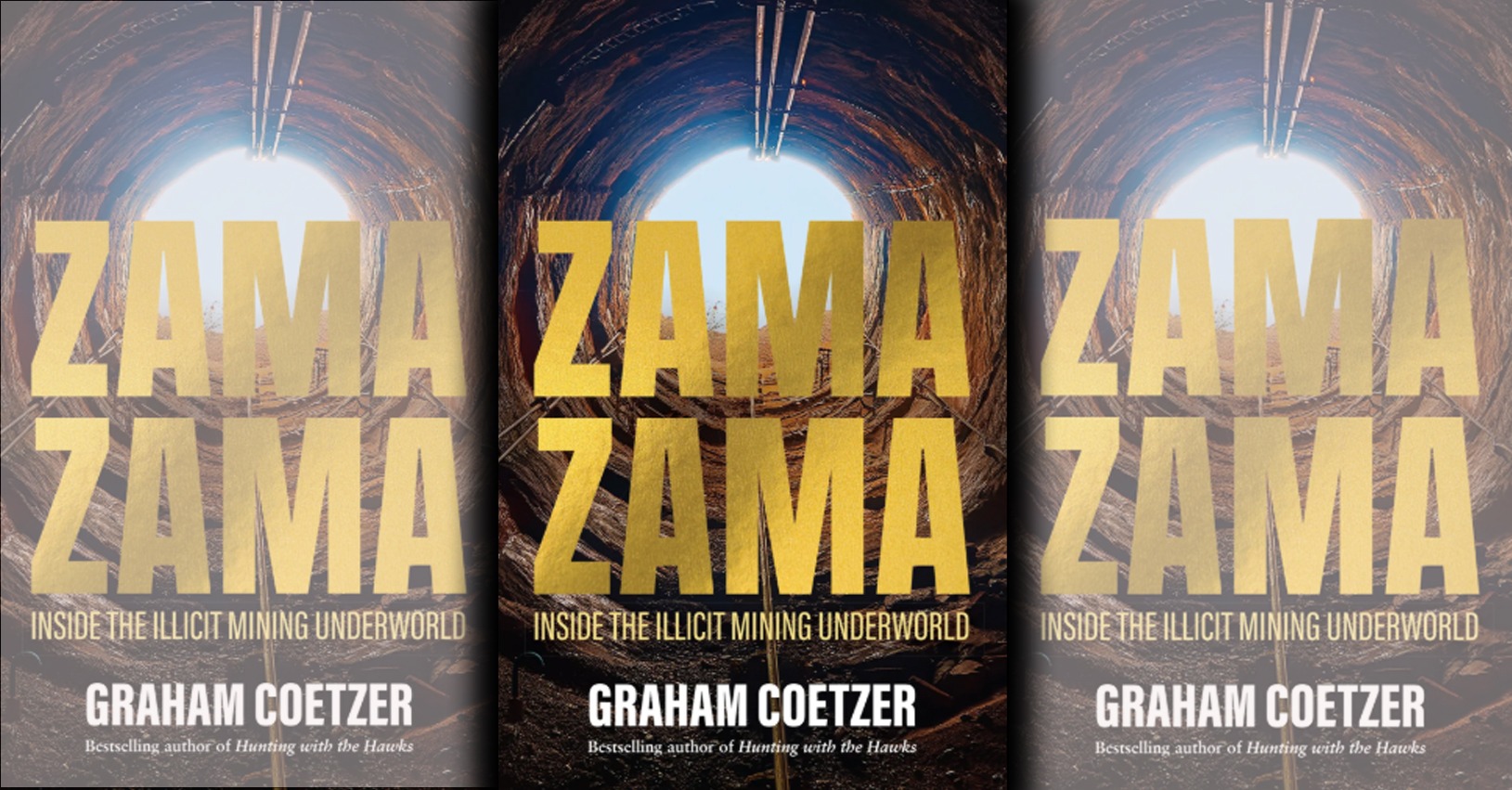
 Zama Zama by Graham Coetzer. (Photo: Jonathan Ball Publishers)
 Graham Coetzer’s latest book, Zama Zama: Inside the Illicit Mining Underworld, reveals how illicit gold is smuggled and laundered through a labyrinth of private refineries and fraudulent mining permits, leveraging loopholes in South Africa’s regulatory framework to facilitate an intricate VAT scam that reintroduces “dirty gold” into the legitimate global market. Here is an excerpt.
***
I’ve told you I can’t explain humanity’s obsession with gold. But I can tell you that I’ve seen gold fever. That’s what those in the know call the corruptive seductive power the metal exerts over the people who spend their lives chasing it. And, I’ll admit, I’ve felt its irresistible pull.
Going after gold is like gambling: you pick your horse or place your chips and pray the odds fall your way. Those odds are always going to be stacked against you. But, just like when you back the underdog in a horse race, there is a certain undeniable magic that courses through your veins when you get the win. For very little input, after all, you could be walking away with a major score. It’s that feeling – that surge of adrenaline and excitement – that people get addicted to.
If you know where to look, getting your hands on some raw gold is rather simple. But don’t be fooled, the type and quantity I’m talking about would be nowhere near enough to make a living from. And of course, without the necessary permits, it would be illegal.
I once found some in a matter of minutes. And in that discovery, I got a small taste of what gold fever is all about.
It was during the research phase of a major investigation we were conducting to expose the innermost workings of the illicit gold trade. Back then I was relatively new to reporting on the gold scene. A colleague, Susan Comrie, and I had travelled to an isolated plot of land to meet an insider whom we were trying to convince to share his story with us.
Susan is a highly respected investigative journalist who currently works for the amaBhungane Centre for Investigative Journalism. She’s one of the best journos I’ve worked with – and in the early days of my career I could count on her to be the steady voice of reason to my more impulsive, go-with-your-gut reporting style.
We’d been meeting with this particular insider on and off for the better part of a year. To protect his identity, we’ll call him Clover. I can’t tell you where we met, or what he looks like. Suffice to say that Clover was one of those sources you really need on a big investigative assignment. He’d been part of a massive illegal gold operation, and had first-hand knowledge of the inner workings, as well as plenty of evidence to back up his claims. At the time, he claimed he’d changed his ways and was going legit.
Clover had invited us to come and see a legal gold-mining project he had launched. It was a small operation right next to a river. For a few hundred thousand rand, you can buy all the machinery you would need to start your own little gold mine. It would cost much less if you’re happy to perform manual labour. Whether you could get the licence to do so legally is a whole other story. Quite frankly, in today’s South Africa, I’d venture to say it’s more a story of who you know…
In any case, we’d jumped at the opportunity to go see him, hoping that we could finally convince Clover to go on the record, albeit with a hidden identity. During an impromptu tour, he took us from his processing plant to the excavation site. A front-end loader was parked near the river, next to a large pile of sand that had recently been dug up. It looked like any other large heap of sand I’ve ever seen.
“There’s gold in here?”
“A lot.” Clover wasn’t bragging, just stating facts.
“You’re digging near the river?”
“It’s alluvial gold.”
He launched into a brief geology lesson. Over millions of years, the gold-bearing rock in the mountains around us had been “worked” by water. As time passed, rainfall and floods and the like had eroded gold deposits from the original veins of rock, eventually depositing them in the low-lying rivers and streams in the area. The right “guy”, according to Clover, could tell you where to find gold just by looking at a given piece of land, even if it had no current water sources. “They can tell where a river used to flow, thousands of years ago,” he said.
When you’re working with a source, criminal or not, it’s important that they trust you. So while Susan and I were both eager to get to the actual reason for our visit, we weren’t pushing all that hard yet either. Getting someone to spill the beans, in my opinion, is an art form. Much like walking a tightrope. Be too aggressive, and they’ll clam up. On the other hand, if you’re not constantly pushing the envelope as an investigative journalist, you’re in the wrong job. “Have you ever panned for gold?” Clover asked before we could steer the conversation in our desired direction.
We hadn’t.
“Then you can’t leave before you try!” His face lit up with a mischievous smile. “I’ll grab some pans.” He disappeared into a nearby shipping container that was being used as a makeshift storage room and returned with two plastic gold-sifting pans.
“Come,” was all he said before leading us down to the river. A handful of sand was scooped up from the shallows and unceremoniously dumped into one of the pans.
“Gold is heavier than sand, heavier than stones,” Clover explained. “So, what you need to do is get some soil from the riverbed, then fill your pan with water up to about here,” he said as he pointed at a spot about halfway up one of the sloped edges of the pan. It looked like nothing more than a large Tupperware bowl, one you’d be able to prepare a salad in.
“Then you swirl the water around like this,” Clover said, rotating the pan, “and start separating out all the sand and little stones. The gold particles won’t float. Gold’s funny like that. Because of its density. It’s about 19 times denser than anything else in the pan. So when you’re shaking the pan, all the gold drops to the bottom.”
Susan and I had started debating the ethics of giving it a try, but Clover was having none of that.
“I own the permits to mine here; I’m giving you permission. Besides, it’s not like I’d let you keep any of it,” he insisted, with that same mischievous smile. “Aren’t you big-time journalists allowed to have any fun?”
It wasn’t about having fun or not. We were so close to finishing our story. It was a story we’d spent months working on, one that involved billions of rands of fraud and smuggled gold. A story we were getting a lot of flak for from certain quarters – people who didn’t want one of the underground scene’s biggest secrets to be revealed. A story we had few on-the-record sources for … But in the end, though, we did what any good investigator would have done. We went panning for gold. DM
Zama Zama by Graham Coetzer is published by Jonathan Ball Publishers. It is available for a retail price of about R350.