




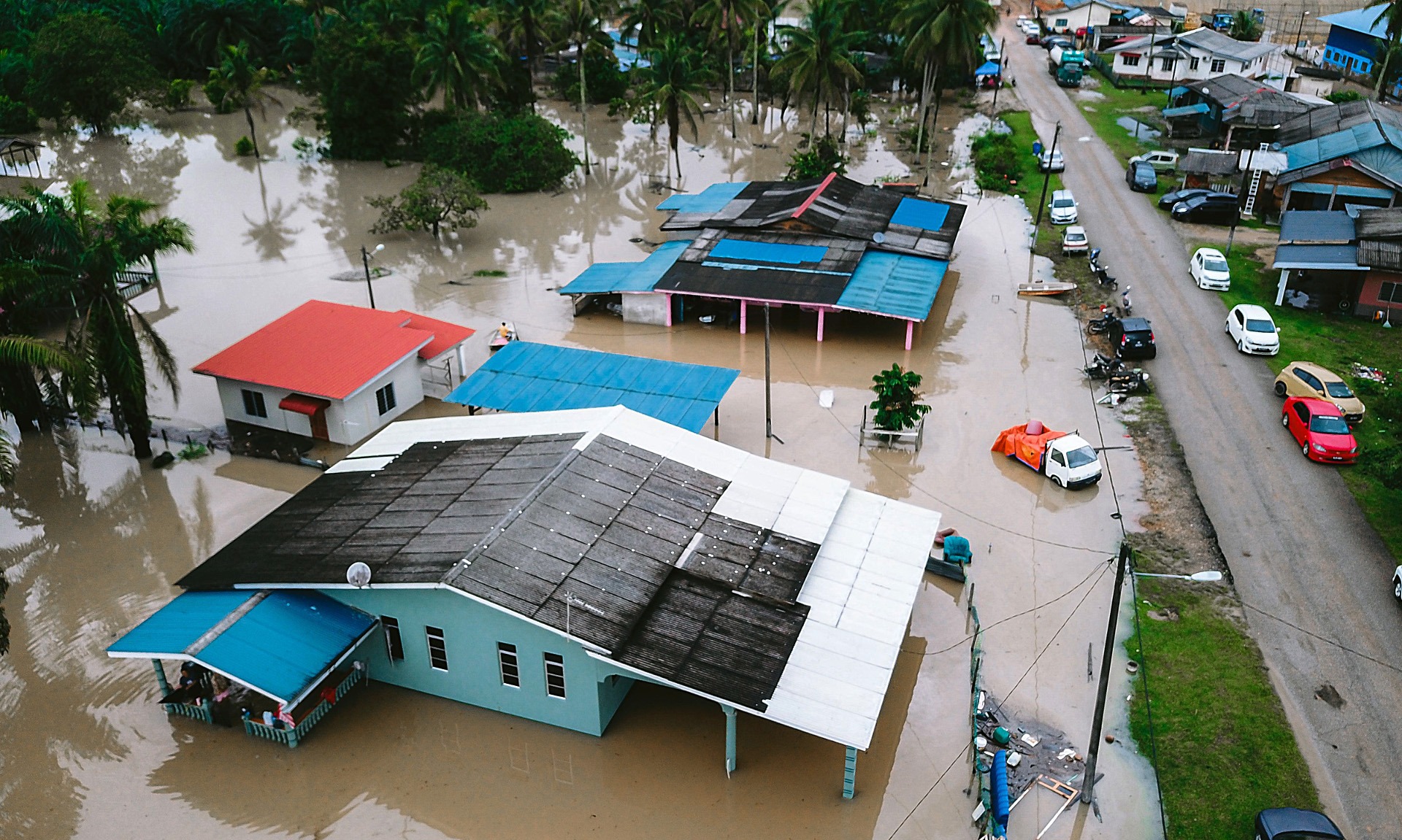
 How badly unexpectedly heavy weather will affect people’s lives depends on a combination of environmental factors and communities’ preparedness. (Photo: Pexels)
The weather is good for small talk. But it’s been making big headlines more and more often lately.
In the first five months of this year alone, many parts of South Africa have been battered by storms, floods and lasting or scorching heat, with the government issuing three notices of weather-related national disasters and official warnings about severe heat between January and May.
Researchers agree that global warming caused by the release of large amounts of greenhouse gases from burning fossil fuels like coal and oil can be clearly linked to intense downpours and heavy storms occurring more often.
But how badly unexpectedly heavy weather will affect people’s lives depends on a combination of environmental factors and communities’ preparedness.
“We are vulnerable to events which we may be able to forecast but whose actual intensity in specific locations we may not be able to predict,” said President Cyril Ramaphosa shortly after the spate of heavy weather days in parts of the Western, Eastern and Northern Cape in early May, which claimed at least 10 lives, displaced thousands of people and badly damaged roads, buildings and utility systems.
And it is exactly this type of unpredictability that climate experts say the world has to stall itself against in the face of changing long-term weather patterns.
But can every extreme weather event be pinned on climate change?
To answer this, scientists compare how likely it would have been that an event of similar intensity would have occurred if the atmosphere had not warmed from what it had been about 150 years ago.
For example, rainfall like what caused the heavy floods in parts of Limpopo, Mpumalanga and Mozambique in January is likely to occur only every 50 years, researchers found, which makes it a rare event. But it would have been even rarer if the air had not warmed by about 1.3°C, their analyses showed. Moreover, datasets they looked at suggested that downpours during spells like these are becoming about 40% more intense.
Having historic or baseline data to compare current events to is important to help scientists predict how things might change, which, in turn, can help decision-makers plan ahead so that the fallout of extreme weather can be handled better.
In today’s story – the second in our series about what climate change could mean for South Africa – we look at what the data says about the country’s baseline and possible future weather patterns. Missed part 1? Read it here.
One country, five climates
South Africa has five distinct climate regions, with areas in the west generally being drier and hotter while those towards the east experience milder temperatures and wetter days.
/file/attachments/orphans/Graphic1_SouthAfricahasfiveclimatezones1_202703.jpg)
Where people live depends, to a large extent, on weather patterns in an area. Places with a fairly mild temperature range and enough but not too much rain are often desirable, because there’s likely to be enough water and fertile soil to grow food.
For example, about two-thirds of South Africa’s population live in climate zone 2 (covering Gauteng, Mpumalanga, KwaZulu-Natal, the Eastern Cape and parts of the Free State and North West), with mild temperatures and all-year rainfall, our analysis showed, whereas less than 1% of the population live in climate zone 4 (covering the Northern Cape), characterised by hot, desert-like conditions. (In our analysis, we used census data for 2022 to determine how districts fit into the approximate climate regions, which is why the coloured borders have ragged lines. In reality, zones won’t follow such exact boundaries.)
But governance structures – and by implication how money is allocated for building and maintaining roads, schools and clinics and providing people with services like power, water and sanitation – don’t follow climate boundaries.
Instead, the Constitution says that Treasury must give each province a fair amount of money from the available kitty based largely on the number of people in a province and their specific social or development needs. For the current financial year (2026/27), provinces have roughly R11,000 to R17,000 per person available – made up of the provincial allocation and a small amount from conditional grants – to care for their constituents (this excludes money that is given to national departments).
So, a province like the Northern Cape, with a population of about 1.4 million and spanning an area of about 373,000km2 that includes three different climates, will have less money available than, say, KwaZulu-Natal, which has nine times as many people but spread across only about a quarter of the size of the Northern Cape and falls into a single climate zone.
Looking ahead
Scientists who helped to put the government’s report together on how well the country is faring in sticking to its United Nations climate promises modelled what changes in temperature, rainfall and dry spells could reasonably be expected in each climate region for different levels of global warming. They used the so-called SSP3-7.0 scenario, which assumes “a rocky road” ahead, because of things like slow economic growth, high inequality and barriers to international trade.
/file/dailymaverick/wp-content/uploads/2023/09/ED_468416.jpg "Flooded homes in Sandvlei, Western Cape, on 25 September 2023. (Photo: Brenton Geach / Gallo Images)")
To make such forecasts, they use “a family of models, each running a standard experiment but with different assumptions, and also input data from across a big area, including the surrounding oceans”, explains Mohau Mateyisi, a climate scientist at the Council for Scientific and Industrial Research who was part of the reporting team. This means that the modelling gives a range of answers that all vary slightly, he says.
The projections from models are estimates, though, and so there’s always some uncertainty linked to the answers, Mateyisi explains. If the models all return values with the same direction of change (e.g. all positive or all negative), researchers interpret it as showing a fair amount of certainty in the expected values. This is often the case with temperature estimates.
But if some models give positive values as answers and others give negative values, it suggests that the estimate is less certain. This is often the case with projections about future rainfall.
In the plots shown here, the coloured part of a “box” shows the spread of the final values returned by the different models used in the calculation. A longer area means there is more variation among values from which the median – shown by the black horizontal line inside the box – is calculated. The “whiskers” show the minimum and maximum values in the range, and if they are long, it means there’s even more variability around the median.
/file/attachments/orphans/Graphic2_Iftheworldgets2Cwarmer1_405235.jpg)
Under the Paris Agreement, countries commit to try to avoid Earth’s atmosphere warming by more than 2°C compared with what it was about 150 years ago. Modelling results show that if we fail to achieve this and the global temperature hits this upper limit of warming, daytime temperatures all across South Africa could likely be about 2°C to 3°C higher than what they were between 1961 and 1990 (top panel). The researchers say this shows that some regions in South Africa are likely to be warming faster than the global average.
The biggest temperature rise is expected in climate region 1, which is the hot, summer rainfall area in the northern part of South Africa. Climate region 2, which covers the eastern interior of the country, could expect a mean increase of about 2°C, although increases of between 1°C and about 4.5°C are possible. The smallest temperature increase – just under 2°C is expected in climate region 5, which covers almost the whole Western Cape.
Average rainfall is expected to change by less than 10% from what it’s been in the past (middle panel), although regions 3 and 4 – the central interior and hot, desert-like region towards the west – could see considerable variability in rainfall. But more than that: because the range of modelled values for those regions includes both positive and negative values, there’s also a fair amount of uncertainty about the estimates, which tells researchers that rainfall is likely to be unpredictable.
When we look at the length of dry spells, the picture becomes fuller. Dry spells are likely to last longer across the country, especially in climate regions 1 and 4, which are the hottest and driest parts of South Africa. These results seem to go with considerable variability and coupled with almost no change in total rainfall, it’s possible that heavy, sudden and unpredictable downpours may be on the cards in most regions.
Looking back
South Africa has been pummelled by 82 disastrous floods and storms like strong winds or severe hail or snow between 1980 and 2023, an analysis shows – and the trend suggests that the count will increase. In the first four years of the current decade there have already been as many floods as in the full 10 years between 2000 and 2009.
/file/attachments/orphans/Graphic3_Floodsandstorms1_812677.jpg)
These extreme weather events appeared to be clustered in the eastern parts of the country, the researchers found, with KwaZulu-Natal being hit especially hard. Although it’s not unexpected that the eastern parts of the country would get more rain than the drier west, simply because of the natural climate pattern in South Africa, the fallout from such extreme events is something to take note of, the authors write.
Their analysis shows that flooding was most often reported in large urban areas, regardless of what part of the country it happened in, which suggests that “human factors may play a role in amplifying the impacts of intense rainfall events in metropolitan regions”.
A rapid study of heavy rains and resulting flooding in southern Botswana and KwaZulu-Natal in February 2025 showed something similar: when urban areas grow fast but infrastructure and services don’t keep pace, intense downpours can easily overwhelm things like drainage systems and make the effects much worse.
The harm from human-induced climate change is not only a future threat, but a present-day reality, experts say. To brace ourselves against the storm, the world will not only have to adapt to what has already changed, but also act to halt Earth’s air warming further.
Says Mateyisi: “Although models can’t give us exact answers, they will keep on improving and we should use them as the best available science. The choices we make now must put people’s lives first; we can’t afford not to take action.” DM
Watch out for the third and last part next week.
This story was produced by the Bhekisisa Centre for Health Journalism. Sign up for the newsletter.
/file/dailymaverick/wp-content/uploads/2025/02/Bhekisisa_logo_hi_res.jpg "MC-Pepfar-Exempted")
Comments
Scroll down to load comments...