




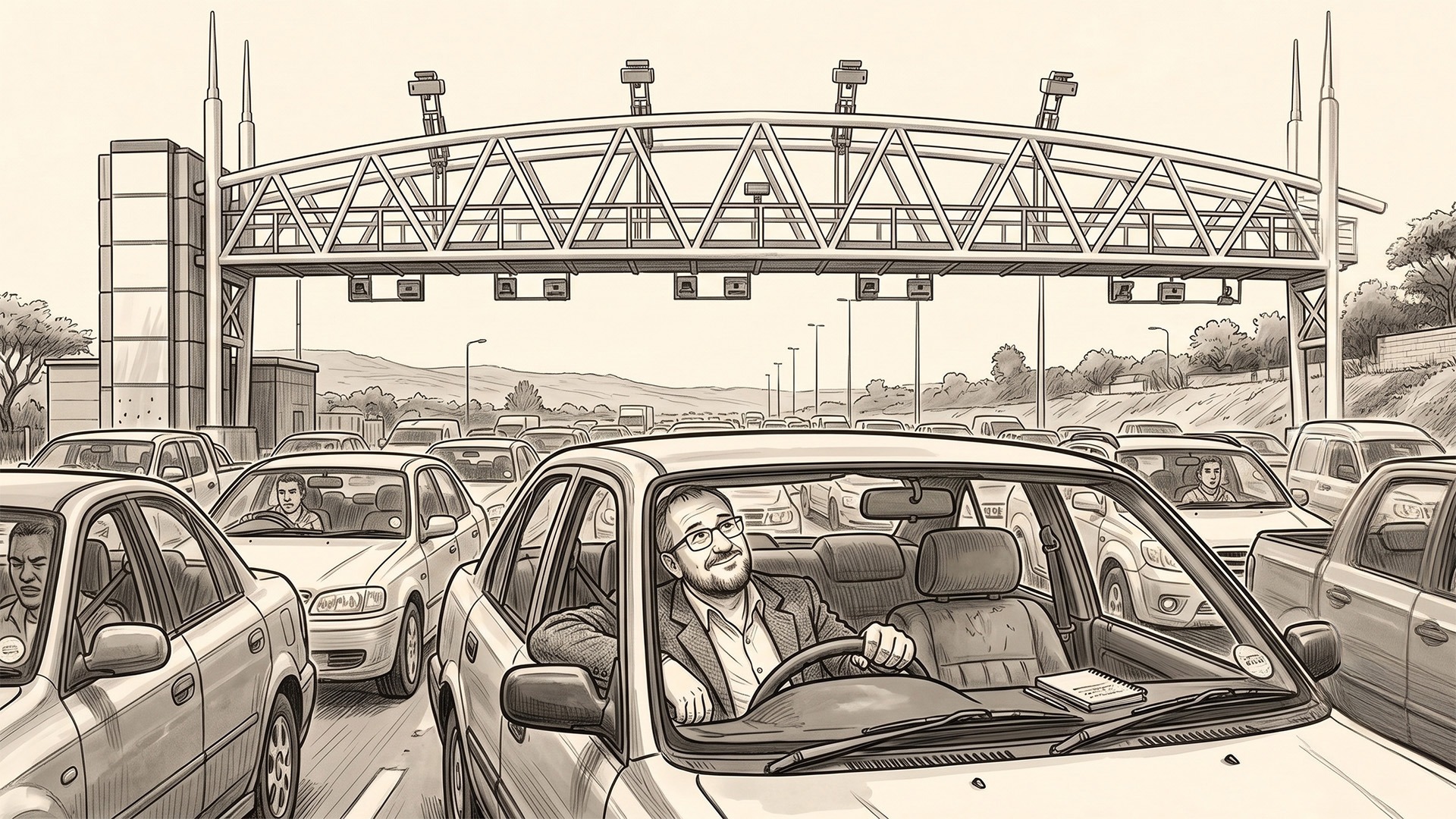
 Illustrative image: (Generated with Google Gemini Flash Image 2.5)
I can’t remember when I first realised the government was going to use an e-toll system in Gauteng to pay for the highway improvements between Joburg and Tshwane.
But I did already know it was not going to work.
It was probably the first issue to unite South Africans across all of our class, geographic and racial divides.
I’ve never really understood what was going on in government at the time, in those years leading up to their fateful decision in 2007.
I was reporting for EWN at Radio 702 in Gauteng and traffic on those highways had become incredibly intense. I remember an advocate once phoning in to tell Jenny Crwys-Williams he had been late for a court case starting at ten in the morning, having left Pretoria about three hours before.
As someone who spent hours in Tshwane at government press conferences, I had developed a working knowledge of all the petrol stations along the way, along with cheese griller prices and those with the best loos.
One literally had to stock up.
At the time, in those pre-World Cup days, I felt the Allandale turnoff was labouring under a curse. Everyday it was a disaster.
I have a very clear memory of speaking to the transport director-general in the first two months of 2008. At the time that was Mpumi Mpofu (she is now the CEO at Airports Company South Africa) about how they were going to improve the highway system.
When she explained into my microphone that there would be a major change to the Allandale turnoff I couldn’t contain my excitement.
But at no point was there a conversation about paying for it. Or about the e-tolling system.
This was the real sin of the whole thing – that we really had not been asked.
When the system finally started I realised with a shock that quite a few of my friends had bought e-tags. When I said I wasn’t going to do it they shook their heads and said that I should comply with the law.
I said that I thought the whole thing was immoral and thus I wouldn’t.
I, of course, was a journalist, allowed to give my opinion and take my chances. Lawyers and accountants are not.
When I was occasionally asked by businesses if they should pay up I said no, those gantries would come down in the end.
But you can imagine their problem. Many firms would have a policy, quite correctly, of 100% compliance with the law. They would have to do it, their parent companies in other countries would force them.
Somewhere right now an accountant is tallying up the cost of this policy. Cabinet has now [formally said] something that was obvious from the beginning, that no one is going to be prosecuted for not paying.
And the proof this lay in what happened when Outa (then Opposition to Urban Tolling Alliance, now the Organisation Undoing Tax Abuse) first said they would pay the legal fees of the first person charged with non-payment.
Sanral, and the government, blinked. They didn’t prosecute anybody.
And in a game of chicken involving cars and highways, when you blink, you’ve lost.
But this game is not quite over, despite how much the government would like to be rid of it.
Many individuals and companies paid up, in good faith. The government says there will be no refunds because this was the legal policy at the time.
They’re probably on fairly firm ground with that. But South Africa is a place where individuals who feel unfairly treated can do something about it.
And it would just take one really annoyed individual to find a way to win a case against the government for the floodgates to open.
I also think that e-tolls might also have changed the way we feel about the government over the much longer term.
If I, a person who has everything to gain from the rule of law, who was born firmly in the middle class, was comfortable with not paying e-tolls, has it made me more comfortable to treat other laws slightly differently?
I can’t tell you one way or another.
But when I hear conversations around the braai about the government and Joburg (the football World Cup and the Springbok season have yet to start) I do wonder if e-tolls played an important role in changing the attitudes of many people towards the government.
Before e-tolls, paying your bills was almost the definition of middle class. Now, I have found myself explaining to an older person that it would be best if they simply ignored all of the WhatsApp messages telling them to pay their fines.
I can’t be sure if the fines are legit and no one should ever just click on a link in a message from an unknown source. And to try to work it all out is just impossible.
So my advice was to not do anything. Most fines simply stagnate anyway. If they really mean it you will find out when you try to get a new licence disc for your car.
In a strange way I think I have every reason to hate e-tolls.
They made me take the state less seriously.
And that is a terrible outcome. DM
Comments
Scroll down to load comments...