




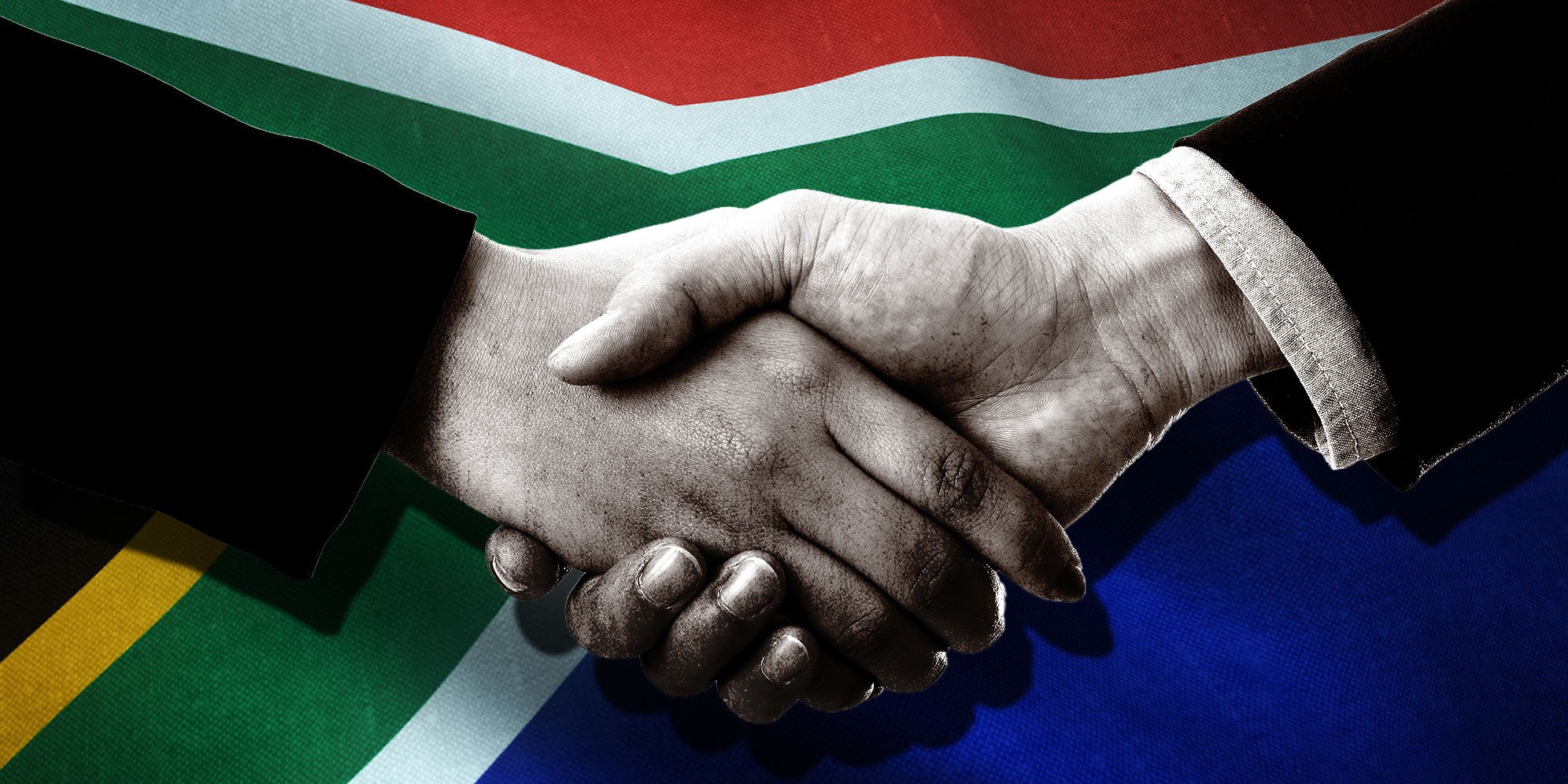
 Illustrative image: Handshake. (Photo: iStock) | South African flag. (Image: Magnific) | (By Daniella Lee Ming Yesca)
 /file/dailymaverick/wp-content/uploads/2025/10/label-Op-Ed.jpg)
It is incontrovertible that we are living in highly dynamic, unpredictable times. Until recently, a broadly stable global order informed our approach to development and policy optimisation. That may need to change.
Here in South Africa, we had navigated the transition from an apartheid state to a fully functioning and world-class democracy, albeit coupled with the challenges of transforming society and the economy into one that addressed poverty, inequality and unemployment on a sustainable basis.
Despite the progress that we made, particularly in the first decade and half after the advent of democracy, some of that progress was arrested and, in some cases, reversed. Now exacerbated by a far more fragmented global environment – one defined increasingly by strategic competition, industrial policy, resource nationalism and the politicisation of capital itself.
Nevertheless, what we have discovered in South Africa, over the past five years in particular, is that if we can appropriately harness the capacity, skills and resources of the private sector, we can produce a sustainable model of collaboration which enables us to make impactful and lasting advances, particularly in times of crisis.
I want to begin with a tension that I suspect everyone in this room navigates, in one form or another, in one country or another.
The tension is this: genuine economic development requires both the state and the private sector. But in most countries with a serious developmental agenda – and particularly those emerging from histories of colonial extraction, structural inequality and high levels of poverty – those two actors begin, not from partnership but often from mutual suspicion. The state regards private capital as self-interested, socially indifferent and politically unreliable. The private sector regards the state as inefficient, prone to capture and ideologically hostile to markets.
Although both views are partially correct, neither is complete.
South Africa’s experience over the past three decades – from the first institutional experiments in structured collaboration through to the achievements of the current government-business partnership – is, I think, one of the more instructive case studies in how this tension is addressed. Not resolved. Navigated. The tension never disappears. But it can be made productive. With measurable results.
I want to discuss how that happened in South Africa – and why I believe the moment we are in globally makes this topic more urgent than it has ever been before.
The private sector in South Africa that has been mobilised in the partnership represents large companies and small ones. It is multinational corporations and family enterprises. It is listed mining houses and unregistered street vendors. It is the bank in Sandton and the spaza shop in Soweto. Formal and informal, domestic and foreign. Taken together – across all those forms – it constitutes the substrate on which the country’s economic life stands.
Let me give you the numbers:
Of South Africa’s 17 million employed people the state, across all spheres of government, employs about two million. The private sector – formal and informal together – employs about 15 million. Two-thirds are in formal employment and one-third in the informal sector.
In aggregate, the private sector accounts for about two-thirds of South Africa’s GDP. It produces essentially all of the country’s exports – roughly $110-billion in 2024, equivalent to about a third of GDP.
The private sector is not a sectional interest with which the state chooses to engage. It is the very foundation on which the developmental state stands.
It is the engine of capital formation. Private investment accounts for about 73% of all fixed investment expenditure in South Africa.
And it is the principal contributor to the fiscus – to the very state through which redistributive policy operates, in the form of personal and corporate income tax and supplemented by VAT and duties.
I am citing these numbers because they make a structural point that the political conversation often forgets.
The private sector is not a sectional interest with which the state chooses to engage. It is the very foundation on which the developmental state stands. The schools, the hospitals, the social grants, the public infrastructure, the very capacity of the state to act – all of these are, in significant part, financed by private economic activity.
That is why genuine collaboration has been pursued. It is structural and catalytic in leveraging all available capacity.
For those in the room who know South Africa’s history well, what I am about to say will be well understood. For those less familiar, it is necessary context – to better appreciate the collaboration I am describing.
South Africa’s democratic transition in 1994 produced one of the world’s most progressive constitutions, coexisting with one of the most unequal economies on Earth. The apartheid system had been politically oppressive. It was also an economic system, deliberately organised around the exclusion and exploitation of the majority. Large parts of the private sector had operated within and benefited from that system. This is not a polemical observation. It is a historically accurate one.
The result was that the post-apartheid political economy carried a deep and, in many respects, legitimate suspicion of private capital. Important currents within the government – the labour movement, the South African Communist Party and significant voices within the ANC – held the view that the state was the primary instrument of transformation, and that the private sector was at best a necessary constraint to be managed, and at worst an obstacle to redistributive justice.
I am not here to relitigate that debate. The people who held those views were not wrong about the history. And some of what they feared – the tendency of private capital to extract rather than build, to serve shareholders before citizens, to resist redistribution – is well documented and not unique to South Africa.
Trust plays a key role in the partnership – between the protagonists in the partnership, as well as between society and stakeholders and individual constituencies. The Edelman Trust Barometer, which is published globally, has consistently found that business is markedly more trusted in South Africa than the government. The 2025 figures find business standing at 68%, compared with the government’s 36%. One of the widest gaps of any of the 28 countries surveyed. We anticipate a positive shift for the government reflecting higher levels of confidence in the Government of National Unity.
The structured presence of the private sector in national economic deliberation produces better outcomes than its exclusion.
The first formal institutional response to this tension came in 1994, in the very first year of democracy: the establishment of Nedlac – the National Economic Development and Labour Council.
Nedlac was, in conception, a remarkable institutional innovation. It brought together the government, organised business, organised labour and community representatives in a single statutory body, with a mandate to seek consensus on economic and labour legislation before it went to Parliament. It was an explicit acknowledgement – from all four constituencies – that no single constituency had the legitimacy or the capacity to drive economic development alone.
What Nedlac has demonstrated, over its 30 years of operation, is that the structured presence of the private sector in national economic deliberation produces better outcomes than its exclusion. Primarily because the quality of policy that emerges from genuine multi-stakeholder engagement is more durable, more implementable, and more likely to survive political transition than policy designed in a single ideological register.
It also demonstrated the limits of consultative collaboration. Nedlac could negotiate. It could deliberate. What it was less equipped to do – by design – was execute at speed. The model, valuable as it is, was not built for crisis. That lesson would matter.
In March 2020, South Africa went into lockdown. The scale of what the country was facing became immediately clear. GDP would contract by 6.9% – worse than the global average of 3.3%; 1.6 million net jobs would be lost. The health system faced a shock it was not designed to absorb. And the social protection system – already supporting more than 17 million grant recipients – came under enormous strain.
Within days of the lockdown, Business for South Africa (B4SA) was established – mobilising hundreds of business professionals, working pro bono and virtually, in direct operational partnership with the government. Not advising from the outside. Not simply commenting on policy but actively engaging in converting policy into implementation.
Covid demonstrated that self-interest, properly aligned with national interest through a structured partnership, produces outcomes that no amount of ideology on either side can match.
Three workstreams were established immediately. On healthcare: a national PPE portal was established, an advisory committee formed, every company in the healthcare industry mobilised, and infection scenarios modelled – enabling the government to make faster and better-informed decisions than it could have made alone.
On the economy: an integrated economic and healthcare model was built, and used in real time, to work with social partners and specific industries to modify lockdown rules, so that sectors could continue to operate and the economy keep moving.
And on labour – through Nedlac, drawing on existing architecture, a furlough system was designed and implemented. Six million South Africans – workers who would otherwise have had nothing – received income support because business and government sat inside the same design process and built a mechanism that neither could have delivered alone, at the pace the crisis demanded.
What Covid demonstrated is that self-interest, properly aligned with national interest through a structured partnership, produces outcomes that no amount of ideology on either side can match.
If policymaking during Covid was the proof of concept, the vaccine roll-out was the stress test. And it held. In early 2021, B4SA extended its remit and pivoted – this time around a single, complex, time-sensitive objective: supporting South Africa’s national vaccination programme with five new workstreams.
The combination of public mandate and private execution capacity built a system capable of delivering more than 400,000 doses per day across public, private and occupational health sites. Vaccine supply was secured for 120% of the target population. The private sector – initially allocated 15% of available supply – ended up administering more than 30% of all vaccinations between July and December 2021. The time required to vaccinate the adult population was cut from two financial years to one.
By November 2021 about 14 million South Africans had been fully vaccinated. More than 16 million had received a first dose.
What became apparent was that combining the resources and capabilities of the public and private sectors was more productive than either party working in isolation. The continuous sharing of data, operational capacity and institutional reach produced outcomes that the state alone, working with formal procurement timelines and civil service constraints, could not and cannot replicate at the speed a public health emergency demands.
The private sector did not profit from the vaccination programme in any conventional sense. Companies gave time, expertise, logistics infrastructure and distribution networks. The motivation was partly enlightened self-interest – a vaccinated workforce and a recovering economy – and partly something harder to model but real: a sense of clear commitment to the country in which they operated. The collaboration did not eliminate political tension or bureaucratic friction. It managed it.
The Covid and vaccine experience produced something the country had not had before: proof, at scale, that the collaboration model worked. The question that followed was whether the proof could be turned into deliberate institutional design – or whether it would fade, as crisis mobilisations usually do, when acute pressure eased. Specifically, would the government-business collaboration be appropriate with regard to an economy that had consistently underperformed.
In July 2020, at the request of the government, business published its Accelerated Economic Recovery Strategy which was integrated into the government’s Economic Reconstruction and Recovery Plan.
In January 2022, business met the President and proposed a limited number of immediate priorities for joint implementation: all contributing to inclusive and sustainable growth These were not aspirational goals. They were operational priorities, again with clearly identified workstreams and joint accountabilities.
This priority framework created the scaffolding for the partnership that emerged in 2023. It was the formalisation of three years of accumulated institutional learning and relationship building. By this time, we had an established and successful model, which we would use for the current phase of the partnership. Already key structural constraints had emerged including energy, transport and logistics and crime and corruption.
Load shedding – rolling power cuts – had become the defining feature of economic life. In 2023, South Africa experienced load shedding on 290 days of the year. The cumulative cost of the energy crisis between 2020 and 2023 was estimated at about 15% of GDP growth foregone.
Logistics constraints – with port handling times stretched to 20 days, rail freight volumes down 34% and border queues of 19km – were estimated to have cost about 5% of GDP in lost growth in 2023 alone.
Crime, on World Bank estimates, costs South Africa about 10% of GDP every year.
Add those numbers up. Year after year, the country was paying – in lost growth, lost investment, lost jobs, lost foreign exchange – a price that was simply unsustainable.
To compound the problem, South Africa was placed on the Financial Action Task Force grey list of jurisdictions in February 2023, with strategic deficiencies in anti-money laundering and counterterrorism financing. For a country seeking long-term institutional capital, that was not a technicality. It was a fundamental signal about institutional credibility.
The global context has shifted dramatically in ways that make the question of public-private collaboration not merely a domestic governance matter but a question of geopolitical and economic strategy.
The response from business to these challenges was unprecedented. About 160 CEOs from South Africa’s leading companies – together representing about R11-trillion in market capitalisation and nearly 1.5 million employees – pledged to act in support of the partnership with the government. We stated:
“As South African business leaders, we firmly believe in the immense potential of our country... committed to being a force for good.”
That commitment was translated into structure including governance and oversight, a cadence of engagement and appropriate mobilisation of resources from both sides. A Joint Strategic Oversight Committee – co-chaired by the Presidency and B4SA – meets every four to six weeks to monitor deliverables and resolve blockages. CEO sponsors from leading companies are publicly accountable for each workstream. The President chairs meetings of key Cabinet members and business leaders every eight to 12 weeks. And an independent Resource Mobilisation Fund procures both funding and specialist skills and capabilities with the rigour that institutional donors require.
Business has contributed substantially, both in direct catalytic funding and the provision of pro bono resources, to the partnership. The principles are explicit and deliberately agreed: the government sets policy. Business assists with implementation and brings a market view. Funding is catalytic, not a substitute for public budgets. And both parties place the national interest ahead of individual or sectoral interest.
These contributions are in addition to the direct and indirect contributions by the private sector and its employees to the fiscus. Although the catalytic contribution is, in scale terms, modest, what it buys, deployed precisely, is acceleration of structural reform and operational improvement coupled with transparency and accountability.
The results of the partnership have been significant and enduring. In October 2025, South Africa was fully removed from the FATF grey list, having met all 40 recommendations. Load shedding dropped from 290 days in 2023 to seven in 2025. Port handling time fell from 20 days to two. Border queues from 19km to three. Coal-line security incidents are down by half. The Digital Evidence Unit is operational, working with the National Prosecuting Authority on State Capture cases. Five hundred investigators have received financial forensics training.
These are not claims. These are audited outcomes from a partnership that has been visible, transparent and subjected to public scrutiny.
As I said at the outset, we need to consider the partnership acknowledging the changing global paradigm. The global context has shifted dramatically in ways that make the question of public-private collaboration not merely a domestic governance matter but a question of geopolitical and economic strategy.
We are living through the most significant fracturing of the global economic order since Bretton Woods. The post-Cold War consensus – that liberalising trade and capital flows, combined with independent institutions and rules-based multilateralism, would produce convergent prosperity – is not merely under political pressure. It is functionally broken. The institutions that embodied it – the WTO, the IMF’s development frameworks, the G7’s claim to global economic stewardship – retain their formal existence, but in many respects have lost the capacity to set the terms of engagement that they had even a decade ago.
What has replaced that consensus is not a new order. It is competition – between the hegemonies such as the US and China for technological supremacy, supply chain control and spheres of influence; between a resurgent nationalism in many markets and the continued pressure of global capital flows that do not respect borders.
For a country like South Africa – a middle-income African economy, resource rich, institutionally sophisticated and complex, with significant exposure to all the major powers and professed alignment with none – this environment is both threatening and, for those prepared to navigate it strategically, full of opportunity.
Models are being fundamentally challenged, even disregarded. Whether it be the Washington Consensus – fiscal discipline, privatisation, liberalisation, structural adjustment; conditionality models, in which external capital comes packaged with governance requirements set by creditors; or the Chinese model – infrastructure financing, often in exchange for resource access.
The partnership model that South Africa has developed is not just a domestic governance innovation. It is a prototype for a new kind of development partnership
And the new frontier – the Inflation Reduction Act model, the EU’s Carbon Border Adjustment, the reshoring and friend-shoring strategies of the major powers – represents a third force: industrial policy at a scale that distorts global markets and creates new pressures on developing economies to choose sides in a bifurcation that serves neither their immediate interests nor their long-term developmental goals. This is where South Africa’s collaboration model has particular relevance.
The support that business contributed to the government partnership is not aid. It is not conditional lending. It is not infrastructure-for-resources. It is primarily domestic private resources, voluntarily mobilised and deployed through transparent governance structures, in direct partnership with an elected government pursuing a national development agenda. This is a model that any country with a serious private sector and a development challenge can adapt.
For South Africa specifically, the geopolitical environment creates both pressure and opportunity. The country has mineral resources that every major power wants access to as they build the clean energy infrastructure of the next century. The competition for those resources is intensifying. South Africa will be courted. It will also be pressured.
Supply chains are reorganising at a pace not seen since the post-war reconstruction. South Africa is one of very few African countries – and one of a limited number of emerging markets globally – with the combination of attributes that serious capital requires: deep legal and financial institutions, a sophisticated private sector, an independent judiciary, a functioning democracy, and a resource base strategically relevant to the clean energy transition.
The question is whether South Africa can move with sufficient speed and institutional coherence to capture such growth opportunities – before other jurisdictions, with less-compelling fundamentals but more consistent execution, establish the relationships and infrastructure first.
That speed and coherence is precisely what the public-private partnership model provides – and what neither state-led development nor market-only solutions can deliver at the pace this moment requires.
In this environment, the partnership model that South Africa has developed is not just a domestic governance innovation. It is a prototype for a new kind of development partnership: one that mobilises private capital without surrendering public sovereignty, that delivers results without creating dependency, and that builds institutional credibility from the inside rather than importing it from outside.
The question of how the private sector can be mobilised for development purposes, in ways that respect sovereignty and build rather than undermine institutional capacity, is a critical one. South Africa’s experience is a relevant data point.
Let me close with what I believe the South African experience has established:
Thirty years ago, South Africa built Nedlac – a formal architecture for the structured participation of government, business, labour and civil society in national economic deliberation. It was imperfect. It was contested. But it established the principle: that no single actor has the legitimacy or the capacity to drive development alone, and that the collaboration of the private sector does not compromise the public interest – it is a precondition for delivering it.
In 2020, a pandemic forced that principle into practice at a scale and pace that no constituency had planned for. Business mobilised within days. Sixty billion rands reached six million workers. A national PPE supply chain was built from scratch. A vaccination system capable of delivering 400,000 doses a day was constructed through the combination of public mandate and private execution. An all-of-society Solidarity Fund launched in a week. None of it was perfect. All of it worked.
And then – and this is the part that I think is genuinely unusual – South Africa chose to fundamentally extend and reinforce that model. One hundred and sixty CEOs, representing more than 75% of the market capitalisation of the JSE, stood up in the face of a different set of crises and said: we will be part of the solution, not a commentary on the problem. The results have been significant. Load shedding down 98%; port turnaround from 20 days to two; a FATF grey list exit based on all 40 recommendations having been met; R2-trillion in projected private energy investment.
South Africa is not a finished story. The structural challenges remain – unemployment above 40%, inequality among the highest on Earth, an organised crime problem that remains deeply embedded. The political risks are real. The question of whether the collaboration model survives political transition and the normal erosion of reform energy is genuinely open.
But the direction is established.
South Africa does not offer a template, but it does offer a model. Contexts differ. Histories differ. The specific form that collaboration takes in any country must grow from its own institutional soil, its own political economy, its own negotiated accommodation between the legitimate interests of state and market.
But South Africa does offer proof – audited, publicly acknowledged proof – that the tension between those interests can be rendered productive. That what looks like an ideological impasse can become an operational partnership. That a country with deep historical reasons for mutual mistrust between government and business can, under sufficient pressure and with sufficient leadership on both sides, choose cooperation over conflict. And that when it does, the results are meaningful and enduring. DM
Martin Kingston is executive chairperson of Rothschild and Co SA and chair of the Business for South Africa steering committee.