




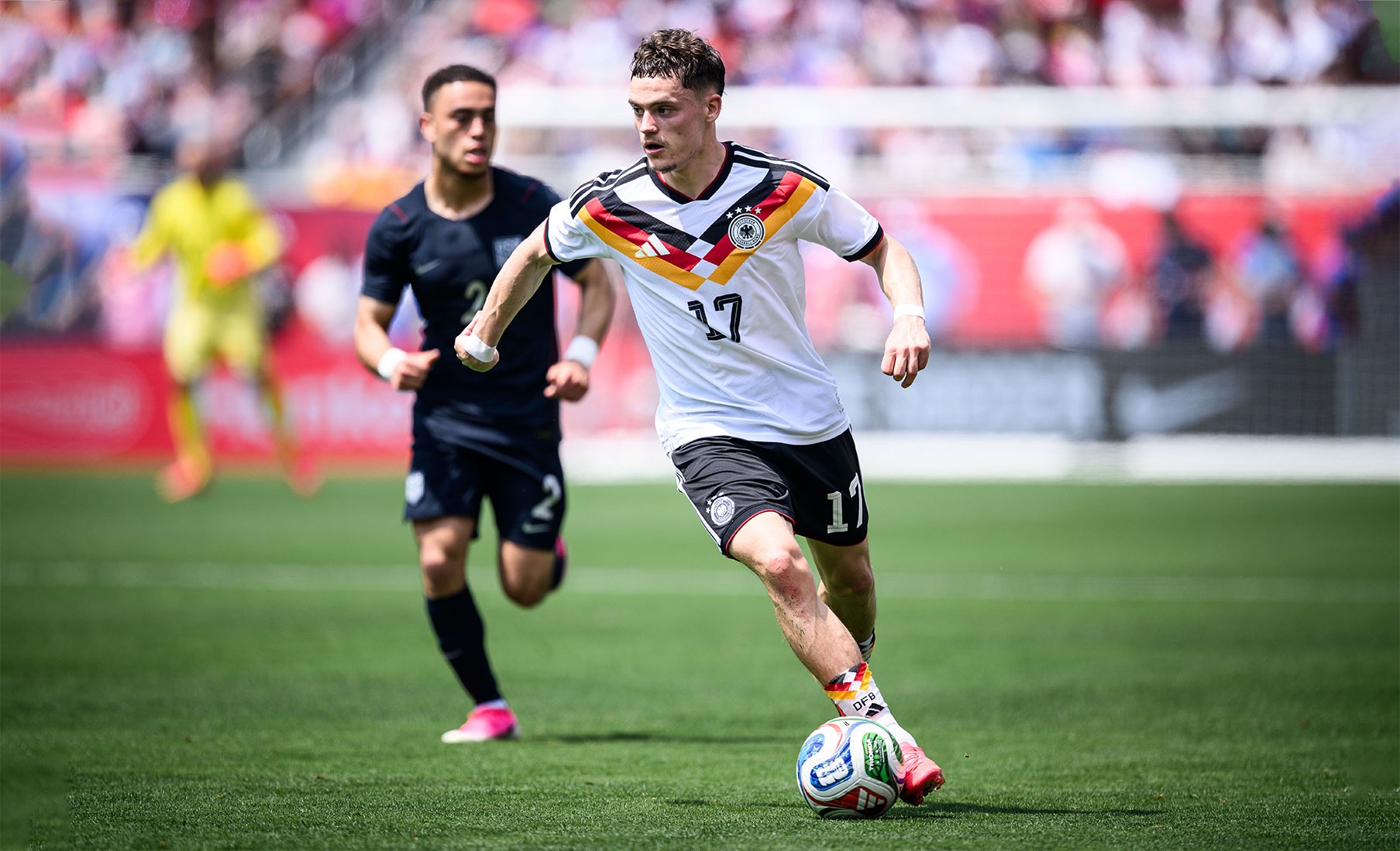
 German wunderkind Florian Wirtz will be a key figure for the four-time world champions. (Photo: Marvin Ibo Guengoer / GES Sportfoto / Getty Images)
Curaçao
The plan
Only a Fifa member since 2011, Curaçao have spent years building towards a first World Cup appearance. As an autonomous country within the Kingdom of the Netherlands, the island has been able to draw on a rich pool of Dutch-raised talent with Curaçaoan roots.
They were well prepared for the qualifying cycle and had an advantage with the World Cup being hosted by the United States, Mexico and Canada.
“We knew we wouldn’t face them in qualifying, which often proved a stumbling block,” says the goalkeeper Eloy Room about this edition’s Confederation of North, Central America and Caribbean Association Football format. “So that became a real trigger for all of us, like: ‘If there’s a chance to reach the World Cup, it’s now.’”
Room mentioned important qualifying games against Haiti [a 5-1 win] and Trinidad [0-0], which made them realise something special might be possible. Then came the home game against Jamaica, which Curaçao went on to win 2-0. When they drew the reverse leg 0-0, they achieved the unthinkable and qualified for the World Cup, remaining unbeaten in their 10 matches and making them the smallest nation ever to take part, both in population [about 156,000] and land area [171 square miles].
“I think God was with us that night,” said Leandro Bacuna, a 34-year-old midfielder and Curaçao captain. “Because you’ve seen the game, everyone’s seen the game. Couple of balls on the post… Everywhere. But our keeper was great, so I think it was meant for us. It was a story written for us.”
And now the World Cup is looming. To survive a group with Germany, Côte d’Ivoire and Ecuador would be a huge achievement.
“We do want to continue in the same way we’ve played in recent years, by playing possession-based football from the back,” said Room. “But we will have to adapt because we’re going to a World Cup where we may have less of the ball than our opponents. Still, we have to stick to our own strengths, as we can play good football.”
/file/attachments/orphans/2278966383_270847.jpg "Curaçao manager Dick Advocaat during the international friendly match between Scotland and Curaçao at Hampden Park on 30 May 2026 in Glasgow, United Kingdom. (Photo: Visionhaus / Getty Images)")
The coach
At 78, Dick Advocaat will become the oldest coach ever at a World Cup, surpassing the previous record held by Otto Rehhagel, who was 71 when he led Greece at the 2010 tournament. The former Rangers and Sunderland manager took charge in 2024 and guided Curaçao to qualification, making it one of the finest achievements of his career.
Yet earlier this year he stepped down to be with his ill daughter and was succeeded by Fred Rutten, who had previously been unable to take the role in 2023 for medical reasons. But when it became clear that the situation involving Advocaat’s daughter had improved, a behind-the-scenes push gathered momentum to bring him back, as he remained highly popular. Rumours circulated that sponsors had pressured the federation to reinstate him, and the situation intensified, after which Rutten ultimately stepped aside of his own accord, clearing the way for Advocaat’s return.
Star player
Leandro Bacuna has represented Curaçao for more than a decade and has played the longest at the highest level, having spent three seasons in the Premier League with Aston Villa. Together with his younger brother Juninho he leads the team and forms part of one of the island’s best-known football families, with brother Johnsen and father John both having represented the former Netherlands Antilles. Leandro is hugely popular among the local population, involving himself within the community. On international trips, he can often be found helping out with the luggage of the team, or other tasks, always ready to lend a hand when needed.
/file/attachments/orphans/2278910127_979327.jpg "Leandro Bacuna of Curacao passes the ball during the friendly against Scotland. (Photo: WM Sport Media / Getty Images)")
One to watch
Livano Comenencia spent nine years at the PSV academy, before playing two seasons for their reserve side in the Dutch second tier. A regular across several Dutch youth national teams, his journey then took him to Juventus in 2023, where he further developed his game with the club’s Next Gen team. Now at FC Zürich, the midfielder underlined his growing importance with a crucial goal in a 2-0 win over Jamaica, helping Curaçao win their Caribbean qualifying group. Technically polished and comfortable dictating play from deep, he combines composure on the ball with the engine of a classic box-to-box midfielder.
Unsung hero
Steady presence at the back, Juriën Gaari got selected for Curaçao while still playing for the Dutch amateur side Kozakken Boys, and was then part of Curaçao’s Caribbean Cup win and the country’s first ever Gold Cup participation in 2017. It marked the start of a career that has since taken him to RKC Waalwijk and Saudi clubs Al-Hazem and Abha Club. Although a late bloomer in the professional game, he has already amassed significant international experience with almost 60 games for Curaçao. Never one to seek the spotlight, he nevertheless commands respect and is an important presence within the team.
What to expect from fans at games?
It is all singing and dancing, the Caribbean vibe wrapped in warm exuberance. After Curaçao qualified for the World Cup, the music artist Jeon released Mama Wa’, a song dedicated to the Blue Wave, the national team’s nickname. The song captures the pride surrounding the achievement, with several members of the squad mentioned. Estimates suggest more than 3,000 fans will travel for the opening match against Germany, with charter-flight packages being arranged from the island. Around three-quarters of that number are expected for the remaining group games against Ecuador and Côte d’Ivoire.
Relationship with the US/Trump?
Curaçao tends to take a broadly pragmatic view of the United States, viewing it through the prism of regional stability, economics and neighbouring Venezuela, whose coastline lies just 65km away, underlining the island’s strategic position in the southern Caribbean. Foreign affairs and defence are handled by the Netherlands, of which Curaçao is a constituent country.
In regard to the tournament, the high prices threaten to limit the travelling support. “It’s just incredibly expensive,” says Angelo Cijntje, Curaçao’s performance coach. “This is not affordable for the average person in Curaçao. I’m wondering how they’re going to manage it. People will do everything they can, they might even be willing to sell their car just to experience this. But it’s a real pity that Fifa and the US are making it so difficult to be there.” By Arthur Renard
Ecuador
The plan
Ecuador’s La Tri arrive at the 2026 World Cup as one of the most solid and respected teams in Conmebol. They finished second in the qualifiers behind Argentina (despite the points deduction from the 2022 Byron Castillo case), standing out for having one of the continent’s best defences and, by mid-May, a long unbeaten streak under the coach, Sebastián Beccacece.
Tactically, Beccacece – influenced by Jorge Sampaoli and Marcelo Bielsa – relies on high intensity, aggressive pressing and quick transitions. He frequently uses a 4-2-3-1 system along with a 4-4-2 or variations of it featuring a solid double pivot, a creative attacking midfielder and explosive wingers. The block remains compact, with emphasis on defensive solidity and vertical attacks. The defensive line is the team’s greatest strength: Willian Pacho (Paris St-Germain), Piero Hincapié (Arsenal), Pervis Estupiñán (Milan) and Joel Ordóñez (Club Brugge), who sometimes plays as a full-back, all provide balance and strength. In midfield, Moisés Caicedo (Chelsea) is the box-to-box engine; up front Enner Valencia (Pachuca) remains lethal, while Gonzalo Plata (Flamengo) brings pace and flair.
After an inconsistent 2024 Copa América campaign, where they won only one game in the group before being knocked out by the eventual champions Argentina in the quarter-finals, Ecuador secured World Cup qualification with key victories that showed collective maturity. This is not a team dependent on one superstar; it is young and balanced. However, scoring goals remains an issue; Beccacece’s side scored just 14 goals in the qualifiers (they conceded only five).
“We wanted to maintain the defensive solidity the team already had… but also release the chains to maximise the players’ individual strengths,” said Beccacece. The head coach has taken some mild criticism for sometimes being too cautious, and his declarations are no longer as well received by a significant portion of fans inside the country – something that may not be as visible abroad.
Ecuador are a dangerous dark horse: disciplined, athletic and eager to get through Group E against Germany, Côte d’Ivoire and Curaçao and repeat the success of advancing beyond the first round as they did at the 2006 edition in Germany.
/file/attachments/orphans/2278726268_346869.jpg "Chelsea star Moisés Caicedo is Ecuador's key figure. (Photo: Visionhaus / Getty Images)")
The coach
Argentinian Sebastián Beccacece took charge in August 2024 after Félix Sánchez was sacked following Ecuador’s Copa América quarter-final defeat. A former assistant to Jorge Sampaoli with Chile and Argentina, Beccacece previously coached Racing, Independiente and Elche, but this is his first experience as a national team head coach. He has brought structure, intensity and tactical flexibility, and under his leadership, Ecuador breezed to second in Conmebol’s qualifications. His rockstar-like style has rejuvenated La Tri, and although some still criticise him for a style of play that does not fully excite fans, Beccacece is focused on the majority: “The most rewarding and satisfying thing since we’ve been at the helm is seeing the fans reconnect with the players and rekindle their love for the national team. The fans have fallen back in love with the national team, particularly with this group of players.” Heading into 2026, he is one of the continent’s most respected – and talked-about – coaches.
Star player
Moisés Caicedo. A relentless midfield engine, he recovers balls, distributes with precision and constantly arrives in attacking areas. He is considered one of the best players in the world in his position, with top-level experience in the Premier League and Champions League. Alongside Willian Pacho and Piero Hincapié, he forms the core of Ecuador’s new European-based generation.
“It’s a short competition and we have to make the most of it,” Caicedo says of this summer’s tournament. “We can’t settle for just qualifying: we know we’re capable of more. We’re raring to take that next step so that the days when simply qualifying was the be-all and end-all are confined to the past.” A future captain in the making, Caicedo combines physicality, technique and leadership. Ecuador no longer depends solely on Antonio Valencia; Caicedo is the axis that makes everything work.
One to watch
Kendry Páez remains Ecuador’s biggest emerging talent, although his European career has not exploded as expected. After his multimillion-dollar move to Chelsea, he struggled for consistency and has been far from the level many predicted, leading to loan spells at Strasbourg and River Plate. At River, he has earned only sporadic minutes and in recent weeks has not been a regular part of Eduardo Coudet’s squad. Even so, Beccacece continues to trust his dribbling ability, vision and immense potential. The 2026 World Cup could become his perfect opportunity to prove why he is considered one of South America’s most exciting prospects. A rough diamond that needs to shine now.
/file/attachments/orphans/2273868816_541632.jpg "Kendry Paez, who plays club football for River Plate in Argentina, is one of the rising stars in the Ecuador team. (Photo: Marcelo Endelli / Getty Images)")
Unsung hero
Willian Pacho and Alan Franco are Ecuador’s silent heroes. Pacho is the elegant left-footed centre-back who organises the defence with composure in buildup play and flawless duels. He does the quiet work that allows Ecuador to press high without taking unnecessary risks. Alan Franco, meanwhile, is the all-action midfielder responsible for the dirty work: recovering balls, covering spaces, helping defensively and bringing balance to midfield. They do not steal headlines like Moisés Caicedo does or Antonio Valencia did, but they are fundamental to Ecuador’s collective solidity and to maintaining the best defence in Conmebol.
What to expect from fans at games?
Ecuadorian fans are expected to travel to the United States in strong numbers thanks to the proximity, and they will be boosted by the large Ecuadorian migrant community living in the US. Expect bright yellow everywhere, giant flags, hats and nonstop joy. Supporters loudly sing “¡Ecuador, Ecuador!” and “Sí Se Puede”. The atmosphere will be vibrant, festive and generally peaceful – more dancing than fighting. Fans are expected to turn the venues into a true tricolour celebration filled with colour, drums and unconditional support as they seek revenge after Qatar 2022, where the team exited in the group stage. Bring sunscreen… and patience for the traffic!
Relationship with the US/Trump?
Ecuador, under President Daniel Noboa, maintains a cordial and pragmatic relationship with the United States and Donald Trump: cooperation against drug trafficking, trade agreements and generally good chemistry. Trump has spoken positively about Ecuador regarding economic matters. The national team and the Ecuadorian federation remain politically neutral and focused on football (Beccacece is Argentinian, so he avoids political comments like they are penalties) and fans appreciate the proximity because many Ecuadorians live in the US. Overall, the vibe is good between both countries: fans will arrive ready to enjoy the World Cup with no major political drama… just some reggaeton and ceviche. By Francisco Limongi
/file/attachments/2993/fifa_2026_groups_774403.png)
Germany
The plan
Predicting Germany’s tactics is not entirely straightforward, because Julian Nagelsmann likes to change both his line-up and his system. In fact, Nagelsmann kept switching formations throughout the World Cup qualifiers. The result was five mediocre to poor performances, including a 2-0 defeat in Slovakia that could easily have been heavier. But in the end, the German team were convincing in the return fixture, swept their opponents aside 6-0 and won their group convincingly.
Nagelsmann will probably base his team on the XI from the match against the Slovakians in Leipzig, as well as on a highly passionate style.
“We have to play with emotion,” says Nagelsmann, who is regarded as a tactical obsessive and who is often seen shouting and raging in the technical area.
The national team’s traditional recipe for success has been to adopt the things that work well at Bayern Munich and, in 1974 and 2014, that led to World Cup triumphs. The chances of a repeat initially appear favourable: this season has gone exceptionally well for Germany’s only genuinely world-class club. Nagelsmann is therefore likely to rely on Jonathan Tah, Aleksandar Pavlović, Joshua Kimmich, Leon Goretzka, Jamal Musiala and the impact substitute Lennart Karl (with Serge Gnabry unfortunately sidelined through injury) as well as Manuel Neuer, who ended his international retirement in May to play in his fifth World Cup.
But can the Munich axis be relied upon? Musiala is out of form, and in recent months was not much more influential for Bayern than Goretzka, who sat on the bench in all the important matches in the second half of the season yet still seems certain to start under Nagelsmann. And Kimmich will play in a different position for Germany than he does for Bayern: at right-back rather than in central midfield. It is a solution with risks.
Kimmich embodies a problem in German football: there is a lack of individual class. He is certainly a master of the traditional virtues. But as captain, because of his shortcomings in tackles and one-on-one situations, he does not measure up to predecessors such as Lothar Matthäus, Michael Ballack or Philipp Lahm. Germany also used to pride themselves on their goalkeepers and defenders. That, too, is currently lacking, despite the return of Neuer, who is 40 now. Nor are there any midfield strategists such as Toni Kroos or Mesut Özil at present.
/file/attachments/orphans/2280219645_497380.jpg "German coach Julian Nagelsmann needs to navigate his side through the Group phase for the first time since 2014. (Photo: Alexander Hassenstein / Getty Images)")
The hope lies up front. In the No 10 role Nagelsmann has a wide range of options in Florian Wirtz, Musiala, Kai Havertz and now also Karl, all of whom possess outstanding skills. He will probably use Havertz as a deep-lying centre-forward as there was never any doubt about the Arsenal forward’s technical ability, only about his efficiency. Will he be more clinical this time than he was at Euro 2024? He will need to be because, with Niclas Füllkrug and Nick Woltemade still not really established, this is a team without a classic goalscorer.
The coach
More and more figures within German football are criticising Nagelsmann. Most recently, Uli Hoeneß accused him of misunderstanding his role.
“Our national coach thinks he wins the match. No, the team wins the match,” said Bayern Munich’s still-influential honorary president. Nagelsmann has so far achieved little more than a run of mixed results with the Germany side, and he also keeps making life difficult for himself with curious remarks. After the 2-1 win over Ghana in March, irritated by reporters’ questions, he publicly rebuked his match-winner Deniz Undav. A decade ago, as a young coach, he saved Hoffenheim from relegation and soon afterwards led the club into the Champions League. He is only 38 years old, but the promise that many believed they saw in him – that he would become a great coach, even a genius – has yet to be fulfilled.
The star player
Florian Wirtz combines the qualities of a playmaker with those of a tireless team player in a way that is exceedingly rare. “He is extremely hard-working and not a classic No 10 who only wants the ball, but someone who also puts in a lot of work,” said Nagelsmann, who defended Wirtz when he came in for criticism in the months after he moved to England. All in all, Wirtz did not have a terrible season at Liverpool. But measured against his class and his transfer fee, it has not been a particularly good one. The same applies, to some extent, to the national team. Against non-elite opponents, as in the 4-3 win in Switzerland in March, Wirtz can blow everyone away with his technique and his interplay with Kai Havertz or Lennart Karl. But if Germany are to have a successful World Cup, the 23-year-old will also have to perform against major football nations.
One to watch
At the age of 10 Lennart Karl had a trial at the Bernabéu, but decided to stay in Germany. When he said this January that Real Madrid was his dream club and that he definitely wanted to play for them one day, some Bayern fans took offence. Yet it is probably precisely this mixture of self-confidence and carefree ease that defines the 18-year-old. A year ago he was still playing for Bayern’s Under-19s; now his dribbling is feared everywhere. He made his international debut in March.
“He is calmer than I expected,” said Nagelsmann. “I had absolutely no sense that the hype had gone to his head.”
Unsung hero
Nico Schlotterbeck and Antonio Rüdiger attract more attention, but Germany’s best defender is Jonathan Tah. His strength in the tackle and his composure on the ball will be crucial. Tah is not a man of many words and comes across as quiet off the pitch. On it, however, he seems to have found his role, and in the United States he will play his first World Cup match at the age of 30. “It certainly was never pleasant playing against me, because I have a certain physicality,” he told Zeit two years ago. “But now I’m even more unpleasant, because I always keep my opponent in view and stay right on him.”
/file/attachments/orphans/2280273484_900102.jpg "Jonathan Tah in action against the United States at Soldier Field on 6 June 2026 in Chicago, Illinois. (Photo: Alexander Hassenstein / Getty Images)")
What to expect from fans at games?
“Olé, super Deutschland, olé!” “Deutschlaand, Deutschlaaand, Deutschlaaaand!” German terrace chants cannot quite keep up with the creativity of Jamal Musiala’s or Lennart Karl’s dribbling and, during the home Euros two years ago, Nagelsmann complained that Germany’s fans were too quiet. Being typically German, the DFB set up a working group in 2024 to improve the atmosphere: the AG Stimmung. “People want to sing, they just need someone to tell them what to sing,” said lead chanter Bengt Kunkel. However, Kunkel will not be travelling to the United States. He feels the same as many Germany fans, for whom this World Cup is simply too big and too expensive. Even so, there will probably be at least a few more German supporters in the United States, Mexico and Canada than there were in Qatar.
Relationship with the US/Trump?
Much like German football itself, it has seen better days. At the end of April, Friedrich Merz criticised Donald Trump in front of school pupils in the Sauerland, saying he had gone to war with Iran without any strategy whatsoever. Trump’s response was that Merz had no idea what he was talking about and was doing a terrible job. The fact that it may not always be wise to say every truth aloud is something both the German chancellor and the national coach still have to learn, the latter having already had to backpeddle on several occasions in his career. No one should expect any sign of rebellion from the DFB in the United States. There was some discussion in Germany about boycotting the World Cup because of the Greenland crisis, but only briefly. The DFB still seems traumatised by the One Love armband affair at the World Cup in Qatar. “I’m no longer taking part in the political discussion,” said the captain Joshua Kimmich. “We’ve seen that it’s not really productive when we players speak out politically.” By Nico Horn and Oliver Fritsch
Ivory Coast
The plan
Côte d’Ivoire return to the world stage for the first time since the golden years of the early 2010s. They do not quite have the star power of old but their squad is packed with recognisable faces to fans of Europe’s top leagues. The 2023 Africa Cup of Nations winners, on home soil, usually play 4-3-3 although there are questions over who will play in arguably the most important position: holding midfield. Jean Michaël Seri, the 34-year-old former Fulham and Hull midfielder, had made the position his own but hasn’t been the same since spending a year out of the game with an ankle injury. Nottingham Forest’s Ibrahim Sangaré is expected to step into the breach.
The coach, Emerse Faé, prefers a style of play that prioritises defensive solidity and relies on the individual qualities of wingers on the counterattack. Les Éléphants did not concede a single goal in 10 qualifying matches to get here. Their defence, which sometimes evolves into a back three, is led by Roma’s Evan N’Dicka, whose revolving defensive partners include Atalanta’s Odilon Kossounou and Reims’ Emmanuel Agbadou. Franck Kessié, formerly of Barcelona and Milan, still runs the midfield and wears the captain’s armband. Then Faé has a wealth of options in attack such as Nicolas Pépé, Amad Diallo and Yan Diomandé. Evann Guessand may bear the weight of expectation in the absence of a Didier Drogba-type figure up front.
Absent in 2018 and 2022, Côte d’Ivoire want to make the most of their return to the big time, and the president of their federation has set expectations high.
“The fixed objective is to play at least six games, which is the quarter-finals,” said Yacine Idriss Diallo. He will want to move on from a disappointing Afcon defence in January, exiting to Egypt at the quarter-finals in Morocco. Friendly wins in March (1-0 vs Scotland and 4-0 vs South Korea) showed signs of promise.
/file/attachments/orphans/TL_2500670_360843.jpg "Franck Kessie of Ivory Coast. (Photo: Mahugnon Leopold Soglo / Gallo Images)")
The coach
“I’m not going to the United States for a holiday,” Emerse Faé has said. “I’m a competitor and my objective is to go as far as possible. Why not win it?” The former midfielder has been on the coaching staff since 2022, initially as an assistant to Jean-Louis Gasset. After Gasset was sacked, remarkably mid-tournament at a home Afcon in 2024, Faé stepped in and led the hosts to their third continental title. This has been the 42-year-old’s first job as a head coach after he had spells in charge of youth teams at Nice and Clermont in France. This is his second World Cup experience having played for Côte d’Ivoire at their debut in 2006.
Star player
Nicolas Pépé arrives at the World Cup in perfect shape to lead Côte d’Ivoire from the front. The former Arsenal winger was nominated for the Player of the Season award in La Liga after a fine campaign with third-place Villarreal that included eight goals and eight assists. The left-footer excels coming in off the right wing, but can also play as a second striker. His main qualities lie in his dribbling, but he’s not shy of letting fly when in range. Absent from Afcon in Morocco owing to personal reasons, this is a first, and probably last, World Cup for ‘Nico’ after winning his first cap 10 years ago. “I’m 30 now and I don’t see myself staying with the national team until 34 to play at the next World Cup,” he has said.
/file/attachments/orphans/2278090016_194100.jpg "Ivory Coast star Nicolas Pépé, seen here playing for Spanish club Villarreal. (Photo: Eric Alonso / Getty Images)")
One to watch
Christ Inao is the present and the future of the Côte d’Ivoire side. The 19-year-old is a risk-taking midfielder who has enjoyed a breakthrough season in senior football with Trabzonspor in Turkey. He won his first cap last November and played his way into the starting lineup during the Africa Cup of Nations in Morocco. After impressing in the Süper Lig and winning the Turkish Cup, Trabzonspor hope to make a handsome profit on any future sale of Inao. Some standout displays this summer could increase that margin.
Unsung hero
Franck Kessié has been a Côte d’Ivoire international since 2014, winning his first cap a few months after their last World Cup appearance in Brazil. Now, at 29, he is the captain and yet still goes under the radar. The box-to-box midfielder provides much-needed balance to Emerse Faé’s team and does a lot of the dirty work. He left Barcelona for Al-Ahli in 2023 and has won back-to-back AFC Champions League titles with the Saudi Arabian club, being named best player in the competition this past season. A serial winner, Kessié also has league medals from Serie A and La Liga.
What to expect from fans at games?
Not many Ivorians will make the trip to North America owing to a number of administrative constraints placed on citizens of Côte d’Ivoire who want to enter the United States. It will be down to the diaspora already in the States to bring the noise, although their group fixture against Germany will take place in Toronto. The other two are in Philadelphia, where the team are based. Expect to see some familiar colours: the flag is very similar to Ireland’s and the team strip is like the bright orange of the Netherlands. Song and dance, and a dose of humour, form the base of the Ivorian support.
Relationship with the US/Trump?
Everyone in Côte d’Ivoire is happy to be back at a World Cup for the first time in 12 years. No comments have been made by the federation or players regarding politics in any of the host nations, including the United States, nor about the ticket costs. The Trump administration said in May that Côte d’Ivoire fans would be exempt from paying the $15,000 visa deposit to enter the US if they had valid match tickets, but that was way too late for the majority of people who had considered going. Côte d’Ivoire was one of a number of countries affected by the Trump administration’s cuts to USAid, with bilateral deals for public health aid agreed instead. By Prince Akabla
Comments
Scroll down to load comments...