




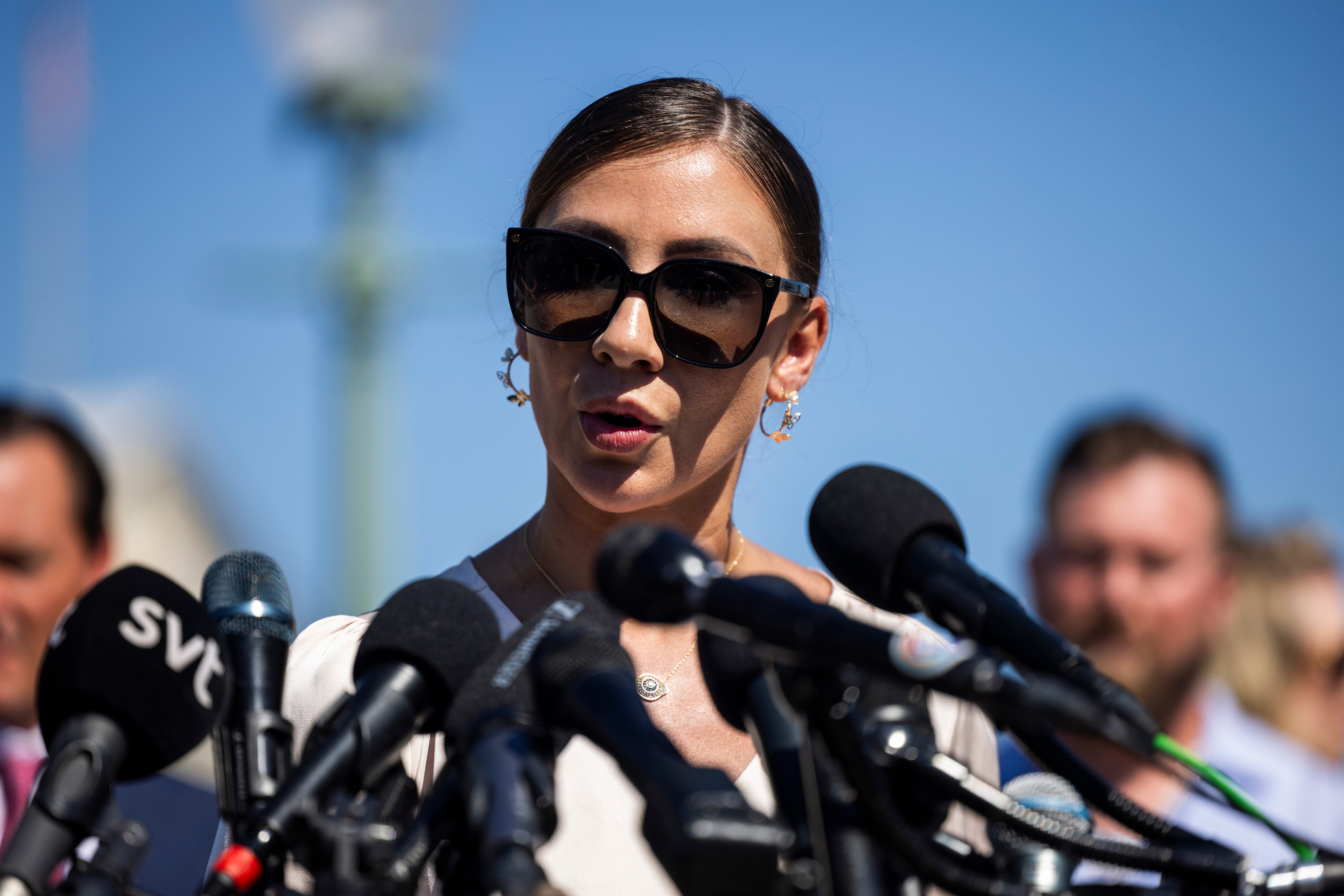
 Survivor of the Jeffrey Epstein and Ghislaine Maxwell sex-trafficking scandal Marina Lacerda speaks at a press conference with other survivors outside the US Capitol in Washington, DC, USA, 03 September 2025. On 02 September the House Oversight Committee released 33,000 pages of documents on the scandal that they received from the Department of Justice. EPA/JIM LO SCALZO
In September, she and other accusers appeared at a news conference pressing for the release of the Epstein files. “She’ll be unalived,” a stranger wrote under a YouTube video of a news report about Lacerda that day. “She really should’ve stayed quiet. RIP.”
The harassment intensified when Lacerda’s name appeared at least 46 times in unredacted Justice Department documents months later. Online, she was called a liar and a prostitute who deserved what happened to her. Her 12-year-old daughter was taunted at school by classmates asking if she was Epstein’s child.
Today, Lacerda lives with her daughter in a gated community and sleeps with a handgun on her nightstand. “I’m scared that somebody’s going to come in the house,” she said. “I’m just paranoid all the time.”
Lacerda is one of 23 Epstein accusers Reuters identified who’ve faced threats, harassment and intimidation by trolls, haters and other foes – some after speaking publicly about their abuse, others after their identities were exposed in the Justice Department’s Epstein files, and in some cases both. Drawing on interviews with the women, police and court records, and thousands of online posts, the review is the most comprehensive to date of the scope and severity of attacks on Epstein’s accusers.
The harassment took many forms. Strangers photographed women’s homes. Unfamiliar cars lingered outside and sped off when confronted. Some women received threats of violence, including calls from people claiming to know where they lived. Several say they no longer leave home alone.
The Justice Department said it took steps to protect victim information after releasing millions of pages of Epstein-related investigative files in December and January, and moved quickly to fix redaction errors when notified. Asked about its handling of the files for this report, Justice Department spokesperson Natalie Baldassarre said that “no victim should face harassment, threats, or intimidation after coming forward.” She added that the department is “not to blame for backlash directed at victims who voluntarily revealed their identities long before files were published.”
Former Attorney General Pam Bondi, who President Donald Trump fired in April, acknowledged “redaction errors” in May 29 testimony to Congress about the Justice Department’s handling of the Epstein files. She said she had delegated responsibility for releasing the documents to her then-deputy Todd Blanche.
“We made mistakes and we owned up to them,” Blanche, now Acting Attorney General, testified before a congressional committee on May 19. “Of course any time we release a victim’s name that shouldn’t be released, we have failed as a Department of Justice.”
For the 23 women Reuters interviewed, the news organization reviewed documentation of their allegations against Epstein – much of it in court or law enforcement records – or confirmed they received compensation through court-approved funds or settlements. All said the harassment had deepened the harm they say Epstein inflicted, placing them in the spotlight of an enduring national criminal scandal fueled by Washington politics and their own push for accountability.
Lawmakers from both parties have drawn some of the women into political battles. They have been invited to high-profile events, including the annual State of the Union address, to pressure the Trump administration over its handling of the case, demand the release of more files and pursue greater accountability for Epstein’s associates.
The accusers face a fraught calculation: Speaking out can draw attention to abuses that long went unpunished, but also expose them to further harm. At least 10 of the women interviewed by Reuters said they now own weapons – including guns, Tasers, pepper spray or knives – or use armed security for protection.
Nearly all the women described living in a constant state of vigilance. Four told Reuters they reported threats to police, but the cases didn’t lead to prosecutions because authorities couldn’t identify suspects or determine that a crime had occurred, according to the women and police records. One case remains under active investigation, police said. Other women said they chose not to contact law enforcement, citing distrust rooted in what they saw as past failures to act on their abuse claims.
In Lacerda’s case, a YouTube spokesperson said the “unalived” threat was removed after Reuters asked the video-sharing platform to comment on it.
The motivations of those menacing the women range from victim-blaming to conspiracy theories. The women have drawn fire across the political spectrum – sometimes for voting for Trump, more often for criticizing his handling of the Epstein files or for suggesting he’s covering up information. Trump was a friend of Epstein’s for years. He has denied knowing about the financier’s sex crimes.
Some victims are accused of seeking money or attention, branded as prostitutes or grifters. Others, particularly those from Russia or Eastern Europe, have been called foreign spies. Trolls question why some women returned to Epstein after being abused; others say women who were 18 or older when victimized have weak claims.
Even women who were minors at the time have faced criticism. Some harassers suggest they should have understood the risks, or blame their parents for failing to protect them.
At the same time, the women have received widespread praise for speaking out and forcing Epstein’s long-buried abuses into the open. Women’s rights groups, lawmakers from both parties and others have hailed them as brave.
Epstein pleaded guilty in Florida in 2008 to prostitution charges, including soliciting an underage girl, under a deal that resulted in him spending 13 months in jail. Arrested again in July 2019 on federal sex‑trafficking charges involving minors in New York and Florida, he died in a Manhattan jail awaiting trial. His death was ruled a suicide. About $425 million has been paid to at least 200 victims through a compensation fund and settlements with his estate and banks accused of facilitating the abuse. His accomplice Ghislaine Maxwell was convicted in 2021 and is serving a 20‑year sentence.
In at least 6,250 instances, names, addresses, phone numbers, birthdates and photos appeared unredacted in the Justice Department’s release of the Epstein files, exposing the identities of at least 177 women – in some cases repeatedly for the same women, said Brittany Henderson, whose Florida law firm represents at least 250 Epstein accusers.
Reuters was unable to independently verify that count. But the Justice Department said in a February letter to judges overseeing the cases against Epstein and Maxwell that it had taken down “several thousands of documents and media that may have inadvertently included victim-identifying information.”
Blanche said in his May 19 testimony that the department removed documents “the second” victims or their lawyers reported them and had lawyers working “24/7” to “make sure that we fixed every single problem.”
Yet even after errors were flagged, personal information remained visible, sometimes for months, according to a Reuters review of the files and emails sent by the women’s lawyers to the Justice Department.
In dozens of cases, Henderson said, the information remained public even after she had reported the errors. Some were corrected within days, but others went unaddressed for weeks or were reposted without being fully redacted.
The Justice Department declined to comment on Henderson’s specific cases. But the spokesperson said it “takes victim redaction seriously” and that when personal information is found to be unredacted, “our team swiftly fixes the issue and republishes the appropriately redacted pages.”
REPEATED ERRORS
In the summer of 2004, Danielle Bensky was 17, an aspiring ballerina at a New York performing arts school, when she said she was invited to Epstein’s Manhattan mansion to work as a paid masseuse.
There was nothing sexual at first, but that soon changed, she said. When she told him her mother had been diagnosed with a brain tumor, Epstein threatened to use his pull with New York hospitals to interfere with her mother’s care unless she complied with his sexual demands. She said she took the threat seriously and continued visiting him, and that the abuse went on for about a year.
In April 2021, Bensky went public, identifying herself as an Epstein victim. But it wasn’t until the Justice Department began releasing the Epstein files – including unredacted documents identifying her – that she began receiving violent threats.
In December, her first name and phone number appeared in one document and her full name in another. In January, one document listed her full name and birthdate; another had her name, birthdate, phone number, and home and workplace addresses. That document was up for about three days before the Justice Department took it down, her lawyer, Sigrid McCawley, estimates.
While picking up her son from school in February, Bensky saw that she’d received a Facebook message from a man in New Mexico: “I would skullfuck you until you died.” The man’s Facebook page included photos of him holding an assault rifle. Her thoughts immediately turned to her son. “I just want to make sure that he’s safe,” she said in an interview.
Bensky, 39, now a dance teacher and choreographer, blocked the sender. Reuters contacted the man, Robin Clark, through his Facebook page to ask about the message. He replied: “I’m sure she endured some fucked up shit I cannot imagine but she is not the only victim and she chose the wrong path.” Then he told the reporter to “fuck off” and blocked her. Other attempts to reach Clark were unsuccessful.
Bensky reported Clark’s message to Facebook in June. The account was removed for violating Facebook’s policies, according to a spokesperson for parent company Meta.
In March, another release of Justice Department files brought Bensky’s name back into public view, this time in a 2008 statement she had given to a Federal Bureau of Investigation agent. In it, she described Epstein masturbating while she massaged him. When she stopped, he grew upset, told her to leave and paid her $300, she told the FBI.
McCawley, her lawyer, said she notified the Justice Department on March 7 and followed up nine days later after the department failed to redact the file. Only then was it redacted, she said.
In April, Reuters reviewed the Justice Department website and found that Bensky’s last name remained visible in two additional places. Reuters informed her, and her lawyer again contacted the department. The information, her lawyer said, was redacted several days later.
“It puts survivors in a place where you feel gutted,” Bensky said of the Justice Department’s redaction errors. “I’m always much more cautious and looking over my shoulder now.”
Former Playboy magazine model Audra Lynn Fasano said Epstein raped her in 2004. She went public with her accusation last July, four years after reporting Epstein to the FBI. In February, her status as a former Playboy model appeared unredacted in the Epstein files. Her zip code was briefly unredacted, too.
Soon after, she told Reuters, unfamiliar vehicles lingered outside her home. One parked near her driveway but drove off when she began recording it. In May, the department reposted the document with the Playboy detail redacted, but it still appeared in search previews on the department’s website. After Reuters asked about it, the issue was fixed.
Another woman, who has never publicly identified herself as an Epstein accuser and spoke to Reuters on condition of anonymity, said she spotted a stranger in March photographing her home after her name and those of family members appeared unredacted in the Epstein files. After Henderson, her lawyer, flagged it to the Justice Department, it took about a month to be fixed, the woman said.
The botched redactions have sparked legal action. In March, an accuser filed a class-action lawsuit in federal court against the Justice Department and Google over the “wrongful disclosure and republication” of personal information in the Epstein files.
The suit, brought by a woman whose identity is withheld in court filings, alleges the Justice Department “outed approximately 100 survivors” in violation of the Privacy Act of 1974, which bars releasing personal information without consent.
Google, the complaint alleges, republished the data, “making it permanently and globally accessible.” The suit seeks an order requiring Google to remove and stop displaying the personal information, as well as damages, including at least $1,000 per victim from the federal government. The complaint says the disclosures led to harassment and threats to victims’ safety.
The Justice Department and Google have not issued a formal response in court to the lawsuit. Both declined to comment on it for this report.
‘OVERWHELMING’
In April 2019, Maria Farmer went public with her account of abuse by Epstein and Maxwell. She said she was inspired by Virginia Giuffre, who eight years earlier had abandoned anonymity to accuse Epstein of trafficking her to powerful men.
Giuffre died by suicide last year. Farmer, now 56, said she also considered ending her life because of what she described as relentless harassment, threats and public attacks after speaking out. “I’ve wished I didn’t have to live any longer,” she told Reuters. “Who could survive the absurdity of being the whistleblower of a case, only to then be blamed for the crimes you reported?”
Farmer’s story began with what she has described as a seemingly ordinary encounter with Epstein. This account is drawn from multiple sources: her sworn affidavit filed in April 2019, a civil complaint filed later that year against the executors of Epstein’s estate, an ongoing 2025 lawsuit she filed against the U.S. government, police and FBI complaint records from 1996, and Reuters interviews with Farmer and her lawyer.
In 1995, while studying for a master’s degree in fine arts from the New York Academy of Art, Farmer met Epstein at an art show and sold him a painting at half price after he offered to help her career. The next year, he hired her to acquire art for him. Then 26 and newly graduated, she sourced artwork while also working as a receptionist at his Manhattan mansion, keeping track of visitors.
In the summer of 1996, Epstein arranged for her to travel to Ohio to work on an art project. While there, Farmer alleges, Epstein and Maxwell led her into a bedroom and sexually assaulted her. The abuse extended to her family, Farmer said. In her sworn affidavit, she said her 15‑year‑old sister, Annie, was also sexually abused by Epstein in New Mexico.
After returning to New York with the help of her father later that summer, she reported Epstein and Maxwell to the New York Police Department and the FBI. She told authorities about her own abuse and what she believed was a wider system involving minors that she witnessed at Epstein’s mansion. She said Epstein threatened to “burn her house down,” according to notes from a September 1996 FBI complaint form.
In her account to investigators, Farmer urged agents to look beyond Epstein, she told Reuters. She recalled seeing prominent figures around Epstein, including Trump and former President Bill Clinton, she said. She did not witness either man engage in unlawful conduct, she said, but wondered what they were doing with Epstein.
Trump has denied knowing about Epstein’s crimes. A Clinton spokesperson pointed to his congressional testimony in February when the ex-president said he “saw nothing that gave me pause” during his time with Epstein and had no knowledge of the financier’s crimes, which came to light long after they stopped associating.
The FBI agent hung up on Farmer mid‑call, she said in the lawsuit she filed last year. Investigators did not pursue her allegations or open a substantive inquiry, she said.
She left New York soon afterward, changing her name and moving repeatedly. She lived under aliases in South Carolina and North Carolina after discovering that Maxwell had tracked her movements, according to Farmer’s lawyer. Epstein and Maxwell threatened to kill her if she spoke to police again, Farmer said.
“We could shoot you twice in the back of the head,” she recalled Maxwell telling her. A lawyer representing Maxwell declined to comment.
In the months before Epstein’s 2019 arrest, Farmer went public, filing an affidavit detailing her allegations in the hope that prosecutors would act. Unlike other accusers around that time, she chose not to remain anonymous, following Giuffre’s approach. The two women were among the first to use their real names to confront Epstein and his inner circle. Farmer said she believed speaking openly might force some measure of accountability.
Instead, she said, it ruined her life. Strangers attacked her online, calling her a “pathological liar” and a “scam artist” who was “never a victim of Epstein” and should be prosecuted and sent to prison. She has cycled through a dozen phone numbers and email addresses after her accounts were repeatedly hacked.
“It has been so cruel and overwhelming,” she said of the response.
One episode still stands out, she said. In January 2022, while undergoing radiation treatment for Hodgkin’s lymphoma, she received a call from a woman who said she lived in California and owned a large cache of guns.
“‘I know where you live,’” Farmer recalled the woman saying. Farmer reported the call to police in Hot Springs Village, Arkansas, where she was living at the time, according to a police report reviewed by Reuters. An officer attempted to contact the caller but was unsuccessful, and the case was later closed after no further harassment was reported. A Hot Springs Village Police Department spokesperson declined to comment further.
Strangers posted her personal information and home address online. In February, after someone shared a photo of her house on the social media platform X, Farmer no longer felt safe. “I had to leave,” she said. “You feel violated.” She moved soon after and put her home up for sale. Her elderly mother, who lived nearby, now drives an hour to visit.
“I’ve just watched it completely devastate her,” said her sister, Annie, 46. “It’s really changed the way that she interacts with the world.”
Farmer leaves her new home only once a week, she said, and never alone. When she goes outside, she wears a hat and sunglasses and scans her surroundings.
In May 2025, Farmer filed a lawsuit against the U.S. government alleging negligence in failing to protect her and other victims from Epstein and Maxwell. She accuses the FBI of doing “absolutely nothing” after she first reported Epstein’s alleged crimes. The government has not yet responded to the lawsuit’s allegations in court but filed papers arguing the case should be transferred to Florida. The case is pending in the U.S. District Court for the District of Columbia. The Justice Department said it “cannot speak to FBI actions from 30 years ago.”
ALWAYS ON ALERT
For Farmer and some others who have accused Epstein of sexual abuse, the harassment has not eased with time. They have reshaped their lives to cope with it.
Jena-Lisa Jones was 14 when she said a friend of a friend took her to Epstein’s Palm Beach home in 2004. She said she had been told she would be paid to give him a massage, but instead he sexually abused her.
After she spoke about that experience at the U.S. Capitol last September, she was inundated with texts and direct messages. Strangers called her a liar. One urged her to kill herself. “It broke me,” she said in an interview.
Then came the phone calls: dozens in a night from unknown numbers, some silent, others mocking her abuse. “You better fucking answer when I call you back,” said one caller who identified himself as “Daddy Epstein” in a voicemail. Reuters reviewed the recording but could not identify the caller.
Jones said she didn’t report the calls to police, citing a lack of faith in law enforcement after its handling of the Epstein case.
Jones, now 37 and a mother of four, has installed security cameras at her Florida home. When she goes out, she carries a knife and a Taser, and scans parking lots for cars that linger or circle back. “I’m just always on high alert,” said Jones.
Lacerda, the woman who now sleeps with a handgun by her bedside, said she, too, is vigilant. Identified as “Minor Victim-1” in Epstein’s 2019 federal sex-trafficking indictment, she was 14 when she said she was abused after meeting the financier in 2002.
To make it harder for strangers to find her, she changed her name on property records.
“I absolutely love that I broke my silence,” she said. “But the aftermath — it’s just paranoia.”
(Editing by Jason Szep)
Comments
Scroll down to load comments...