




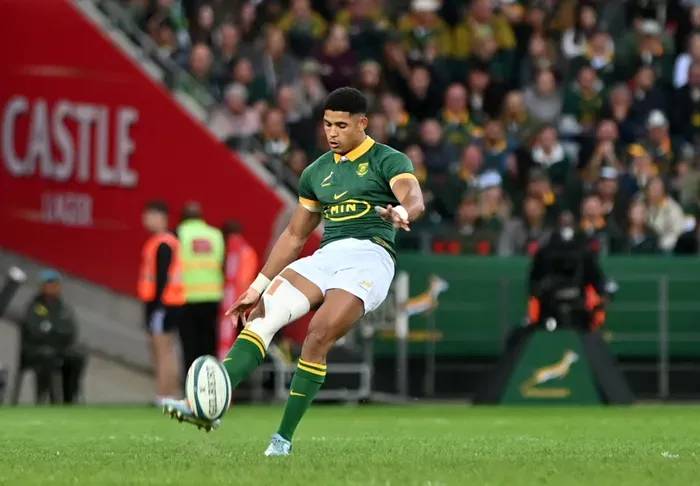
 The Springboks’ Sacha Feinberg-Mngomezulu kicks the ball during the recent Rugby Championship. Feinberg-Mngomezulu is likely to miss the Springboks’ November Tour after suffering a knee injury. (Photo: Ayanda Ndamane / Independent Newspapers)
 There has been a lot of bad news on the injury front over the past few weeks with key Springboks such as Kwagga Smith, RG Snyman and Morné van den Berg ruled out for the rest of the season, and Ethan Hooker listed as doubtful for the Greatest Rugby Rivalry series against the All Blacks in August.
The last thing Springbok coach Rassie Erasmus needed ahead of the double-header in Gqeberha on 20 June was another major injury headache.
Yet here we are, weighing up South Africa’s flyhalf options in the wake of the news that Sacha Feinberg-Mngomezulu could be sidelined for three to six months after sustaining a serious ankle injury in the recent United Rugby Championship (URC) quarterfinal between the Stormers and Cardiff.
With this timeline in mind, the best-case scenario is Feinberg-Mngomezulu missing the matches against the Barbarians, England, Scotland and Wales in the coming weeks, and returning in time for the four Tests against the All Blacks. The worst-case scenario is one of the Springboks’ key players missing most of the Test season – including that marquee series against New Zealand.
Feinberg-Mngomezulu has taken to social media in recent days to express his disappointment, and going by the reaction, the wider South African rugby community shares his frustration.
Although the Boks started the 2025 Test season as the No 1-ranked team in the world, they found another attacking gear in the second half of the campaign, after Feinberg-Mngomezulu was backed consistently in the No 10 shirt.
/file/attachments/orphans/TL_2507996_233536.jpg "Sacha Feinberg-Mngomezulu of the Stormers on attack during the United Rugby Championship match between the Stormers and Sharks at the DHL Stadium on 24 January 2026 in Cape Town. (Photo: Anton Geyser / Gallo Images)")
And so, the big question that has been asked in the wake of the latest injury report is whether the Boks will continue to dominate Test rugby in 2026, and whether they will persist with their all-court game with a different player pulling the strings at flyhalf.
Libbok, Pollard back in the frame
Erasmus often lists squad development as one of the Boks’ priorities – along with winning Tests and fulfilling the team’s transformation goals.
Since 2022, there’s been a push to bolster South Africa’s flyhalf stocks and Handré Pollard, Manie Libbok, Jordan Hendrikse and Feinberg-Mngomezulu have enjoyed opportunities at the highest level. During this period, the Bok coaches have name-checked Damian Willemse, Willie le Roux, Faf de Klerk and Cheslin Kolbe as utility players with the capacity to play No 10 if the situation demands it.
Although the Boks have had their fair share of injury setbacks in other positions, they have been spoiled for world-class options at flyhalf. By the end of the 2025 season, Feinberg-Mngomezulu had established himself as the first-choice No 10, starting in nine out of 15 games. Libbok was used as a specialist finisher for much of the year – playing eight games from the bench – whereas Pollard, a double World Cup-winner, played just five matches.
/file/dailymaverick/wp-content/uploads/2025/07/TL_2422351.jpg "Bok flyhalf Manie Libbok in action. (Photo: Richard Huggard / Gallo Images)")
It will be interesting to see how Feinberg-Mngomezulu’s absence changes the approach to selection and possibly the Springboks’ pattern of play in the coming months. Libbok doesn’t take the ball to the line like the youngster, but he is arguably the best distributor in the squad.
Although Pollard has worked to develop his attacking skills since joining the Bulls at the start of the club season, it’s his game management and goal-kicking – and his calmness under pressure – that set him apart.
In a broader sense, this is a great headache to have, and it would be fair to expect all three players – injury permitting – to travel with the Springboks to the 2027 World Cup. But having relied on two attack-minded flyhalves in the match-23 for much of the 2025 season, will Erasmus favour Pollard as a starter or finisher in 2026? Is it as simple as moving Libbok out of that bench role and into the starting XV?
Should Pollard spearhead a more pragmatic approach from the outset, before the team shifts gear, with Libbok and the bomb squad taking control in the second? And if Feinberg-Mngomezulu is unavailable and Pollard is off the park, can Libbok be trusted to nail a late penalty or conversion in a tight contest?
The selectors will be wrestling with these questions over the coming weeks.
Siyaya a possible bolter
A closer look at the series against the All Blacks highlights an unprecedented challenge: four gruelling Tests on successive weekends, with the last staged in far-flung Baltimore in the US. According to Erasmus, as many as 40 players may be needed to survive that series – and three flyhalf options may be essential.
In an ideal world, Feinberg-Mngomezulu, Libbok and Pollard would share the flyhalf responsibilities across those big matches. But if one or two of these players are unavailable, Erasmus may need to back a utility player for the role, or go deeper into the South African depth chart.
Jordan Hendrikse is currently recovering from injury and may only become an option at a later stage. The Sharks utility back started two Tests in 2024, before missing out on selection in 2025.
Clearly, Erasmus needs to plan for the worst-case scenario and find at least one more flyhalf alternative. The double-header in Gqeberha on 20 June may provide some answers. South Africa A will tackle Zimbabwe in the Nelson Mandela Bay Stadium before the Springboks face the Barbarians at the same venue later in the day.
These fixtures will provide a wider group of players with some game time before the Nations Championship, and give the Bok coaches a chance to assess some of the younger and less established options.
/file/attachments/2992/TL_2439043_539875.jpg "Zekhethelo Siyaya during the U18 International Series match against England at Paarl Gimnasium in Paarl on 16 August 2025. (Photo: Grant Pitcher / Gallo Images)")
Zekhethelo Siyaya caught the eye while playing for the unbeaten Westville Boys’ High team last season and went on to represent the Sharks at Craven Week before earning selection for South African Schools. More recently, the versatile youngster has played for the Junior Boks and has started for the Sharks at No 10 at the back end of the URC. Based on these impressive showings, he was invited to attend the second Bok alignment camp in Cape Town.
Siyaya (18) is two years younger than Feinberg-Mngomezulu was when he represented South Africa A in 2022. The latter made his first Test appearance against Wales in 2024 at the age of 22. Nevertheless, it appears that Erasmus intends to bring Siyaya and other promising young stars through to the senior squad sooner rather than later.
The matches against the Barbarians and Zimbabwe should provide Erasmus with some leeway to experiment and develop another flyhalf option apart from Pollard and Libbok. A utility player such as Willemse may be given the No 10 duties in one of the matches, but it wouldn’t come as a shock to see Siyaya getting a run from the bench.
Indeed, there may be cause to fast-track other Junior Springboks such as Riley Norton (lock), Esethu Mnebelele (hooker), Markus Muller (centre), Kai Pratt (prop) and Cheswill Jooste (wing).
And uncapped players in their early twenties such as Haashim Pead (scrumhalf), Batho Hlekani (flank), Siba Mahashe (flank) and Jaco Williams (wing) are almost certain to feature in Gqeberha. DM
Jon Cardinelli is a freelance writer.
This story first appeared in our weekly DM168 newspaper, available countrywide for R35.
/file/attachments/2993/DM-05062026-001_135175.jpg)