




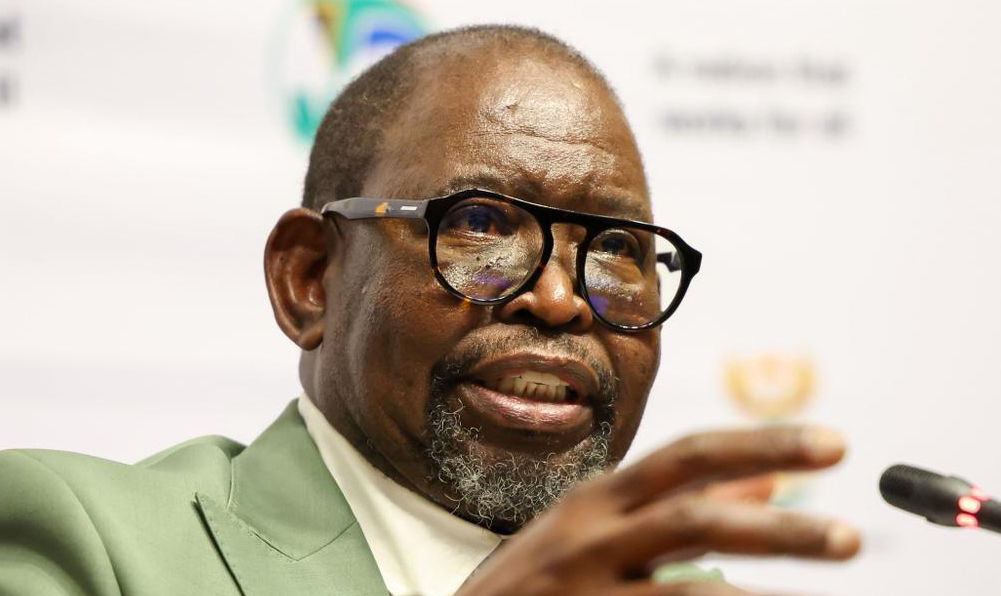
 The Fitch credit rating upgrade is another feather in the fedora of the Minister of Finance, Enoch Godongwana. (Photo: Jairus Mmutle / GCIS)
 South Africa’s sovereign credit rating is still in the “junk” category, but there is light at the end of the long tunnel.
Fitch Ratings gave South Africa its first upgrade in more than 20 years, raising its long-term foreign and local currency ratings by one notch to BB from BB- while keeping its outlook stable. Significantly, South Africa is only the second G20 country to get a Fitch upgrade so far this year against the backdrop of the Iran conflict and a souring global economy.
Such upgrades help to lower government borrowing costs, and by extension those of businesses and households, and signal improved investor confidence in the economy and the state’s ability to service its debt.
“The upgrade primarily reflects South Africa’s record of prudent fiscal management and progress on fiscal consolidation, despite weak economic growth and domestic and external shocks. Together with GDP revisions, this leaves debt/GDP well below levels anticipated when we downgraded it to ‘BB-’ in 2020,” a Fitch statement read on Friday, 5 June.
“The implementation of the wage agreement that caps FY26 wage increases at 4% (even if actual inflation is higher), and a public-sector early retirement scheme will restrain the wage bill.”
The upgrade is another feather in the fedora of Finance Minister Enoch Godongwana and his team. They have strived to contain rising debt levels that threatened to become unsustainable, by charting a fiscal path that has included an end to endless bailouts to failing state-owned enterprises and the drawing of a line in the sand with regards to public-sector wage hikes.
“The implementation of the wage agreement that caps FY26 wage increases at 4% (even if actual inflation is higher), and a public-sector early retirement scheme will restrain the wage bill,” Fitch noted.
“We anticipate debt/GDP will stabilise over the next two years at around 80% of GDP (including local government debt), well above the 2027 ‘BB’ median of 53%. Debt stabilisation is due to improved fiscal performance and [...] improved market sentiment.”
The Fitch upgrade follows other positive moves on the ratings front for South Africa. The trend started in November last year when S&P gave South Africa a one-notch upgrade. Moody’s has also altered its South African outlook to positive from stable, raising the prospect of another upgrade on the horizon.
All three ratings agencies now have South Africa two notches below the coveted investment grade status that the country once wore like a badge of honour – a state of affairs that underscores the sheer scale of the challenge of ascending that lofty peak again after the descent into junk.
This is one of the many toxic legacies that former disgraced president Jacob Zuma has bequeathed to the South African body politic from his ruinous State Capture years in office.
‘Clear turnaround’
“South Africa still has some way to go to regain its investment grade credit rating but for the first time in more than a decade we are seeing a clear turnaround in the downward ratings trend,” said Dr Duncan Pieterse, director-general of the National Treasury.
“The turnaround is especially notable because it comes at a time when the global sovereign credit trend is overwhelmingly negative.”
Pointedly, Pieterse said the twin objectives of stabilising debt and then reducing the debt-to-GDP ratio will be embedded with the adoption of “[…] a fiscal anchor, details of which we expect to announce in the 2026 Medium Term Budget Policy Statement”.
A “fiscal anchor” can take one of two forms as outlined by the Treasury last year in a discussion document on the subject.
The clearest path is a numerical fiscal rule, which would impose strict and pre-defined limits on government borrowing to prevent it from exceeding a specific debt-to-GDP ratio or a deficit rule to curb annual borrowing. The International Monetary Fund has recommended this approach.
The other, a parliamentary procedures model, “[…] would not rely on predetermined hard fiscal targets or ceilings. Instead, they would integrate fiscal sustainability principles into the process of tabling and voting on budgets.”
The bottom line is that a fiscal anchor will help to anchor investment and market sentiment and help to blaze the trail back to investment grade status.
South Africa’s economy and fiscal outlook still face a plethora of challenges and headwinds, and the slow-growth trajectory and shocking levels of unemployment remain major causes of concern.
But at least the rot has been arrested and on fiscal matters, sentiment is moving up again instead of down. DM