



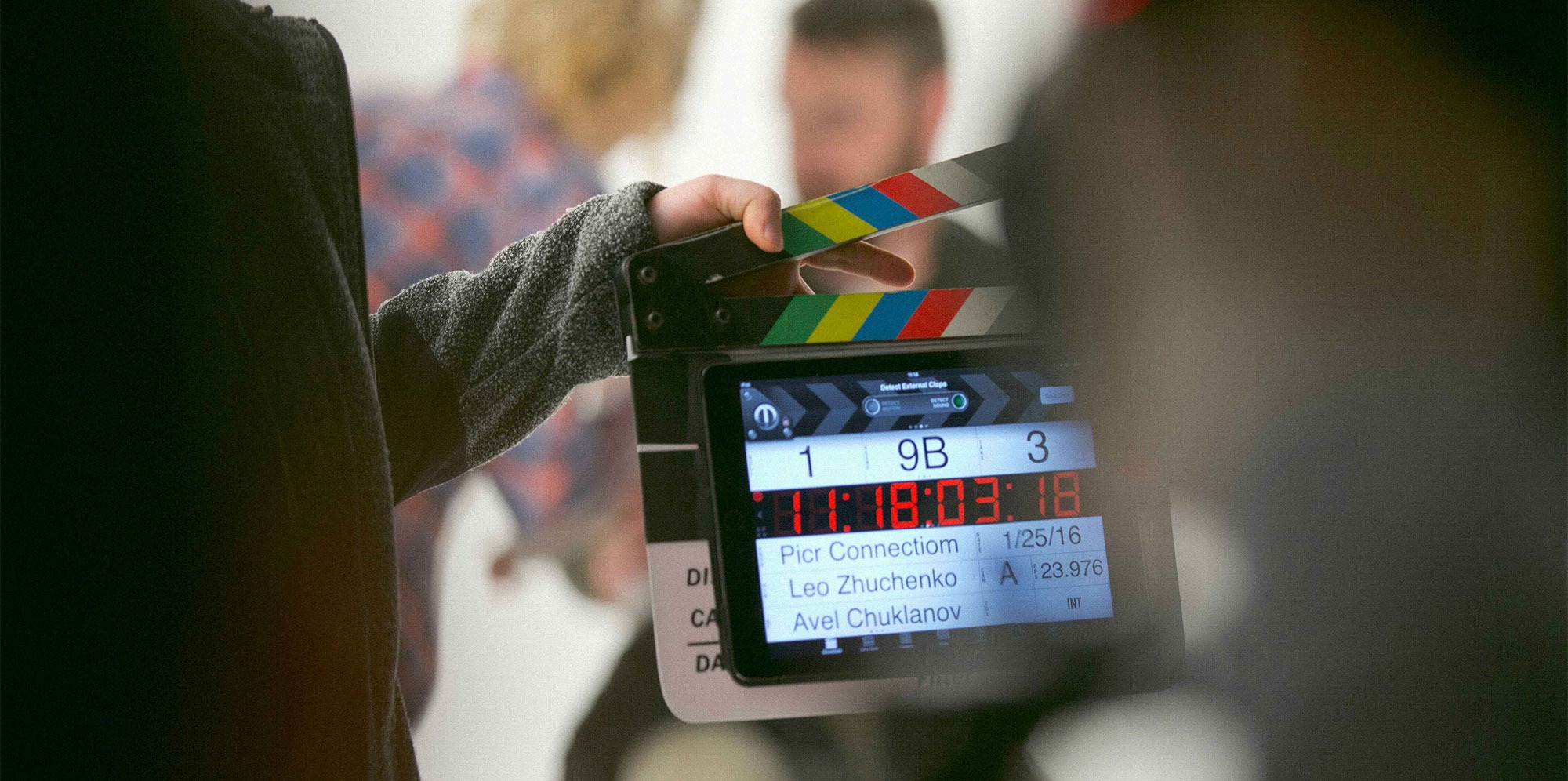
 The first fully AI-generated feature film has been accepted into a major festival’s official programme. (Image: Avel Chuklanov / Unsplash)
Two things happened in the first week of June 2026 that, taken separately, might have registered as interesting, even startling film industry footnotes. Together, they are a harbinger of something larger.
The first was an announcement by the Tribeca Film Festival – one of the world’s most prestigious showcases for independent cinema – that it would give its world premiere slot to Dreams of Violets, the first fully AI-generated feature film to be accepted into a major festival’s official programme. The 75-minute docudrama, directed by Iranian-born brothers Ash and Pooya Koosha, is a fictionalised account of the massacre of Iranian civilians during the January 2026 protests, a period of near-total communications blackout when conventional filmmaking was simply impossible.
No cameras, no sets, no actors – just AI video models fed on journalistic reports, photographs and eyewitness accounts, although the hybrid nature of the creative elements is telling.
The story was imagined by Ash Koosha, and whether AI contributed the actual dialogue itself is a little hazy. The voices were also recorded by Koosha, later transformed and migrated to characters’ voices by AI. The film cost $2,000 and was made in roughly two months. Tribeca co-founder Jane Rosenthal called it “a powerful example of how emerging technologies like AI can be used not simply as tools of innovation, but as vehicles for deeply human storytelling”.
The second thing to have occurred concerned Martin Scorsese, now 83 years old with a half-century of masterpieces behind him. He announced he was joining Black Forest Labs, a generative AI start-up founded in 2024 in Freiburg, Germany, as an adviser.
In a video released alongside the announcement, Scorsese used the company’s Flux image model to storyboard scenes from his forthcoming film What Happens at Night, a drama starring Leonardo DiCaprio and Jennifer Lawrence. “Cinema is a young medium,” he said, “only around 125 years old, so we have to be open to how it can evolve.” What was left dangling was how far it could evolve.
The juxtaposition is instructive. At one end, a $2,000 film made by a diaspora director who could not have told his story any other way. At the other, the most decorated living filmmaker on earth, using AI to pre-visualise a DiCaprio vehicle. The tools are not quite the same, but the underlying logic is identical: story is the immovable centre of the cinematic universe, and AI can contribute to story, the director’s vision of its expression and its journey to screen.
Scorsese’s move did not come in isolation.
Darren Aronofsky, whose entire directorial identity is built on the rawness of human suffering (check out The Whale, with Brendan Fraser, if you want a perfect example), went further still. In May 2025 he launched Primordial Soup, an AI studio, in partnership with Google DeepMind, deploying the company’s Veo video model. His most visible output has been On This Day… 1776, a short-form series for TimeStudios that recreates moments from America’s revolutionary year on their 250th anniversaries.
The series was widely panned on its January 2026 release – “the most unnatural thing I’ve ever seen,” ran one YouTube comment – prompting Aronofsky to acknowledge at a Cannes summit in May that the early episodes were rough and explicitly experimental. He said his curiosity had been ignited in 2023 by Midjourney imagery: “I instantly realised that it was going to change everything that we do as filmmakers.” He formed Primordial Soup, he said, “because I wanted to be ready”.
Steven Soderbergh, for his part, used Meta’s AI tools to create entire sequences in his Cannes documentary John Lennon: The Last Interview – sequences he said could not have been produced any other way – and has stated he plans to use AI “a lot” in his upcoming Spanish-American War film. His position is unequivocal: “My job is to deliver a good movie, period.”
It all starts with story
Technology (and more recently AI) has been transforming the production stack for decades across the layers of pre-production, production and post-production. From the 20th century’s talkies, colour film, green screen, digital video editing and CGI to the more recent advances in photorealistic pre-visualisation technologies, synthetic sets and achievements like the “younging” of Indiana Jones’ Harrison Ford by director David Fincher. All of these have been impressive but not particularly controversial (unless, of course, you were a “scissors and tape” film editor who lost your job in the 1990s).
But it is here where the sparks fly – in the fertilised embryo from which the final product is born – the story idea and screenplay. Few screenwriters will openly admit to their reliance on AI. But consider what Paul Schrader (Taxi Driver, First Reformed) said in a 2025 post. He asked ChatGPT for film ideas – one for “a Paul Schrader film,” then for Anderson, Tarantino, Bergman and others and was “stunned”, writing: “Every idea ChatGPT came up with was good. And original. And fleshed out. Why should writers sit around for months searching for a good idea when AI can provide one in seconds?”
He also sent it an old, unproduced script for feedback. He stopped short of saying he’d used ChatGPT on anything in production, but I suspect that a significant percentage of screenwriters are secretly binging at the AI smorgasbord, too ashamed to admit their secret vice until it is creatively acceptable.
The most consequential implication of all this is not what it does for directors and screenwriters. It is what it does for the filmmaker who does not have a studio relationship, a seven-figure development deal or access to the machinery of legacy production finance.
Ash Koosha made Dreams of Violets because AI gave him no alternative – or rather, it gave him an alternative he could not otherwise have had. His story, set inside a communications blackout in a country where a journalist filming on a phone risks execution, was unproducible by any conventional means. AI did not lower the bar. It removed the bar entirely. The film exists because the tools exist.
That logic scales. A filmmaker in Lagos, São Paulo or Cape Town no longer needs to spend a decade cultivating relationships with the handful of institutions that control access to development capital. Storyboarding, visual effects, synthetic locations, voice synthesis, cinematography, lighting, music scoring, editing – each of these was once a line item requiring specialist labour and infrastructure. Now they are becoming prompts. The creative bottleneck is shifting from money, access and specialist skills to imagination – which is precisely where it always aspired to be.
Tribeca has intuited this. It now has a controversial partnership with OpenAI, which funded two filmmakers to make AI-integrated live-action shorts – an institutional acknowledgement that the next wave of important cinema may not come from Los Angeles or London.
Pushback has been loud and emotive. The structural defence for writers is the Writers Guild of America contract: the 2023 Minimum Basic Agreement states that AI cannot write or rewrite literary material; companies must disclose any AI-generated material given to writers; and the contract is due to be revisited in 2026. Any guild member who admitted using AI substantively on a produced script would be in murky contractual territory at best. I suggest this will be short-lived, a version of the union protections in the 1970s for Fleet Street newspaper linotype operators trying to hold back the tsunami of automation.
The Koosha brothers probably did not care or think about unions or guilds. They simply made a notable work of art with the tools available.
AI slop, human slop
None of this means the revolution is clean. For every Dreams of Violets there are ten of thousands of AI-generated short films circulating on YouTube and TikTok – jittery hands, melting faces, awful scripts, generic soundtracks, narratives assembled from statistical averages of every thriller ever made. The outputs are instantly recognisable – emotionally inert, ugly, boring or derivative in ways that make us all weary, the simulation of depth without ever encountering it.
AI, as we have already seen, produces film and video slop at scale.
But then, so do humans. The history of cinema is not a continuous upward arc of masterworks. For every Scorsese there is an ocean of forgettable studio product – sequels engineered by committee, IP extensions greenlighted by algorithm, franchise entries whose primary purpose is to occupy a release date. Hollywood has also produced derivative and forgettable work at scale for as long as it has existed.
So AI will produce bad films in abundance. But it will also produce films that could not exist otherwise – the Iranian memorial, the Lagos thriller, the Cape Town noir shot on a $5,000 budget. Among them there will be excellence. It would be churlish to decry that.
As I was about to publish this article, I was discussing it with my wife, novelist Kate Sidley. She made this point – even if 100% AI-created films became consistently and reliably the best on display, she would still choose to watch those behind which there was the determination, skill and sweat of a human with a creative vision. After all, is that not part of the age-old two-way and very human contract between artist and audience? DM
Steven Boykey Sidley is a professor of practice at JBS, University of Johannesburg, a partner at Bridge Capital and a columnist-at-large at Daily Maverick. His new book, It’s Mine: How the Crypto Industry is Redefining Ownership, is published by Maverick451 in South Africa and Legend Times Group in the UK/EU, available now.
Comments
Scroll down to load comments...