




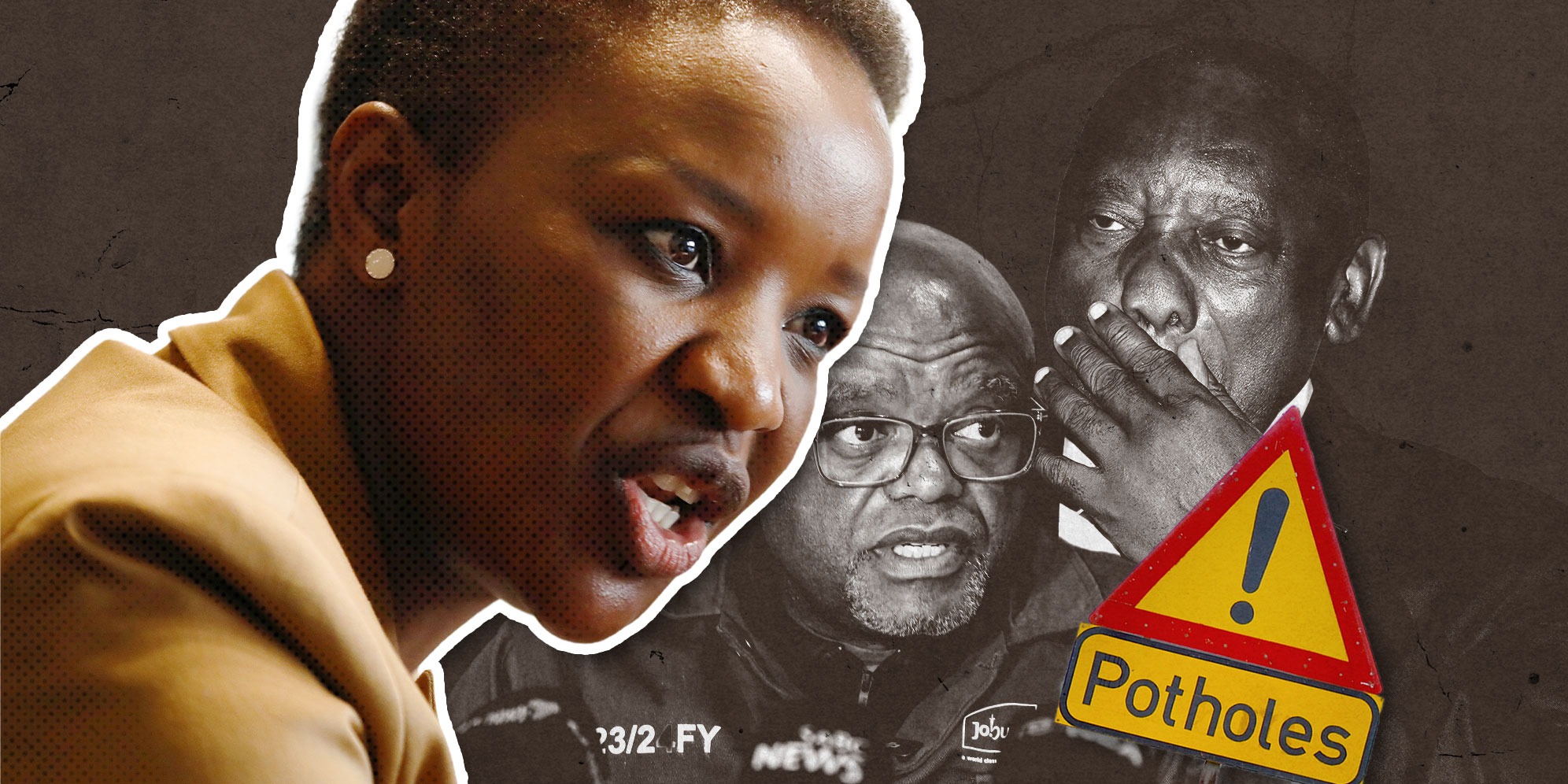
 Illustrative image: Business Leadership South Africa CEO Busi Mavuso. (Photo: Masi Losi / Gallo Images) | Johannesburg mayor Dada Morero. (Photo: Sharon Seretlo / Gallo Images) | President Cyril Ramaphosa. (Photo: Frennie Shivambu / Gallo Images) | Pothole sign. (Photo: Magnific) | (By Daniella Lee Ming Yesca)
 Q: Business has set out, in the statement about Joburg, its commitment to act. How will you do so by deploying skills and talent? Is it the Eskom and Transnet model, or is it actually providing capital?
A: It’s actually going to be all of those.
Maybe I must just say that, at the moment, we are not entirely clear how we’re going to be called in to support. But I think we’re very clear that we will come in and support, as we have offered, if we’ve got a credible, committed counterparty on the other side.
The reason the Business-Government Partnership worked was because the President wanted it to work. President Cyril Ramaphosa asked Discovery CEO Adrian Gore whether business could help address what was, at that stage, a national crisis.
A very clear structure was established, with responsibilities, deliverables and a clear cadence of meetings. We knew who was responsible. If there wasn’t delivery, the blockages were identified and addressed.
You’re going to have to have a structure like that in Johannesburg.
Q: What does a credible counterparty look like in a city?
A: It boils down to commitment.
It’s someone who wants business to intervene and who will give business the space to intervene in a manner that only business can.
It’s also someone willing to open up systems and processes to scrutiny, interrogation and intervention.
You can’t bring business in and still want to keep the status quo. We can’t be told there are no-go areas – touch this but don’t touch that.
It’s going to have to be a completely open process so that we can really see and get to the bottom of what is failing. If you don’t get to the bottom of it, then the intervention you deploy might be hit-and-miss.
Q: At Eskom and Transnet did you have that level of access?
A: Yes.
The National Energy Crisis Committee (Necom) and the National Logistics Crisis Committee (NLCC) were set up precisely to allow that kind of scrutiny.
Those structures were given the power to interrogate Eskom and Transnet and determine where the systems were failing.
How do we deal with operational failures? Why are power stations falling over? How do we improve the energy availability factor?
At one point we deployed about 350 engineers into Eskom and Transnet. Their job was to examine the systems in their entirety and identify what was actually going wrong.
Part of that process involved bringing back the original equipment manufacturers (OEMs).
Eskom and Transnet had reached a point where they were no longer properly utilising the companies that had built much of the infrastructure and were best positioned to maintain it.
The analogy I use is that if you’ve got a Volkswagen, eventually you take it back to Volkswagen.
Some of those OEMs effectively said: you’ve spent years maintaining this equipment incorrectly and now, when it’s falling apart, you’re asking us to come back and fix it.
But Necom and the NLCC created the conditions for that level of openness.
Q: Are we going to get that in Johannesburg? You argue that when Johannesburg is in visible decline, it undermines South Africa’s growth story. Why does Johannesburg matter so much?
A: Johannesburg matters because it is the economic hub of South Africa.
About 70% of the country’s head offices are here. The city contributes about 16% of national GDP.
A huge number of investment decisions are made here.
The President’s investment conference was held here. The G20 and B20 were here. That reflects the importance of Johannesburg because a great deal of capital is located here and much of the investment that enters South Africa enters through Johannesburg.
I worry that we don’t fully appreciate how investment decisions are made.
South Africa is already substantially foreign-owned. Those decisions are often made in boardrooms in China, Brazil, France and elsewhere.
Capital is not sentimental.
When investors are told that companies in Johannesburg must continuously manage around state failure – around water outages, electricity failures and deteriorating infrastructure – they start looking elsewhere.
Capital has many addresses.
If our address is not attractive, it goes somewhere else.
That’s why Johannesburg matters.
If Johannesburg succeeds, it strengthens South Africa’s growth story. If Johannesburg fails, the consequences extend far beyond the city’s boundaries.
Q: Your statement argues that Johannesburg’s decline is not a new or partisan issue. That’s different from what some political parties say.
A: I think it would be disingenuous to say that Johannesburg’s problems started with the current administration.
The decline has happened gradually.
Maybe the last time the city was really functioning effectively was under Amos Masondo.
When parties such as the DA came into office and focused on fixing the billing system, they were doing so because the billing system was already broken.
The potholes, traffic lights and some of the other problems may have intensified over time, but the cracks were already there.
This has been a long-term decline.
That said, we’re not absolving the current administration.
Dada Morero is doing a terrible job.
What concerns me is that he publicly rated his own performance as seven out of 10.
For someone to look at the current state of Johannesburg and conclude that it represents a seven-out-of-10 performance suggests a worrying degree of being tone deaf.
If you’re going to fix a problem, you first have to acknowledge that it exists.
Q: You say this is not about who governs the city but how it is governed. Are you arguing for political reform?
A: Not really.
The point is not to attack one political party or another.
Johannesburg is governed through a coalition arrangement. Responsibility therefore sits across multiple political actors.
The ANC is in coalition. Other parties are in coalition.
In fact, some of the parties within the coalition have themselves tried to remove Dada Morero through motions of no confidence.
That tells its own story.
But the provincial government also has questions to answer.
How do you watch a city decline over many years and not intervene sooner?
One of the lessons here is that we should not wait until a train is about to crash before we act.
Surely there should be mechanisms that allow intervention as decline becomes visible, rather than only at the point of collapse.
Q: You’ve also spoken about the city’s structure and municipal reform.
A: Yes, because accountability matters.
The municipal reforms currently being discussed seek to strengthen ring-fencing and governance.
If the City of Johannesburg collects R11.9-billion intended for water services but only R1.3-billion is ultimately utilised for water infrastructure, then something is fundamentally wrong.
The reforms would ensure that utilities are directly accountable for the resources allocated to them.
There would also be stronger governance oversight.
Appointments would be made through more independent processes.
I’ve even heard discussions about involving the Institute of Directors South Africa in aspects of governance reform.
The point is not reform for reform’s sake.
The point is accountability.
Q: You say property values have fallen and residents have become poorer. What’s the evidence?
A: We commissioned a detailed study through Genesis Analytics.
Some of the findings are alarming.
The operating expenditure-to-capital expenditure ratio in Johannesburg is around 17:1.
The average metro is closer to 10:1.
In parts of the Western Cape it is closer to 6:1.
The City pays suppliers, on average, after about 311 days.
It spends only about 0.5% of asset value on repairs and maintenance when accepted benchmarks are closer to 8%.
Those figures tell a story of underinvestment, deteriorating infrastructure and institutional weakness.
Q: What should happen first if business is invited in?
A: We know broadly what is failing because we’ve done the research.
But we’re not going to make decisions unilaterally.
The first step would be sitting down with government and identifying the 20% of interventions that will produce 80% of the results.
For us, the network industries are critical.
Electricity.
Water.
Roads.
It doesn’t make sense that South Africa can experience energy stability nationally while Johannesburg residents continue experiencing outages because the city’s distribution network is deteriorating.
The same applies to water.
These are the systems that underpin economic activity.
Q: Can business actually feel these failures directly?
A: Absolutely.
I was speaking to KPMG and asking how they manage recurring water outages.
The answer was simple: they bring in water tanks.
Businesses across Johannesburg are creating expensive workarounds for failures that should not exist.
The pothole example is another illustration.
I was told that private sector interventions can repair a pothole for about R7,500.
The City of Johannesburg spends about R65,000.
Whether you’re a resident, a ratepayer or an investor, those numbers raise obvious questions.
How is it possible that the same pothole costs almost 10 times more when repaired by the City?
Those are precisely the sorts of questions that deserve public scrutiny.
Q: You are asking parties contesting the election for costed commitments. Why?
A: Because the fiscal crisis sits at the centre of everything else.
The Auditor-General has raised profound concerns.
If political parties want to govern Johannesburg, they need to explain how they intend addressing the city’s financial crisis.
We refuse to accept decline as inevitable.
We refuse to normalise failure.
The situation is serious, but it is not irreversible.
With the right leadership, governance and support, Johannesburg can recover.
Q: What sort of timeline are we talking about?
A: To turn the city around completely may take 10 years.
But meaningful progress can happen much sooner.
If you’re focusing on roads, electricity and water, people should be able to see improvements within a year.
Not perfection – but visible progress.
You repair potholes and maintain them.
You stabilise electricity distribution.
You begin addressing water infrastructure systematically.
That’s how confidence starts returning.
Q: You’ve criticised Cabinet’s position on a section 139 intervention – the Constitution’s section 139 allows for a failing municipality to be placed under administration.
A: I have.
The fact that Cabinet has not supported a section 139 intervention is disappointing.
It raises questions about political will.
Are we more concerned about the optics of intervention because local elections are approaching, or are we concerned about arresting the city’s decline?
If the government has powers available to it, this is surely the moment to use them.
Johannesburg is too important to fail.
Q: Have you tried to meet with Gauteng premier Panyaza Lesufi? In terms of the Constitution, the province has oversight of the city.
A: I invited premier Lesufi to come and speak to us.
He never even acknowledged the correspondence.
That concerns me because when we talk about credible and committed leadership, responsiveness matters.
Engagement matters.
Leadership matters.
Q: You say you want a public accountability mechanism.
A: Absolutely.
Restoring confidence requires transparency.
If commitments are made, they should be public.
If targets are agreed, they should be public.
If progress is being made, people should know.
If progress is not being made, people should know that too.
Accountability is not confrontation.
It’s a necessary condition for confidence and investment.
That’s why Business Leadership South Africa established a reform tracker.
Independent accountability mechanisms matter.
Q: Finally, what kind of mayor does Johannesburg need?
A: Someone with management experience and leadership capability.
Someone with merit.
Someone committed to turning the city around.
Someone who understands what is at stake if Johannesburg fails.
Someone who appreciates the responsibility Johannesburg carries within South Africa’s economy.
And somebody willing to work with business, civil society and every stakeholder prepared to contribute.
The solutions to Johannesburg’s problems are not going to come from politics alone.
Q: You clearly love Johannesburg. What keeps you here?
A: Its vibrancy.
Its diversity.
Its people.
People here are more open than they are in many other places.
There is an energy to Johannesburg.
There is a sense that people still see one another as human beings first.
I love the theatre.
I love spending time with my children.
I love the life of the city.
And I think that’s why so many people are willing to fight for it.
People love Johannesburg.
That’s why we refuse to accept its decline as inevitable. DM
This interview with Busi Mavuso was transcribed using Notes LLM and then edited using ChatGPT. An editor checked at each step of the process.