



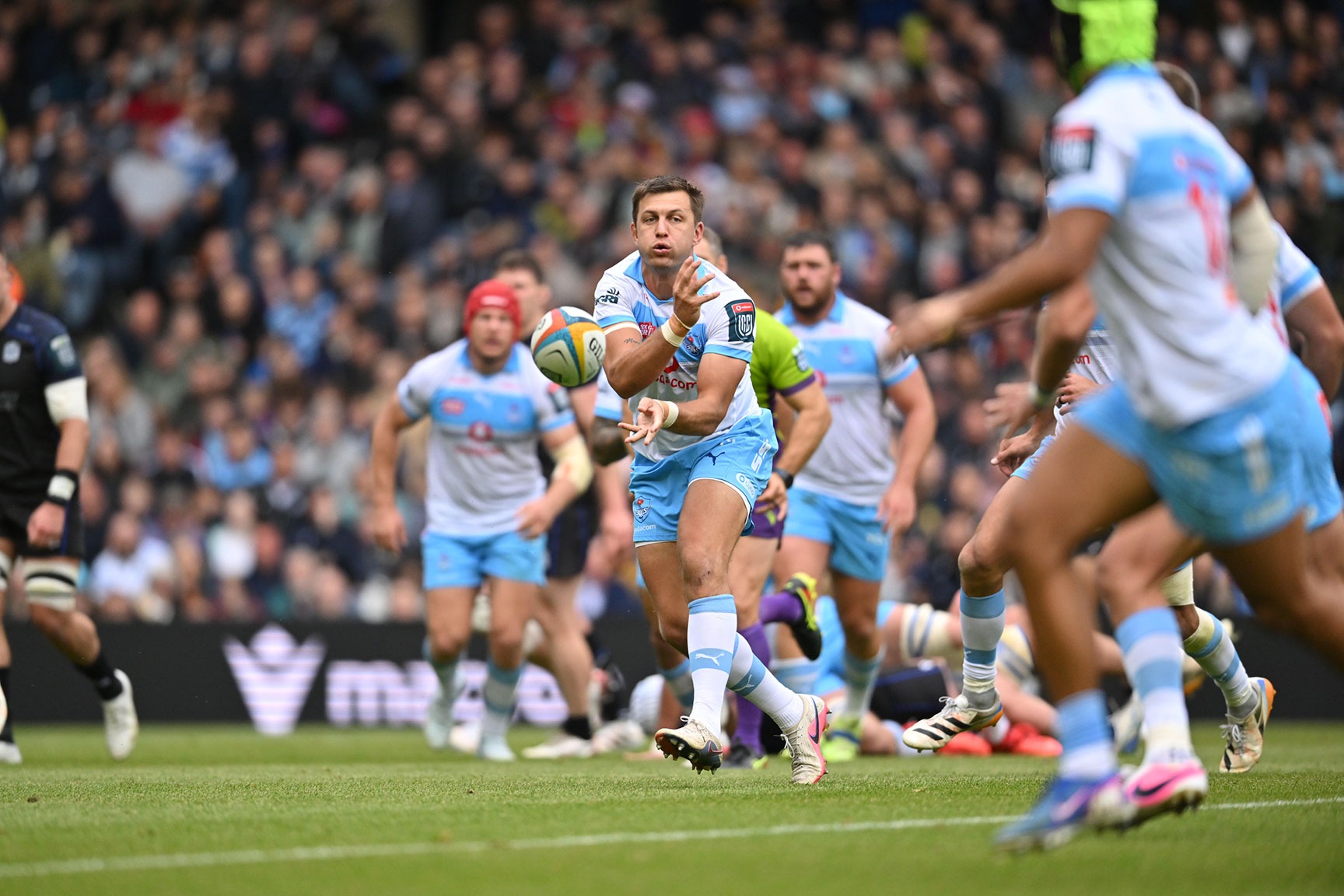
 The Bulls beat Glasgow 22-21 in an URC semifinal to book a place against Leinster in the final at Croke Park on 19 June. Flyhalf Handré Pollard (pictured) will be a key figure. (Photo: Johan Rynners)
 The United Rugby Championship (URC) final on 19 June will see defending champions Leinster take on the Bulls at Croke Park in Dublin. It’s the final the tournament deserves, with the two form teams edging their way through a pair of titanic semifinal battles.
Leinster overcame the Stormers 20-11 in a tense clash at the Aviva Stadium in Dublin, while the Bulls shaded the Glasgow Warriors 22-21 in Edinburgh.
The Stormers’ clash against Leinster had two extremely curious refereeing decisions following a couple of vital incidents that shaped the outcome of the game.
The first came in the 68th minute when replacement Stormers loose forward Ruan Ackermann plunged recklessly into a ruck to clean out Leinster’s Ronan Kelleher. At first glance from the stands or on TV, it looked bad. But referee Hollie Davidson waved play on.
/file/attachments/orphans/WhatsApp-Image-2026-06-07-at-1713_979964.jpg "A screenshot of the incident when Ackermann slammed into Leinster hooker Ronan Kelleher. (Image: Screenshot / YouTube / United Rugby Championship)")
At the next break in play, the television match official (TMO) drew Davidson’s attention to the incident.
The core criterion for a straight red card is foul play that is deemed “highly dangerous and intentional”.
The steps that officials must consider are clear, starting with “Has head contact occurred?” From there, they go through a process of “yes” and “no” factors (see below) to determine the sanction, if any.
/file/attachments/orphans/Screenshot-2026-06-07-172904_458949.jpg "The process officials follow in determining a red card. (Image: Daily Maverick)")
It was the textbook definition of a straight red card, but Davidson opted for a yellow to be reviewed. Naturally, the official in the bunker deemed that the incident met the red card threshold.
Apologised
The Stormers did not have any objections to the outcome, and no one can. But as watchers of the game, we can question why officials are making these errors when they have so many angles to consider.
Stormers director of rugby John Dobson went as far as apologising to Leinster for the incident.
“We probably should apologise for that [Ackermann] send-off; that is what we have to get rid of in rugby,” Dobson said after the match.
“A tucked shoulder to the head, then you won’t have players jackalling at the breakdown. My only thing to Leo [Cullen, Leinster’s head coach] was to say sorry about that. I had no issue with that call. Up until then, we could see some cracks starting to appear physically in Leinster, and that ill discipline was costly.”
Moments after the Ackermann incident, though, the Stormers were again on the wrong side of the law, only this time, it felt unjust.
Replacement lock Salmaan Moerat was yellow-carded for “deliberately” kicking the ball out of Leinster scrumhalf Jamison Gibson-Park’s hands.
It was a ludicrous call considering Moerat was on the ground, facing away from Gibson-Park and unsighted. How he “knew exactly what he was doing”, according to Davidson, is a mystery.
That left the Stormers playing the final nine minutes with 13 men.
When Ackerman was yellow-carded, the score was 13-11 to Leinster, but the Stormers were starting to win the physical battle.
From Ackermann’s transgression, Leinster gained field position, which ended in a try from Gibson-Park, which came in the next play after the ball was allegedly kicked out of his hands deliberately.
Such fine margins turn big games.
Clearly, Ackermann’s moment of madness was the turning point of the match, and it cost his team dearly. It was out of character, considering he has only had one yellow card in his entire professional career. The only mystery is why Davidson didn’t reach for the red immediately.
The Moerat incident had consequences too, and the officials got it wrong despite clear video evidence to the contrary.
/file/attachments/orphans/TL_2540850_631195.jpg "Stormers director of rugby John Dobson. (Photo: Ashley Vlotman / Gallo Images)")
“A big moment was when we got into their 22, which we didn’t do often. If we converted there, we were in a reasonably good position,” said Dobson.
“We could see they looked a little bit tired. That second yellow card [to Moerat] I didn’t quite understand.”
The Stormers were always up against it without key injured players such as flyhalf Sacha Feinberg-Mngomezulu, but they delivered a largely superb display against the odds.
Their defence was intense and physical, and their kicking game, while frustrating some purists, created chaos and won cheapo field position. Had wing Seabelo Senatla been fit, it could have been a different story, as he is an aerial artist.
Ultimately, Leinster had too much experience and nous, especially against 13 men, but there are real green shoots of progress for the Stormers to take from this season.
“Up until minute 68, we dared to dream,” said Dobson.
“We defended well. Yes, we had personnel issues, and I don’t want to make it sound like an excuse. We weren’t going to come here and out-attack Leinster; we wanted to make it a dogfight, give them set-piece pressure and defend well. I think that was working.”
Bulls stun Glasgow
The Bulls produced a stunning rearguard against Glasgow to come back from 21-3 down to win 22-21 in the first semifinal.
The Bulls pack and bench changed the game, while another strong game from scrumhalf Embrose Papier behind the pack kept Glasgow on their toes.
Flyhalf Handré Pollard was uncharacteristically wayward from the tee, missing three second-half penalties, all taken after the Bulls had hit the front.
The tactic to continually go for poles instead of choosing a kick to the corner and backing their rolling maul was strange. But the intent, composure and sheer bloody-mindedness of the Bulls was impressive and will give them confidence going into the final.
/file/attachments/orphans/IMG_4233_993065.jpg "Bulls scrumhalf Embrose Papier continued his impressive form in the URC semifinal against Glasgow at Murrayfield. (Photo: Johan Rynners)")
“We showed so much commitment tonight. I’m so proud of the team. It’s a privilege to be part of this group, this occasion and a comeback like that,” said coach Johan Ackermann.
“The comeback is special, I won’t lie. They were really playing good rugby. Franco [Smith, the Glasgow coach] has built that team over four years, and they’re a quality side.
“That’s why this is probably one of the best victories I’ve had. The character of the team was outstanding,” said Ackermann.
“It would have been easy to panic after the first half, but the players stayed calm, trusted the process and kept believing that if we could improve our discipline and accuracy, we could get ourselves back into the game.
/file/attachments/orphans/IMG_4224_862612.jpg "Bulls wing Kurt-Lee Arendse against Glasgow. (Photo: Johan Rynners)")
“We knew we hadn’t been good enough in the first half. We gave them too many opportunities and too much territory. But the response after halftime was exceptional. The players fronted up physically, won key moments and took their chances when they came.”
Although the final in Dublin is 11 days away, the Bulls flew home on Sunday and will return to Ireland in about a week.
After a poor start to the season, the Bulls have won 11 of their last 12 URC matches. They are brimming with confidence.
Ackermann has found his feet in Pretoria after a shaky first few months in the job. As the coach has settled in, so too have the Bulls’ style and confidence. They last lost a URC game on 13 March against the Stormers. Since then, it’s been an impressive run. DM