




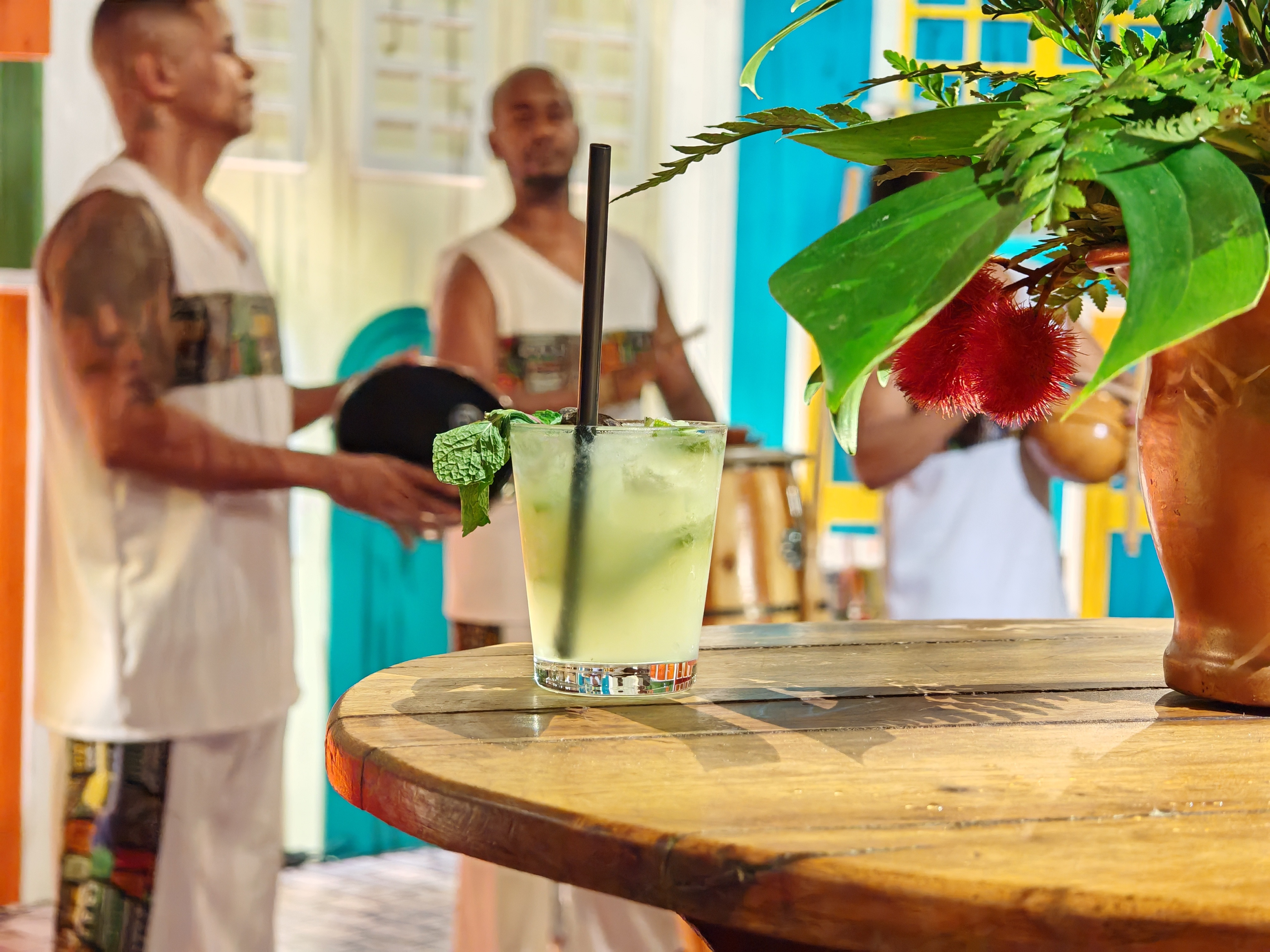
 The Caipirinha is not just a cocktail, it is a microcosm of the sustainable fuel economy. (Photo: Lindsey Schutters)
 MINIBAR: Water bottles are not complimentary. Charges apply if consumed. Tap water is not potable.
My bulletproof jetlag fighting strategy has three main pillars: get on sleep stream as quickly as you can, hydrate, and move your body. The first one was easy because the Latam Airlines flight routing (Jozi>Sao Paulo>Rio) got me to the hotel at just after 1am – and I forced myself to stay awake until my head hit the hotel pillow.
At a ratio of 3.2 Randelas per Brazilian real, the cost of consumption for the second foundational pillar of my transatlantic timezone survival plan was becoming an expensive habit at R$10 for each of the four 310ml bottles of rejuvenating water in the hotel room.
There is no kettle in the room at the Windsor Tower Hotel.
But let’s rather talk about sustainable aviation fuel (SAF) because this is something that, according to veteran IATA AGM attendees, is something that always gets a lot of attention.
A spoonful of sugar
“Brazil is driving on sustainable fuels!” exclaims a fellow meeting observer who was questioning the yellow hue of my Caipirinha. “They put it in their cars…” he continues – Brazil’s Fuel of the Future Law (enacted on 9 October 2024) is targeting a 35% bioethanol blend for gasoline by 2037.
Last year, the country’s mines and energy minister, Alexandre Silveira, raised the level to 30% (up from 27%), and the 2026 increase is slated to take the commuter transport juice mix up to 32%. At the full extent of the law the country will be (by its own calculation) preventing 705Mt of CO2 and have netted the Brazilian economy R$260-billion.
That 2% increase in bioblend is estimated to absorb the expected four billion-litre ethanol surpluses from this year’s sugarcane and corn harvests and strip 1.2 billion litres of gasoline from the fuel demand over 12 months.
At the time of writing current pump prices a running at an average of R$6.62/l.
Upon its enactment the biofuels development programmes had already secured R$20-billion in private investment across the ethanol, biodiesel, SAF, green diesel and biomethane ecosystems.
“… and they put it in their bodies!” My enlightened colleague is yelling over a suspiciously translucent version of a Caipirinha, devoid of the yellow fruitiness (I forgot the names, but the mixologist at the Boeing-hosted welcome reception assured me that it was authentic Brazilian fruit) contained in my glass.
The cachaça (cane spirit – older readers will know it as Cape to Rio in its discount liquor local form), lime, sugar and ice concoction is, as the mumbling moustachio asserts over the increasingly louder music, a microcosm of the bioethanol economy in a glass.
Finding local solutions
“The window for e-SAF is closing very fast,” Preeti Jain, IATA head of net zero research, said during the media briefing on sustainability. For a South African journalist who has been covering the ebbs and flows of the perennially emerging hydrogen economy, this statement came as a shock.
The flavour of SAF Jain is calling into question blends green hydrogen and captured carbon (pulled directly from the atmosphere) into a super-sustainable jet fuel that has absolutely no downsides – except for commercial viability and a working pilot project – and is pretty much tailor made to fit the deficiencies within Mzansi’s just energy transition.
We could be the Brazil of e-SAF.
/file/attachments/2993/IMG_20260606_150307_205526.jpg "Preeti Jain (second from left) on the panel for the sustainability media briefing. (Photo: Lindsey Schutters)")
But, that particular pipe dream was imagined after an EU mandate to decarbonise the aviation sector, but no firm government support to help the sector’s main players achieve these lofty goals.
When Daily Maverick sought clarity directly after the briefing, Jain instead argued against a one-size-fits-all approach to SAF, specifically cautioning against adopting European models like e-SAF when local infrastructure offers different advantages.
“I would say every country needs to see solutions which are more suited to their resources, their energy infrastructure… and their abilities… There shouldn’t be just copy paste what Europe is doing which is e-SAF.”
She is also hyper aware of whence the JET funding comes, and the important role hydrogen should play in Mzansi’s decarbonisation journey.
“When I look at the South Africa you mentioned, I see [a country] that has a good, established value chain when it comes to lipids feed stocks. You know they have first generation, plant reborn-based lipids feed stocks? And you have refiners like Sasol and Petro SA… and I understand that Sasol already is looking into co-processing in refineries, which means the country can have that as a first [SAF] starting point.”
It comes as no surprise that the primary aviation industry lobby group is punting the fossil fuels fever dream of algae-based biofuels as a response to the dirty aura of crude oil; which is itself the product of prehistoric plankton.
A product of isolation
Jain also pointed to South Africa’s unique historical expertise with the Fischer-Tropsch process (Sasol’s isolation era coal-to-oil tech), suggesting that the country should build a rural supply chain using agricultural residues rather than pivoting away from established infrastructure.
And, thankfully, she can see hydrogen production as a pathway to success for the region.
“You need hydrogen for all SAF pathways... you need hydrogen for HEFA (hydrotreated esters and fatty acids – read: old cooking oil) pathways… and if you use green hydrogen it means you further lower down the carbon intensity of the product. You also need hydrogen for A-to-J (alcohol-to-jet). You also need hydrogen for Fischer-Tropsch, and you need more hydrogen for e-SAF. So hydrogen is needed in all the processes.”
Later, at the Boeing welcome reception, my enlightened colleague was foreignsplaining Sasol’s apartheid-era sustainable fuel advantage over the industry. And how, with just a little positive investment, South Africa could reclaim its rightful place at the top of the future fuels mountain.
I caught a glimpse of Christ the Redeemer on the drive from the airport, but then the car took one of the many tunnels connecting the sprawling urban expanse that is Rio de Janeiro and the smaller-than-expected iconic statue disappeared from my picture of the city.
A pure Caipirinha tasted like more – and undoing its damage cost another R$20 to the minibar tab. DM