




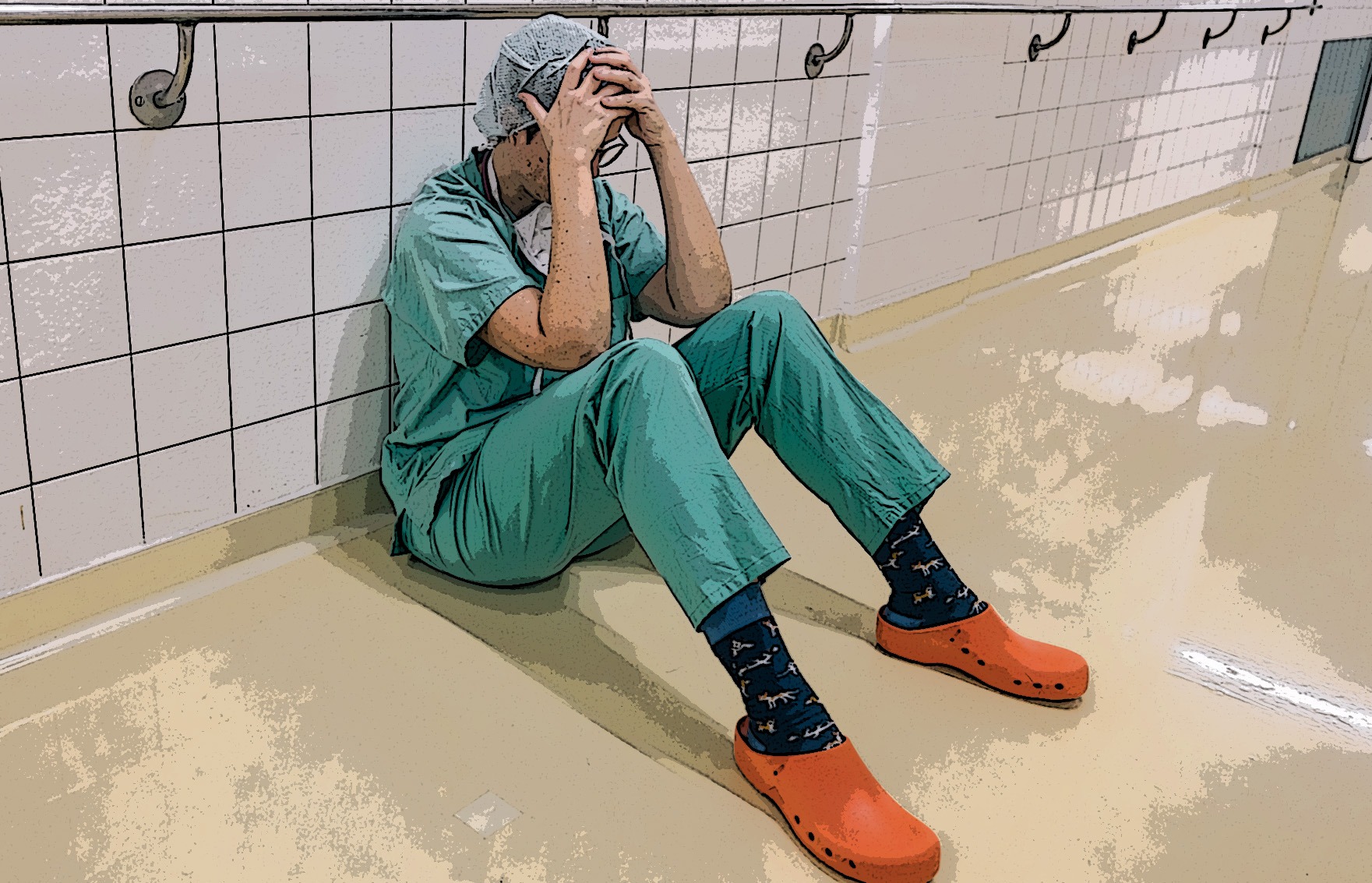
 The fifth of June is #CrazySocks4Docs day – a global campaign meant to spark important conversations about mental health stigma in the healthcare workforce. (Photo: iStocks)
 /file/dailymaverick/wp-content/uploads/2025/10/label-Op-Ed.jpg)
On the first Friday of June, the corridors of many of South Africa’s public hospitals and medicine and health sciences campuses will boast flashes of bright stripes and mismatched cartoon characters on the socks of the feet of the people who work and learn there.
The fifth of June is #CrazySocks4Docs day – a global campaign meant to spark important conversations about mental health stigma in the healthcare workforce.
#CrazySocks4Docs day was spearheaded by Australian cardiologist Dr Geoff Toogood in 2017 to raise awareness of and challenge the stigma often associated with doctors seeking support for their mental health challenges.
The initiative encourages healthcare workers and students to prioritise their wellbeing and support one another with compassion and understanding. In 2019, the South African non-profit organisation, the Ithemba Foundation, launched #CrazySocks4Docs locally by collaborating with the local healthcare sector and the 10 medicine and health sciences faculties at universities across the country.
According to Dr Bulumko Lusu, a medical doctor working in state mental health and board member of the Ithemba Foundation, SA’s healthcare workforce operates under acute stress nearly all the time.
“The objective of bringing #CrazySocks4Docs to SA was to highlight the difficulties facing people working in the local medical field. None of us operate in isolation, although it can often feel that way.”
The toll of a limited healthcare system
While healthcare worker burnout is a global crisis, SA’s compulsory community service doctors often face a uniquely ruthless baptism of fire. Young doctors, nurses and other students from the health sciences are flung onto our frontlines where they work in under-resourced spaces with little supervision and overwhelming responsibility.
A sobering 2021 KwaZulu-Natal study revealed that 85.2% of young doctors are burnt out. Classified by the International Classification of Diseases (ICD-11) through emotional exhaustion and detachment, burnout isn’t just an individual mental health struggle; it is a systemic failure threatening the backbone of our healthcare system, often hitting the youngest and most vulnerable doctors the hardest.
Behind these statistics lie harrowing daily realities, where isolation and resource scarcity define every shift. Dr Vhuḓi Ravhutsi, a junior South African doctor working in a district hospital in Limpopo, recalls the terrifying pressure of the frontlines: “It is not alien to find yourself intubating and bagging a patient while waiting for advanced EMS because you don’t have a functioning ventilator, and you are a junior doctor alone.”
/file/attachments/orphans/Crazysocks2_884751.jpg "Established by an Australian cardiologist and brought to SA by the Ithemba Foundation, #CrazySocks4Docs Day aims to challenge the stigma around seeking mental health support within the medical community. (Photo: Karen Ducey / Getty Images)")
Ravhutsi said that he often didn’t have the time or space to reflect and deal with such moments, especially if associated with mortality. He simply moved on.
This relentless pace forces clinicians to internalise trauma, leaving deep moral wounds. Another young doctor, Dr Azhar Nadkar, who works in a hospital in Cape Town, highlights the enduring psychological toll: “I have experienced many moments where limited staff, overcrowding or resource constraints made it impossible for me to give the level of care I wished I could give, and those moments stay with me long after the shift ends. We carry the emotional weight of those situations home with us.”
The effect on healthcare students
For students in the health sciences observing the system, the transition to professional life appears daunting. A fifth-year medical student reflects on the pressure awaiting them: “The interns working in hospitals seem to be the ones largely holding the system together. They are expected to jump from ‘being a student’ to ‘being a doctor’ in the span of a few weeks, and carry all the burdens that come with it, which is quite a terrifying thought. I have seen interns being talked down to, shouted at, and overwhelmed. If I had to say what worries me most about life post-graduation, it is whether I will have what it takes to handle everything thrown at our interns. Because some days, I don’t think I will.”
These operational pressures are often exacerbated by rigid institutional hierarchies. A second-year nursing student highlights her concerns about entering an environment that can lack collegiate support: “What worries me most is the toxic relationships among co-workers. I am afraid that on top of the already strenuous workload that affects us daily – where you are expected to wrap the body of a deceased patient you were talking to less than an hour ago and then be ‘A-Okay’ for the next patient.”
Awareness and solidarity through socks
Against this, the true meaning of #CrazySocks4Docs comes alive. Far from a casual awareness day, it is a movement designed to shatter the culture of silence. For many moving from the classroom to the wards, wearing the socks becomes a statement of solidarity.
“When I first wore the crazy socks as a student, it felt like a meaningful awareness campaign,” Nadkar reflects. “Now that I’m working, it carries an even deeper significance. It reminds us that behind the strong image are human beings trying their best, and it lets us know it is okay to not always be okay.”
Ravhutsi echoes this, viewing the colourful socks as a badge of authentic, lived experience: “The ‘awareness’ now is personal and authentic. The campaign commands a stop-and-reflect moment and pulls us together to acknowledge the humanity behind medicine, but also shine a spotlight on its systemic shortcomings. From high patient volumes to workplace bullying, this campaign serves as an invaluable opportunity to dive deep into dialogue.”
Ultimately, #CrazySocks4Docs sparks the conversations needed to build structural support and mutual respect in our classrooms, clinics and hospital wards. By wearing colourful and mismatched socks, the younger generation of healthcare workers is building a community where nobody should have to navigate these pressures in isolation, turning a simple gesture of “silly socks” into a catalyst for reform. DM
Dr Florence de Vries is the chairperson of the Ithemba Foundation, a nonprofit organisation that focuses on mental health awareness.