




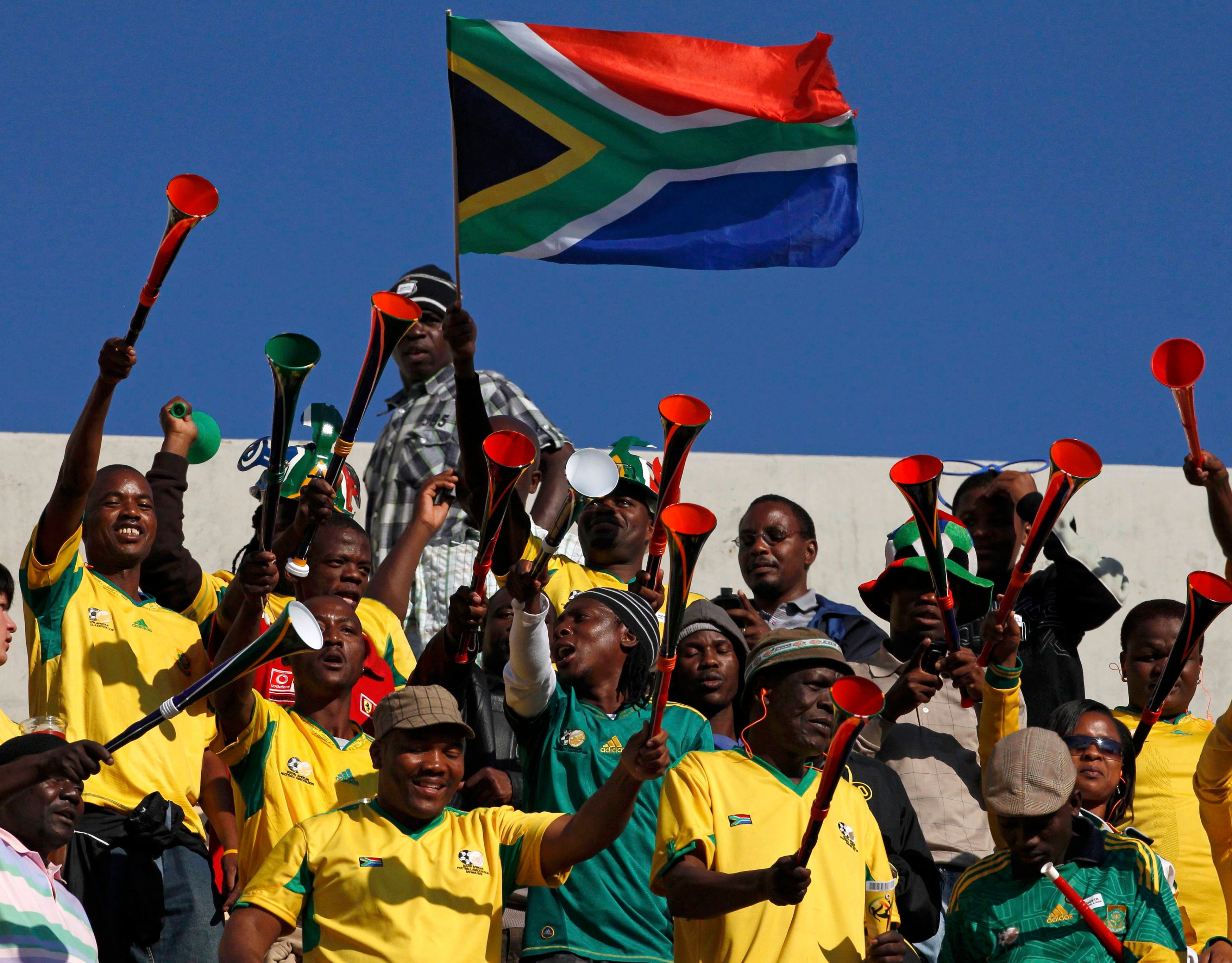
 Soccer fans with vuvuzelas while awaiting the start of the 2010 World Cup Group F soccer match between Paraguay and New Zealand at Peter Mokaba stadium in Polokwane on 24 June 2010. (Photo: Reuters / Ivan Alvarado)
 Soccer fans looking to bring the party to World Cup games will have to go without vuvuzelas, with Fifa banning the plastic horns from venues in the US, Canada and Mexico in its stadium code of conduct.
Vuvuzelas, a horn made with a long plastic shell, are a staple of South African soccer matches and took the world by storm at the 2010 World Cup in South Africa.
But they have drawn criticism over their monotonous droning sound, often likened to a swarm of bees.
Along with vuvuzelas, whistles, air horns and other excessively loud noise-making devices are prohibited from all 16 World Cup venues, according to Fifa’s stadium code of conduct.
Instruments that emit laser beams, laser pointers or similar emissions are also banned.
The list of prohibited items and behaviours goes on to state that body paint and body tattoos do not constitute clothing. Streaking, flashing or removing clothing to reveal intimate body parts is also prohibited.
Fifa has also banned spectators from bringing reusable water bottles into venues, citing safety concerns.
Attendees who violate the rules can be refused entry or removed from the stadium, the code says.
/file/attachments/orphans/LM2E66P1FAG01_838372.jpg "A fan blows a vuvuzela during a 2010 World Cup Group H match between Spain and Chile at Loftus Versfeld stadium in Pretoria on June 25, 2010. (Photo: Reuters / Ivan Alvarado)")
Ivory Coast stun France
On the field, France brushed aside concerns after suffering a surprise 2-1 defeat by Ivory Coast in a World Cup warm-up match on Thursday, insisting the setback would serve as a useful reminder rather than a cause for alarm before the tournament.
Didier Deschamps’ side led through a superb first-half goal from Rayan Cherki, but were overrun after the break as Guela Doue and Amad Diallo turned the game around for the Elephants in Nantes.
With France opening their World Cup campaign against Senegal in New York on 16 June, midfielder Aurélien Tchouaméni said the result should be viewed in the context of preparations rather than as a warning sign.
“It’s a pity to lose but we’re in a preparation phase, we stay confident,” Tchouameni said. “There is no conclusion to draw from this game, even if we had won it. We will be ready.”
/file/attachments/orphans/GettyImages-2207349020_838483.jpg "France’s Aurélien Tchouaméni. (Photo: Jean Catuffe / Getty Images)")
France fielded an experimental side, with several Paris St Germain players rested after last weekend’s Champions League final triumph, and made numerous changes after half-time.
Defender Lucas Hernandez also played down the significance of the defeat.
“We always want to win but we’re in a phase of preparation and there were a lot of substitutions,” Hernandez said. “We’re in good spirits.”
Deschamps, however, admitted his side had lost control of the contest after an encouraging opening 45 minutes and warned that France would face opponents with similar qualities in the United States.
“A defeat is never pleasant, even if we did some good things in the first half,” Deschamps said. “In the second half we made a lot of changes, but that’s no excuse. We were not as good after the break and they brought a lot of pace.
“We will face the same type of team on 16 June.”
/file/attachments/orphans/GettyImages-2271223478_475425.jpg "Amad Diallo scored the winner for Ivory Coast against France in a World Cup warm-up in Nantes. (Photo: Richard Sellers / Sportsphoto / Allstar via Getty Images)")
The France coach said the result could prove useful if it prevented his players from becoming complacent before the tournament.
“It’s a reminder, if we needed one, not to think we’re better than we are,” he said, with Cherki adding: “It’s a little warning, and I can tell you we’re not going to the World Cup thinking we’re favourites and we’re going to crush everyone.”
The expanded 48-team World Cup, hosted by the US, Canada and Mexico, runs from 11 June to 19 July. Mexico will open the tournament against South Africa on 11 June at the Azteca Stadium in Mexico City. Reuters/DM