




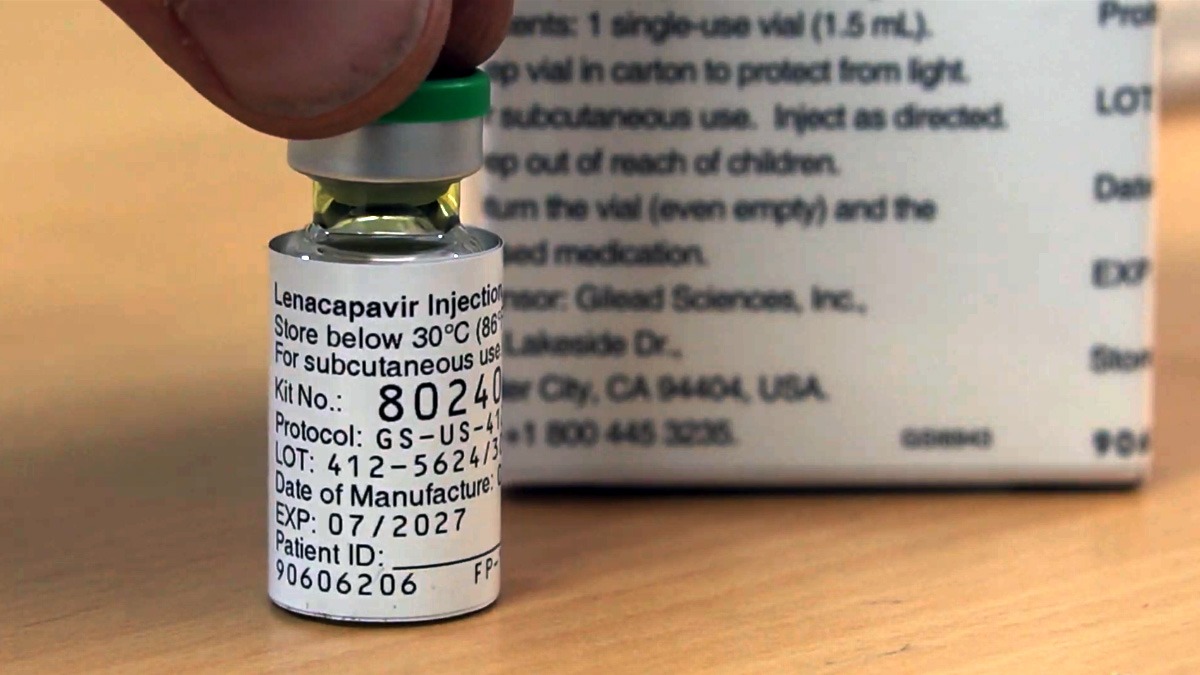
 South Africa has started rolling out Lenacapavir, a groundbreaking injectable HIV prevention drug, offering a new lifeline for those struggling with daily medication. (Photo: Tim Wege / Bhekisisa)
 /file/dailymaverick/wp-content/uploads/2025/10/label-Op-Ed.jpg)
On Friday, a young woman in Mpumalanga walked into a clinic and received two injections and two pills that were taken immediately followed by another two to be taken on Saturday to ensure her protection from acquiring HIV for the next six months.
For South Africa, this marked more than the arrival of a new medicine; it marked the beginning of a new chapter in HIV prevention. This is a remarkable moment for South Africa, which has for more than four decades served as both the epicentre of the global HIV epidemic and the cradle of its most resilient responses.
For a young woman in Mpumalanga, a province where nearly one in three women between 25 and 49 live with HIV, a daily pill has never been a simple thing. It requires privacy she may not have, routine her life may not allow, and a willingness to be seen seeking protection in a world that still judges her for needing it.
As a country, South Africa has built one of the world’s largest antiretroviral treatment programmes, demonstrating what political will, community mobilisation and sustained investment can achieve. Yet, it still carries the world’s heaviest HIV burden, with thousands of new infections occurring each year. Today, more people than ever are living longer, healthier lives because they know their status, are on treatment, and are virally suppressed. That progress is hard won and it must be protected while keeping in mind that treatment success alone will not end the epidemic. To bend the curve of new infections, prevention must advance as rapidly as treatment has.
Sustaining the gains of treatment while simultaneously driving down new infections is the defining challenge of this moment. It demands that we expand and strengthen every tool available, and this week, a powerful new one has arrived. SA joins eight other African nations already rolling out Lenacapavir, but given the scale of its epidemic, the strength of its health system, and its historic role in shaping the global Aids response, its adoption carries particular weight for the continent and the world.
Twice-yearly injectable
The national roll-out of Lenacapavir, a long-acting, twice-yearly injectable pre-exposure prophylaxis, represents the most significant advance in HIV prevention technology in a generation. The evidence is remarkable: clinical trials demonstrated 100% efficacy among cisgender women, with compelling results across other populations. For many people, this will be transformative. But its power lies not in replacing what works, but in expanding what is possible.
Yet scientific progress travels alongside misinformation, and Lenacapavir will be no exception. We know from research already under way in South Africa that false claims are forming. Some include that the injection causes organ failure or cancer, that it is a vaccine, that it is designed to harm rather than protect. None of this is true.
Lenacapavir is not a vaccine; it is pre-exposure prophylaxis, working differently by blocking HIV from entering cells, and it must be taken consistently to maintain protection. Some people will notice a small nodule under the skin at the injection site, and this is a known, benign and temporary response. When images of this circulate on social media, as they will, they should be understood for what they are: a normal part of how this medicine works, not evidence of harm. We urge communities to seek information from trusted health providers, and we commit to ensuring that accurate, accessible information reaches people before misinformation does.
We have long known that the most effective prevention option is the one a person can actually use consistently. Oral pre-exposure prophylaxis has changed and saved countless lives, and it remains the right choice for many. Condoms, treatment as prevention, and a range of other interventions continue to form the backbone of a comprehensive response. Lenacapavir does not displace any of these.
Just four jabs a year makes all the difference
What it does is reach people for whom daily pill-taking is genuinely difficult – those navigating pill fatigue, stigma, disrupted healthcare access, or simply the complexity of lives that don’t fit neatly around a daily regimen. For adolescent girls and young women, sex workers, mobile populations and gender-diverse communities, the option of four injections a year rather than 365 daily pills can be the difference between sustained protection and none at all.
SA’s decision to place adolescent girls and young women at the front of the Lenacapavir rollout recognises what the data has long shown that young women carry a disproportionate burden of new infections, and that their protection requires more than good intentions. A twice-yearly injection that offers discreet, autonomous protection is genuinely meaningful for a young woman navigating the complex realities of her sexual and reproductive life. Fortunately, Lenacapavir is one option within a broader prevention choice and for young women, that choice is most meaningful when it sits alongside the full range of sexual and reproductive health services they are already seeking: contraception, comprehensive sexuality education, and gender-based violence support, in spaces where they feel safe, respected, and in control of their own decisions.
This is why roll-out must be deliberate and equitable. Lenacapavir supply is being scaled up globally, and SA’s phased introduction is designed to ensure that those at highest risk are prioritised first. This is not a constraint to apologise for – it is a rights-based approach in action. Reaching the people who need it most, first, is precisely what an equitable public health response looks like.
As supply grows, so too must the infrastructure to deliver it: robust health system readiness, seamless integration into primary healthcare, community-based distribution and demand-informed planning built with the people this intervention is designed to serve.
Public health history teaches us that scientific breakthroughs do not automatically translate into human progress. A medicine priced out of reach, or available only in settings disconnected from the communities that need it, cannot fulfil its potential.
The true measure of Lenacapavir’s success will not be its clinical profile alone, but the equity of its distribution. This requires sustained investment in local manufacturing, voluntary licensing, and long-term affordable supply. Work that must continue urgently and in parallel with roll-out.
Global leadership
SA has routinely demonstrated global leadership in HIV advocacy, science and policy. As an early adopter of this innovation, the country has another historic opportunity, not simply to introduce a new medicine, but to pioneer a roll-out model grounded in human rights, community ownership and equitable access that others can follow. The world is watching, and what South Africa learns will shape how this tool reaches millions beyond its borders.
As UNAids, WHO, and UNFPA (the UN Population Fund), this is our collective commitment: to work with the government, civil society, communities and development partners to ensure that Lenacapavir’s promise is fully realised, for every person who needs it and not just those who are easiest to reach.
Lenacapavir is not the end of the road. It is a catalyst, for stronger prevention systems, for greater bodily autonomy, for a response that is finally as diverse as the people it serves.
By matching scientific progress with political courage and genuine community partnership, South Africa can once again demonstrate that the fight against HIV is not only about managing disease, but also about expanding opportunity, protecting dignity, and saving lives. If we get this right, the goal of ending Aids as a public health threat will move from aspiration to possibility. DM
Alankar Malviya is the Multi-Country Director for UNAids South Africa, Lesotho and Eswatini. Shehnaaz El -Halabi is the Country Representative for the World Health Organization South Africa. Yu Yu is the Country Representative for UNFPA South Africa.