




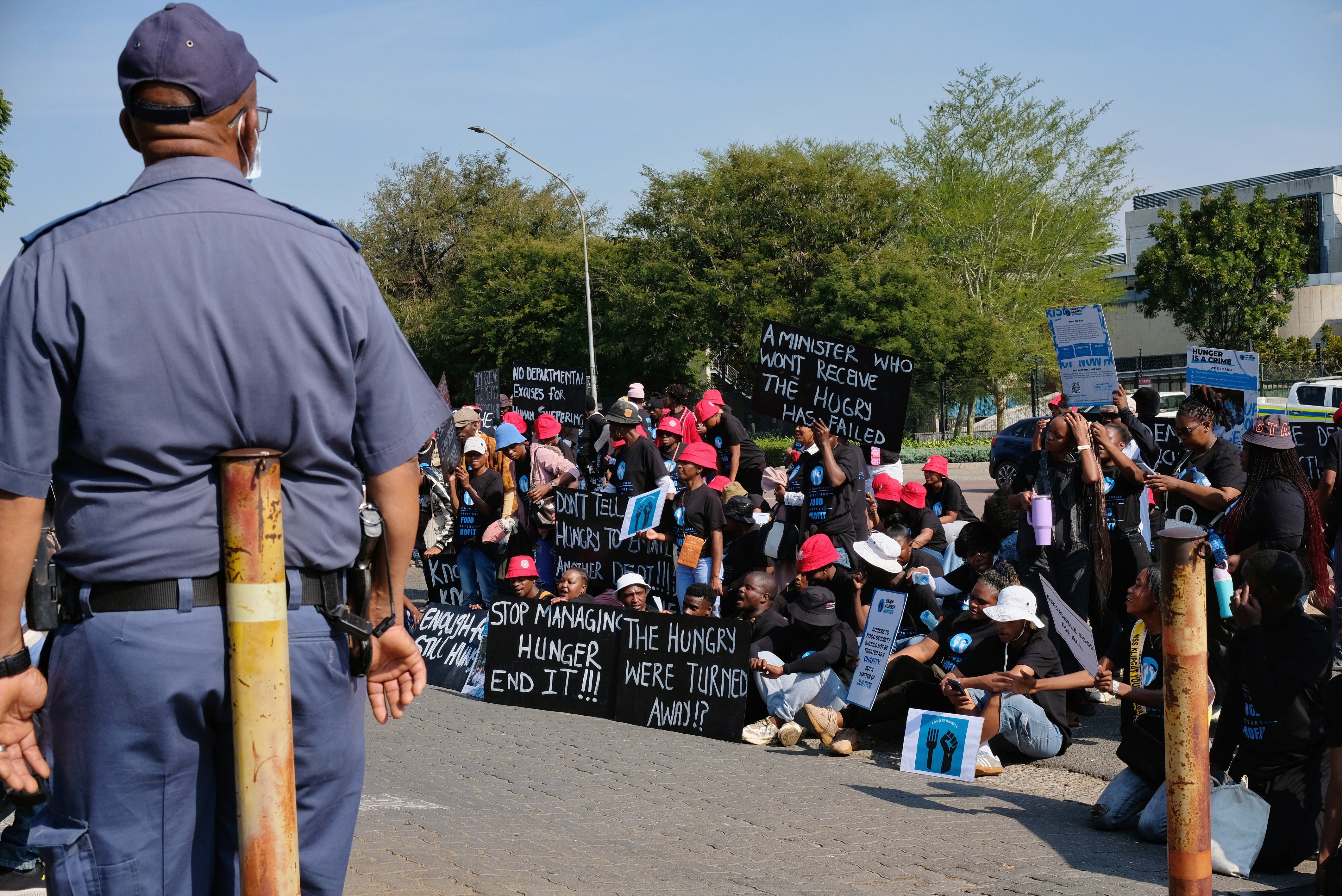
 Police stand by as Union Against Hunger members and supporters sit down outside the Department of Agriculture’s offices in Pretoria on World Hunger Day, 28 May 2026. With the picket, the union demanded that the department announce a clear and urgent timetable for finalising the National Food and Nutrition Security Plan and its adoption by the Cabinet before World Food Day, 16 October. (Photo: Daniélle Schaafsma)
 On 28 May 2026, World Hunger Day, members of the Union Against Hunger gathered outside the Department of Agriculture’s offices in Pretoria. They were there to hand over a memorandum demanding, among other things, that the government publish its draft National Food and Nutrition Security Plan immediately and have it adopted by the Cabinet by World Food Day on 16 October 2026.
In response to the Union Against Hunger’s notice to picket and request to receive its memorandum at the Department of Agriculture, Minister John Steenhuisen said that he was “not the appropriate executive authority to receive a memorandum whose central demands fall substantially outside the constitutional and legislative mandate of the Department of Agriculture”, directing the union to engage instead with “the Presidency and related coordinating departments” on matters relating to the Food Security Council and intergovernmental coordination structures.
A departmental representative nonetheless came out to accept the memorandum on the day.
/file/attachments/orphans/5_488347.jpeg "Union Against Hunger co-founder Mark Heywood hands a memorandum to the acting deputy director-general for food security and agrarian reform, outside the Department of Agriculture's Pretoria offices on 28 May 2026. The memorandum demands that the draft National Food and Nutrition Security Plan be published immediately, that the names of the National Food and Nutrition Security Council members be published, and that the council convene without delay. (Photo: Daniélle Schaafsma)")
During a separate engagement with the MEC for Social Development of Gauteng, Nomantu Nkomo-Ralehoko, on the same day, Nkomo-Ralehoko said that the Department of Agriculture had “policy responsibility” and was responsible for issues of food security.

The Department of Agriculture told Daily Maverick that “the department coordinates government response to food security-related matters”.
Speaking at the picket, Heywood said the Department of Agriculture’s own mandate included food security, rural development and market access.
“If food security does not mean people can access sufficient, nutritious and affordable food,” the Union Against Hunger’s memorandum states, “then the phrase has been emptied of meaning.”
The missing plan
The National Food and Nutrition Security Plan 2018-2023, the government’s primary framework for coordinating its response to hunger across departments, expired in March 2023. No replacement has been published.
At the South African Human Rights Commission’s (SAHRC) national inquiry into food systems in March 2026, the Department of Agriculture confirmed that a “draft zero” for a replacement had been developed and was undergoing consultation with other departments and external stakeholders. The department also acknowledged at the inquiry that the new plan had not yet been costed or assigned a ring-fenced budget.

According to Heywood, who cited the Department of Agriculture’s planning presented to Parliament, the new plan is scheduled for Cabinet approval in the first quarter of 2027.
Meaning that by the time a plan is adopted, if it follows this timeline, SA could have gone approximately four years without an operational national food security framework.
The department did not respond to questions about this timeline or about what specific stumbling blocks had delayed the development of a replacement plan. However, the department said that it planned to gazette the National Food and Nutrition Security Plan by September 2026 and conduct public roadshows from July 2026.
On what had governed the coordination of the government’s response to hunger during this period, the department said that as the new plan was being developed, the previous plan remained relevant and “reporting on the old indicators is still relevant”.
/file/attachments/orphans/6_300127.jpeg "The Union Against Hunger picketed outside the Department of Agriculture’s offices in Pretoria on 28 May, demanding that the department treat food affordability as a food security issue and not someone else’s problem, and support small-scale farmers and producers in meaningfully accessing markets. (Photo: Daniélle Schaafsma)")
Heywood described the delay as “negligence”.
“I don’t think the government actually understands the seriousness of the hunger crisis and its cost to our country,” he told Daily Maverick. “The Department of Agriculture doesn’t have a visionary understanding of what this plan is about. It’s being approached more as a sort of tick-box exercise.
“The practical consequences are that hunger and malnutrition that could be mitigated is not,” he said. “At the most extreme level, it means preventable child deaths from malnutrition.”
The Union Against Hunger’s memorandum calls for the plan to be published immediately and adopted by the Cabinet by 16 October 2026.
Dr Yvonne Erasmus, Senior Researcher at the Socio-Economic Rights Institute of South Africa, said the absence of the plan created a specific accountability problem.
“SA doesn’t have framework legislation in place in relation to the right to food, which sets out clearly who is responsible for what and what the accountability mechanisms are,” she said. “The plan is also important because there isn’t an alternative accountability framework.”
/file/attachments/orphans/1_618106.jpeg "Union Against Hunger members and supporters demanded that the department take responsibility for South Africa’s hunger crisis. (Photo: Daniélle Schaafsma)")
The Department of Agriculture noted that according to the General Household Survey of Statistics South Africa, the number of food-insecure people had decreased from 18.5% during the Covid period to 14.9% in 2025, and that “the programmes of government are working”.
The council that has never met
At the SAHRC inquiry in March 2026, the Department of Agriculture told the commission that the president had issued letters of appointment to members of the National Food and Nutrition Security Council, the body established to coordinate the National Food and Nutrition Security Plan across government departments and stakeholders.
The department confirmed that the council had been formally established and that the president appointed government ministries to it in March 2022. The appointed ministries are the Presidency as chair, Agriculture as member and secretariat, and 10 other departments – Health; Social Development; Basic Education; Land Reform and Rural Development; Cooperative Governance and Traditional Affairs; Water and Sanitation; Small Business Development; Communication and Digital Technologies; International Relations and Cooperation; and Trade, Industry and Competition.
The council has not met, according to the Department of Agriculture, because the government was reconfigured following the 2024 elections, ministers changed, and departments changed names.
“The council will convene once new members are appointed,” the department said, adding that it would “expedite the functionality” of the council, with the assistance of the Office of the Deputy President.
Speaking to Daily Maverick, Heywood said the opacity around the council’s composition made it difficult to assess whether it was operational at all.
“Nobody knows who is on the National Food and Nutrition Security Council,” he said. “If this council actually existed and was meeting, they should already be addressing the food security crisis.”
The department described food and nutrition security as “a government-wide obligation” while confirming that “the Department of Agriculture coordinates the activities on behalf of government”. The Union Against Hunger’s memorandum contests any narrower reading of that mandate directly. “A food system that produces food but leaves people hungry is a failed food system,” it states.
/file/attachments/orphans/3_676384.jpeg "The Union Against Hunger insists that while the country does produce enough food, there are millions who still go hungry, and the Department of Agriculture does not stand outside of this crisis. (Photo: Daniélle Schaafsma)")
Heywood has said that if a functional council was not convened soon, they intended to establish their own, a body bringing together civil society, trade unions, academics, community members and business representatives.
Heywood drew a parallel with the Treatment Action Campaign’s (TAC) approach before the South African National Aids Council was reconstituted, when the TAC built cross-sector relationships and developed proposals before the government had done so.
“If a food council is announced by the government, and if it has bold terms of reference, and if it meets urgently, then there’s no need for what we’re doing,” he said. “But we are trying to fill a vacuum that is deadly.”
At the picket on 28 May, Heywood told the Department of Agriculture’s representatives that they were “not just picking on you here, we are asking for a partnership. But the partnership that we want is a partnership not in word, but in action.”
The Department of Agriculture said it welcomed the Union Against Hunger coalition, describing it as “part of the food and nutrition security ecosystem”.
Lessons from the previous plan
The 2023 implementation evaluation of the previous National Food and Nutrition Security Plan, commissioned by the Department of Planning, Monitoring and Evaluation, found that of the plan’s 65 performance indicators, 48% had either not been met or had no data available to assess progress. Of the 17 impact-level indicators, only seven could be tracked, and all seven showed wide gaps against their targets. The stunting rate of children under five remained largely unchanged over the entire five-year implementation period.
The evaluation identified two primary reasons for the failure: the plan was essentially invisible outside of the departments meant to implement it, and no dedicated budget had been allocated to it. Departments were expected to fund implementation from existing budgets with no clear mechanism for ensuring they did.
/file/attachments/orphans/2_364947.jpeg "Union Against Hunger members and supporters picket outside the Department of Agriculture's offices in Pretoria on 28 May 2026, World Hunger Day, demanding the department take responsibility for South Africa's hunger crisis. (Photo: Daniélle Schaafsma)")
Erasmus said the new plan must address these failures directly.
“It would be crucial that the Food and Nutrition Security Council be properly constituted at both national and provincial levels and be made up of a wide range of stakeholders,” she said. “No budget had been allocated to the previous plan. Data availability and tracking to measure progress against targets was another key stumbling block. These different elements need to be aligned: design an inter-departmental plan, fund the plan, have an oversight body that can ensure that the plan is implemented, and then make sure that the data is available and fed back to monitor progress.”
The most important targets in any new plan, she said, related to children.
“These are entirely preventable problems and within our means and know-how to solve.”
The Union Against Hunger has given the Department of Agriculture until 16 June 2026 to respond formally to its memorandum. DM