



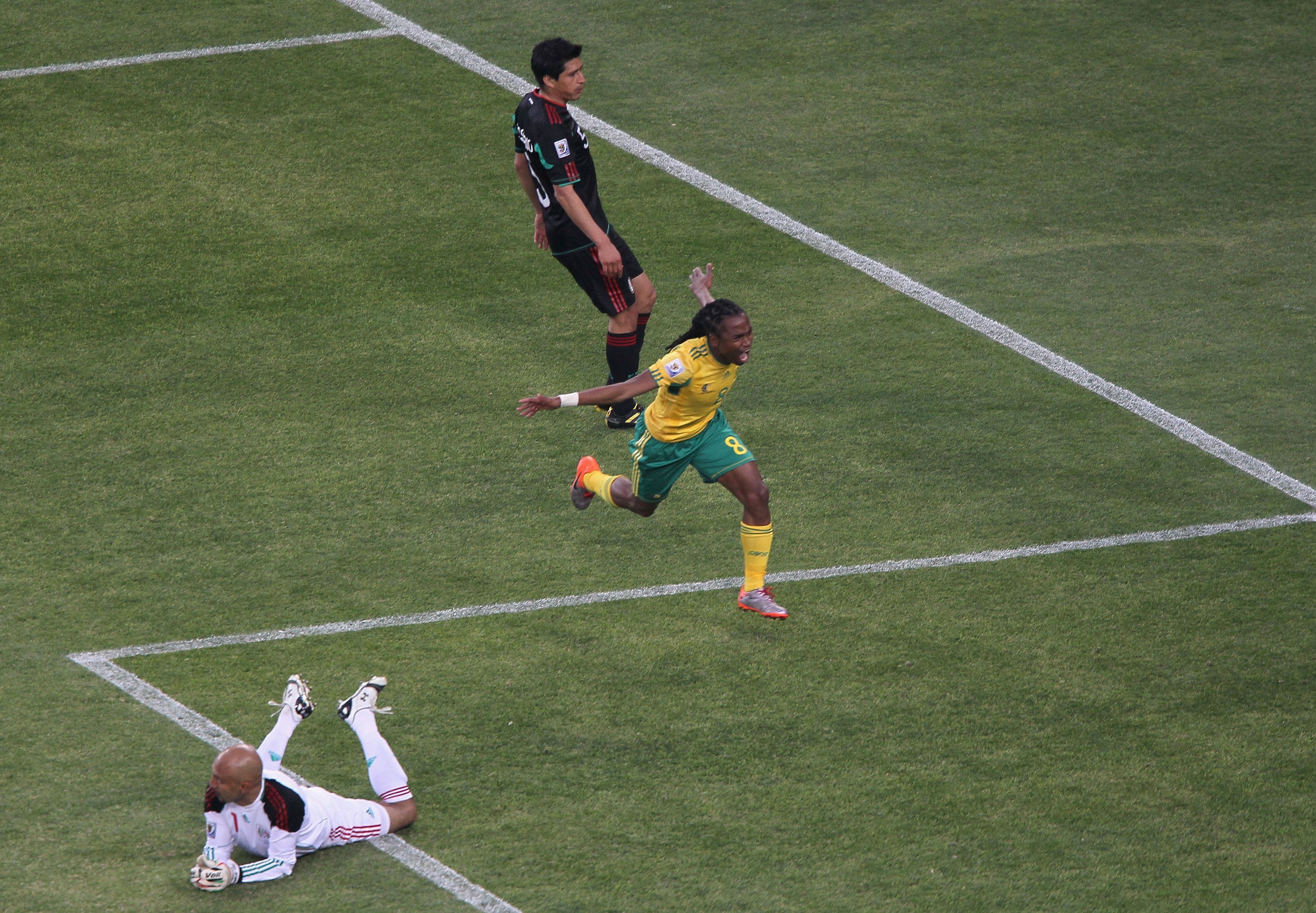
 Siphiwe Tshabalala of South Africa celebrates scoring the first goal of the 2010 Fifa World Cup against Mexico at Soccer City, Johannesburg, on 11 June 2010. (Photo: Christof Koepsel / Getty Images)
1930 in Uruguay (as a reward for being the reigning Olympic champions from 1928). The hosts won the first-ever World Cup final 4-2 over neighbours Argentina. The massive new 90,000-seater Estadio Centenario in Montevideo wasn’t finished in time for the first week of the tournament. Everyone affiliated to Fifa was invited and 13 teams showed up – nine from the Americas and only four from Europe (France, Yugoslavia, Belgium and Romania). Egypt accepted but missed their boat from Marseille to South America after a storm delayed them.
/file/attachments/2993/RC1F36FB44E0_797148.jpg "The inaugural Fifa World Cup in Uruguay in 1930. (Source: Action Images)")
1934 in Italy. The hosts beat Czechoslovakia 2-1 after extra-time in the final. Thirty-two nations entered the competition with 16 qualifying. Reigning champions Uruguay boycotted because only four European teams had accepted their invitation to the first tournament. The event was distorted into political propaganda by Italian dictator Benito Mussolini with the final being played at Rome’s Stadium of the National Fascist Party.
1938 in France. Italy defended their title by beating Hungary 4-2 in the final. The main Latin American teams boycotted because they felt the tournament should have gone back to South America. Another major absentee was the brilliant Austrian Wunderteam, who qualified as one of the favourites but the Nazi annexation of Austria (the Anschluss) before the finals meant their players were reluctantly merged into the German side, who ultimately performed poorly.
World War 2. With the World Cup suspended because of the war, the Italian vice-president of Fifa, Dr Ottorino Barassi, hid the trophy in a shoe-box under his bed to keep it safe.
/file/attachments/2993/MT1ACI972966_196584.jpg "The official tournament poster for the 1950 Fifa World Cup in Brazil. (Source: Action Images)")
1950 in Brazil. The tournament did not have a final. The winner was decided by a four-team, second-round mini league, but it so happened that the last game between Brazil and Uruguay in the newly built Maracanã Stadium was the decisive fixture, in which Uruguay beat the hosts 2-1 and they have been dining out on that result ever since. Defending champions Italy were massively weakened by the loss of the entire champion Torino club team in a plane crash a year earlier. The English turned up for the first time, having previously considered the event as beneath them, and infamously lost 1-0 to US.
1954 in Switzerland. West Germany was responsible for the biggest shock in a final (and the most unpopular) when they beat Hungary 3-2. Ferenc Puskás’ Marvellous Magyars had transformed world football with 30 unbeaten matches and had destroyed the Germans 8-3 in a group game. They also led 2-0 in the final before fading in heavy rain. There are smouldering accusations that the Germans doped at half-time – some say a vitamin shot, others methamphetamine – which is why they were so physically superior in the second stanza.
/file/attachments/orphans/GettyImages-3166552_465759.jpg "Hungary’s Ferenc Puskás was perhaps the first genuine superstar of international football. (Photo: Central Press / Getty Images)")
1958 in Sweden. Brazil beat the hosts 5-2 in the final to claim their first title. Seventeen-year-old Edson Arantes do Nascimento, better known as Pelé, exploded onto the scene with a goal in the quarters, a hat-trick in the semi and a brace in the final. Wales and Northern Ireland reached the quarters, England did not. Just Fontaine of third-placed France scored a record 13 goals in the tournament.
1962 in Chile. Brazil (without the injured Pelé) defended their title by beating Czechoslovakia 3-1 in the final. This was the most violent tournament in World Cup history with several matches degenerating into brawls, including the infamous Battle of Santiago when Chile beat Italy, who had two players sent off.
1966 in England. The hosts beat Germany 4-2 in extra time at Wembley with West Ham’s Geoff Hurst scoring a famous hat-trick. Two-time defending champions Brazil and Pelé were quite literally kicked out of the tournament with constant fouling. African teams boycotted the competition over an unfair qualification process but Mozambican-born Portuguese striker Eusébio won the Golden Boot. North Korea astounded everyone by beating Italy 1-0 and leading Portugal 3-0 in the quarters before losing 5-3.
/file/attachments/orphans/GettyImages-2667564_982511.jpg "England captain Bobby Moore holds up the Jules Rimet trophy as he is carried on the shoulders of his team-mates after their 4-2 victory over West Germany in the World Cup Final at Wembley Stadium in 1966. Also pictured are (from left) Nobby Stiles, Jack Charlton, Alan Ball, Martin Peters, Geoff Hurst, Ray Wilson, George Cohen and Bobby Charlton. (Photo: Central Press/Hulton Archive/Getty Images)")
1970 in Mexico. Brazil beat Italy 4-1 in a magnificent final. England’s keeper Gordon Banks made “the save of the century” from Pelé in a 1-0 group loss to Brazil; Italy’s 4-3 extra time semifinal win over West Germany was dubbed “the game of the century”, and Carlos Alberto’s clinching goal in the final, in which he was the ninth player to touch the ball after a silky move, was, surely, “the team goal of the century’. Yellow and red cards were introduced, as were subs. Africa had a direct qualifier (Morocco) for the first time.
/file/attachments/orphans/GettyImages-1227541383_990543.jpg "Pelé celebrates after winning the 1970 World Cup in Mexico. Brazil beat Italy 4-1 in the final at the Azteca Stadium. (Photo: Alessandro Sabattini/Getty Images)")
1974 in West Germany. The hosts won the final 2-1 over the glitzy Netherlands with Johan Cruyff and their famous Total Football. The Dutch took the lead in the final before a German had even touched the ball when Cruyff earned a penalty in the first minute but “Kaiser” Franz Beckenbauer’s home team won out in the end. Earlier in the competition West Germany lost to East Germany in a group game in the first-ever match between them. Zaire (now the DRC) lost 9-0 to Yugoslavia.
1978 in Argentina. The hosts won a tumultuous final 3-1 in extra time over the unlucky Dutch (who hit the post with the final kick of normal time). A young phenom named Maradona, at 17, was excluded at the last minute from the home squad. The event was an exercise in naked propaganda by the ruling military junta and serious allegations remain that a key game was fixed – Argentina needed to beat a talented Peruvian team by four goals to reach the final over bitter rivals Brazil, and they won 6-0 with the Peruvian goalkeeper having been born in Argentina.
/file/attachments/orphans/GettyImages-1630887_327254.jpg "West Germany captain Franz Beckenbauer (No 5). (Photo: Allsport UK /Allsport)")
1982 in Spain. Italy beat West Germany 3-1 even though they failed to win a game in the group stages. The tournament expanded from 16 to 24 teams. Maradona was sent off against Brazil whose sumptuous team (Zico, Sócrates, Falcão, Éder et al) seemed destined for glory until they switched off against Paolo Rossi and Italy. West Germany met Austria in the Disgrace of Gijón – a 1-0 German win meant both teams would qualify for the knockouts and Algeria would miss out; Germany got an early goal and then both teams played with a palpable lack of purpose for the rest of the match. A Spanish newspaper reported the appalling game in the crime section and, from the next tournament, final group games kicked off simultaneously.
1986 in Mexico again after Colombia pulled out late citing financial burdens. Argentina beat Germany 3-2 in the final. Maradona’s “hand of God” goal against England in the quarters tends to overshadow his astonishing slaloming individualistic effort in the same game. The last World Cup when you could rock up without tickets and get into almost any game (I know, because I was there and attended six matches without any advance planning). José Batista of a filthy Uruguayan side was sent off against Scotland after less than one minute, a World Cup record.
/file/attachments/orphans/GettyImages-1449637133_106755.jpg "Argentinean maestro Diego Maradona celebrates as he is carried off the field by fans and teammates after winning the 1986 Fifa World Cup. Argentina defeated West Germany 3-2 at the Azteca Stadium. (Photo: Paul Bereswill / Getty Images)")
1990 in Italy. The newly reunified Germany beat a cynical Argentina (who ended up with only nine men on the pitch) 1-0 in a grim final at the end of a dour tournament with the lowest goal per game ratio ever, 16 red cards and about 1,000 Maradona body rolls after being fouled. Cameroon beat Argentina in the group phases and became the first African team to reach the quarters with 38-year-old Roger Milla scoring four goals, all as a sub. England’s Paul Gascoigne famously burst into tears in the semifinal against Germany when a booking meant he would not play in the final … which England didn’t reach anyway.
1994 in the US. To the mystification of most Americans, the final was won by Brazil over Italy without a goal being scored in 120 minutes of football – 0-0 after extra time then penalties deciding the issue for the first time. The gifted Roberto Baggio (aka “the divine ponytail”) missed the key spot kick for Italy. Nigeria qualified for the first time and topped their group. Maradona was expelled from the tournament after he failed a drug test. Roger Milla, now 42, broke his own record as the oldest World Cup finals’ goal scorer. Colombian defender Andrés Escobar’s own goal effectively eliminated his team and he was killed outside a bar in Medellín ten days later, possibly in retaliation for his mistake.
1998 in France. The hosts beat Brazil 3-0 in the final to win their first World Cup. Brazilian superstar Ronaldo had some kind of seizure just before the final and played anonymously. The tournament expanded from 24 teams to 32. Golden goals in extra time were introduced and decided France’s game against Paraguay in the Round of 16. Bafana Bafana (coached by Philippe Troussier) appeared for the first time, losing heavily to France and then drawing with Denmark and Saudi Arabia.
2002 in Japan and South Korea. Brazil beat Germany 2-0 in the final to win their fifth title with Ronaldo scoring both goals (and eight in all). South Korea and Japan – historically bitter diplomatic antagonists – had rival hosting bids before Fifa persuaded them, reluctantly, to become the first-ever joint hosts. Defending champions France failed to win a game or score a goal. Turkey and South Korea were surprise semifinalists. Bafana Bafana, under Jomo Sono, drew with Paraguay, beat Slovenia and lost 3-2 to Spain (after twice leading), to go out on goal difference.
/file/attachments/orphans/GettyImages-2147048073_993454.jpg "Cafu (far left) of Brazil and his teammates celebrate with the trophy after winning the 2002 Fifa World Cup in Yokohama, Japan. (Photo: Richard Sellers / Sportsphoto / Allstar via Getty Images)")
2006 in Germany. South Africa were meant to host this tournament, until the Germans (Kiwi Charles Dempsey and all that) stole our votes and our thunder. Italy beat France on penalties (1-1 after extra time) to win their fourth title in a final best known for French superstar Zinedine Zidane’s extra-time head butt on Marco Materazzi after the Italian insulted his sister or his mother or … nobody is really sure. Golden goals were scrapped. Eighteen-year-old Leo Messi made his World Cup debut against Ghana. A Russian referee handed out 16 yellow and four red cards in the Round of 16 match between Portugal and the Netherlands known as the Battle of Nuremberg.
2010 in South Africa. Spain, who dominated the era, won their first World Cup with a turgid 1-0 extra time win over a dirty Dutch team. Defending champions Italy failed to win a match. SA (under Carlos Alberto Perreira) became the first hosts not to reach the knockouts – a 3-0 loss to Uruguay scuppered us but we did beat France 3-2 and Siphiwe Tshabalala’s goal in the opening draw with Mexico was a truly orgasmic moment. Messi and the rest of a talented Argentine team could not overcome Maradona’s chaotic management and were destroyed by Germany. Uruguayan Luis Suárez’s cynical goal-line handball wrecked the hopes of a plucky Ghana in the quarters.
2014 in Brazil. Germany beat Messi’s Argentina 1-0 after extra time in the final. The Germans famously destroyed the horrified hosts 7-1 in the semis in the Maracanã. Defending champions Spain went out in the group stage, as did England and Italy. Costa Rica were the surprise packet. Suárez was suspended for nine matches after biting Italian defender Giorgio Chiellini. Goal line technology was introduced.
2018 in Russia. France beat Croatia 4-2 in the final. For the third consecutive tournament, the holders were eliminated in the first round when Germany crashed out ignominiously. England’s Harry Kane won the Golden Boot with six goals. No African team progressed to the second round for the first time since 1982. Fair play criteria came into use for the first time when Japan qualified for the knockouts over Senegal because they had received fewer yellow cards.
2022 in Qatar. Argentina won their third title when they beat holders France on penalties in an epic final, which ended 3-3 after extra time. Messi scored twice in the final and French superstar Kylian Mbappé got the first hat-trick in a final since 1966. Argentina lost to Saudi Arabia early on and Germany once again failed to make it out of the group stages. Morocco became the first African team to make the semis.
/file/attachments/orphans/GettyImages-1451164904_191230.jpg "Argentina’s Lionel Messi was the star of the 2022 Fifa World Cup in Qatar. Argentina beat France on penalties in the final at the Lusail Stadium, after the match ended 3-3. (Photo: Julian Finney / Getty Images)")
2026 in USA, Mexico and Canada. The first time three nations have hosted. The tournament has expanded from 32 to 48 teams.
2030 – the centenary finals – to be hosted by Spain, Portugal and Morocco with single games in each of Uruguay, Argentina and Paraguay.
2034 in Saudi Arabia. DM
Comments
Scroll down to load comments...