




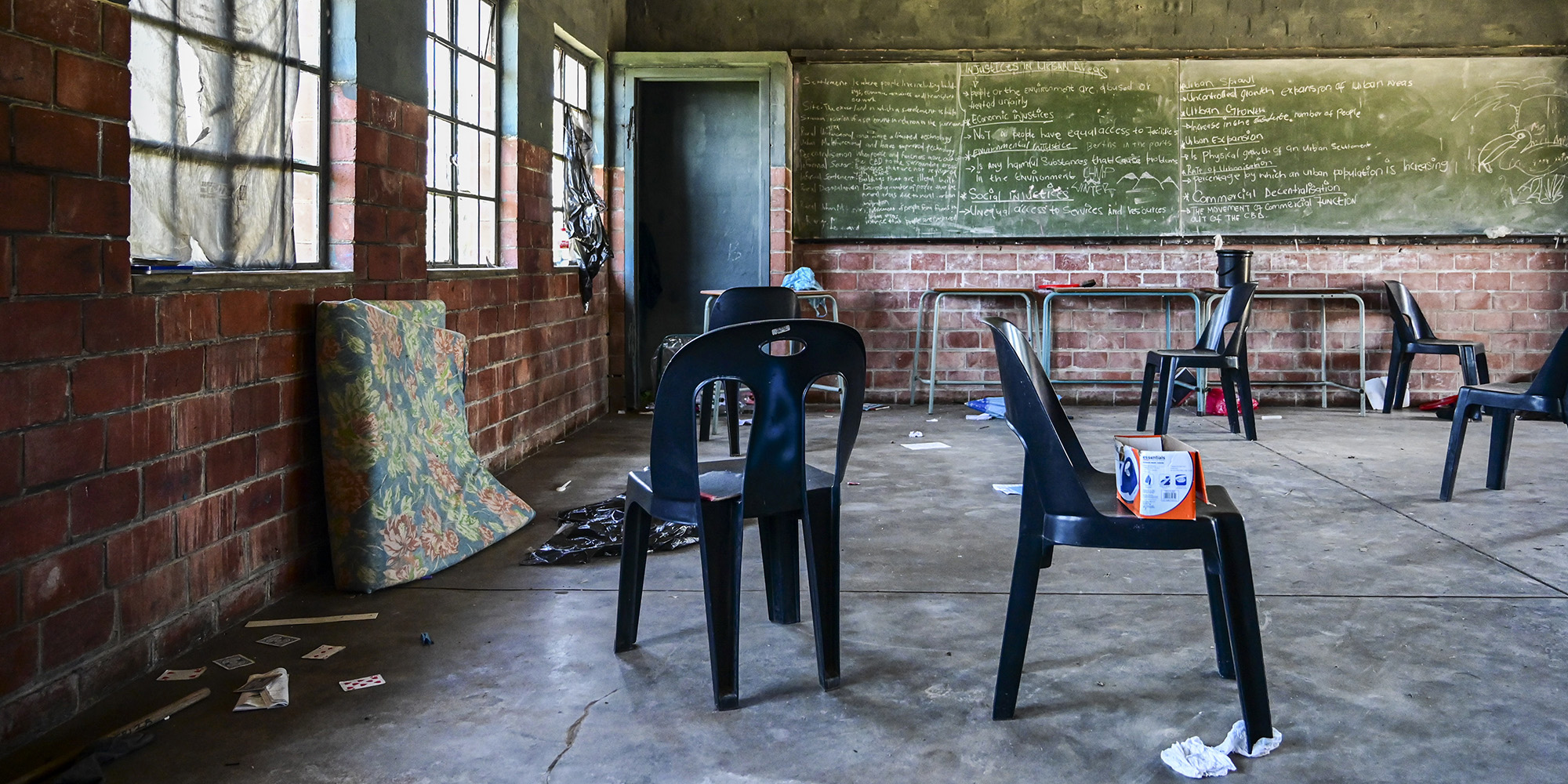
 A classroom at Bhekisisa High School taken on 17 January 2023 in Durban, South Africa. (Photo: Gallo Images / Darren Stewart)
The KwaZulu-Natal Department of Education has narrowly avoided a funding crisis after securing a R2-billion emergency advance from the National Treasury. However, while the multibillion-rand intervention brings immediate relief, it ultimately acts as a temporary patch for a department on financial life support.
According to Sakhile Mngadi, the DA KZN spokesperson on education, the country’s largest provincial education system has been driven to the brink by cumulative budget cuts and poor financial choices. These include risky contracting, inadequate controls and a persistent failure to align spending with available resources.
“Internally, there is just no appetite to reform. They are actively resisting the Financial Recovery Plan presented by the Treasury to assist them. They are directly fighting against the Section 18 intervention; they fight all of it,” said Mngadi.
/file/attachments/orphans/Taku-KZN-fundingcopy_302012.jpg "Nkosinathi Ngcobo, KZN Department of Education HOD. (Photo: Gallo Images/Darren Stewart)
<br>
<br>")
Chronic overspending
In August 2025, the KwaZulu-Natal Provincial Treasury invoked Section 18 of the Public Finance Management Act (PFMA), taking direct control of the department’s finances after massive budget overruns and a failure to remedy its financial situation.
In May 2026, it escalated the intervention by placing the Provincial Accountant-General permanently in charge of all financial functions, with authority to demand documents, issue binding instructions and enforce consequence management.
The escalation was driven by chronic overspending and cash-flow insolvency that left the department unable to meet statutory and contractual obligations, compounded by widespread unlawful deviations, unauthorised contract extensions, weak consequence management and systemic failures that have repeatedly disrupted school feeding, pupil transport, textbook delivery and teacher pay.
Mngadi warned that if the department’s internal management team continued to resist fiscal discipline and blame Treasury rather than acknowledging its failure to use funds effectively, there would be a push for the ultimate penalty.
“There have been talks of implementing Section 100, which would mean completely removing the administrative functions from the province and placing the entire department under full national administration. The Auditor-General has already cited many reports to this effect,” he said.
When asked by Daily Maverick for comment, KwaZulu-Natal Department of Education spokesperson Muzi Mahlambi said, “What do they mean by resistance because it’s been a year that we have had section 18?”
Why emergency advance won’t stop the bleeding
The KwaZulu-Natal Department of Education has welcomed the cash-flow advance, noting that R28-billion in sustained national budget cuts and austerity measures imposed since 2020/21 had placed “immense strain” on its ability to support schools, educators and learners.
It said the advance would not cover Learning and Teaching Support Materials (LTSM) or the next round of norms and standards payments due in November, and that the brief reprieve would inevitably trigger a new cycle of fiscal distress.
“Delays in payments to service providers and for LTSM will persist, leading to the accumulation of new debt in the following financial year. Without an additional allocation of funds and a permanent solution to the funding gap, the sector will remain in the same precarious position,” said the department.
Responding to questions from Daily Maverick, the National Treasury said the advance had been provided to fund the department’s transfer obligations to schools in terms of norms and standards, as well as the procurement of LTSM for the 2027 school year.
The cash advance relates to May 2026 and November 2026; no further advances have been approved, and the amounts advanced will be recovered through reductions in transfers to the provincial fiscus between December 2026 and March 2027.
The maths behind the operational crisis
Mngadi explained that 92% of the department’s R70-billion budget went to salaries for 144,000 employees, leaving just R6-billion for infrastructure, maintenance and service delivery.
This operational purse was further strained by mountains of historical debt.
“Historically, the department has been creating debt it can’t fund, then using the next year’s budget to clear it. In this financial year alone, they’re sitting on R1.1-billion,” he said.
/file/attachments/orphans/Taku-KZN-funding_626782.jpg "Why a R2bn emergency advance won’t save KZN Schools. (Graphic: ChatGPT)")
Surviving the squeeze
With operational cash exhausted, service delivery is severely affected as this year, no textbooks were procured, scholar transport routes were reduced and schools are not receiving their norms and standards allocations.
Although norms and standards funding is meant for learning materials, utilities and maintenance, it isn’t ring-fenced and is routinely diverted to plug other shortfalls. It’s also underfunded in KwaZulu-Natal compared with national standards.
The province pays:
Quintiles 1-3 schools: R955 instead of R1,672 (a R717 shortfall);
Quintile 4 schools: R522 instead of R838 (R316 shortfall); and
Quintile 5 schools: R179 instead of R289 (R110 shortfall).
This results in a combined deficit of more than R2-billion.
“We’ve been to schools where principals were running extension cords to next-door neighbours because the school had the lights cut. Others were paying from their own salaries to buy printing paper, so that they could have exams happen. These are the real-life, day-to-day management challenges that this financial crisis is having,” Mngadi revealed.
A principal at a no-fee school in the Umlazi District, who asked to remain anonymous, told Daily Maverick that he had been forced to adopt a brutal approach to budgeting just to survive.
“We have to economise. We have embarked on a culture where we emphasise to learners to save whatever they have and take good care of it. It could be water, it could be the lights, anything that consumes money, we try to save as much as we can,” said the principal.
This year, he had to negotiate with service providers to delay payments for up to three months. The school has resorted to leasing out parts of its property to cope with the financial demands.
“Some people use our premises for church services, and we levy a fee for the classroom they use after school hours. These small sums add up at the end of the day to keep the school running,” he said.
In the Pinetown District, a principal of a fee-paying school shared a similarly grim outlook, noting that they had enough cash reserves only for immediate needs, leaving them utterly vulnerable to any unplanned expenditure.
“I have now resorted to badgering the parents who can pay by constantly reminding them of their outstanding fee accounts by sending text messages, addressing the issue of outstanding fees at parents’ meetings,” said the principal, who also asked to remain anonymous.
Demands for accountability
Thirona Moodley, the KwaZulu-Natal head of the National Professional Teachers’ Organisation of South Africa (Naptosa), said that the advance would stabilise the department for the time being, but stressed that there had to be a sustainable, long-term solution to the ongoing crisis. She said the department had historically been underfunded by the National Treasury and that allegations of mismanagement had worsened an already difficult situation.
“These allegations must be thoroughly investigated, and consequence management must follow where wrongdoing is found,” she said.
The National Treasury said the use of the advance would be monitored through the department’s monthly expenditure and quarterly performance reports submitted to the KwaZulu-Natal Provincial Treasury, the National Treasury and the National Department of Basic Education. DM
Comments
Scroll down to load comments...