




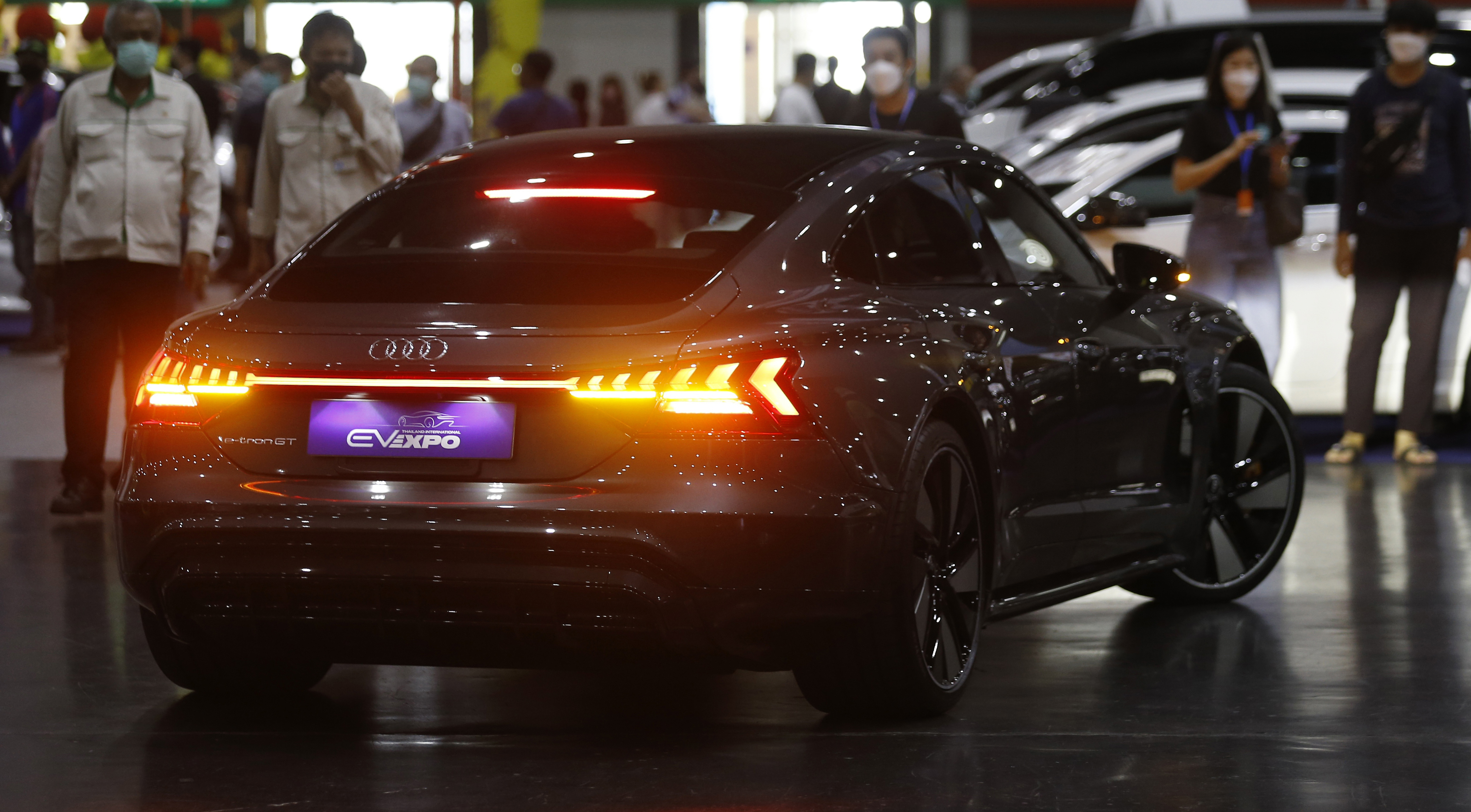
 Visitors test drive an Audi e-tron GT electric vehicle (EV) car at the Fast Auto Show Thailand and EV Expo 2023 trade show at BITEC in Bangkok, Thailand, in July 2023. (Photo: EPA / Narong Sangnak)
At a recent EE Business Intelligence webinar on the state of the electric vehicle industry, Hiten Parmar, executive director of The Electric Mission, Ndia Magadagela, CEO of Everlectric, and Grant Locke, managing director of Volvo Car South Africa, unpacked the road ahead for electric mobility in South Africa.
Parmar’s opening message was blunt: South Africa has moved, but too slowly.
The country produced 618,077 vehicles in 2025, but its automotive sector is still heavily tied to internal combustion engine production. However, South Africa’s vehicle manufacturing industry is export-orientated, with the EU and UK among its most important markets. Those markets are moving towards stricter emissions rules and, eventually, the phase-down of new petrol and diesel vehicle sales.
“It is important and immediate that South Africa transitions its manufacturing incentives to allocate for these emission vehicle technologies,” Parmar said.
SA needs to keep up to speed in two lanes
His point was not that South Africa has no industrial base. Quite the opposite. Rather, he said local production lines had the flexibility to adapt to different powertrain technologies, depending on decisions made by vehicle manufacturers. The question is whether the country can move fast enough to protect its existing automotive base while building a new one.
On the demand side, the market is still tiny. Parmar said South Africa had 4,502 battery electric vehicle registrations by the end of 2025, and 4,835 plug-in hybrid electric vehicle registrations. His deeper estimate, using data adapted from SARS and AutoStats, put battery electric passenger vehicle stock at about 7,900 units.
That is growth, but not yet the sort of growth that changes the market’s centre of gravity. Parmar said South Africa remains far from the 5% market-share tipping point at which adoption starts to accelerate.
There are also gaps: vehicle affordability, import duties, charging infrastructure, electricity anxiety and limited model choice. Yet the speakers argued that some of these objections were beginning to lose bite, particularly for commercial fleets.
Magadagela said fleet operators had already found pockets where EVs worked, not because of green branding, but because they lowered costs.
“What we have seen for the fleet side is that commercial fleets have done the maths,” she said.
Everlectric’s case studies are based on more than 12.5 million kilometres driven by early adopters, with more than 2.75 million kilograms of carbon emissions saved. The company says these fleets achieved 100% operational EV availability, with no downtime or mechanical issues. Everlectric clients include the likes of Aramex, DHL, Sanitech, Scatec and Adcock Ingram.
/file/dailymaverick/wp-content/uploads/2025/03/Charging.jpg "The BMW X3 30e xDrive has an electric range of 81km to 90km, after which it switches over to a petrol-powered engine. (Photo: BMW Group)")
The key is route discipline. EVs make most sense where vehicles follow predictable hub-and-spoke patterns: leave base, deliver, return to base and charge during planned downtime.
Magadagela said the EV-as-a-service model allows a fleet to use electric vehicles, dedicated charging infrastructure, maintenance support and data systems without carrying all the upfront complexity itself.
“This has become one of the ways in which electric fleets can adopt electric mobility without the headache,” she said.
The ICE vs EV cost comparison
Her presentation showed why the running-cost argument is gaining strength. In one direct purchase comparison between a Maxus eDeliver3 and an Isuzu D-Max Gen 6 over five years and 240,000km, the EV’s total cost of ownership was estimated at R860,000 against R1.26-million for the internal combustion equivalent. On a financed basis, the EV still came out lower, at R1.04-million compared with R1.28-million.
The fuel line does the heavy lifting. In that example, the EV’s fuel or electricity cost was R138,000, compared with R651,000 for the diesel/petrol vehicle. Maintenance was also lower.
/file/attachments/orphans/ownershipcosts_388452.jpg "Cost comparison of an ICE car vs an electric car. (Source: Everlectric)")
For heavier commercial vehicles, the break-even point depends on distance, diesel prices, electricity prices and the lease structure. Everlectric’s 2025 rebased data showed that, at about 2,500km a month, EV panel vans and some larger trucks can become cheaper to operate than diesel equivalents.
However, all of that is on the commercial side. For ordinary buyers like you and me, the picture is less tidy.
Locke said Volvo is seeing a sharp rise in interest from consumers. AutoTrader searches for electrified vehicles rose 220% between March 2025 and March 2026, while Google search data showed weekly searches for electric cars and related terms more than doubling as South Africans entered 2026.
/file/attachments/orphans/VolvoEX30_480007.jpg "Between January and April 2025, Volvo delivered 114 electric vehicles to customers in South Africa, with the EX30 pictured here leading the charge at 48 units. (Photo: Volvo)")
“I think the fuel price is driving this,” Locke said. “It hits people every single day when they fill up their vehicle.”
Volvo’s own website traffic also shows rising interest in battery electric vehicles, although Locke cautioned that this is specific to Volvo and not necessarily the whole market.
His most striking example was a real-world Volvo EX30 case study over two years. The vehicle covered 28,744km, logged 188 charging sessions and used 4,991kWh of electricity. Because most charging happened at home or work (much of it using solar), the total energy cost over two years was just R970.08.
A comparable petrol vehicle, assuming consumption of 7.5 litres per 100km and petrol at R22.40 a litre, would have required about 2,155 litres of fuel at an estimated cost of R48,277. That implies fuel savings of about R47,307 over two years.
Locke said the vehicle also avoided an estimated 3,777kg of carbon dioxide over the period, with operational emissions roughly 55% lower than an equivalent petrol vehicle.
Purchase price
The catch is the purchase price. EVs remain more expensive than petrol cars, and Locke said residual values are still hard to call because South Africa’s second-hand EV market is young. Tyres and insurance also need closer watching.
Charging, however, is improving. Locke said major highways such as the N1, N2 and N3 now have chargers spaced within roughly 300km, while urban EV drivers in Johannesburg, Cape Town and Durban can generally find a charger within 20km. Rubicon’s charging sessions doubled in 2024 compared with 2023, with early 2026 indications showing charging up 64%.
The next shift may be that EVs stop being seen only as cars. Locke pointed to bi-directional charging, where a vehicle can power appliances, a home, another EV, or feed electricity back into the grid.
“For the longest time, a car has just been a car,” he said. “But now with bi-directional charging, a car becomes more.”
For now, South Africa’s EV market is not racing. But the business case is becoming harder to ignore, especially where fleets can sweat the numbers and where motorists have access to solar.
The road ahead is still full of potholes. But for the first time, the EV argument is less about tomorrow’s promise and more about today’s spreadsheet. DM
Comments
Scroll down to load comments...