




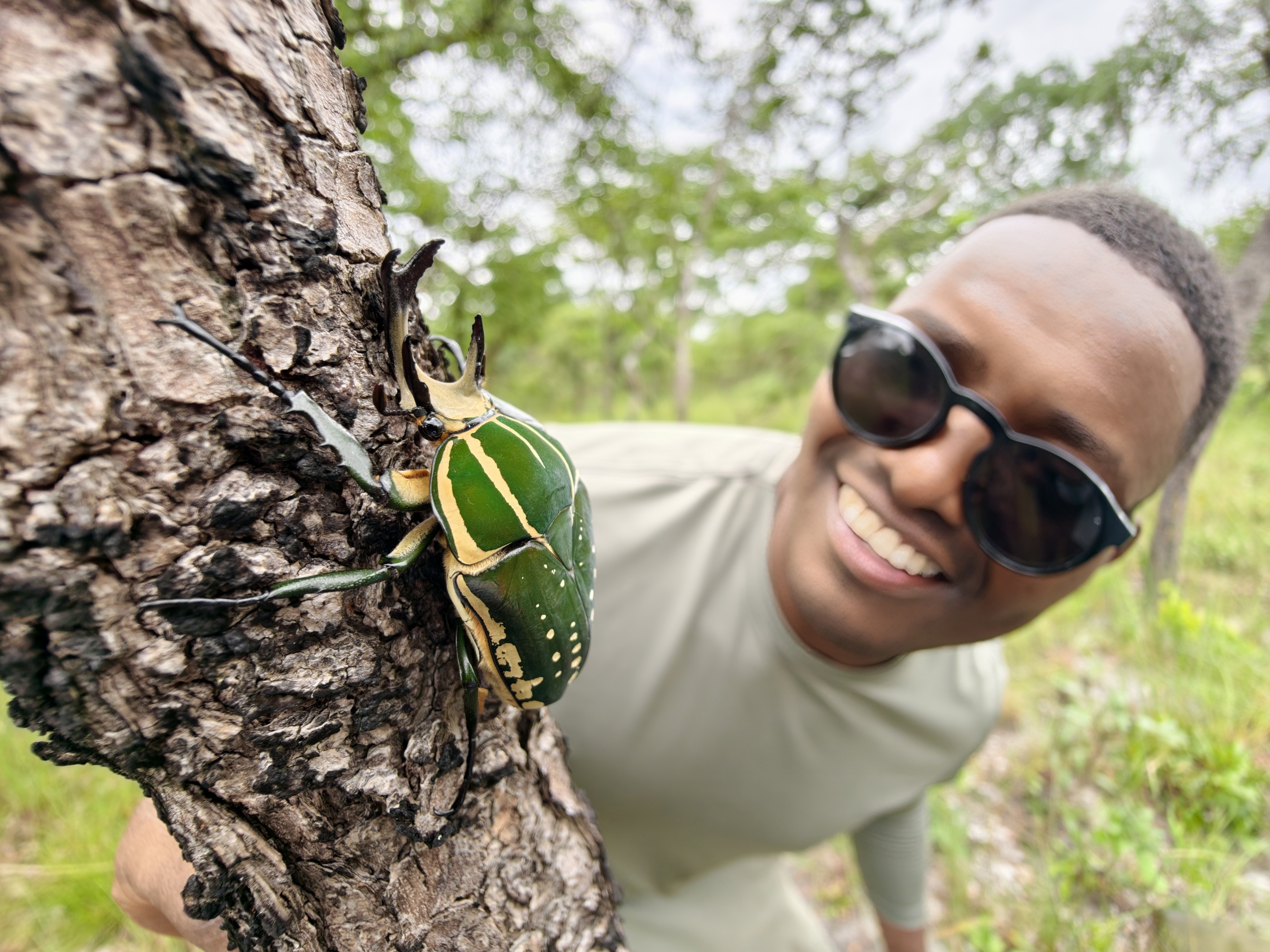
 Coleopterist Dr Gimo Daniel with a giant African fruit beetle (Photo: Nicky Bay)
High on Angola’s eastern plateau, in Moxico Province, lies one of Africa’s great almost-unknown treasures: the Angolan Highlands Water Tower.
It’s a vast upland landscape of miombo woodlands, wetlands, grasslands, sandy soils and source lakes, where water begins journeys that shape life across much of southern and central Africa.
From here, rivers flow into the Congo, Okavango, Zambezi and Cuanza systems, sustaining ecosystems and communities thousands of kilometres downstream, including Botswana’s legendary Okavango Delta.
For a place so important, it has remained astonishingly little known. Angola’s long civil war, persistent landmines, remoteness and difficult access kept scientists away for decades.
While the Okavango Delta became a global conservation icon, many of the highland headwaters that feed it stayed almost blank on the biological map.
That is now changing fast.
In February 2026, a team of 16 African and international specialists travelled to the remote Lisima plateau for the Cassai Life Atlas, a biodiversity survey conducted by The Wilderness Project. Supported by Fundação Lisima and The HALO Trust, the expedition set out to document life in the upper Cassai catchment, one of the least-studied parts of the Angolan Highlands Water Tower.
“Being on the ground in a place like this, with a team of specialists working across so many groups of life, is both a privilege and a thrill,” said Rob Taylor, expedition leader and conservation ecologist.
“These headwaters are not only vital for biodiversity; they also provide water, ecological resilience and support livelihoods far downstream. A clear understanding of the biodiversity here is essential for the effective protection of the entire system.”
What they found was extraordinary: dozens of species unknown to science, including eight undescribed dragonfly species, three new grasshopper species and about 60 moths and butterflies thought to be new to science.
The team also recorded important findings across frogs, reptiles, bats, plants, beetles, spiders and scorpions, with some specimens still awaiting detailed laboratory study.
/file/attachments/orphans/Rob_Taylor_DSC_96152_986476.jpg "The bush viper is a highly venomous, arboreal snake. (Photo: Rob Taylor)")
/file/attachments/orphans/Rob_Taylor_DSC_90352_287144.jpg "The butterfly flutterer dragonfly is named for its distinctive butterfly-like flight. (Photo: Rob Taylor)")
/file/attachments/orphans/Rob_Taylor_DSC_14362_476695.jpg "Adult coppers have warning colouration, potentially mimicking unpalatable species. (Photo: Rob Taylor)")
The result is not just a list of curious creatures. It’s a first proper glimpse into a region that may be one of Africa’s most important freshwater and biodiversity frontiers.
The dragonflies and damselflies offered some of the clearest evidence of Lisima’s ecological importance. The expedition recorded 103 species, bringing the known total for the Lisima region to 163.
Thirty-four had not previously been recorded from Lisima, six were added to Angola’s national list, and eight undescribed species first detected in 2019 are now being formally described.
Dragonflies are tightly bound to freshwater. Their presence, diversity and specialisation say something about the health and variety of streams, wetlands and river systems.
/file/attachments/orphans/Nicky_Bay_Neuroptera-Mantispidae-Sagittalata-P2070874_643475.jpg "The mantidfly lacewing. (Photo: Nicky Bay)")
/file/attachments/orphans/Piotr_Naskrecki_Angola_20260222-PNA04530copy_344260.jpg "Two-coloured bushcrickets are masters of camouflage. (Photo: Piotr Naskrecki)")
“Lisima’s sandy plateau releases some of the clearest and most reliable fresh water in Africa” said Dr Klaas-Douwe B Dijkstra, a leading dragonfly specialist and associate of the Naturalis Biodiversity Center in the Netherlands. “This is reflected in the region’s dragonflies and damselflies, with several highly specialised species found nowhere else.”
The insect discoveries did not stop there. The team recorded 47 grasshopper, katydid and cricket taxa, including three species new to science. Dr Piotr Naskrecki, director of the EO Wilson Biodiversity Laboratory at Gorongosa National Park in Mozambique, noted that many animal groups were not especially abundant, probably because the soils are low in nutrients. Yet the number of new insect species surprised him, with some likely to be endemic to the region.
/file/attachments/orphans/Nicky_Bay_Orthoptera-Enyaliopsis-P2060429_975315.jpg "This armored cricket is one of three katydid species<br>new to science recorded on the Cassai Life Atlas. (Photo: Nicky Bay)")
new to science recorded on the Cassai Life Atlas. (Photo: Nicky Bay)
More than 1,000 butterflies and moths were recorded. Among the geometer moths, researchers found an unusual meeting of ecological worlds: Congo forest species, Cape fynbos species and miombo woodland species all appearing in the same wider landscape.
The team also later reared caterpillars to connect moth species with their host plants. This linked 25 geometer moth species to 19 host-plant species across 13 plant families. Eight of the reared moths appear to be undescribed, and preliminary estimates suggest that up to 6% of all recorded moth species may be new to science.
The reptiles and amphibians added another layer to the picture. In a single wet-season survey, the team recorded 47 taxa: 24 amphibians and 23 reptiles. These included Gaboon adder, variable bush viper, Anchieta’s cobra, Oates’s twig snake and a rich wetland frog assemblage.
/file/attachments/orphans/Nicky_Bay_Serpentes-Viperidae-Bitisgabonica-P2208730_680719.jpg "The gaboon adder is a sit-and-wait ambush predator, perfectly camouflaged to blend in with the forest floor. (Photo: Nicky Bay)")
Such records underline the importance of Lisima’s dambos, swamp forests and wetland habitats, which function as refuges, nurseries and corridors for many forms of life.
In caves, the team documented Sundevall’s roundleaf bat and Rüppell’s horseshoe bat, along with associated bat flies and ectoparasites. Even there, in the dark, the survey found layered ecological relationships that had barely been recorded in the region before.
/file/attachments/orphans/Piotr_Naskrecki_Angola_20260211-PNA01218copy_680844.jpg "The large-eyed green tree snake is a specialised forest species. (Photo: Piotr Naskrecki)")
The plant team made more than 320 collections across miombo woodland, wet grassland, dambos, swamp forest, river margins and rocky stream habitats. These collections help build the botanical baseline needed to understand how the whole system works.
For Angolan biologist Laurinda de Fraga, who specialises in arachnids, the expedition was also a contribution to Angola’s natural heritage and to future generations who will inherit responsibility for protecting it.
“It is a way of leaving a lasting contribution to future generations of Angolans, while reinforcing the pride and responsibility of protecting this unique area,” she said.
The Cassai Life Atlas builds on earlier surveys in the Okavango and Lungwevungu headwaters over the past decade. Together, these expeditions have found more than 70 species confirmed new to science, nearly 300 more awaiting taxonomic study, and many hundreds of species previously unknown in Angola.
In a remarkably short time, an underdocumented headwater landscape has become one of the most exciting emerging conservation frontiers in Africa.
The discoveries arrive at a critical moment. For years, remoteness and minefields limited access and helped protect parts of Lisima from large-scale disturbance. As roads expand and minefields are cleared, previously inaccessible areas are becoming more vulnerable.
Diamond mining, slash-and-burn agriculture, timber harvesting and settlement expansion are already putting pressure on forests, rivers and habitats. Forest cover is being lost, rivers are becoming more turbid through erosion and sedimentation and natural habitats are becoming smaller and more fragmented.
/file/attachments/orphans/Nicky_Bay_Lepidoptera-Alucita-P2113474_568305.jpg "Many-plumed moths are easily recognised by their unique wing anatomy. (Photo: Nicky Bay)")
/file/attachments/orphans/Nicky_Bay_Hemiptera-Lophopidae-P2134602_890260.jpg "Planthoppers are known for their distinctly flattened<br>front tibiae, which contribute to their overall leaf-like appearance. (Photo: Nicky Bay)")
front tibiae, which contribute to their overall leaf-like appearance. (Photo: Nicky Bay)
/file/attachments/orphans/Nicky_Bay_Araneae-Smodicinus-P1014000_191065.jpg "This undescribed crowned crab spider fluoresces under ultraviolet light. (Photo: Nicky Bay)")
/file/attachments/orphans/Nicky_Bay_Araneae-Paraplectana-P2186964_785143.jpg "Another potentially new species to science is this ladybird orb-web spider. (Photo: Nicky Bay)")
There is also good news. In 2026, Lisima gained Ramsar designation as a wetland of international importance, a recognition of its value not only to Angola, but to the wider region. The designation does not guarantee protection by itself, but it gives conservationists, communities and government a stronger platform from which to act.
For now, the scientists are still sorting specimens, preparing journal submissions and adding names to life forms that, until recently, had no place in the books.
Somewhere on the Lisima plateau, a dragonfly is flying over clear water, a moth is awaiting its first Latin name, and a river is getting ready to become recognised as an African treasure.
For more information contact thewildernessproject.org.
Cassai collector’s bag
More than 1,000 moths and butterflies, 60 moths new to science;
47 grasshopper, katydid, and cricket taxa, including three new to science;
163 dragonflies and damselflies, 34 new to science;
24 amphibians;
23 reptiles;
320 plants.


Comments
Scroll down to load comments...