




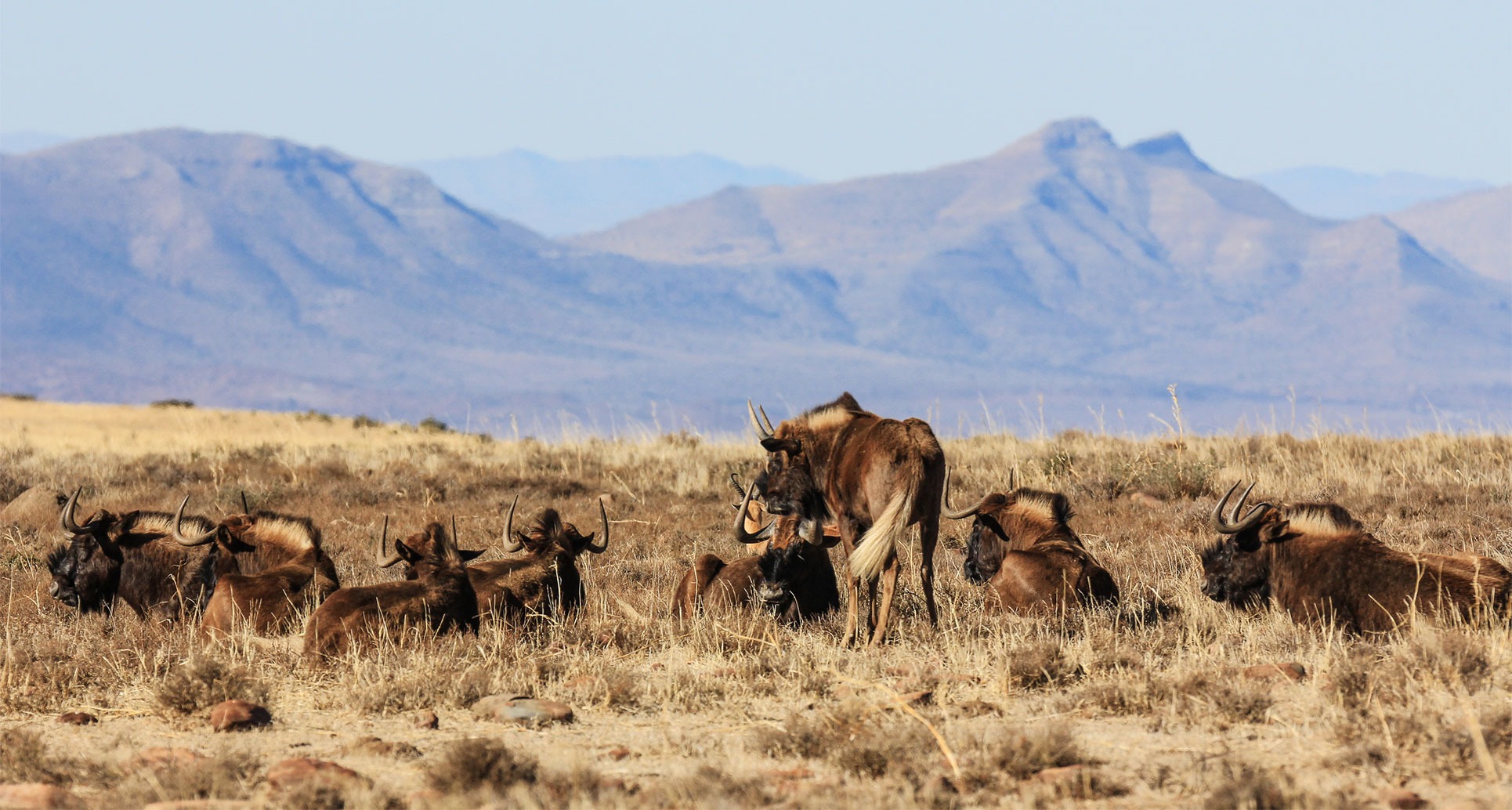
 Black wildebeest are found only in South Africa. Despite recovering from the brink of extinction, the black wildebeest suffers from reduced genetic diversity, raising concerns about its future. (Photo: Chris Marais)
Conservation geneticists are concerned that while it managed to survive hunters and disease in the 19th century, the black wildebeest will be hybridised out of existence by its burlier cousin, the blue wildebeest.
The estimated 300 animals still in existence by the beginning of the 20th century became the foundation for the species’ eventual recovery. Thanks to conservation efforts, the black wildebeest population has rebounded to about 16,000 animals today, but that recovery came with a genetic cost. The species experienced a severe genetic bottleneck, and as a result may now have significantly less genetic diversity than its blue counterpart. The blue wildebeest, by contrast, numbers about 1.5 million animals, and is familiar from the mass migrations that take place across the Serengeti in Tanzania.
/file/dailymaverick/wp-content/uploads/2025/07/11.-kimberley-micro_resize.jpg "Blue wildebeest at Mokala National Park, Northern Cape. (Photograph: Chris Marais)")
In South Africa, as game farmers and reserves buy and transport animals and mix and match their herds, a lack of vigilance or awareness of the hazard of hybridisation may have the unintended consequence of eclipsing the one, and because the blue wildebeest is the beefier of the two, it is the more likely to outmuscle the black wildebeest.
As part of a project initiated by Oppenheimer Generations Research and Conservation, a research team from the University of Pretoria, including Dr Anri van Wyk and Arrie Klopper, are probing the genetics of 50 individuals of each species from the same property to determine the extent of hybridisation between these two iconic African antelope species, and what that means for their conservation.
There are two critical thrusts to the research. First, because the black wildebeest is endemic to SA, its loss will impoverish species diversity in the country. Second, and something that is not generally appreciated, “Hybrid individuals don’t have a conservation status, so they’re not protected in any way,” says Van Wyk.
/file/dailymaverick/wp-content/uploads/2025/05/kalahari-6_resize.jpg "Wildebeest jousting. New genetic tools aim to identify hybrids and inform wildlife management strategies, safeguarding the unique traits of the endangered black wildebeest. (Photo: Chris Marais)")
A previous behavioural study, conducted at the same location which has about 500 black and 850 blue wildebeest, has shown that the two remain largely ecologically separated on the reserve. The advantage of doing this genetic research at this property is that its herds have been there for approximately eight generations. This will allow them to determine the extent of hybridisation, if any, and the potential effect of mixing on the gene pools of both species.
Van Wyk’s focus has been not just been on wildebeest, but hybridisation more broadly, how and where it occurs, and whether it can be reliably detected.
“My PhD looked at known hybridisation in bontebok and blesbok, and roan antelope,” she explains. “I developed molecular tools to detect hybrids and to determine for how many generations you can identify backcrossed individuals for conservation purposes.” Backcrossing is the mating of a hybrid offspring with a parent species resulting in offspring with a genetic identity closer to the parent species.
/file/dailymaverick/wp-content/uploads/2024/09/Wildebeest-by-James-Hendry.jpg "Wildebeest in full flight. (Photo: James Hendry)")
One question dominated her early work: How far can hybrid genes spread before they become invisible to standard genetic testing?
In those early studies, the tools of choice were microsatellite markers, short, repeating sequences of DNA often used in conservation genetics. These markers, while useful, have limits.
“We tested a lot of cross-species microsatellites, mostly from cattle or sheep, to find those that could distinguish blue and black wildebeest,” she says. “But simulations showed that after just one backcross, some hybrid individuals became undetectable.”
That’s where new technology comes in. Van Wyk says “the field of genetics has exploded in the last 10 years. It’s just ridiculous what we can do. It took more than 10 years to first sequence the human genome. Now they do it in less than a week.
“What was available to us at first was microsatellite markers, which is simple, repeat units within the genome, mostly in noncoding regions. And the nice thing about them, is that you can use markers that have been developed for other species like cattle, sheep, goats, and you can use them to study other bovid species.
“That was an easy marker to use. We just tested various cross-species microsatellite markers, and then we looked specifically if we could pick up differences that are fixed within the blue and the black wildebeest. And then if they do hybridise, you would see that there’s a mixture between the alleles that’s fixed within the black and the blue”.
/file/dailymaverick/wp-content/uploads/2023/11/5.-Graaff-1.jpg "Black wildebeest in the Camdeboo National Park. (Photo: Chris Marais)")
Today, whole genome sequencing and single nucleotide polymorphism analysis offer a much sharper lens.
Van Wyk, Klopper and team are now using full-genome data to pinpoint genetic markers that are fixed (consistently different) between blue and black wildebeest. From this, they developed a panel of 260 single nucleotide polymorphisms that will be used to study hybridisation in wildebeest.
“Think of a single nucleotide polymorphism as a single-letter difference in the genetic code,” Klopper explains. “The idea is to find markers where all blue wildebeest have one version and all black wildebeest have another. When you see a mix, that signals a hybrid individual.”
They used wildebeest from Kruger National Park, where only blue wildebeest occur, and black wildebeest from a Free State farm with no history of blue wildebeest presence as their reference populations. A known F1 (first-generation) hybrid served as a test case and matched expectations: approximately half blue, half black.
Ideally, of course, says Klopper, they would prefer to do whole-genome sequencing on each animal, rather than simply isolating 260 characteristics as they have.
“But it’s not cost-effective. One genome costs around R7,000. The chip will be closer to R700 per animal, which is much more realistic for farmers and conservation agencies.” As Van Wyk points out, “A wildebeest costs what, around R9,000. Well, you can’t ask a farmer to test an individual for almost more than it’s worth, and they will never pay that.”
This work has major implications for wildlife management. Over recent decades, animals of uncertain genetic status, potentially hybrids, have been translocated across reserves and farms without screening. In black wildebeest, the consequences could be severe.
“Blue wildebeest bulls are larger and more dominant,” says Van Wyk. And even though the black wildebeest is fleeter of foot than the blue, “the blue can potentially outcompete black wildebeest bulls for females, especially in mixed populations. That leads to hybrids that carry blue genes but remain within black wildebeest herds, breeding back into that population.”
Over time, this gene flow risks swamping the black wildebeest’s gene pool. The two species, while capable of interbreeding, have distinct ecological adaptations and behaviours. Black wildebeest prefer open grasslands and show aggressive tendencies, says Van Wyk, and males are known to tear out bushes just to improve their view. Blue wildebeest are more territorial and structured in their social dynamics.
/file/dailymaverick/wp-content/uploads/2022/12/zebra-7.jpg "Black wildebeest, which only occur in South Africa, have a rather distinctive profile. (Image: Chris Marais)")
Hybridisation threatens the genetic integrity of both species.
“You can get outbreeding depression,” says Van Wyk, “where the mix of genes doesn’t function well together.”
“Fertility might drop, or individuals might be less fit in their environment,” adds Klopper. “It’s not always the case, but it’s a serious conservation concern.”
The reserve, they note, is, because of its history, an ideal site to investigate real-world genetic introgression.
“We see blue and black wildebeest in close proximity, sometimes just across a road from each other,” says Van Wyk. “One individual stood out for us; it looked like a hybrid wildebeest, but it was mingling with black wildebeest females. That’s exactly the kind of case we want to test.”
Fieldwork begun in winter last year as wildebeest naturally gather when the land dries. The team conducted biopsy darting of 100 animals – 50 blue, 50 black - with help from a veterinarian. DNA will be extracted from the skin biopsies and run through the single nucleotide polymorphism chip to genotype each individual.
The researchers aim to finish by this mid-year.
“The hardest part is done,” says Van Wyk. “We filtered millions of single nucleotide polymorphisms to 260 reliable markers, ran simulations, and validated them against published datasets. The chip is with the manufacturer now. Once we have it, we can run tests on new samples, and on hundreds of archived samples from my PhD, to build a much broader picture of wildebeest hybridisation in SA.”
Van Wyk and Klopper point out that it isn’t just about wildebeest. It’s about building tools that help conservationists make informed decisions, about which animals to move, where to move them, and how to protect what makes each species unique.
As hybridisation increasingly blurs species lines, often inadvertently driven by human management, these tools may become essential to preserving genetic integrity in the wild. DM
This story was produced with support of the independent research agency, Jive Media Africa.


Comments
Scroll down to load comments...