




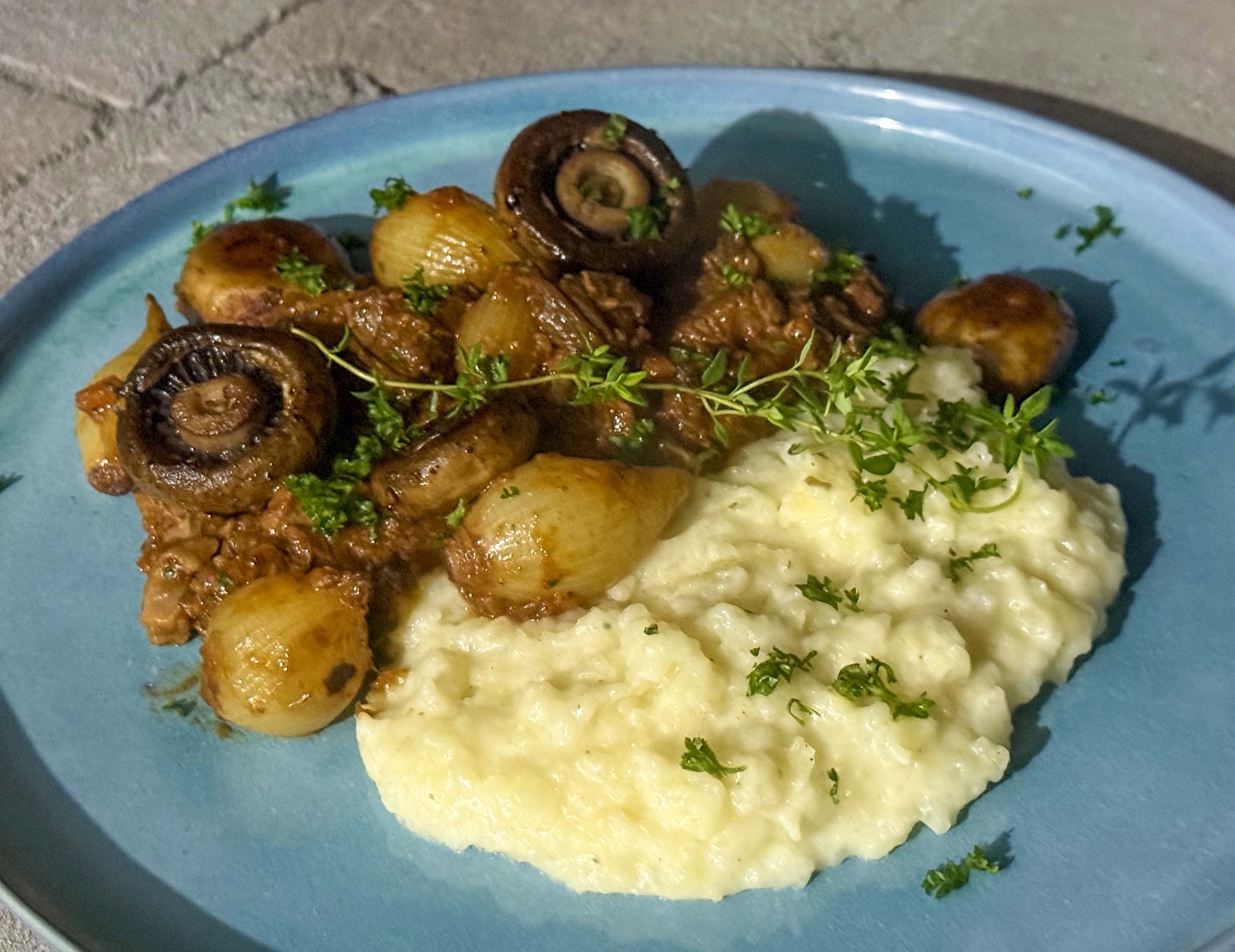
 Tony Jackman’s slightly quicker take on a boeuf Bourguignon. (Photo: Tony Jackman)
 So many of us work at home today that we’re able to organise our days in fresh ways. Unless you have meetings or urgent deadlines, it’s possible to start work early, say, with a view to take a break at 3pm or 4pm to get a stew or casserole going for supper.
That’s where this classic peasant dish comes in.
Boeuf Bourguignon is humble food derived from common sense. The dish was created by peasants in Burgundy in the Middle Ages who used red wine – which was being made there even then – to deal with the toughness of the cheap cuts of beef available to them.
The dish uses cheap cuts of beef, the wine that is made nearby, mushrooms foraged, humble onions, and herbs that proliferate. Some aspects of this will have developed in the ensuing centuries leading to our time, but isn’t it wonderful that a dish can survive the aeons intact and now be known and beloved worldwide?
That’s exactly how we should cook, using what’s right under our noses.
To dine at 7pm you’ll need to get this going by 4pm, but 3pm would be preferable. I often interrupt my workday to get a dish such as this started, then, once it’s simmering gently, get back to work while time and a little heat get the job done and the meat tender.
Because it’s cooking itself, it can be relatively unattended for most of its cook, but do stroll through to the kitchen now and then to give it a gentle stir and check that it’s not catching, or whether the heat beneath the pot needs adjusting.
There is more work to be done later, once you’ve downed tools for the day. The pearl (or baby) onions are cooked separately and added at the end, and the same goes for the mushrooms.
I took a tip from a friend and braised the baby onions in Old Brown Sherry for a lovely bit of winter-warming oomph. And it gives a cheeky touch of South Africa to a French country classic.
This recipe is a tad more refined than it would have been in the Middle Ages when, I imagine, everything would have been shoved into a pot all at once before it went onto a flame to cook while the peasants all went back to toil and till in the fields. Or harvest grapes. Or whatever peasants in Burgundy did in the Middle Ages.
Ingredients
200g bacon lardons (okay, bacon “bits”)
A little flavourless oil
1 onion, halved and then sliced thinly
2 medium carrots, top and tailed, peeled and sliced thinly
3 garlic cloves, peeled and finely chopped
1kg beef short rib or other cheap beef cut, sliced into 3cm cubes (trim and discard fatty parts)
2 heaped Tbsp flour
1 x 750ml bottle decent red wine
2 Tbsp tomato paste
6 thyme sprigs
1 bay leaf, crumbled
For the onions:
14 or so baby onions or 24 pearl onions, peeled
1 bouquet garni of 2 or 3 sprigs each of parsley, rosemary and thyme, tied together with kitchen string
½ cup beef stock
½ cup Old Brown Sherry
Salt and pepper
For the mushrooms:
2 Tbsp butter
250g button mushrooms (whole if small, halved if larger)
2 thyme sprigs
Salt and black pepper to taste
Method
Boil a medium pot of water and plunge the unpeeled baby onions into it. After a minute, tip them into a colander in the sink. Leave them to cool, then slip their skins off and trim the root ends.
For the stew:
Cut rindless bacon (preferably quite thickly cut) into small lardons, or use “bacon bits”. Oil a deep, heavy pan very lightly and fry them off until cooked all over, and keep to one side.
Cube the beef. Make sure that the beef is dry, and brown the pieces a few at a time, being sure that they don’t touch one another in the pan. They must fry, not steam. Remove to a side-dish.
Add a little more oil to the pan. Add your sliced onion (not the small onions) and thinly sliced carrots and sauté, stirring, until the onions are softened. Remove the vegetables to the dish with the beef.
Pour the wine into the pan from which everything has been removed (except those “nasty bits”), and scrape the bottom vigorously with a wooden spoon. Bring to a simmer and let it cook for a couple of minutes.
Add a crumbled bay leaf. Season to taste with salt and pepper. (Go easy, you can always add more salt later.)
Add the beef and vegetables back to the pot.
Sprinkle the flour over the meat and vegetables, give it all a stir, put the lid on the pot, put the lowest heat on under it, and leave it for four minutes. Take the lid off, stir again, put the lid back on and leave it for another 3 minutes.
Now pour the wine and stock into the casserole, stir, and add the tomato paste, chopped garlic, bacon and fresh herbs.
Put it on the hob on a moderate heat and bring it to a simmer. Cook at a moderate simmer for 3 to 4 hours. (Don’t forget to get back to work now.)
For the onions:
Add the beef stock, Old Brown Sherry and bouquet garni to a pot and then add the skinned onions. (They’re in a colander in the sink, in case you’ve forgotten. I forgot this week, and wandered around the kitchen like a headless chicken for five minutes trying to find the blimmin’ onions.)
Season lightly with salt and black pepper. Bring to a simmer and cook gently until most of the liquid has cooked away and the onions are coated in a syrupy glaze. Reserve.
For the mushrooms:
Slice the stems off the mushrooms and discard. Keep the rest of the mushroom whole.
Melt 2 Tbsp butter in a heavy pot and add the mushrooms. Throw in a few thyme sprigs. Cook on a moderate heat, stirring, until they have released their juices and those juices have mostly cooked away. The mushrooms will turn a nutty brown. Reserve.
Serve a generous portion of the stew and spoon onions and mushrooms on top. A side of creamy mashed potato would be perfect. Yes, mine turned out a bit lumpy. It’s not the end of the world. Be sure to spoon the deeply flavourful sauce over too. Garnish with fresh thyme. DM
Tony Jackman is twice winner of the Galliova Food Writer of the Year award.
Follow Tony Jackman on Instagram @tony_jackman_cooks.