



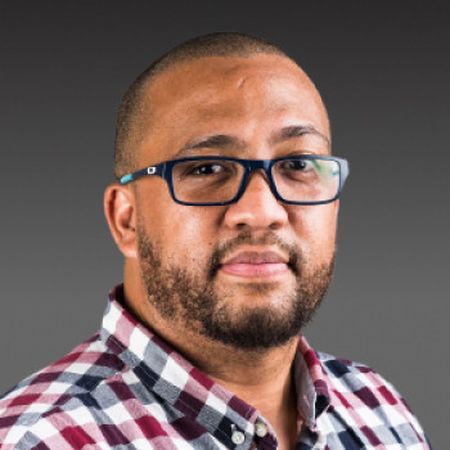
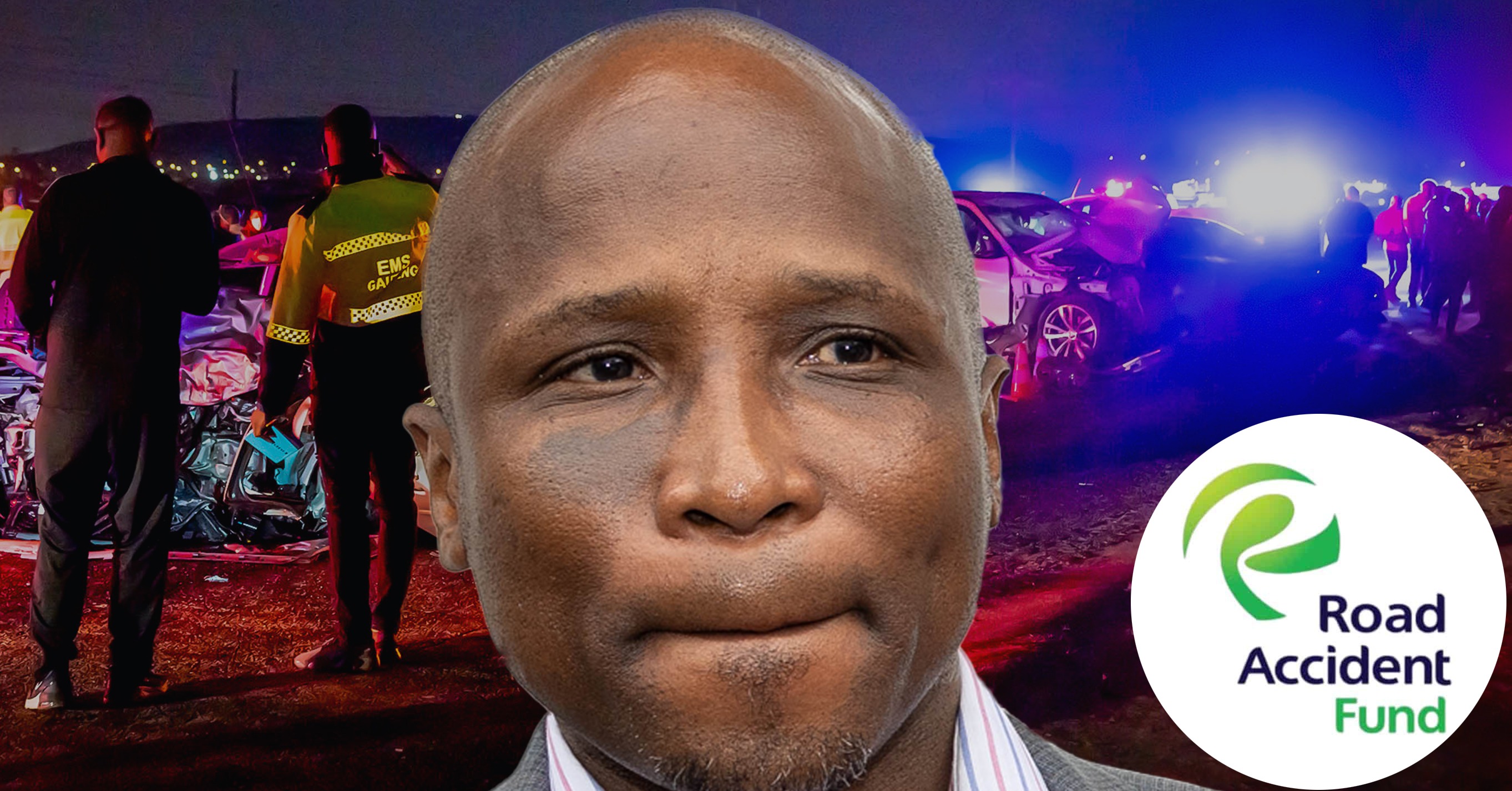
 Illustrative image: Crash on the Golden Highway, south of Johannesburg. (Photo / Shiraaz Mohamed) | Road Accident Fund logo. (Photo: X) | Former RAF CEO Collins Letsoalo. (Photo: Gallo Images / Papi Morake)
We need to go back to November last year to trace the original source of the debate among the Standing Committee on Public Accounts (Scopa) members when deciding whether to lay criminal charges against former Road Accident Fund (RAF) CEO Collins Letsoalo.
Scopa summoned Letsoalo to answer questions about his management decisions on 25 and 26 November 2025, but on the first day, he did not appear. Instead, his legal team, Sithi & Thabela Attorneys, issued a formal demand to the Scopa chairperson (Songezo Zibi) to “cease and desist from [the] unlawful ‘oversight inquiry’”.
They argued that Scopa’s mandate was restricted to financial accountability, while operational and governance oversight of the RAF fell exclusively under the parliamentary transport committee. The attorneys argued that proceeding would violate the audi alteram partem rule (the right to be heard) and declared that Letsoalo had “not received any summons or formal notice”.
Zibi clapped back later that evening, acknowledging the correspondence, but noting that Letsoalo had still failed to appear “as per the summons”.
To eliminate logistical excuses, Zibi directed that the second day of the hearing (26 November) be held virtually, providing a Zoom link for Letsoalo to attend. Zibi explicitly reminded Letsoalo’s attorneys that “in terms of section 17 of the Powers Act, it is a criminal offence for a person who has been duly summoned not to appear without sufficient cause”.
No presence in the present day
As you can probably deduce, the former CEO has still not made contact with Scopa to answer its questions.
The question on the floor is whether to press on with charges. To this end, the core of the debate surrounding the decision to prosecute is the measurement of legal risk, specifically whether the summons was “duly served”. The Speaker of the National Assembly sourced independent legal counsel, who have highlighted the following risk:
Section 14 of the Powers, Privileges and Immunities of Parliament and Provincial Legislatures Act requires a summons to be delivered “to the person mentioned in the summons”.
Because the sheriff could not locate Letsoalo to hand-deliver the document, Parliament used a “substituted service” (read: they sent the summons via email, SMS, WhatsApp, posted it on social media, and fixed it to the gate of an alternate address).
The independent legal advice warned that strict judicial interpretation of the Act might deem substituted service legally defective, presenting a risk that “a prosecution may be unsuccessful”.
That legal risk is somewhat offset by evidence that Letsoalo had actual knowledge of the summons. This is demonstrated by the November correspondence from his lawyers and his public media interviews acknowledging the summons.
Letsoalo was demonstrably aware he was required to appear, and this could support an argument of “substantial compliance” with the Act’s objectives.
Adopting a defensive posture
Letsoalo’s primary defence for non-appearance hinges on his assertion that Scopa lacked jurisdiction. However, Parliament’s legal advisers believe that this is not a sufficient cause for evading a summons.
Their learned position is that Letsoalo was required to either appear and raise these objections on the record, or seek a court interdict to halt the inquiry, neither of which he did.
But Scopa was understandably vexed by the question of whether to accept the measured legal risk or to abandon the charges to avoid potential embarrassment in court.
ActionSA’s Alan Beesley was fast out of the gate, pressing for urgency of action. “Under Mr Letsoalo’s watch, the RAF became a wrecking ball... And I think Parliament, we’re just going to become another talk shop if we don’t act… I think we need to accept that there may be some risk involved.”
ActionSA later released a statement adding that the resolution (the vote to lay charges passed as a “yes” by eight to three) “demonstrates that such conduct carries consequences”.
No answers or resolution
While there is room for debate on the legal case involving Letsoalo’s evasion of Scopa, evidence of his transgressions while in his role as RAF CEO stacks pretty high.
Among the instances of workplace bullying, fabrication of board resolutions and assorted governance failures that were heard by Scopa, it was under Letsoalo’s instruction that the RAF unilaterally changed its accounting standard from IFRS 4 to IPSAS 42 to artificially reduce its recorded liability from more than R300-billion to roughly R28-billion.
He also wasted public funds on a prolonged, hostile legal battle against the Auditor-General of South Africa (Agsa) to defend this policy change, spending more than R20-million in public funds on litigation.
Scopa found that this was fundamentally unlawful, as only the Accounting Standards Board (ASB) – under the Minister of Finance – has the constitutional and statutory authority to determine accounting standards for public entities.
Letsoalo’s persistence in fighting Agsa despite losing multiple court battles plunged the RAF into a state of audited disclaimers and financial illegitimacy. It’s strange, then, that he would not rush to defend his name. DM
Comments
Scroll down to load comments...