




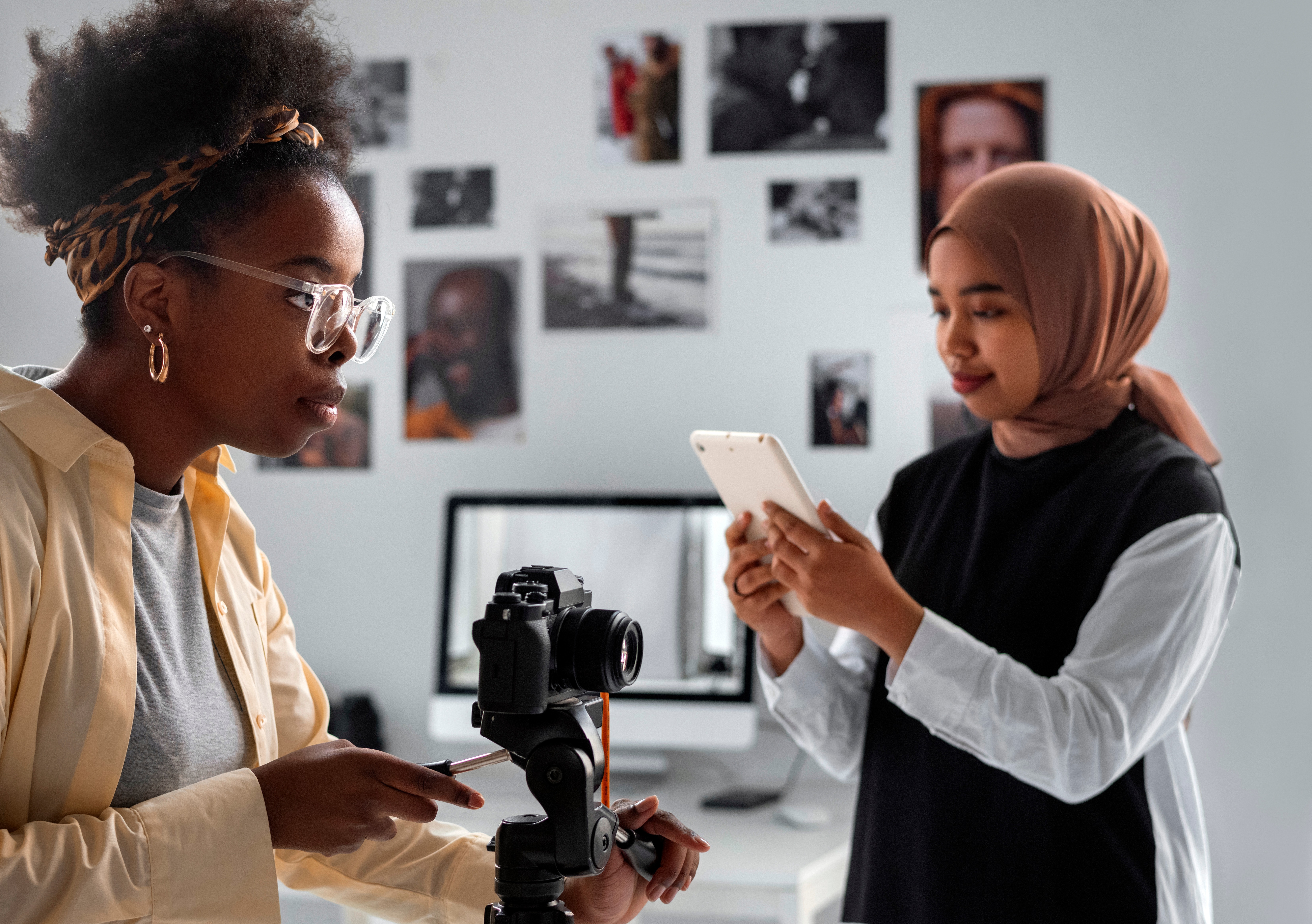
 A new report scrutinises news content creators as they replace traditional news media. (Photo: Freepik)
 /file/dailymaverick/wp-content/uploads/2025/10/label-Op-Ed.jpg)
News media in South Africa are staring down the barrel of an existential threat, and the bullet has already been fired. Many legacy brands that we know and still, despite everything, trust, will almost certainly disappear in the next few years.
This won’t be news (sic) to you, but people who care about being informed, and who realise how fundamental a functioning free press is to the survival of open societies like ours, will be wondering, what comes next?
What comes next is already here. As of September 2024, about one in four people in South Africa get news from individuals rather than organisations. A recent report from the US-based Center for News, Technology and Innovation (CNTI), in collaboration with Code for Africa (CfA), looks at these individuals, variously termed “news creators” and/or “indie info providers” (and more on those terms later).
The report is entitled “South Africa indie info providers: responding to resource constraints with creativity and collaboration” and has some interesting insights gleaned from a survey of 43 “content producers”, and in-depth interviews with 18 of those.
The aim of the report? To understand the backgrounds of news creators, their motivations, relationships with their audiences, revenue streams and strategies, and their sense of their role in the broader news information landscape.
Unsurprisingly, many news creators are building direct-to-audience brands that augment their freelance profiles, and seven of the 11 interviewees who had journalism backgrounds began their indie brands as freelancers.
‘Creators’ vs journalists
They were largely seeking to build their profiles, motivated by the decline in journalism opportunities in South Africa. The whole issue of whether news creators qualify as journalists, or even want to be known as journalists, is revealing. While the term “journalist” resonated with many interviewees, some felt the term was too limited. They see “creatorsˮ as distinct from journalists.
/file/attachments/orphans/ChatGPTImageJun3202607_19_26PMcopy_159174.jpg "A new report looks at news content creators as they replace traditional news media. (Graphic: ChatGPT)")
One of the interviewees articulates the problem of authority.
“I’m a new media creator who talks about the news and delivers news to people, so in a very simple way, I am a journalist. But I do it through wide-ranging media reading and consumption of information. I do lots of online data research… I’m definitely doing journalism, but in South Africa, with our investigative journalists and our frontline beat journalists, it feels odd to put me in that category.ˮ
The urgent question, and one that can perhaps be addressed only by news creators and traditional journalists working collaboratively, is how to usefully move those two modes of production together.
Editorial standards
How do we engineer this new media landscape so that legacy media’s ethical and editorial standards, as well as the whole system of trust-building involving industry bodies and press councils, apply to news creators?
How do we adapt the sometimes hidebound structural imperatives of traditional media to take advantage of the new systems of dissemination and trust that news creators embody?
And crucially, how do we build sustainable, authentic journalism business models for whatever this new thing turns out to be?
The report reveals that news creators are already addressing these questions, and that “they work to build credibility through audience knowledge and interactions, along with traditional journalistic authority, especially through a rigorous process of sourcing, verification and fact-checking”.
We should also probably agree on what we’re calling these new journalists. “Indie info providers” sounds cumbersome, but also risks muddying what we mean by “independent news”.
“News creators” also has its problems, given that news is traditionally not created, but reported.
According to the report, “some South African interviewees consider themselves ‘creators’, but they see this role as distinct from journalism. At least one person sees becoming a creator as largely positive, an opportunity to expand their professional toolkit. ‘I felt like I’d be very limited if I only had journalism as a skill,’ they said. Others are much more negative about the term, like one interviewee who differentiated creators from ‘serious people’ ”.
Fault lines
It’s fault lines like these that the CNTI report surfaces, and it will be interesting to see how the news ecosystem adjusts to accommodate the new ways of conceptualising, defining and doing news. There are also lessons to be learnt in how South African news creators differ from their US counterparts.
Dotted throughout the report are boxes labelled, “What the US can learn from South Africa”, which might strike the more sensitive South African reader as a tad extractive. Reverse engineered, though, these lessons are equally relevant to South African media.
Some examples. South African news creators move fluidly between freelance work and their indie brands, seeing each as creating opportunities for the other. In the US, interviewees turned to both only after losing full-time jobs, and largely see the two as in conflict with each other.
For those of us hoping to see a productive mashup of traditional media and news creators, this would seem to be encouraging for South African journalism.
SA creators’ broader context
Also encouraging is how South African news creators are refreshingly non-parochial.
“Both US and South African interviewees are working to fill gaps left by legacy media, but only South Africans situate their work in a larger global context. This difference likely reflects the varied priorities of Global North and post-colonial audiences.”
This also echoes the finding that SA news creators are “doubling down on local voice and vantage, countering the dominance of foreign and foreign-influenced media”. And in fact, “many see their identity as a key part of their branding. This cohort of interviewees raised concerns about ongoing dependence on foreign coverage, which is short on local stories for local people and tends to be overwhelmingly negative. In response, they see themselves as ‘decolonizing’ local media and offering a ‘solutions mindset’, which are intertwined.”
Fake news, disinformation
The report emphasises that this type of journalistic and ethical rigour is important in South Africa, “where some interviewees see the country as ‘uniquely vulnerable to fake news and bot-led disinformation networks”, because it “has been inundated with online disinformation campaigns from domestic and international actors, increasing concerns about information integrity.”
Ironically, the 2025 Reuters Digital News Report (DNR) shows that independent news creators and influencers also negatively affect online trust by contributing to a fragmented alternative media environment, and are globally perceived as major spreaders of misinformation. This is a friction point that the South African news ecosystem as a whole will need to address. [Disclosure: CfA is a partner on the Reuters DNR.]
Another differentiator is that, unlike their US counterparts, “many South African interviewees have strong relationships with newsrooms. They appear on broadcasts, have their work republished and co-host events.”
They also have “a clearer and more sophisticated sense of their audiences, while US intervieweesʼ knowledge is somewhat more vague. South African indie info providers generally see audience feedback as generative, [and] many interviewees described their audiences as a valuable source of ideas and inspiration. They work to build credibility through audience knowledge and interactions, along with traditional journalistic authority.”
There is a lot more to be gleaned from this rich report, which you can find on the CNTI site. The report is part of a large body of work going on at the moment, as media analysts try to define what news creators are, where they’re headed, and indeed, who they are.
All this data will be essential to how the news ecosystem, in its entirety, grapples with questions of how we can retain traditional values that still remain important, while also maintaining the trust relationship between news producers and news consumers in a very different landscape of news consumption. DM
Chris Roper is a senior strategist at Code for Africa, the continent’s largest civic tech and forensic data analysis nonprofit, with more than 140 full-time staff in 26 African countries.