




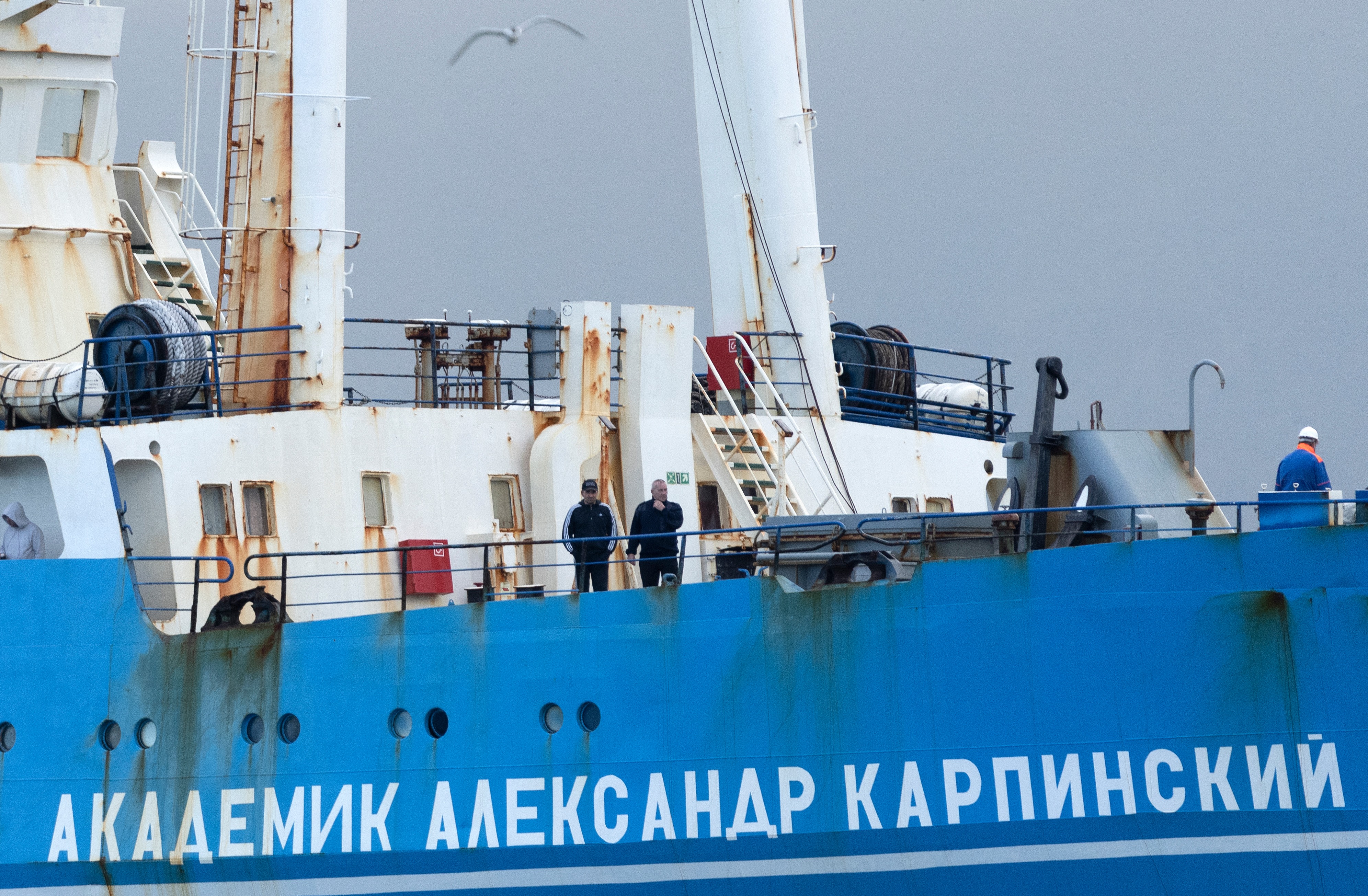
 The Akademik Alexander Karpinsky, a Russian state polar survey ship, returns to Cape Town on 3 April 2023 after an expedition in the Southern Ocean. (Photo: Nic Bothma)
A Russian state ship under US sanctions went to Antarctica and hid its location to look for banned oil and gas, according to explosive evidence uncovered by Daily Maverick.
Buried in a Russian report tabled at Antarctica’s highest diplomatic forum is the missing piece of a three-year “spoofing” mystery: the secretive seismic mission that unfolded along Antarctica’s most geopolitically sensitive coastline – the so-called Unclaimed Sector.
This sector, the only part of the frozen continent not claimed by any country, is also known as the Marie Byrd Land coast where China and Russia announced plans in 2025 to expand their geopolitical footprint.
The Kremlin now admits the survey – led by state mineral explorer Rosgeo – unfolded somewhere in the Antarctic summer months between October 2024 and April 2025.
But Daily Maverick has established through three independent sources that the Akademik Alexander Karpinsky kept broadcasting its location from Baltic and Russian waters during the same summer field season.
The ship, owned by Rosgeo’s Polar Marine Geosurvey Expedition (PMGE), barely moved:
- The ship has “not left Russian waters since May 2024”, the Estonian Navy told us in December 2025.
- St Petersburg is the ship’s only reported location from May 2024 to December 2025, according to 4,800 Automatic Identification System (AIS) pings from AIS Hub.
- The ship’s Marine Traffic port calls since 2015 show its location has stayed in the Baltic Sea after its last recorded return from Antarctica in 2024.
- March 2024 marks the last time the Karpinsky’s location was marked in Antarctica, according to AIS Hub.
- Neither the ship nor its location has matched to Cape Town – its favourite Antarctic gateway – since 2023, according to Marine Traffic.
/file/attachments/orphans/MarineTrafficPortcallsJune1firstslidecopy_757649.jpg "The Karpinsky’s port calls from 2015 to 2026 tell a revealing story: the ship’s location stayed in the Baltic during the 2024-25 summer field season, when Russia now says it was off Antarctica’s Unclaimed Sector. (Screenshot: MarineTraffic.com)")
/file/attachments/orphans/MarineTrafficPortcallsJune1secondslidecopy_121339.jpg "The Karpinsky’s 2015-26 port calls include two records for Estonia in 2025 and 2026. (Screenshot: MarineTraffic.com)")
That means the US-sanctioned ship was supposedly in the Baltic – and even in Estonia, where it is also banned under EU Ukraine war sanctions – while doing seismic surveys in Antarctica about 18,500km away at the very same time.
A more likely explanation?
The ship appears to have outwitted the Estonian Navy and faked its location data while covertly prospecting the Unclaimed Sector seafloor – a banned activity under the Environmental Protocol to the Treaty.
Oil and gas surveys off the Unclaimed Sector
Moscow tabled its newly disclosed report on Russia’s 2024-25 “scientific research” activities at the closed Antarctic Treaty talks that wrapped in Hiroshima, Japan, on 21 May 2026.
The five-page document betrays a remarkable admission in a single paragraph.
“Marine geophysical work,” it says, “was carried out from the [Research Vessel] Akademik Aleksandr Karpinsky on the test site between the Amundsen and Ross seas and on the test site in the Bellingshausen Sea.”
Professor Alan Hemmings, awarded the New Zealand Antarctic Medal by King Charles on 1 June, told Daily Maverick that the Hiroshima wording confirms the Karpinsky was operating off unclaimed Marie Byrd Land, which faces the Pacific Ocean.
“This ‘test site between the Amundsen and Ross seas’ is therefore off the Unclaimed Sector,” Hemmings, of New Zealand’s Canterbury University, remarked after reviewing the Russian Treaty document.
In plain language, the revelatory paragraph also means that:
- The Bellingshausen Sea lies below South America, west of the Antarctic Peninsula.
- The ship was mapping these seafloors, among the remotest in Antarctica, in detail.
The paragraph includes a dry, routine checklist: “Seismic work, differential magnetic and gravitational observations, multibeam echo sounding.”
These are the very “geophysical” methods that Rosgeo’s PMGE subsidiary firm has explicitly linked to oil and gas prospecting in the Unclaimed Sector – or the “Pacific Sector”, as the firm puts it in its expedition diaries.
/file/attachments/orphans/KarpinskyUnclaimedSector2019copy_355896.jpg "The Karpinsky’s seismic surveys off the Unclaimed Sector from February to March 2019. (Screenshot: PMGE)")
The race for Antarctica’s unclaimed frontier
Seven polar powers have carved the continent into vast territorial pie slices – some of which outstrip the size of Greenland by a factor of three.
“Semi-claimant” states Russia and the US have historically reserved the right to make future claims – but no state can own Antarctic land as long as it remains a member of the Treaty and the pact stays in force.
These historic claimant positions have turned the Unclaimed Sector into something of a geopolitical fault line:
- In March 2025, ABC Australia reported that China had declared plans to build a summer research base here – giving Beijing the only annual presence in the sector.
- Later that month, Daily Maverick revealed Russia’s plans to expand its long-dormant Russkaya base for year-round occupation. The 46-year-old base’s reported plans would include new research facilities and a landing strip for long-haul aircraft.
Indeed, in a 14 March 2026 Facebook post, the Russian embassy to South Africa claimed that “the little-explored areas of the Pacific sector of Antarctica” were “one of the main scientific tasks” of the Russian Antarctic Expedition from 2026 to 2028. The tasks are laid out in a 7 March Kremlin order that aims to “strengthen” Russia’s position in Antarctica within the next two years.
Barely a month later, a Wall Street Journal opinion article by the CEO of a space-telco firm urged US President Donald Trump to claim Marie Byrd Land. Daily Maverick also revealed that former Australian Prime Minister Tony Abbott sits on the board of Irish businessman Declan Ganley’s space-telco firm, Rivada Networks. Wrongly arguing that the Treaty allowed new claims, the Rivada Networks-backed proposal alarmed Antarctic experts and pushed a fringe territorial debate into mainstream politics.
“I imagine this Karpinsky activity off Marie Byrd Land has contributed to the paranoia about what Russia and China are really up to with their station plans there,” says Hemmings, an Antarctic geopolitics expert who coined the term “semi-claimant”.
Hemmings has flagged the ship’s “prospecting” activity in media interviews as well as peer review.
/file/attachments/orphans/GF10000143332_259356.jpg "Tony Abbott delivers a lecture on common security challenges during a June 2015 visit to Singapore as Australian prime minister. Picture shot through a video camera's viewfinder. (Photo: REUTERS / Edgar Su)")
How Russia’s Antarctic ghost ship vanished from tracking systems
The Environmental Protocol’s “Article 7” mining ban outlaws “any activity relating to mineral resources, other than scientific research”. It maintains that PMGE’s mineral sorties, which have sailed via Cape Town and South American ports since the ban entered into force in 1998, is legitimate science.
The spoofing controversy creates an obvious problem for that defence: scientific research usually benefits from transparency. Ships searching for something they do not want others to see often do not.
After this ship sparked Cape Town environmental protests and world headlines during the 2022-23 Antarctic season, PMGE’s website stopped reporting on the Karpinsky’s movements despite Treaty rules about transparent scientific exchange.
/file/dailymaverick/wp-content/uploads/2023/01/Russia-Karpinsky-ship-06.jpg "Extinction Rebellion, Greenpeace and other activists protest against the arrival of the Karpinsky in Cape Town, January 2023. (Photo: Shelley Christians)")
In February 2024, the US State Department – the Antarctic Treaty depositary – placed the ship under energy sanctions.
Then came the “spoofing” incidents:
- February 2023: The ship seemed to head from Cape Town to Tallinn, the Estonian capital. It was actually sailing to Antarctica.
- September 2024: Estonian news reported that the Karpinsky seemed to be in Tallinn. Maritime Division director Kristjan Truu told Daily Maverick: “We can confirm that this is an example of spoofing.”
- December 2025: “We confirm that the aforementioned vessel is not in Estonian ports, waters or maritime area of responsibility,” the Estonian Navy told us when the Karpinsky seemed to be back in Tallinn on 3 December. “According to our surveillance data, it has not left Russian waters since May 2024.”
/file/dailymaverick/wp-content/uploads/2024/09/48d7559c-dcf6-4439-a4b4-50f92e87d0de.jpg "Due north? The Karpinsky leaves Cape Town for Antarctica at about 9.28am Pretoria time on 1 February 2023. Its reported destination? Tallinn. (Screenshot: MarineTraffic.com)")
/file/dailymaverick/wp-content/uploads/2024/09/Karpinsky-Antarctica-screenshot.jpg "Due south: The Karpinsky’s actual destination to Neko harbour, West Antarctica, at about 10.49am Pretoria time on 1 February 2023. (Source: Marinetraffic.com)")
On 25 March 2025 – the same day that Russia announced plans to revive Russkaya base in the Unclaimed Sector – we contacted the Antarctic Treaty Secretariat with questions about irregular shipping notification lists.
The summer season was almost over. Why, we asked, had the Karpinsky vanished from – and then resurfaced on – the “pre-season” rather than “annual season” list?
Then-Treaty executive secretary Albert Lluberas offered a cryptic explanation.
Lluberas replied by email. He stressed that advanced notification reporting was voluntary and dependent on states themselves.
/file/dailymaverick/wp-content/uploads/2024/05/Karpinsky-screenshot-May-2024.jpg "The Karpinsky’s actual position on 28 May 2024 as it returns via South America to St Petersburg after its last observed Antarctic mission earlier that summer season. (Screenshot: MarineTraffic.com)")
Smoke and mirrors
During a May 2019 gathering at PMGE’s St Petersburg headquarters, about 50 of the firm’s employees and associates met in the so-called Mirror Hall to unpack the results of that season’s February to March “geological and geophysical” expedition off the Unclaimed Sector.
The Mirror Hall gathering discussed the season’s objective – the “assessment of the mineral resource potential of the subsoil of Antarctica and its marginal seas”. As it turns out, the minutes from the St Petersburg meeting are a mirror image of the Hiroshima disclosure on the Karpinsky’s 2024-25 “scientific research” activities:
- Mirror Hall minutes, 2019 season: “Marine geophysical surveys in the Pacific sector of Antarctica were conducted between the Amundsen and Ross seas. These included seismic surveys using the common depth point method, differential hydromagnetic and gravimetric surveys, and multibeam echo sounding.”
- Hiroshima disclosure, 2024-25 season: “Marine geophysical work (seismic work, differential magnetic and gravitational observations, multibeam echo sounding) was carried out from the [research vessel] ‘Akademik Aleksandr Karpinsky’ on the test site between the Amundsen and Ross seas...”
/file/attachments/orphans/StructuralTectonicSchemeofthePacificAntarcticcopy_783764.jpg "A PMGE rendering described as a “structural-tectonic diagram of the Pacific sector of the Antarctic between the Amundsen and Ross Seas”. (Screenshot: PMGE)")
Daily Maverick reviewed Treaty records and PMGE’s expedition diaries between 2001 and 2026. The evidence chain flushes out that:
- Using the Hiroshima-disclosed techniques, the Rosgeo firm has repeatedly admitted searching for oil and gas through much of Antarctica’s Southern Ocean almost annually since 1998.
- Its documented, specific interest in the seafloor off the Unclaimed Sector emerges in its expedition diaries from 2018 up to the current moment, yielding nearly 20 diary references to assessing the sector’s “oil and gas potential” – or the “potential” of “hydrocarbons”, “mineral resources” and “raw materials”.
- Official Treaty records confirm that the Karpinsky visited the Unclaimed Sector not only in 2018, but returned in 2019 and 2023. The 2024-25 expedition is also listed among these records, even if the Hiroshima disclosure would only unveil the Unclaimed Sector as the actual survey target area as late as the 2026 talks.
- Thus, the Kremlin’s mineral explorer has despatched at least four annual expeditions to the Unclaimed Sector since 2018.
- In some years leading expeditions to other parts of this protected wilderness, PMGE’s own dossier of reports concedes return visits to Antarctica every year since 2018.
- And yet, for 2026, there has been no sign of the Karpinsky on the Treaty’s national non-military ships list – the ship has instead showed up in a port it cannot visit: Tallinn.
/file/attachments/orphans/KarpinskyTallinn2Junecopy_508836.jpg "As captured on 1 June 2026, the Karpinsky’s fake location in Tallinn – from which it is banned – suggests it arrived in the Estonian capital on 11 May. (Screenshot: MarineTraffic.com)")
And years of intensified surveying have led to larger estimates of Antarctic deposits:
- The Rosgeo firm’s 2010 report had previously estimated Antarctic oil and gas at roughly 50 billion tons.
- In 2020, Rosgeo’s Cape Town harbour statement claimed the ship had zeroed in on 70 billion tons (500 billion barrels) of potential oil and gas “resources” off East Antarctica.
Scaling the petrostate ladder
The records betray the promotion of prospecting personnel to the top echelons of the Russian Antarctic Expedition (RAE) – Moscow’s state programme for the region.
Promoted to head the RAE from April 2023, former PMGE director Pavel Lunev also surfaced as a member of the Russian delegation who vetoed emperor penguin protections at the Treaty’s June 2025 Milan talks. At the October 2025 fisheries talks, he re-emerged as an adviser on the delegation who vetoed a marine protected area off the Antarctic Peninsula, where the firm had led six oil, gas and mineral surveys in the counterclaimed Weddell Sea region since 2011. It was at this meeting that Kyiv claimed Russian authorities had arrested Ukrainian delegation member Leonid Pshenichnov for “threatening” Moscow’s Antarctic oil and krill interests.
Lunev told Daily Maverick that the firm’s surveys – which sail to the Far South under the RAE’s flag – were nothing but ordinary science, yet he had personally delivered the “marine work” presentation to the Mirror Hall audience, and signed off the firm’s prospecting reports.
/file/attachments/orphans/PavelLunevMirrorHallcopy_493013.jpg "Then-PMGE director Pavel Lunev – now head of the Russian Antarctic Expedition (RAE) – delivers a presentation in the Mirror Hall, PMGE headquarters, St Petersburg, 16 May 2019. (Photo: PMGE)")
/file/attachments/orphans/PavelLunevselfiecopy_835844.jpg "An 8 July 2022 selfie on PMGE’s VKontakte social media channel shows Pavel Lunev with attendees at a seminar in St Petersburg about the firm’s work. (Photo: PMGE)")
“Our polar explorers conduct their work guided by the principles and requirements of the Protocol on Environmental Protection to the Antarctic Treaty,” Lunev insisted in a RAE statement after the Milan 2025 talks. “Every step of the expedition is carefully considered to minimise impact on the continent’s fragile ecosystem.”
Either way, regardless of where Rosgeo’s “Flying Dutchman” may or may not be at any given mystifying moment in space-time, the intention of the “scientific” surveys, PMGE’s reports note, is to “increase Russia’s presence” and “reflect the geopolitical interests of Russia in this region”.
We received no responses from Rosgeo and the RAE to our latest set of questions about potential prospecting and spoofing activity.
A frozen treaty under fire
Towards the end of May, the Hiroshima meeting wrapped with a whimper.
Not one state tabled a document on the Karpinsky’s known years-long surveys – nor its documented spoofing activity.
The theatre, instead, has taken place outside the Treaty hall. For example, the UK’s December-issued Antarctic strategy includes a chapter dedicated to countermining measures – triggered largely by concerns over the Karpinsky’s expeditions. In February 2026, US Senate Foreign Relations chair Jim Risch publicly accused Russia of violating Antarctic law but has not responded to Daily Maverick’s repeat questions on why Washington lacks an Antarctic countermining strategy.
Can the Treaty still be enforced if powers avoid challenging Moscow?
Klaus Dodds, professor of geopolitics at Middlesex University, London, testified to Westminster on Rosgeo’s survey activities.
He now notes that “Russia is a challenging Antarctic Treaty partner and one thing is clear. They like drilling – whether penetrating the sub-glacial Lake Vostok or plotting to survey and drill elsewhere in the Antarctic. What is less clear is whether they understand Article 7 of the Protocol in the same way others do.”
/file/dailymaverick/wp-content/uploads/2025/06/Pavel-and-the-penguins.jpg "RAE Head Pavel Lunev with the Russian delegation at the Treaty's 2025 Milan talks, posing in front of a life-size image of emperor penguins. In recent years, the Chinese and Russian delegations have vetoed the penguins' rescue plan. (Photo: AARI press statement)")
/file/attachments/orphans/RussianATCMdelegation2026copy_158833.jpg "The Russian delegation that tabled the “scientific research” report at the Treaty's 2026 Hiroshima talks. (Photo: AARI statement)")
South Africa has, for the most part, argued the science and the surveys are as pure as the driven snow.
Asked onboard the SA Agulhas II in May 2025, now-fired South African environment minister Dion George was more direct: “You’re not supposed to go and mine in Antarctica – so why are you looking for oil and gas?” DM


Comments
Scroll down to load comments...