



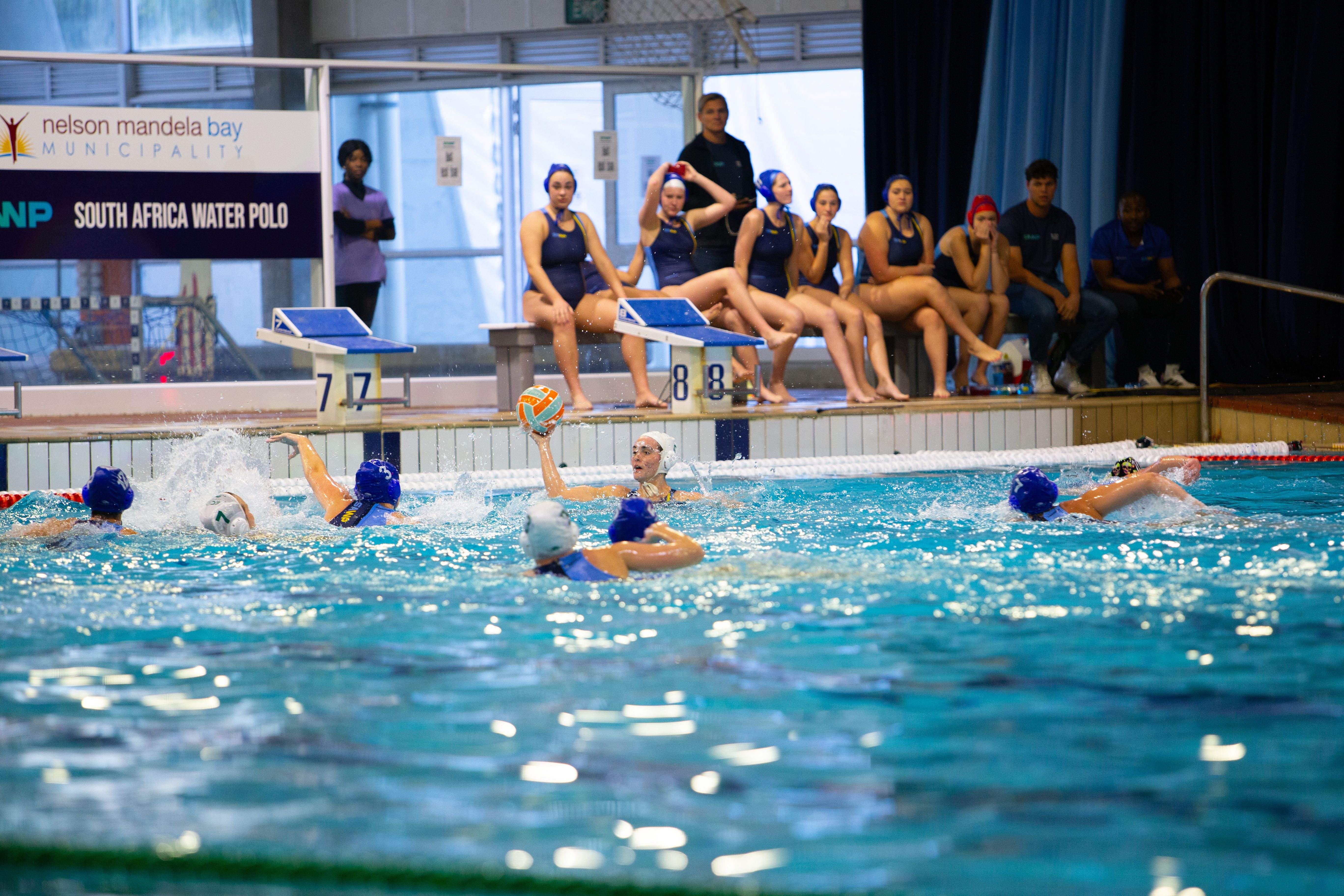
 The inaugural South Africa Water Polo (SAWP) Winter Series held in Gqeberha from 8 to 10 August is one of several tournaments the alternative aquatics body has hosted since its formation in 2025. Now, SAWP and Swimming South Africa are working towards unifying the sport through a partnership. (Photo: Ray Tutter)
 Following months of public disputes and an increasingly fractured water polo community, Swimming South Africa (SSA) and South Africa Water Polo (SAWP) have officially held a formal meeting regarding the future structure and governance of water polo in South Africa.
This is according to SSA in a statement issued on 1 June. The meeting was held on 28 May between representatives of the two bodies in an effort to work collectively towards unifying the sport.
“The meeting highlighted the shared commitment of both parties to place athletes at the centre of all future developments and to work collectively towards unifying the sport of water polo in SA,” the statement read.
SAWP echoed the sentiment in its own statement, issued on 2 June, confirming that the meeting had been “constructive”.
“The discussions were positive and focused on the Memorandum of Understanding SAWP had submitted to SSA, to identify a sustainable framework that serves the best interests of athletes, coaches, officials, clubs and the broader water polo community,” SAWP’s statement read.
/file/dailymaverick/wp-content/uploads/2025/03/TL_1550464-1.jpeg "Swimming South Africa CEO Shaun Adriaanse. (Photo: Steve Haag / Gallo Images)")
A potential new model for water polo
At the centre of the discussions was how water polo in SA should be run and structured. Currently, SSA remains the recognised federation under World Aquatics, and the only body able to select national teams and award colours.
SAWP has consistently maintained that the body does not seek to replace SSA, but rather to work alongside it in “peaceful coexistence”. The alternative body affirmed this stance once again in the meeting.
“South African Water Polo reaffirmed its recognition that there can only be one nationally recognised federation affiliated to World Aquatics and the South African Sports Confederation and Olympic Committee,” said SSA’s statement.
However, SA’s national aquatics body operates five primary aquatics disciplines – swimming, open water swimming, water polo, diving and artistic swimming – and SAWP argued that water polo had unique needs that required a specialised administration.
The current model under SSA has struggled with administration, transformation and elite preparation.
SAWP expanded on SSA’s statement, stating that SAWP proposed a formal partnership model in which SSA remained the recognised national federation, but delegated almost all operational responsibility for water polo to SAWP.
“The discussions centred on a model in which SAWP would continue to manage and operate the sport of water polo on a day-to-day and operational basis, while SSA would maintain its relationship with World Aquatics and fulfil its responsibilities as the recognised national federation,” said SAWP’s statement.
This sits in line with the Memorandum of Understanding SAWP submitted to SSA in 2025. The proposal is built around international models used in countries such as the United States, Canada and Australia, where water polo has a dedicated governing body while remaining connected to the broader aquatic federation for international representation.
Thus, both parties were also exploring the constitutional provisions that would allow for a single integrated water polo formation within Swimming South Africa, said SSA’s statement.
“Both parties agreed that a unified approach would significantly strengthen athlete development pathways, participation structures, governance, and high-performance outcomes within the sport,” the SSA statement read.
/file/attachments/orphans/Timeline_349642.jpg "Timeline of the key events that have unfolded since South Africa Water Polo' s inception in early 2025. (Graphic: Annemieke Thomaidis)")
From conflict to cooperation
More than a year ago, a group of disillusioned coaches, referees, administrators and players decided that they had had enough of SSA’s poor running of water polo.
They formed their own body, SAWP, which Judge Judith Cloete affirmed in a high court ruling on 18 June 2025 had the right to exist.
Nevertheless, SSA has maintained that SAWP remains an unaffiliated organisation, and what has followed has been a string of public and legal disputes.
As recently as March, SSA accused SAWP of victimising and pressuring athletes into boycotting SSA teams and events.
SAWP chief executive Robbie Taylor strongly rejected the accusations.
“SAWP has not been contacted by any sports integrity body, nor have we received any formal complaints regarding athlete victimisation,” he said. “SAWP is a voluntary organisation built on the principles of community, transparency and the love of the game.
“We strongly encourage freedom of choice and have explicitly communicated to our members that we do not ban or victimise anyone for their decisions.
“We simply advocate for fair selection processes, proper administration and high standards, trusting the community to support the structures that best serve the sport’s long-term future.”
To date, SAWP has more than 2,000 registered members and beyond the in-water events it has organised, it now runs the Western Cape, KwaZulu-Natal and Nelson Mandela Bay men’s and women’s water polo leagues, and all the Masters water polo programmes in SA, according to Taylor.
In addition, SAWP and Schools Water Polo South Africa recently announced a partnership to strengthen the talent pipeline.
“Our rapid growth is a testament to athletes, parents and coaches actively seeking a professionally administered sporting environment,” said Taylor.
/file/attachments/orphans/SAWP_04_850361.jpg "South Africa Water Polo has more than 2,000 registered members and outside of the in-water events it has organised, it now runs the men's and women's water polo leagues in the Western Cape, KwaZulu-Natal and Nelson Mandela Bay, as well as all Masters water polo programmes in South Africa. (Photo: Ray Tutter)")
While this is a positive development for water polo in the country, the constant conflicts and back-and-forth accusations have caused a divide in the community and created uncertainty around governance and athlete pathways.
Without the cooperation of these administrative bodies, water polo will continue to suffer.
What happens next?
No formal agreement has yet been reached as the SSA Board still needs to consider the proposal.
“SAWP understands that these discussions are subject to consideration by the SSA Board, which is scheduled to meet this month,” said SAWP’s statement. “SAWP looks forward to receiving feedback from that process and remains committed to engaging constructively and in good faith with SSA.”
In the meantime, SAWP would consult with its stakeholders and the wider water polo community once the relevant processes had been concluded.
“SAWP remains committed to a positive and unified future for water polo in SA,” said SAWP. “However, SAWP was founded because the water polo community could no longer continue to function effectively under the previous structure, and substantial improvements have already been made by SAWP.
“SAWP will therefore continue to apply its time, energy and resources toward securing the best possible outcomes for athletes and the long-term development of the sport.”
SSA CEO Shaun Adriaanse similarly reiterated the “importance of compliance, transformation, and the development of a uniquely South African solution that promotes unity and long-term sustainability for water polo in the country”.
Significant hurdles still remain, but the willingness to work together is a major step forward for the water polo community. DM