




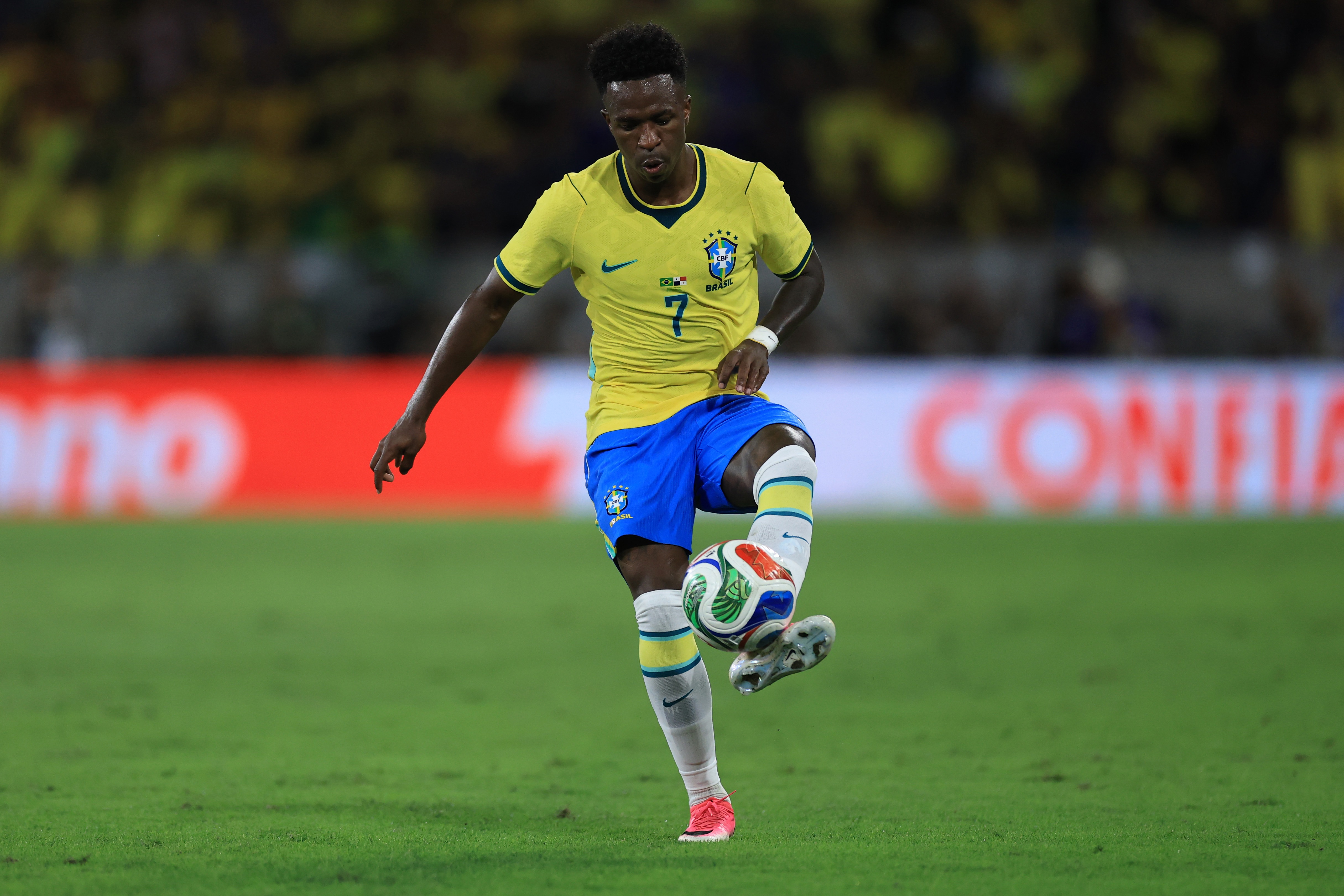
 Vinícius Júnior will be a key player for Brazil at the World Cup. (Photo: Buda Mendes / Getty Images)
 Brazil
The plan
Brazil went on a true rollercoaster ride to reach the 2026 World Cup. There was a political crisis within the Brazilian Football Confederation (CBF), which led to a change in its presidency. On the pitch, it was just as bad, if not worse. It was the country’s worst qualifying campaign yet with defeats in Argentina, Colombia, Uruguay, Paraguay and Bolivia, as well as a historic home defeat – a first in World Cup qualifying – to Lionel Messi and co.
After the 4-1 reverse in Buenos Aires in March 2025, head coach Dorival Jr was sacked and there were even fears Brazil would miss the tournament. However, the South American qualifying – with six direct spots for 10 teams – is extremely forgiving and there was renewed hope, not only for qualification, but for the actual tournament, when Carlo Ancelotti was appointed in May.
Brazil go into the World Cup with the intention of playing a 4-2-4 formation, which has been Ancelotti’s preferred tactical setup since his arrival. However, the Italian has lost several important players to injury, such as Eder Militão, Rodrygo and Estêvão. “Considering the players we have at our disposal, we believe the best model of play for us is to go with four up front,” Ancelotti said in March.
In this system, the defensive midfielders have to support the defence. The lack of high-level full-backs is a concern, especially for a country long accustomed to players such as Cafu, Roberto Carlos, Marcelo and Dani Alves, among others.
The question of whether Neymar would make the World Cup dominated the build-up to the squad announcement, and in the end, the 34-year-old Santos forward had done just enough to get a place in Ancelotti’s 26-man squad. “We realised that in this last period he had continuity and was in good physical condition,” the coach said.
He is unlikely to start, though and, without a true No 9, Ancelotti’s Brazil showed in the friendlies against France and Croatia in March that they would rely on counterattacks and pace, exploiting the potential of Vini Jr, much like Ancelotti did so successfully during his second spell at Real Madrid.
/file/attachments/orphans/GettyImages-2278911734_981456.jpg "Brazil head coach Carlo Ancelotti. (Photo: Buda Mendes / Getty Images)")
The coach
Carlo Ancelotti has won everything – and in every possible way – throughout his career as a club manager. He is one of the most successful managers ever and has won a record five Champions League titles. Now, at the age of 66 – he turns 67 the day before the World Cup starts – he has embarked on a whole new adventure.
“Coaching Brazil is highly motivating,” he told Estadão in 2025. “I believe this is one of the most important moments of my career.” The start to life in Brazil was not easy because of injuries to key players, defeats against Bolivia, Japan and France and the very strong pressure to select Neymar. But the likeable Italian seems as unruffled as always. “I’m not obsessed with winning,” Ancelotti told The Guardian in May. “What I have is a passion for enjoying the moments that football has given me.”
Star player
Vini Jr’s status as one of the best players on the planet is indisputable, but he has, so far, never managed to replicate his Real Madrid performances with the Brazil national team, where he has, at the time of writing, played 47 matches, scoring just eight goals and providing seven assists. This is his chance to change that narrative as he will wear the historic No 10 shirt and be the team’s star at the 2026 World Cup. “If Vinicius is focused on the game, focused on his football, he is the best in the world,” Casemiro told the newspaper As in 2025. “In that way, he is the best. But that’s not easy, because he is constantly provoked.”
One to watch
Endrick needed to take a step back to move two steps forward. Overlooked at Real Madrid by Xabi Alonso, he was loaned to Lyon in January and rediscovered his form, making 12 goal contributions in 17 Ligue 1 games. Carlo Ancelotti did not hesitate to call him up in March, and against Croatia, having come on as a substitute, he proved the impetus as the Seleção came from 1-0 down to win 3-1. He may not be in Ancelotti’s starting XI at the start of the tournament, but be not surprised if he is later on.
Unsung hero
During Arsenal’s climb to the top of the game in England and Europe, Gabriel Magalhães has established himself as one of the best centre-backs in the world. At the World Cup, much will be made of the performances and probable goals from Raphinha and Vini Jr or even Alisson’s saves, but all of that will count for nothing if Gabriel does not hold the defence together. “When you talk about the Brazilian national team, you have to work every day, work at your club so you can arrive here in top form,” Gabriel said in 2025. “I know I’m doing very well, but I also know the level I can still reach.”
What to expect from fans at games?
This World Cup will not feel like playing away for Brazil. According to the government, more than 2.8 million Brazilians live in the United States, most of them in the New York and Miami regions, where Brazil will play two of their three group games. In addition, many fans, possibly as many as hundreds of thousands, are expected to travel to North America for the tournament. The supporters’ group Movimento Verde Amarelo will be present and has the backing of fan groups from 40 Brazilian football clubs. This should make venues such as MetLife Stadium and Hard Rock Stadium feel as close as possible to the Maracanã.
/file/attachments/orphans/GettyImages-1732516091_456717.jpg "Neymar Jr was a popular selection for the tournament. (Photo: Pedro Vilela / Getty Images)")
Relationship with the US/Trump?
The players and the CBF are staying well out of politics for this World Cup, but Brazil and the US had a disagreement in March when President Luiz Inácio Lula da Silva said he had “forbidden” one of Donald Trump’s advisers from visiting the South American country. That was in retaliation for his health minister being denied a US visa. The two met recently at the White House and, while Trump said discussions had been “very good”, the two governments do not agree on key issues such as crime and trade. By Gustavo Faldon
Haiti
The plan
Haiti’s qualification for the 2026 World Cup is one of the most inspiring stories of a football generation. More than a sporting achievement, the Grenadiers’ success represents an extraordinary human triumph forged through adversity, sacrifice and resilience.
At a time when the country continues to grapple with deep political instability and a relentless security crisis, the national team had to play every qualifying match away from home, deprived of the passion and energy of its own supporters. Yet even in exile, they refused to break. Against all odds, they carried the hopes of an entire nation and secured Haiti’s return to the World Cup stage for the first time since the legendary squad of 1974.
The French head coach, Sébastien Migné, has created a fierce and disciplined side built on intensity, tactical organisation and rapid transitions. They are now able to defend with discipline before bursting forward in dangerous counter-attacks. The experience and composure of leaders such as Duckens Nazon, Frantzdy Pierrot and Ricardo Adé give the squad a crucial balance during decisive moments.
Haiti reached the World Cup by first finishing second to Curaçao in Concacaf group C and then winning their third-round qualifying section with key victories against Costa Rica and Nicaragua, establishing the Grenadiers as one of the Caribbean’s most respected football nations.
The Frenchman has shaped Haiti into a modern, vertical transition-based side. His 4-4-2 uses attacking full-backs for width and crossing, often shifting into a 4-2-3-1 in defence as the striker drops deeper to create overloads in midfield. If the midfielders hold their discipline when the full-backs push forward, the system gives Haiti a strong platform to compete. Recent results suggest it is working.
Migné has never been one to hide his ambition. “In one match, anything can happen. The idea is to write a new story with these players,” the coach said before a tournament where his team will face Brazil, Scotland and Morocco.
He then told Fifa.com: “We’ve been handed a tough group … but looking on the bright side, we’ll certainly be in the limelight, which is a tremendous reward for the boys. We’ll now have to go out there and prove that we’re up to the challenge.”
Key players are Johny Placide, the veteran who holds the defence together; Jean-Ricner Bellegarde, who is the midfield engine and Wilson Isidor, the main threat going forward with his pace, movement and technical ability.
/file/attachments/orphans/GettyImages-2279525514_700007.jpg "Duckens Nazon is expected to be Haiti’s star player. (Photo: Megan Briggs/Getty Images)")
The coach
After being appointed in June 2024, Sébastien Migné has become far more than a head coach: an architect behind the nation’s remarkable football revival. A former assistant to renowned manager Claude Le Roy, the French tactician sharpened his experience with African national teams, including Congo and Kenya, before taking charge of the Grenadiers.
Arriving during one of Haiti’s most difficult periods, Migné quickly brought discipline, unity and belief back into the squad. He has never set foot in the country. “It’s impossible because it’s too dangerous,” he told France Football magazine. “I usually live in the countries where I work, but I can’t here. There are no more international flights landing there.”
Star player
With the explosive Duckens Nazon leading the charge, Haiti’s national team is daring to dream big ahead of the World Cup. The prolific striker has become far more than a goalscorer, embodying the passion, resilience and pride of a nation that breathes football.
The build-up to the tournament has not been smooth, as he plays his club football in Iran.
“I was about to take a plane to go to Istanbul or Paris, then the steward told everybody to get off because the war had started,” he told the BBC. “I was stuck at the border for maybe 48 hours. They refused me, sent me back to Iran, and I slept at the border. But I was so lucky because, before the war started, I bought an eSIM. After that, they cut the internet in Iran. The eSIM saved my life.”
One to watch
Still largely unknown to the global football public, the 24-year-old Ruben Providence could emerge as one of Haiti’s breakout stars at the World Cup. Quick, fearless, and dazzling in one-on-one situations, the young winger possesses the kind of explosive creativity capable of changing a match in seconds. Born in France, he came through some of Europe’s biggest clubs, spending time at PSG and Roma before finding stability with Almere City in the Dutch second division, where he is turning heads with his technical flair, sharp movement and confidence under pressure.
Unsung hero
Often overshadowed by flashy forwards and headline-grabbing stars, Danley Jean Jacques remains an indispensable engine of Haiti’s national team. Tireless in midfield, he breaks up attacks, dictates tempo and brings balance with a quiet efficiency that rarely gets the spotlight it deserves. Not always spectacular, but absolutely vital, he plays his club football at Philadelphia Union, whom he joined from Metz in 2024. “Changing countries and discovering a new culture forces you to step out of your comfort zone,” he told the club website. “I’ve had to take on more responsibilities and grow as a person. I’m calm, respectful, a good listener, and quite reserved. As a teammate, I’m always there for the team, to defend the club’s colours and represent our fans.”
What to expect from fans at games?
Fans attending Haiti’s matches at the World Cup should expect an atmosphere charged with raw emotion and pride. From Port-au-Prince to Miami, Haitians are preparing to flood stadiums and watch parties dressed in blue and red, transforming every match into a celebration of national identity. Despite insecurity, economic hardship and electricity shortages back home, supporters remain determined to stand behind the Grenadiers as one people. The Haitian diaspora is expected to bring energy, drums, chants and passion to the stands.
Relationship with the US/Trump?
One controversy has sparked outrage far beyond football. Under travel restrictions tied to the Trump administration, many Haitians without existing US visas may be unable to support the Grenadiers in America. While Fifa president Gianni Infantino promised that “fans from all over the world will be welcome,” the US State Department has confirmed that no special exceptions would be granted for Haitian supporters. Ticket prices are another problem. “We are happy Haiti is back in the World Cup after 52 years,” Julio Midy, founder of Boston-based Radio Concorde, which caters to the local Haitian community in the city, told Al Jazeera. “But tickets are very, very expensive and, unfortunately, we cannot afford it.” By Pierre Richard Midy
/file/attachments/2993/fifa_2026_groups_460135.png)
Morocco
The Plan
Four years after reaching the semifinals of a World Cup for the first time, Morocco are setting sail for North America with ambitions high and a squad with an even better pedigree than that of the one in Qatar.
Sometimes history does repeat itself, and Morocco will hope that is the case this time. Just as in 2022, the head coach has been sacked and a new sheriff is in town. In March, Mohamed Ouahbi, who won the Under-20 World Cup with Morocco last year, replaced Walid Regragui.
The switch means the Atlas Lions will not have much time to get used to the coach’s tactics and philosophy. In late March, Morocco drew against Ecuador (1-1) and beat Paraguay (2-1), showing some signs of improvement compared with the fare that had been on offer under Regragui. Ouahbi prefers a clear 4-2-3-1 formation that morphs into a 4-2-2-2 to create a motorway lane of space in front of the captain, Achraf Hakimi, on the right flank.
The biggest challenge for this Moroccan team will be to live up to expectations. In 2022, they made a deep run when nobody thought they would do so. In 2026, the team is among the top 10-ranked sides in the world. The pressure will be constant. “I am aware of the expectations, but very honoured,” Ouahbi said at his unveiling. “I am committed to working with seriousness, humility and determination and also a lot of patriotism to continue on the path of progression of this team”, he added.
Mentally, this team has already broken a couple of glass ceilings (the aforementioned semifinal, the arrival in the top 10 of the Fifa rankings), but in January, Morocco experienced one of the most bizarre episodes of its football history.
During the final, the Senegal players left the pitch in protest against a penalty awarded to Morocco. After a long delay, Brahim Diaz missed his Panenka spot kick and Senegal went on to win the match 1-0. Two months later, however, the Confederation of African Football, Caf, awarded the title to Morocco.
Senegal have appealed to the Court of Arbitration of Sport, and whatever happens, the Afcon final was traumatic, and the repercussions could burst out at any given time if the results don’t go the team’s way. “We all lived a trauma as Moroccans. That final was a difficult moment, but I think what matters the most is continuity”, Ouahbi says. The continuity would mean to do as well, if not better, than what was achieved in Qatar.
/file/attachments/orphans/GettyImages-1449141309_491124.jpg "Noussair Mazraoui, who plays club football for Manchester United, is one of Morocco’s stars. (Photo: Buda Mendes / Getty Images)")
The coach
Born in Brussels, Mohamed Ouahbi first chose a career in education. However, his first experiences as a teacher were difficult, and at the same time, he was approached by local club Maccabi Foot Brussels (MFB), where he started coaching and discovered the importance of pedagogy and communication.
“At the time, I wasn’t really comfortable in front of a group [of people]. MFB helped impose myself and discover the job of a coach.” Having spent 17 years in the Anderlecht academy, Ouahbi has seen many talented players grow to become superstars.
In 2022, Ouahbi took charge of the Moroccan Under-20 national team. It proved an unqualified success as he not only took the Atlas Cubs to their first World Cup in two decades, but he guided them to their maiden title in Chile. He is now expected to bring the same energy and decisiveness at the top level.
Star player
Achraf Hakimi is, without a doubt, the biggest star Moroccan football has known. If Larbi Ben Barek, Noureddine Naybet and Yassine Bounou have all enjoyed the love and respect of football fans, Hakimi is on another level of stardom.
He’s been consistent and successful among the very best teams in world football. After beginning his career at Real Madrid, he has represented Borussia Dortmund, Inter and Paris St-Germain, where he won the Champions League for a first time in 2025 and repeated the feat in 2026.
“I don’t know if Luis Enrique changed my career,” he said. “But his arrival has changed how the world of football sees me.” In February, it was announced that he would face trial after an allegation of rape was made against him. He vehemently denies the accusation.
/file/attachments/orphans/GettyImages-2269537000_102673.jpg "Morocco superstar Achraf Hakimi. (Photo: Franco Arland / Getty Images)")
One to watch
He became a Moroccan international only in September 2025, but Neil El Aynaoui is already considered one of the Atlas Lions’ best players. Son of Moroccan tennis legend Younes El Ayanoui, Neil is a multifunctional midfielder, very tough in recovering the ball and keen to join the attacks.
After a convincing stint at Lens, he joined Roma last summer and, despite the fans’ initial scepticism and few appearances at the start of the season, the midfielder became an important player to Gian Piero Gasperini. If Morocco are to be successful in North America, El Aynaoui will be an important piece of the jigsaw.
/file/attachments/orphans/GettyImages-2268158524_562878.jpg "Neil El Aynaoui of Morocco. (Photo: Maria Gracia Jimenez / Soccrates / Getty Images)")
Unsung hero
Noussair Mazraoui is a real soldier on the field of play. Framed as a right back, Nous is much more than that. At Manchester United, he has been used in six positions, spanning centre defence to attacking midfield. With the Moroccan national team, Mazraoui is used as a left back, where he can help as a third centre whenever Achraf Hakimi is on the attack, which is often the case. But Mazraoui is definitely important when the team needs a leader, especially when Hakimi is not there. Mazraoui is more than keen to make sure his teammates don’t lose focus, and that says a lot about how involved he really is.
What to expect from fans
Just like in Russia and in Qatar, Moroccan fans will fill their allocated seats in the US. Besides a growing fan base that can afford to follow the national team wherever it plays in the world, Morocco can count on a large diaspora on the other side of the Atlantic. About 30,000 Moroccans live in the states of New York, New Jersey and Massachusetts, as well as many in Canada. So expect Moroccan fans to add colour and positive noise, inside and outside the stadiums. The highlight is likely to be the national anthem.
Relationships with the US/Trump?
Morocco has very strong ties with the co-hosts of the tournament, going back to 1777 when it became the first country to recognise the US’s independence.
Trump, meanwhile, during his first mandate, proclaimed that the US recognised Moroccan sovereignty over Western Sahara, which obviously made him very popular in Morocco. In addition, US culture, especially Hollywood and music, has a huge influence on everyday Moroccan life.
So the main issue at the moment is not political – and not even with the US – but rather with Fifa and the ticket prices. Moroccans are prepared to pay a lot to attend a national team game, but the pricing for this World Cup has obviously reached new highs by some distance. By Amine El Amri
Scotland
The plan
Scotland qualified for the World Cup in dramatic circumstances that absorbed almost three decades of frustration. This marks a first appearance in the event since 1998, and it was achieved at a spine-tingling Hampden Park occasion when Denmark were eventually vanquished 4-2.
Scott McTominay scored with a stunning overhead kick, and Kenny McLean wrapped up the win from the halfway line in added time.
The intervening months have proved tricky. Defeats without scoring against Japan and Cote d’Ivoire, added to audible frustration from Steve Clarke over his contractual scenario, seemed to dampen the Tartan Army’s mood. Earlier, there was euphoria. “The number of people that come up to you and just want to shake your hand to say ‘thank you and well done’, it’s pretty special to feel that,” Clarke recalled. “You’re walking through the airport and every second person wants to shake your hand.”
Now for the trickier part. Clarke has an ageing squad which is light on goal threat if midfielders – primarily John McGinn and Scott McTominay – do not contribute.
The goalkeeping position has been a problem for a considerable spell now. At centre-back, the Scots are adequate rather than strong, having operated with a back three or four. McGinn, McTominay, Andy Robertson and Che Adams are the manager’s go-to men when fit. Umpteen others have been alongside Clarke for several years; this is a Scotland squad high on cap numbers.
Clarke is pragmatic in approach, but it will be a shock if he does not start with two strikers for game one against Haiti. Victory there and Scotland have a genuine chance of progression from the first round for the first time.
There is also a lingering reason for Clarke to at least appear bold; he was castigated by supporters for negative tactics in a must-win match against Hungary at the last Euros.
A more defensive style is likely and understandable against Morocco and Brazil, who simply put are better teams than Scotland. Clarke’s team can be useful in such a situation; they are excellently drilled and carry a counter-attacking threat.
/file/attachments/orphans/GettyImages-2269037910_421275.jpg "Ryan Christie of Scotland on the ball during the friendly against Cote d’Ivoire in Liverpool. (Photo: Richard Sellers / Sportsphoto / Allstar via Getty Images)")
The coach
Scotland were in the doldrums, with tournament participation supposedly an unattainable dream, when Steve Clarke took on the position in 2019. History will look very favourably upon the former Chelsea player, given he has taken his nation to three out of four finals. Clarke is rarely expressive in public, which can count against him, but he retains huge respect from his squad. He takes a hands-on training ground approach and has a menacing side, which players are acutely aware of. Clarke’s speech to Scotland’s team before that make-or-break qualifying tie against Denmark made a massive impact. “It is up there with the best I have ever heard before a game,” said Andy Robertson.
Star player
Scott McTominay has evolved from bit-part player at Manchester United to a hero in Naples. He has grown in stature and significance for Scotland while reviving his club career, and his overhead kick in the Denmark win is etched in history as one of the finest goals ever witnessed at Hampden Park. Alex McLeish’s second tenure is regarded by many as unmemorable, but it was Clarke’s predecessor who convinced this English-born midfielder to declare for Scotland. McLeish’s gift to his nation with that move alone proved significant. Scotland rely heavily on McTominay’s game-changing talent.
One to watch
Ben Gannon-Doak’s switch from Liverpool to Bournemouth has been disrupted by injury, but the winger still gets pulses racing among Scottish fans. Gannon-Doak’s directness and pace mean he is different from those alongside him. Clarke has urged caution among media and fans, wanting the 20-year-old to be given space to develop, yet the nature of his game is such that the noise is understandable. Gannon-Doak memorably reduced Josko Gvardiol to a quivering wreck when Scotland faced Croatia in Glasgow. He will absolutely relish the World Cup stage.
Unsung hero
Bournemouth’s Ryan Christie has quietly established himself as a player with a good Premier League career and is closing in on 75 caps. The midfielder is technically impressive, carries energy and offers a goal threat. Yet the Inverness-born player often seems overlooked when praise is being issued to those within Clarke’s squad. One obvious explanation for that is that two of those routinely deployed alongside him, McTominay and McGinn, are Scotland’s main stars. At 31, this may not be Christie’s last World Cup, but it will unquestionably prove the only one of his prime. It would be no shock to see him make valuable contributions.
/file/attachments/orphans/GettyImages-2271617246_308952.jpg "Scott McTominay is the heartbeat of Scotland’s midfield. (Photo: Joe Prior / Visionhaus via Getty Images)")
What to expect from fans at games?
It is no exaggeration to suggest Scotland’s support might outshine the players. The Tartan Army will travel en masse and in fine spirits. They have earned a reputation for their good nature, regardless of results. A World Cup return after 28 years means scores of people who have never sampled this environment before booked up instantly, regardless of whether they were likely to source match tickets. Expect colour, kilts, bagpipes and a level of alcohol consumption that will make an enormous contribution to the GDP of the United States.
Relationship with the US/Trump?
A little-known fact is that 34 of the 45 presidents of the United States have Scottish roots. None, though, is as strong as that of Trump, whose mother was born and raised in the Western Isles. Trump owns golf resorts in Scotland, meaning an ongoing connection. The president’s love for Scotland can best be described as an unrequited one, but it is surely fair to assume Steve Clarke’s men will be Trump’s second-favourite team in the competition. The Tartan Army, meanwhile, make it their business to be non-political. The Scottish FA is closely aligned with Fifa so a protest or noise from Scotland at the World Cup is highly unlikely. By Ewan Murray