




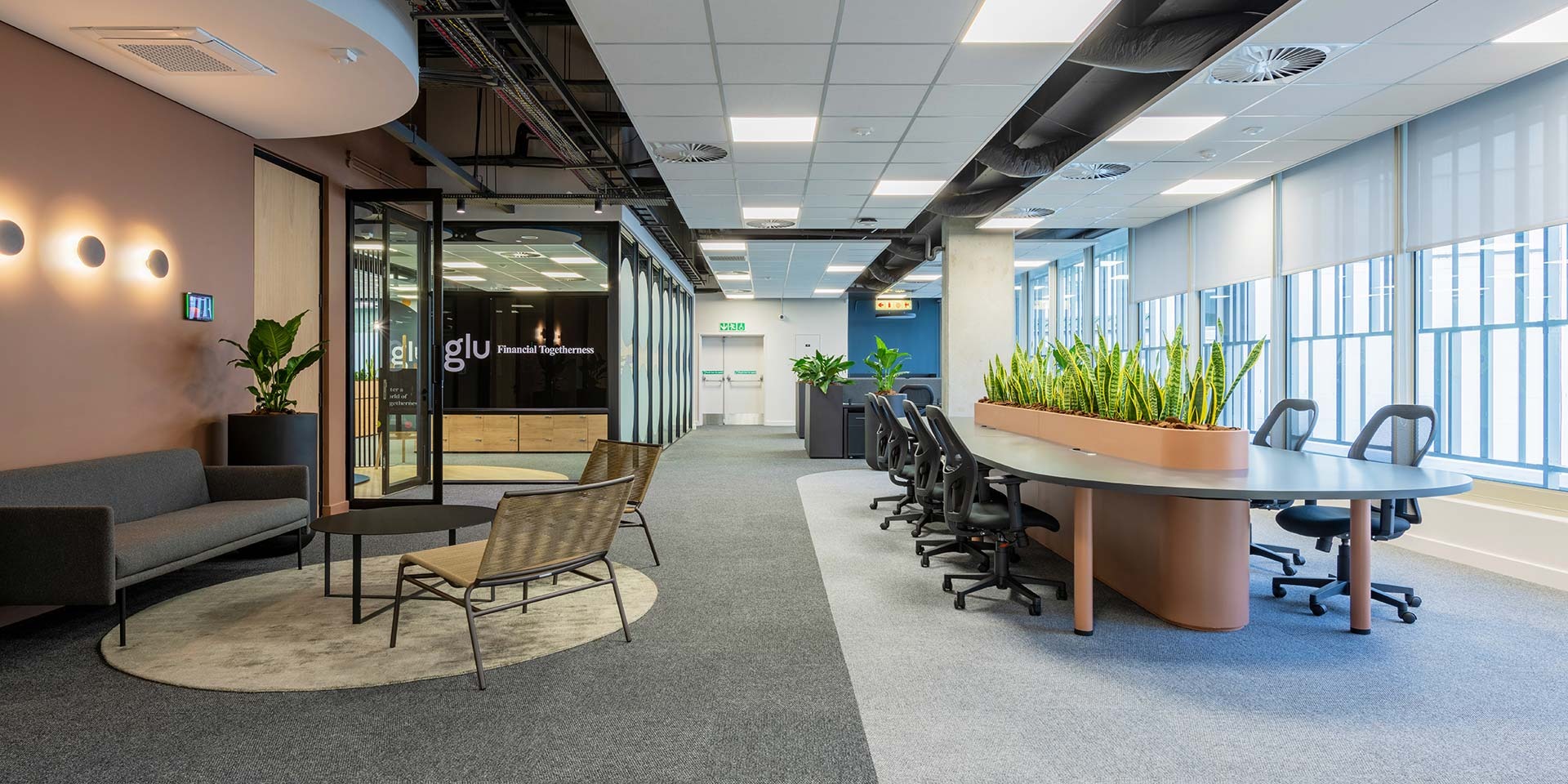
 Trend Group open plan workspace.
For years, the conversation around office space has been driven almost entirely by cost. How many square metres can be reduced? How many desks can be removed? How much rent can be saved through hybrid work?
These are understandable questions in a difficult economy. But they are also increasingly the wrong ones. The modern workplace is no longer simply an operational expense or a line item on a facilities budget. It has become a strategic business tool, one that directly influences productivity, employee retention, organisational culture, operational efficiency, and even long-term profitability.
As artificial intelligence (AI), smart building systems, and hybrid work continue reshaping the global business environment, South African organisations are facing a defining shift. The businesses that view workplace design purely through the lens of cost-cutting risk falling behind those using technology and human-centred environments to create a measurable competitive advantage.
From a static asset into a smart environment
The office is evolving from a static physical asset into an intelligent, responsive environment designed to support how people actually work. One of the biggest misconceptions surrounding workplace technology is that it is primarily about automation or replacing people. In reality, the most effective smart workplaces use technology to improve human experience.
Modern offices generate vast amounts of information every day. Occupancy sensors, booking systems, environmental controls, collaboration platforms, and access systems all produce data that reveals how space is genuinely used. This matters because there is often a significant disconnect between how workplaces are designed and how employees interact with them in practice.
Many organisations discover that large portions of their office footprint are underutilised. Formal boardrooms sit empty while employees gather informally in breakaway areas. Fixed desk arrangements fail to accommodate hybrid schedules. Collaboration spaces become overcrowded while other zones remain unused.
/file/attachments/2992/TrendGroupPrivateClient_552007.jpg "Transform your workspace into a productivity paradise.")
Enabling businesses to redesign their environments
Technology changes this dynamic by allowing organisations to make evidence-based decisions about workplace design. AI-driven analytics can identify traffic patterns, peak occupancy periods, and behavioural trends that enable businesses to redesign their environments more intelligently.
Underutilised areas can be repurposed into collaborative work zones. Flexible layouts can be introduced to accommodate changing team structures. Smart systems can automatically adjust lighting, ventilation, and climate control based on occupancy, improving both energy efficiency and employee comfort.
This shift is particularly relevant in South Africa, where rising commercial property costs and operational pressures are forcing organisations to maximise the value of every square metre. The financial implications are substantial. Smart building technologies have been shown globally to reduce energy consumption by as much as 30%, while more efficient spatial planning can significantly reduce lease exposure and operational overheads.
Workplace transformation is also about talent
But workplace transformation is not only about efficiency. It is also about talent. Hybrid work has permanently altered employee expectations. The office is no longer where work happens by default. It is where employees choose to come when they need to collaborate, innovate, connect, or focus. That distinction changes everything.
If organisations expect employees to commute into physical workplaces, those environments need to offer something meaningful in return. Poorly designed offices create friction, frustration, and disengagement. Well-designed offices create connection, flexibility, and a stronger sense of organisational identity.
This is where technology and design intersect most powerfully. Seamless meeting room technology, integrated collaboration platforms, ergonomic furniture, adaptable work zones, wellness-focused layouts, and biophilic design elements all contribute to workplaces that actively support employee performance and wellbeing.
/file/attachments/2992/TrendGroupManagementConsulting_298125.jpg "Lifestyle interior.")
Workplace environments designed around human needs
Global workplace research continues to show strong links between employee experience and business performance. Organisations that invest in workplace environments designed around human needs consistently report higher levels of engagement, innovation, and retention. In South Africa’s highly competitive talent market, these factors matter more than ever.
Businesses are increasingly recognising that the workplace itself has become part of the employer value proposition. Candidates notice the quality of an organisation’s environment. Employees compare their daily experience against competitors. Workplace quality now plays a role in recruitment, retention, and long-term organisational culture.
At the same time, South African organisations face uniquely local pressures that further strengthen the business case for intelligent workplace investment. Load shedding and infrastructure instability have accelerated the need for resilient, adaptable environments capable of supporting flexible work models. Sustainability expectations are rising as investors, multinational parent companies, and regulators place greater emphasis on ESG performance and green building standards.
Smart workplace systems to address challenges
Smart workplace systems help address these challenges directly. Integrated energy management systems, intelligent lighting controls, occupancy-responsive climate systems, and digitally connected infrastructure reduce unnecessary resource consumption while improving operational resilience. For many organisations, these technologies are no longer aspirational luxuries. They are becoming operational necessities.
However, technology alone is not the solution. One of the most important lessons emerging from the evolution of workplace strategy is that successful offices are not created by technology in isolation. They are created through the integration of technology, design expertise, and human-centred thinking.
The danger for many organisations is approaching workplace investment as a purely procurement-driven exercise focused on aesthetics or upfront cost savings. Poorly executed fit-outs often create long-term operational problems that quietly undermine productivity, collaboration, and employee satisfaction for years.
/file/attachments/2992/TrendCapeTownOffices_915847.jpg "A vibrant environment can transform productivity.")
Professional expertise beyond interior design alone
The most effective workplaces are the result of deliberate strategy. They combine data-driven insight with practical understanding of how people work, interact, and perform best within physical environments.
This requires professional expertise that extends beyond interior design alone. It requires the ability to integrate smart technologies, sustainable systems, hybrid infrastructure, construction delivery, and spatial planning into a coherent workplace ecosystem.
Trend Group has delivered technology-enabled workplace environments across sectors including finance, telecommunications, enterprise software, and professional services. Projects such as BASF South Africa’s relocation to Waterfall, Midrand, and Boston Consulting Group’s office at Oxford Parks in Rosebank reflect how workplace design is evolving to support flexibility, collaboration, wellbeing, and organisational identity simultaneously.
These projects are not simply aesthetic upgrades. They are strategic business investments designed to support long-term organisational performance. The future workplace will continue becoming more intelligent, more adaptive, and more responsive. Offices will increasingly function as living systems capable of learning, adjusting, and evolving alongside organisational needs.
/file/attachments/2992/TrendGroupBASFProject_410345.jpg "Upgrade your workspace with style and comfort.")
Technology must enhance human experience
But the core principle remains unchanged. Technology is most valuable when it enhances human experience. The best workplaces are not those filled with the most gadgets or the newest systems. They are the environments that help people work better, collaborate more effectively, and feel more connected to the organisations they serve.
For South African businesses, the question is no longer whether workplace transformation is necessary. The question is whether organisations are prepared to approach it strategically enough to unlock its full value. Because the true cost of an office is not simply the rent paid every month.
It is the productivity lost in inefficient spaces. The talent lost to better environments. The culture weakened by disconnected teams. And the opportunity lost when organisations fail to recognise the workplace as one of their most powerful business tools. DM
About Trend Group
Trend Group specialises in office interior design and refurbishments in the commercial, industrial and retail sectors. We are a comprehensive, solutions-driven company that operates on a turnkey basis. We offer a streamlined approach to design, procurement, and construction delivery, covering all aspects of the project solution. We are a proud Level 1 B-BBEE accredited company.
Trend Group | info@trendgroup.co.za